How Long Do Job Postings Stay Up? the Data


On this page
23-day median and 36.5-day mean time online is what remained for large U.S. public-company ads after listings still up past 180 days were removed, measured from creation to deletion on about 30 million postings from 3,540 companies (August 2007 through December 2018) in a large academic study of vacancy duration.
Single-opening ads usually leave the board well before that public-company median.
A posting near 30 days old can still match a senior or visa search. The same age on a one-seat opening is often already late. The ad, the unfilled seat, and an active hiring decision run on three clocks.
Posting age is not hiring intent. Verified freshness plus inactivity signals show whether the listing is still worth an application. A single day-count applied to every role does not.
How Long Job Postings Actually Stay Up
Match the row to the opening in front of you. These figures describe what was measured, not a rule for every board.
| What was measured | Typical time online | Pattern behind the number |
|---|---|---|
| Public U.S. company ads, evergreen posts over 180 days removed | Mean 36.5 days, median 23 days | A long tail of unusual ads lifts the mean above the median |
| Single-position postings tied to application data | Mean 9.8 days | 41% of applications arrived in the first 48 hours |
| Single-position openings in a 2025 flow study | Median 7 days, mean 9.4 days | Most common length was 24 to 48 hours; often posted only 2 to 3 days at a time |
| Standard posts from recruitment and staffing firms | Half lasted one week or less | Only 26% stayed active more than two weeks |
| Applicant-facing ads, 8,952 tracked | Median a little over 5 weeks; 30.7-day average if related records are stitched | 88% up at 7 days, 79% at 14, 71% at 21, 59% at 30, 43% at 45 |
The long public-company benchmark
The academic posting study measured time from creation to deletion. Ads still online past 180 days were treated as likely evergreen and removed. What remained averaged 36.5 days, with a median of 23 days. The mean sits higher because a minority of unusually long ads pulls the average up.
Those ads come down when a role is filled, canceled, duplicated, or closed for administrative reasons. Some stay online after hiring has effectively stopped. The set is large U.S. public companies, and it predates today’s mix of remote work and recruiting tools.
The short end is a different object
Single-position postings tied to nearly 80 million applications averaged 9.8 days online, and 41% of applications arrived in the first 48 hours, in analysis by Steven Davis and Brenda Samaniego for the Federal Reserve Bank of St. Louis.
A 2025 IZA discussion paper on application flows found that single-position openings typically stay posted for only two or three days at a time. The median duration was seven days and the mean 9.4 days. The most common bucket was 24 to 48 hours. Half of standard postings from recruitment and staffing firms lasted one week or less, and only 26% stayed active more than two weeks.
A weekly check misses a large share of one-seat roles. Shift work is the sharp version of that problem, which is why a practical guide to landing shifts in local pubs beats a monthly browse for hospitality.
What the applicant URL still shows
A tracking analysis of 8,952 postings on The Role Desk found a longer curve: 88% still online after seven days, 79% after 14, 71% after 21, 59% after 30, and 43% after 45. The median remained available a little more than five weeks. Stitching related ad records produced an average of 30.7 days, because an edit can create a new posting ID while the campaign continues.
Pick the row that matches the opening. Treat roughly one to five weeks as the ordinary window, not a rule for every board.
These papers don’t publish durations per job board, so there is no board-by-board ranking here. Read each board’s posting date against the company careers page before you decide how long that listing has been live.
A Posted Ad Is Not the Same as an Open Role
The posting is the public advert. The vacancy is the unfilled seat. They run on different clocks.
Think of a shop window. Staff take the sign down once enough people have walked in. The sale can still be unfinished.
Nine days of applications, about 45 days to fill
In a technology-sector sample, employers accepted applications for about 9 days on average even though filling the corresponding roles took roughly 45 days, according to research summarized by Chicago Booth. The public advertising interval is not the full vacancy.
Application flow is front-loaded on the same evidence. 42% of vacancies receive all applications within one week, and 56% receive them within two weeks. The advert can still look open after almost all likely applicants have already done so.
Why the advert and the seat part company
- The pool is already large enough. Recruiters close the public ad and keep interviewing the people they have.
- The role is paused. A budget hold or a reorg stops outreach without a hire.
- A duplicate went up. The older URL is the one that dies.
- Work moved into an ATS. Once the req sits in Greenhouse, Lever, Workday, or a similar system, the public ad is optional.
- The requisition was canceled. The seat is gone, and board copies can linger anyway.
- An edit minted a new posting ID. The campaign continues. The link you saved does not.
Deletion is not proof of a hire. A live URL is not proof of an active search.
Confirm the title on the company’s own careers page before you spend an evening on eligibility, salary bands, or a visa read.
Why Some Listings Last Months and Others Days
A listing leaves the median for a mechanical reason. The product on the board and the kind of hire are not the same lever.
What keeps an advert up
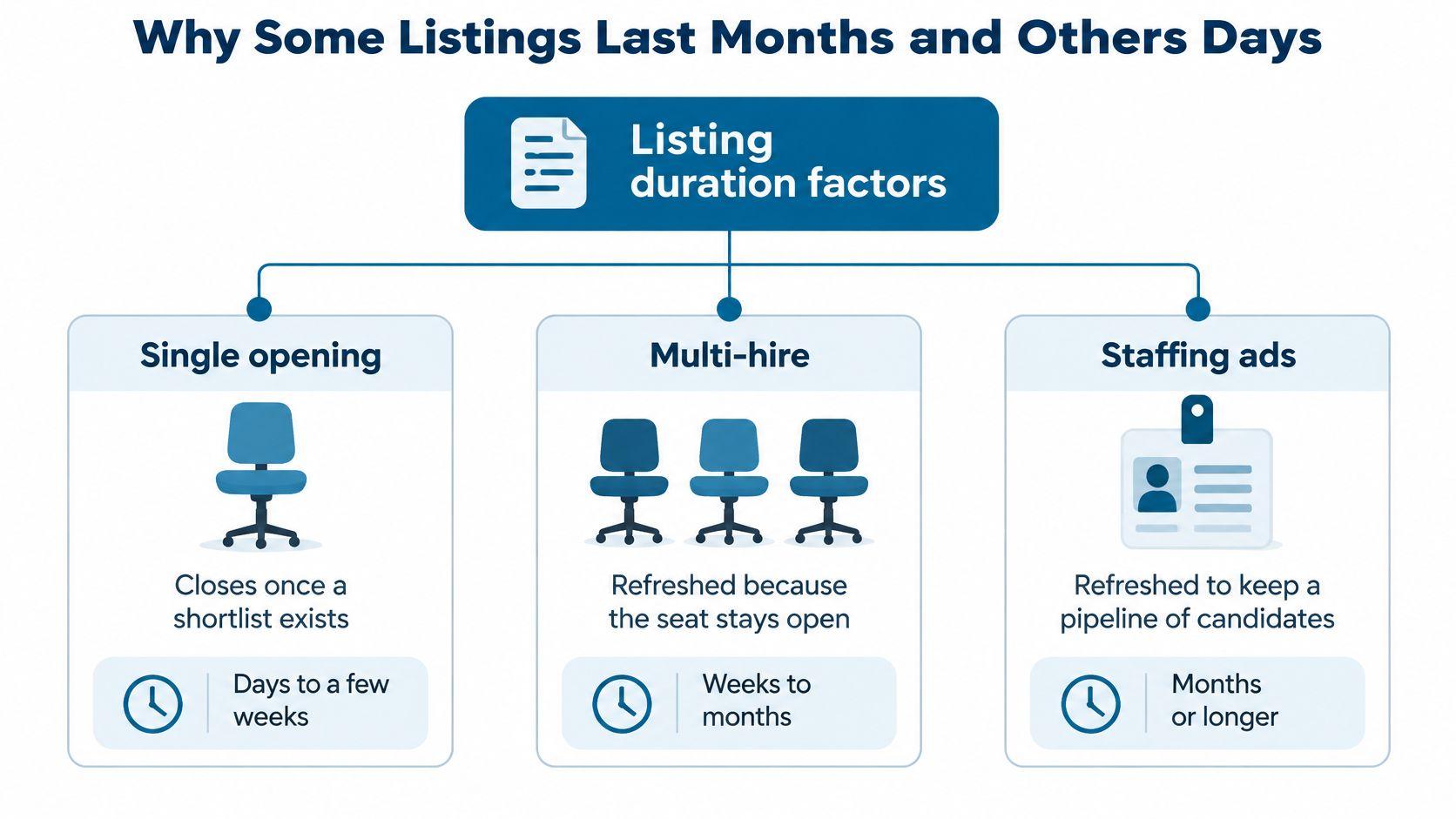
Single openings close once a shortlist exists. The seat needs one person, so the public ad has done its job as soon as interviews are booked.
Multi-hire reqs and staffing ads get refreshed because the seat keeps reopening. A warehouse wave or a contract bench is a pipeline, not a one-time fill, so the same title reappears while individual assignments turn over.
Evergreen listings are a different species once they pass 180 days. The same req stays public, and a small edit can mint a new applicant-facing ID. The URL you bookmarked dies. The campaign does not.
Sponsored placement is a budget, not a hiring decision. A company can keep paying for the slot after the req is paused, which is why a promoted result on a board can outlive the version on the careers page.
Company habit stretches ads even when managers say they want speed. A Clarify Capital survey of 1,000 U.S. hiring managers, reported by The Hill, found that 68% had job postings active for more than 30 days, 40% expected some active postings to remain open for two to three months, and one in 10 reported openings posted for more than six months. 96% said they were actively trying to fill an open role quickly. Intent and the advert’s lifespan are not the same sentence.
What the role itself adds
Senior, regulated, visa-sponsored, and cross-border searches run longer because licensing, salary thresholds, and relocation take calendar time. A 45-day-old domestic hourly ad and a sponsored visa req are not the same object. Compare live destination lists such as visa sponsorship jobs when the search is cross-border, and treat a globally remote req as its own filter rather than a keyword.
If the public ad has already handed you into a long ATS process, the document you send has to survive that handoff. The ATS-friendly resume guide covers how a single-column file keeps the content a parser can read.
Ghost Jobs That Were Never Really Open
18% to 22% of jobs posted on Greenhouse in a given quarter of 2024 were classed as ghost jobs, in a Greenhouse analysis gathered by Sea King WDC. That same write-up summarizes a Glassdoor-based study, discussed in the Columbia Law Review, which estimated up to 21% of postings could be ghost jobs.
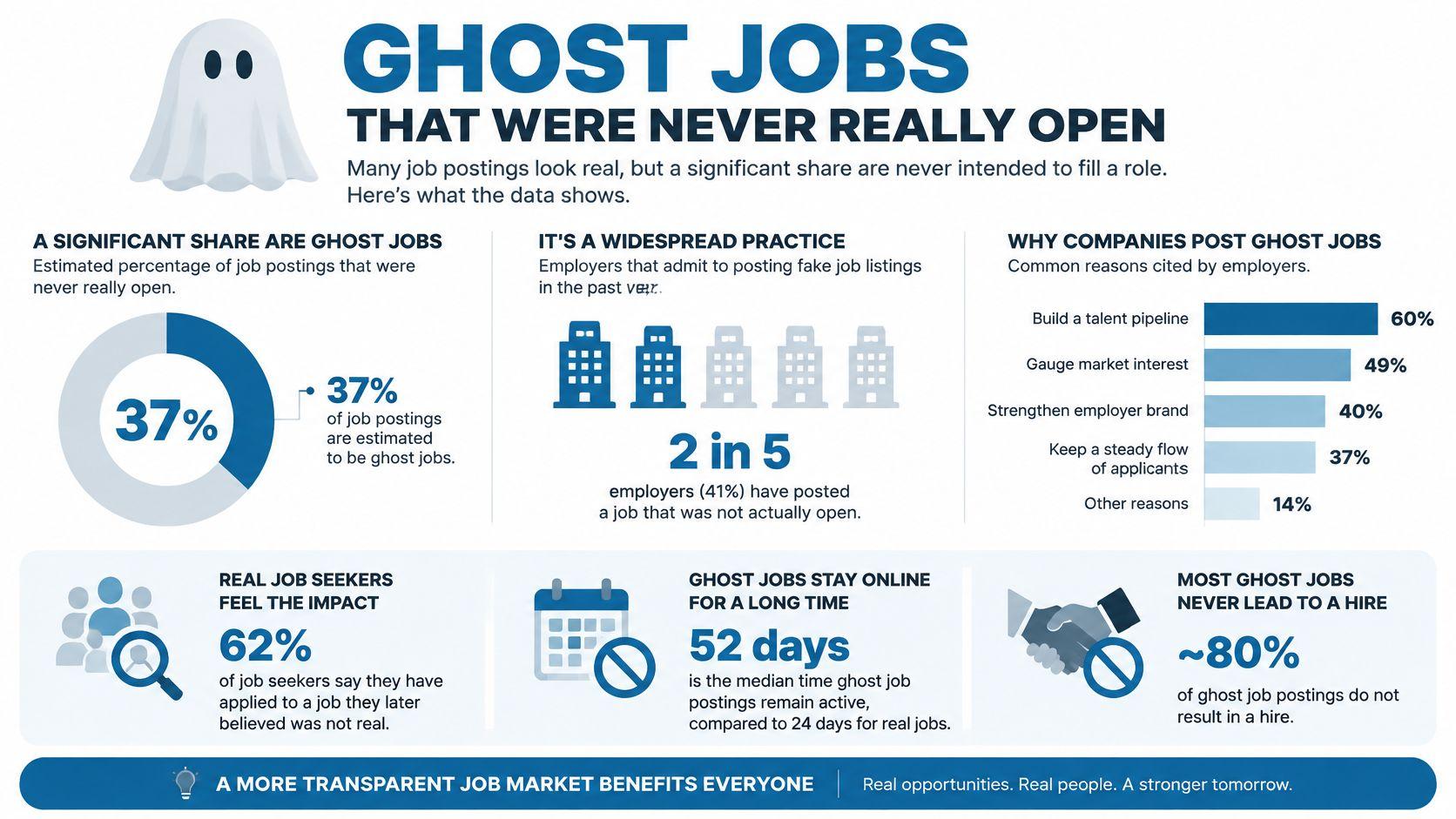
The two ranges do not describe the same thing. Greenhouse measured postings on its own platform, quarter by quarter. The Glassdoor figure used another sample and another definition of a posting with no opening behind it. Folding 18% and 21% into one ghost rate would invent a number neither measurement produced. Hiring-manager surveys add a third scope again: share of companies that say they have advertised roles they were not filling, which is not the share of ads on a board.
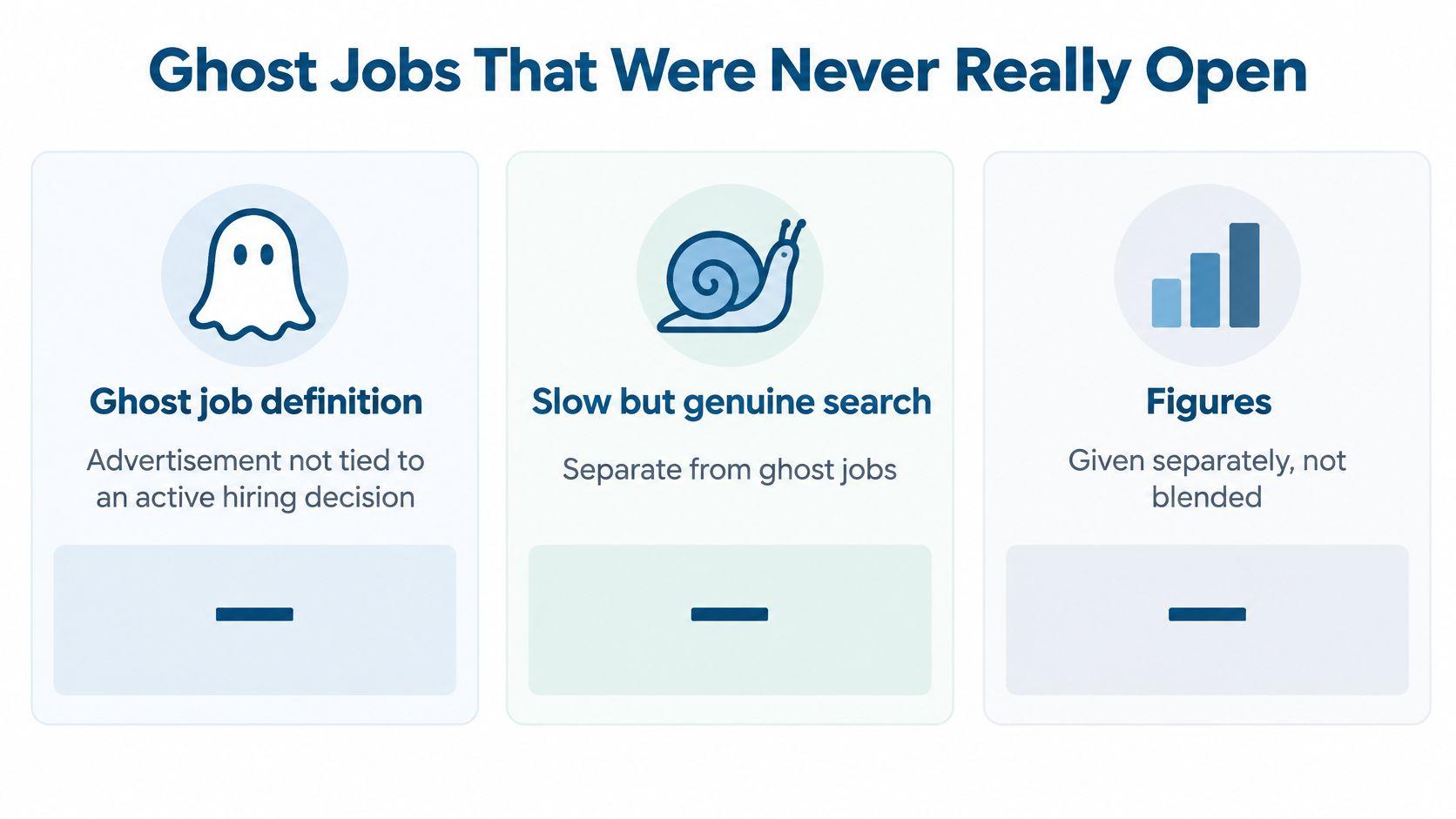
A ghost job is an advertisement with no active hiring decision attached. A slow search for a funded role is a different object. Someone still has a req, a budget, and a candidate to choose. Ghost volume is about intent at the moment of posting, not about how many days the ad has been live.
Four habits produce that kind of ad. A team collects resumes for a role it may open later. A public advert signals growth whether or not headcount is funded. A busy careers page keeps the company name in search. An unapproved budget leaves the requisition up while finance has not said yes. In each case the listing can be hours old and still have nobody to hire.
Posting age is not hiring intent. A 30-day ad can be ordinary for a senior or visa search and already dead for a single domestic opening. The split that changes a decision is verified freshness plus signs the req is inactive, not a calendar cutoff. A brand-new listing can still be non-hiring. A month-old listing can still be a real search.
When an Older Posting Can Still Be Real
A 30-day death rule confuses listing age with hiring intent. There is no universal cutoff for how old is too old.
U.S. Bureau of Labor Statistics data treat job openings as a monthly stock and hires as a monthly flow, so a role can stay advertised across months without proving the employer has walked away. In June 2025, employers reported 7.4 million job openings and 5.2 million hires, a 2.2 million difference, and WorldatWork notes that analysts caution this gap does not prove every unmatched posting is fake.
Time to fill shows why a month is not a deadline. In 2024, the average time to fill an open role was reported as 41 days, and a 2025 hiring-services dataset reported 63.5 days across more than 6,600 customers, in figures discussed by CNBC. A specialized, senior, regulated, or international search can be ordinary past day 30. The same age on a single domestic opening may already be stale. For a sponsored search, eligibility and timing dominate the calendar, which is the point of this visa sponsorship explainer.
| State | What you usually see | What to do |
|---|---|---|
| Recently posted and actively recruiting | Days to about two weeks old, consistent title and location, working apply path, still on the company careers page | Apply as soon as the role fits you |
| Old but plausibly live | Past 30 days, but senior, regulated, visa-sponsored or cross-border, and the company page still lists it | Check the source page, then apply if the details match |
| Old with inactivity signals | Many weeks or months old, missing from the company site, conflicting copies, or a closed apply path | Skip it and use the time on a confirmed opening |
Recently posted and actively recruiting is the easy yes. The ad is young, the title and location match the company page, and the apply path still accepts a submission.
Old but plausibly live is the case people throw away. Seniority, a licence, visa sponsorship, or a cross-border hire explains the length, and the careers page still lists the role.
Old with inactivity signals is the skip. Several weeks or months up, gone from the company site, conflicting dates across copies, or an apply button that fails.
Old does not mean fake. Unverified age is still a poor basis for what you open first.
How to Tell a Listing Is Still Actionable
Run this on the next tab, in order. Stop as soon as the listing fails a check.
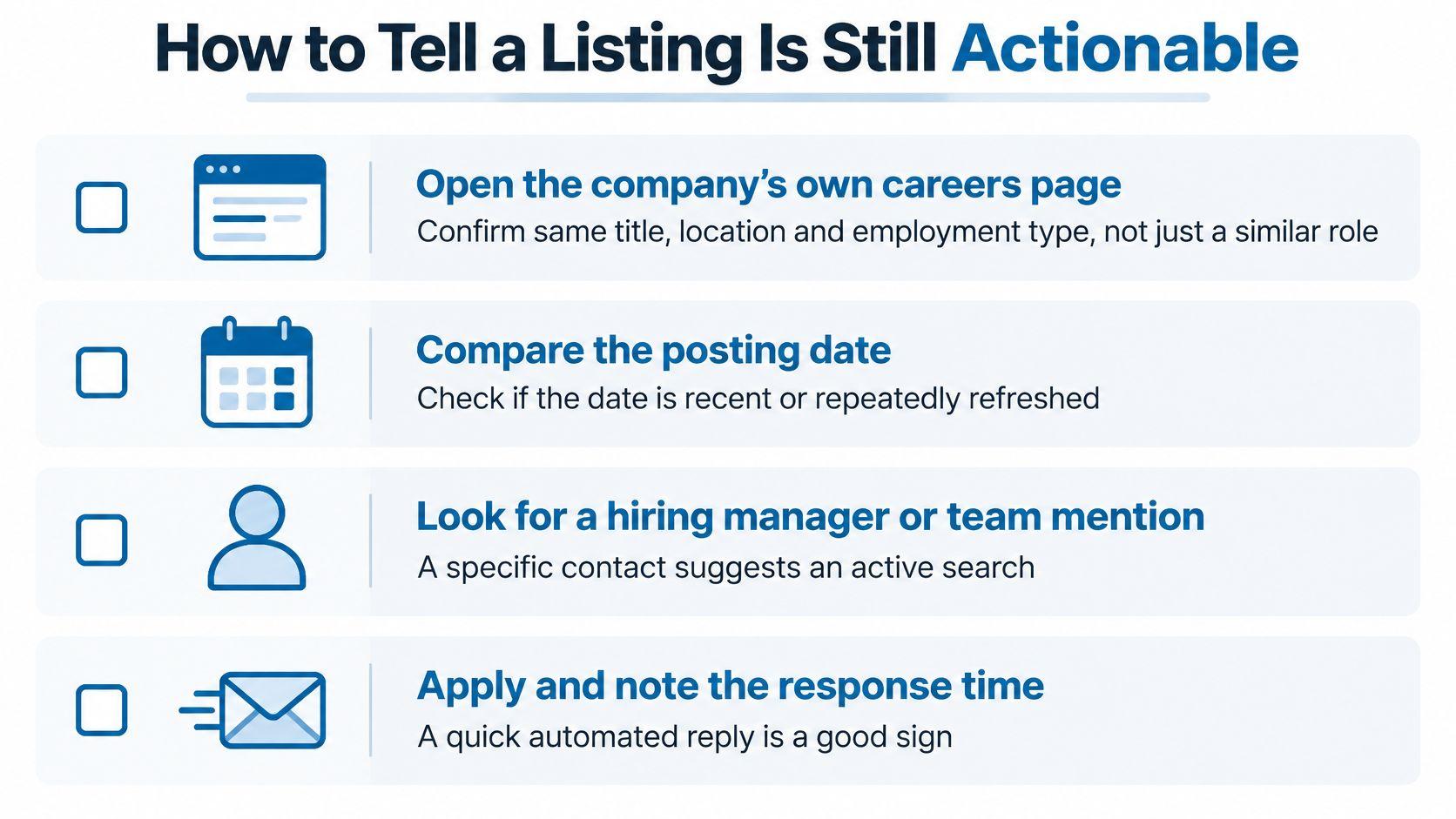
- Open the company’s own careers page. Confirm the same title, location, and employment type, not a similar role in another city.
- Compare dates. Set the board date next to any date on the company page. A much newer company date means a repost, not proof that the old URL is fresh.
- Try the apply path. Go far enough to see that it still accepts an application. Stop if it errors, redirects to an unrelated req, or hits a login that immediately says closed.
- Look for a closing date and recent activity. A recruiter note or a newly edited description is evidence the req moved this week. A static block of text is not.
- Check whether copies agree. Conflicting salary, city, or sponsorship lines are a reason to trust the company page only. People comparing boards in one trade, including those who compare trucking job board sites, already do this because the same req is rewritten differently on each site.
- Prefer a source that rechecks. Every day, automated systems add new roles and remove expired jobs from our database. When you view an expired or closed job on a supported site, the extension hides it from the Global Job Hub and the listing is permanently deleted within 24 hours. A Report button on the web app is there for spam.
Keep a confirmed apply path and discard the rest. Eligibility reading on visa and remote roles is too expensive to spend on a dead URL. Globally remote jobs are worth that check precisely because “remote” on a board often means remote inside one country.
Apply Now or Move On
Apply now when the listing is in the first state. Applicant flow piles up at the start, so waiting for a free evening is how people miss a single opening that was public for only a few days.
Apply after the company page matches when the listing is in the second state. Don’t drop a senior or sponsored search because the date is past a month. Do drop it if the careers page no longer shows that title.
Don’t send an application when the listing is in the third state. The cost is the hour of eligibility reading, not the click. Move that hour to a confirmed opening.
Each state maps to one action, so the call takes under a minute. For the next search, start in a pool that doesn’t rank by ad spend or by the original post date. We cover 50,000+ active roles from 100+ job boards, and you can browse them by role and experience level. Keep the company careers page as the final word on any single role. We provide posting insights on a best-effort basis and don’t guarantee that every closure is caught the hour it happens.
JobGlance refreshes visa-sponsored and globally remote roles every day and ranks them against your resume, so posting age isn’t the thing that decides what you open first. Closed listings are removed on a 24-hour cycle, which matters most when a single opening can vanish in a few days while a sponsored search stays legitimate for much longer. Start the next search on JobGlance.
Keep reading


