Fake Job Postings: How to Spot and Verify Them


On this page
About 14 million people are exposed to employment scams each year, with roughly $2 billion in direct annual losses, according to a Better Business Bureau investigation into job scams. Fake job postings aren’t just an application-time problem. Some are payment traps. Others misuse an employer’s identity. Still others advertise a real company’s role without an immediate intention to hire.
What Fake Job Postings Cost Job Seekers
A polished description doesn’t establish that an employer intends to pay you. The more useful question is what the person behind the posting wants you to do next. An application can become a financial transaction before you’ve established who you’re dealing with.
The BBB investigation found that 36% of job-scam complaints involved fake-check schemes. It also reported that fake-check complaints to the FTC rose 65% between 2015 and 2020, while banks’ fake-check losses increased 40% over a two-year period to $1.3 billion. These are separate findings from the investigation cited above, not components of a single total.
Read the measures correctly
Exposure and reported losses measure different things. Exposure describes people encountering scams. Loss figures describe financial harm. You can’t add them together, and you shouldn’t interpret exposure as the number of people who lost money.
The bank figures also concern fake checks more broadly. They aren’t an additional employment-scam loss estimate. Keeping those boundaries clear matters because an inflated total makes the problem harder, not easier, to understand.
“A fake posting is an employment offer used to take time, money, or identity.”
That’s a practical working definition, not a legal classification. It includes harms that require different responses. Losing application time calls for better prioritization. Sending money or identity documents to an impostor calls for protective action.
Digital access isn’t verification
The BBB describes employment scams spreading through online marketplaces, social media, messaging apps, and unsolicited outreach during the expansion of remote work. Those channels also matter to candidates searching beyond their home country. An entirely online hiring process therefore needs verification, not automatic rejection.
Use separate questions before committing effort:
- Financial safety: Does anyone want money, a transfer, or sensitive information before you can verify the opportunity?
- Employer identity: Is the person contacting you authorized to represent the company?
- Hiring intent: Is there evidence that the employer intends to fill this particular opening?
- Eligibility: Could the company legally employ you from your location or sponsor the permission you need?
The practical outcome isn’t a slogan about trusting your instincts. It’s a decision rule: stop dangerous transactions, verify uncertain identities, and limit effort where hiring intent remains unclear.
Three Kinds of Listings People Call Fake
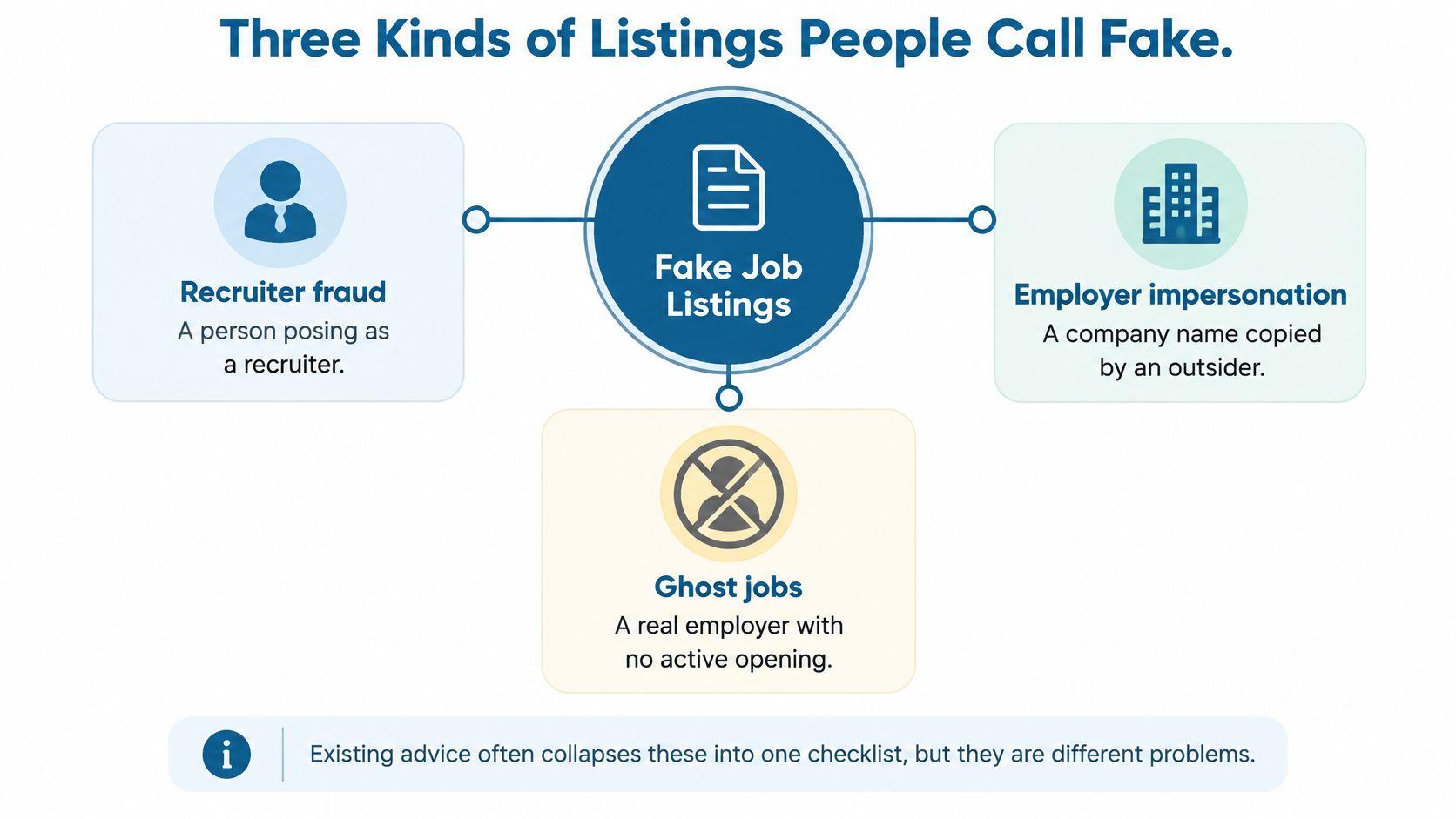
Three different problems can hide behind one label: a scam designed to steal money or data, an impostor using a real employer’s name, or a posting with little immediate hiring intent. The Congressional Research Service reports that complaints about job and employment-agency scams nearly tripled from 2020 to 2024. It also notes that no official statistics measure how common ghost jobs are. Complaints about fraud and advertisements that lead to no hire measure different things. The CRS review of ghost jobs and employment scams explains that distinction.
Separate the intention from the identity
A scam posting uses deception to obtain money or personal information. The company may be invented, or a supposed recruiter may offer a job that does not exist. The right response is to stop before sharing sensitive data or sending money.
Employer impersonation uses a real company’s name or branding without permission. A real company website confirms that the employer exists, not that a particular recruiter represents it. Check whether the recruiter and application channel are authorized.
A ghost job comes from a real employer but may not represent an active, near-term hire. The opening could remain advertised without an immediate need, or lead to no hire. Here, the risk is wasted time. Look for evidence that the role is active before investing heavily in an application.
The categories can overlap. An impersonator may run a payment scam, while a genuine employer may keep an unfilled job advertisement online without criminal intent. Match the check to the risk: protect your information from suspected fraud, confirm authorization when identity is uncertain, and test hiring intent before spending hours applying.
Add eligibility without confusing it with fraud
A genuine opening may still be unavailable to you. A role restricted to domestic employees is not automatically fake if the restriction is clear. For international candidates, confirm whether the employer can hire in your location or sponsor the required work permission. Learn what visa sponsorship means before asking whether sponsorship applies to this specific opening and your circumstances.
A company domain supports identity, not hiring intent. A missing salary does not prove fraud, and a detailed description does not prove recruiter authorization. The CRS also cautions that ghost-job estimates vary because researchers use different definitions and methods. For a single listing, identify what remains uncertain and seek evidence that addresses that specific question.
Scam Formats That Take Money and Data
About 20,000 task-scam reports reached the FTC in the first half of 2024, compared with roughly 5,000 reports for all of 2023. Task scams made up nearly 40% of job-scam reports during that half-year, according to the FTC’s report on rising task scams.
When a supposed employer sends a check
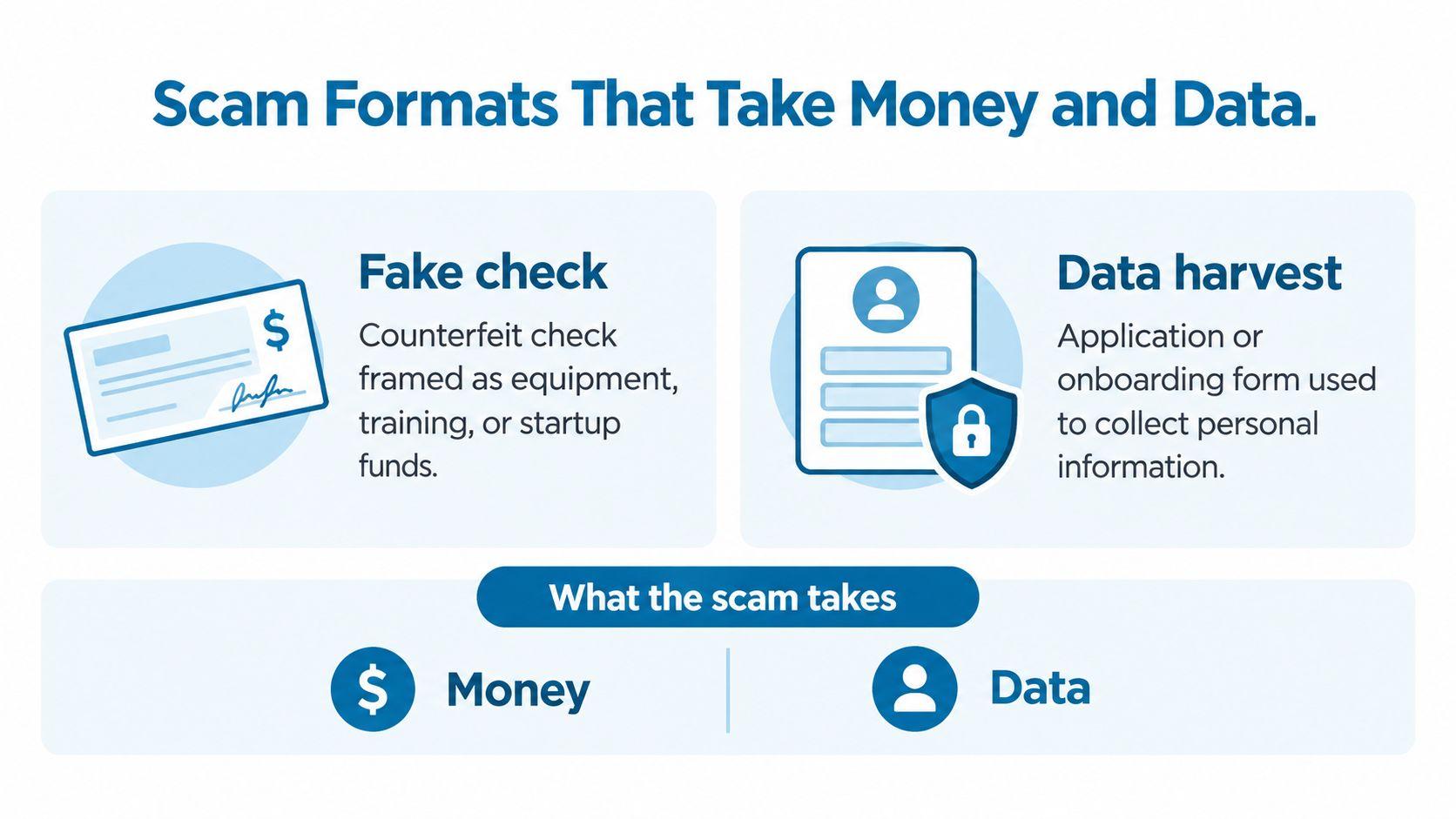
In a fake-check scam, a recruiter says a check covers equipment, training, or wages. They then ask you to return part of the money or send it to another person. The check is counterfeit, even if your account initially shows a deposit.
The risk starts when you send money out. A deposit is not proof that the recruiter or job is legitimate.
When work becomes a deposit requirement
Task scammers promise pay for simple activities, such as rating products or optimizing listings. Then they demand a deposit, often in cryptocurrency, to access more tasks or withdraw supposed earnings. You become the payer.
Reported losses show the scale of the harm. The FTC recorded more than $220 million in job-scam losses during the first half of 2024, after losses tripled between 2020 and 2023. Cryptocurrency losses tied to job scams reached about $41 million in that half-year. The FBI IC3’s 2023 annual report separately recorded $70.2 million in employment-crime losses.
The FTC and FBI figures come from different reporting systems. They cannot be combined into one total or used to estimate the chance that a specific listing is fraudulent.
Scams can also begin through social-media ads or unsolicited messages from people claiming to represent recruitment agencies. The channel alone does not establish whether a vacancy is real.
For candidates seeking work abroad, a sponsorship offer does not make a payment request safe. Check whether the role’s location and visa sponsorship requirements fit your situation, then confirm the employer and recruiter independently.
- Money request: Stop if someone demands a deposit, repayment, or equipment purchase through a channel they chose.
- Sensitive data request: Withhold banking details and identity documents until you have verified the hiring contact.
- Off-platform pressure: Pause before sharing information or paying. Confirm the recruiter’s authorization through the employer.
Red Flags That Change What You Should Do
18%–22% of jobs advertised on Greenhouse’s platform during 2024 were never filled or didn’t represent an immediately real hiring need, according to reporting on Greenhouse’s ghost-job analysis. At least 70% of companies on the platform posted a ghost job in the second quarter, while 15% did so regularly; a separate survey found three in five candidates believed they’d encountered a false listing.
These aren’t official prevalence estimates. They aren’t directly comparable with one another or with scam-report counts. An unfilled role, an employer’s posting behavior, and a candidate’s perception measure different things.
Listing Signals and the Action They Justify
| Signal | Most likely category | Next action |
|---|---|---|
| Deposit or cryptocurrency payment required to release earnings | Malicious scam | Stop paying, preserve evidence, and report |
| Check followed by instructions to send money elsewhere | Fake-check scam | Don’t forward funds; contact your bank if involved |
| Identity documents or banking details requested before an offer | Possible data theft | Withhold information and verify independently |
| Newly created recruiter account combined with off-platform pressure | Possible impersonation | Confirm the recruiter through the employer |
| Board advertisement conflicts with the company careers page | Impersonation, stale listing, or administrative mismatch | Ask the employer to confirm the exact opening |
| Repeated reposting, no start date, and no visible recruiter activity | Possible ghost or evergreen listing | Ask about hiring timing and cap preparation |
| Hiring-growth claims unsupported by the company’s own announcements | Uncertain hiring intent | Seek clarification rather than assuming fraud |
The category column is a working hypothesis, not a verdict. A newly created profile doesn’t prove deception. A missing careers-page entry may need clarification rather than an accusation.
Match the response to the harm
Payment demands justify a stronger response than vague timing. A contradiction about recruiter identity deserves a different check from a vacancy that has been reposted repeatedly. Treating every concern as equally serious wastes attention.
Decision threshold: Escalate protection when money or identity is at risk. Reduce effort when only hiring intent remains uncertain.
A normal application form on a real domain can still lead to a ghost job. That’s why a checklist focused only on obvious scams creates false comfort. You can pass every identity check and still spend an afternoon tailoring an application for a role with no immediate hiring need.
Ask whether the employer can describe an active process, expected timing, or the next hiring stage. If the answer remains vague, don’t manufacture certainty. Keep the opportunity in proportion to the evidence.
How to Verify a Job Posting Before You Apply
More than 3,000 job-scam reports and $13.7 million in losses reached Australia’s Scamwatch in 2024. The National Anti-Scam Centre’s job-scam report found that the average loss was 5.1% higher than the average across other scam categories. Verify the employer and recruiter before sharing money, banking details, or identity documents.
Start with checks that can end the search quickly
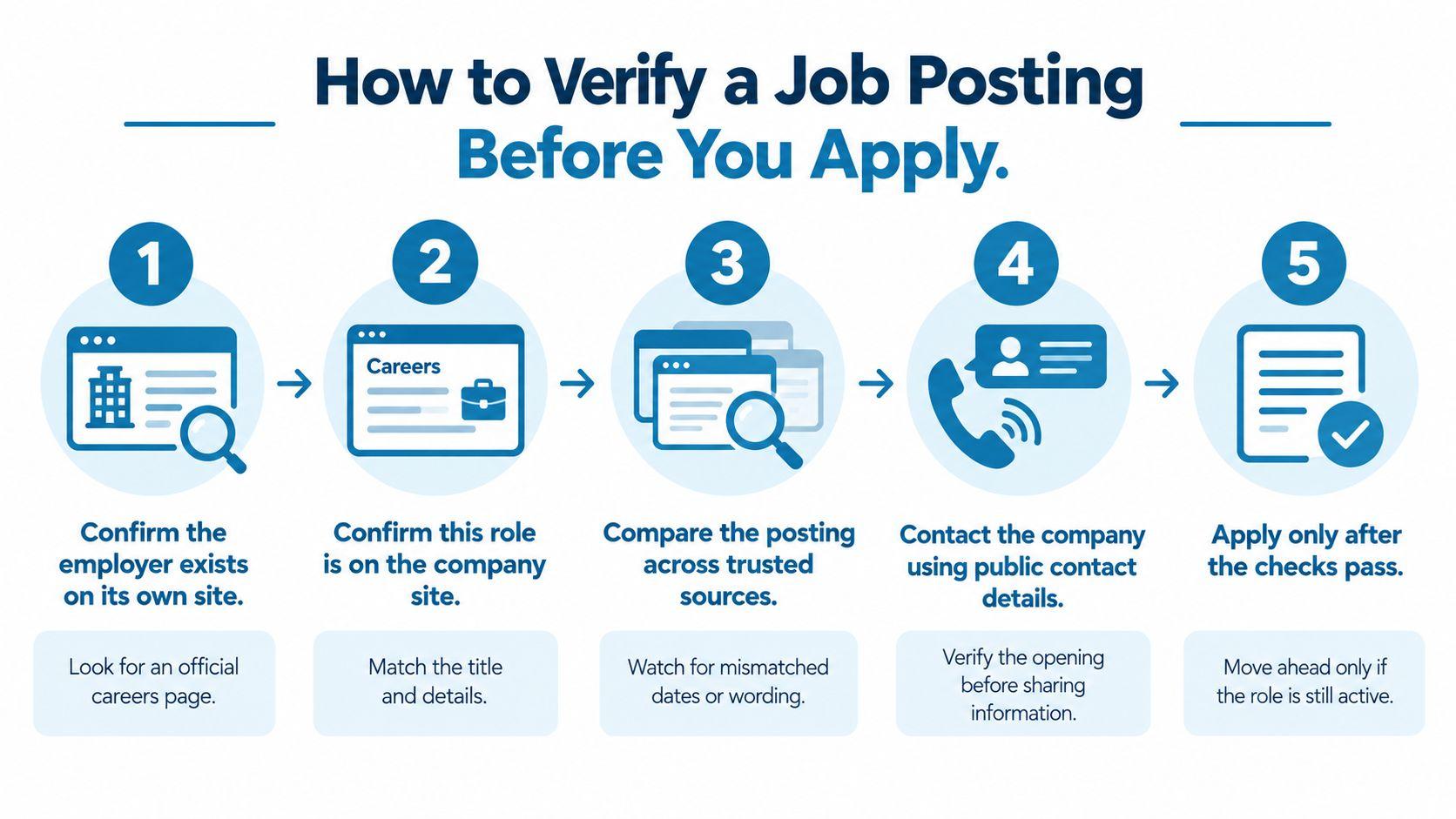
Begin with information you find independently, not details supplied by the recruiter. Visit the employer’s official website and identify its careers page and public contact channels.
- Match the exact opening. Check the title, location, duties, and application destination. If the vacancy is absent from the careers page, ask the employer to confirm it through a public contact channel.
- Verify the recruiter. Search for the person independently. If their identity or authority is unclear, ask the employer to confirm it.
A matching company email domain is useful evidence, but check the full address, not just the displayed sender name. A convincing profile is not proof that the organization authorized the recruiter.
Compare the pay, seniority, location, and responsibilities for consistency. Research on fake-job classification recommends examining job text alongside structured listing details, rather than relying on title keywords alone.
Resolve your right to take the role
For a sponsored position, check the destination country’s official rules and whether the employer qualifies under them. The Netherlands highly skilled migrant route shows why recognized-sponsor status matters. A sponsorship label alone does not confirm that the employer or role meets permit requirements.
Use visa-sponsored job listings to narrow your search, then check the specific employer and offer. An employer’s past sponsorship activity is a reason to investigate, not a guarantee for your application.
For remote job openings, confirm which countries the employer allows, whether you have the right to work there, and how payroll is handled. “Work from anywhere” and remote work limited to one country have different eligibility rules. A job category cannot verify an individual listing.
If you’re helping an older relative assess a suspicious approach, job scam protection with Gini Help offers a candidate-facing resource. In every case, rely on independent confirmation from the employer.
Match your next step to the risk. If the employer checks out but hiring timing remains unclear, limit the time you spend applying. If the employer or recruiter cannot be verified, pause. Do not send money or sensitive documents before you confirm the role and reach an established offer process.
How to Report Fake Job Postings
More than 29,000 scam social-media accounts and 1,850 fake job advertisements were removed during Australia’s 2025 Job Scam Fusion Cell crackdown. The National Anti-Scam Centre’s account of the disruption also reports that Australian job-scam losses increased 151% from 2022 to 2023.
That operation demonstrates the role of coordinated disruption. It doesn’t promise that an individual report will produce a takedown or repayment. Your immediate task is to preserve evidence and reach the organizations that can act on the particular harm.
Save a usable record
Keep the original material before reporting or blocking the account. Don’t continue communicating just to gather more evidence.
- Advertisement evidence: Save the listing URL, screenshots, employer name used, and application destination.
- Contact evidence: Preserve the recruiter’s name, profile, messages, email address, and payment instructions.
- Transaction evidence: Retain receipts, check images, recipient details, and any cryptocurrency wallet information.
- Incident summary: Record what you shared or paid and the order in which events occurred.
Separate facts from suspicions in your report. State that a recruiter requested a transfer, for example, rather than asserting an unverified identity. Clear records are more useful than a long account with missing transaction details.
Report to the channel that fits
In the United States, submit job-scam reports through the FTC’s ReportFraud service. Internet-enabled employment crime also belongs with the FBI Internet Crime Complaint Center, whose reporting system is distinct from the FTC’s.
In Australia, use Scamwatch, with the National Anti-Scam Centre providing the broader anti-scam coordination context. For other countries, identify the official consumer-protection or cybercrime reporting service rather than trusting a recovery contact who approaches you afterward.
Report the advertisement on the job board or social network where you encountered it. Include related accounts and duplicate advertisements when you have evidence connecting them. If someone misused a real employer’s name, notify that employer through its official website.
Reporting supports investigation. It isn’t a payment-reversal service.
If money or financial information changed hands, contact your bank or payment provider promptly and explain what happened. If identity documents were exposed, ask the relevant issuing authority about protective steps.
A fraud report doesn’t itself recover a wire transfer or cryptocurrency deposit. Prevention remains the stronger protection, while reporting gives platforms, employers, and authorities a record they can investigate.
Choosing Tools That Cut Fake Listing Risk
Search tools can reduce the number of stale, duplicate, or ineligible listings you need to assess. They cannot show whether an employer intends to hire. Match each tool’s checks to the risk: listing maintenance can catch expired roles, while company research may help assess an impersonation concern or a role that appears to have little hiring activity.

Match the tool to the risk
JobGlance’s web app aggregates roles from multiple sites, refreshes listings, and removes expired roles. These features can reduce time spent on stale advertisements. They do not confirm that a listed employer is genuine or actively hiring.
Smart Match scores results against your resume and adjusts rankings when you change your search or filters. Use the score to prioritize relevant roles, not to judge whether a posting is safe. For identity concerns, check the employer through its official channels. For a role that may be a ghost job, look for signs of recent hiring activity before investing time in an application.
- Eligibility filters: Sponsorship and work-from-anywhere filters help you focus on roles that fit your visa and location constraints. Work-from-anywhere is separate from domestic remote work.
- Sponsorship signals: A curated employer list marks sponsorship as Likely when there is a track record, while Available means the posting states sponsorship. Treat both as signals to check against the specific role and country.
- Company research: Deep Company Research presents evidence about listing legitimacy, company stability, culture, and interview difficulty. Use the cited evidence and confidence levels to guide your next check.
Keep the tool’s limits visible
The free Chrome extension carries match scores and sponsorship or work-from-anywhere detection to listings on LinkedIn, Glassdoor, Indeed, Wellfound, JobStreet, WeWorkRemotely, WorkingNomads, and Jobspresso. Opening a closed listing can signal the database to hide it.
The extension supports your search; it does not independently verify an employer or prove hiring intent. Confidence levels and match scores help prioritize checks, not replace them.
The publisher’s product and pricing information describes the free tier and Pro subscription. Check the current terms before choosing a plan.
For a focused search, browse entry-level remote openings, then apply the location and sponsorship filters that match your situation. If a role fits, check the employer’s identity and the evidence behind the listing before sending sensitive documents. If the posting appears stale or hiring intent is unclear, ask the employer through an official channel whether the role is still open.
Use software to narrow and maintain the pool. Use independent evidence to decide which applications deserve your time and personal information.
Keep reading


