
What Is Visa Sponsorship? A Job Seeker's Guide (2026)


On this page
Visa sponsorship is when an employer formally backs your application for a work visa, taking on legal responsibility for you as a worker so you can be hired in a country where you don’t yet have the right to work. You still apply for the visa yourself. What the employer provides is the thing you cannot get on your own: an approved job offer and the paperwork that proves it.
That’s the definition. Here’s the part that actually decides your job search.
We checked all 57,277 live job posts in our database on 14 August 2026. Only 4.1% state that sponsorship is available. 61.5% don’t mention it at all.
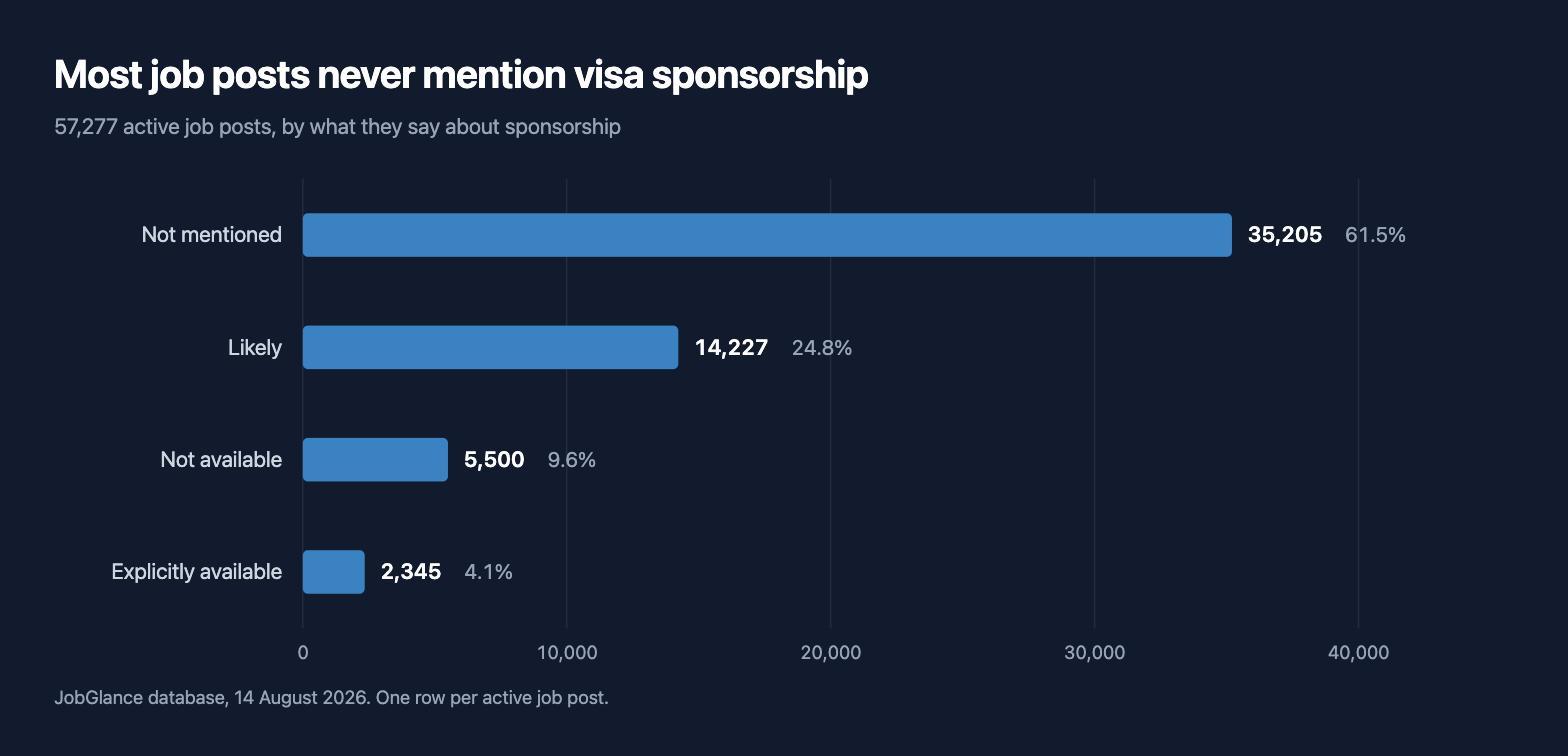
So if you’ve been reading job posts and still can’t tell whether you’d be eligible, you’re not missing something. Six posts in ten simply don’t say.
The reason has less to do with secrecy than with what sponsoring actually costs a company — which is also what tells you where to spend your time.
What the employer is actually signing up for
An employer can’t just decide to sponsor you. In the UK, they first need a sponsor licence from the Home Office: an application, a fee, an assessment of whether the business is genuine and capable of meeting its duties. Most countries run some version of this.
Once licensed, sponsoring one person means:
- Issuing a Certificate of Sponsorship — a reference number tied to the specific role, salary and person
- Paying government fees, which for UK employers include an Immigration Skills Charge on top of the licence
- Proving the role genuinely meets skill and salary requirements
- Keeping records and staying compliant for as long as you work there, with the licence at risk if they get it wrong
Fees and salary thresholds change often enough that quoting them here would be a disservice — GOV.UK’s Skilled Worker visa guide has the current position (checked 14 August 2026).
The takeaway isn’t the numbers. It’s this: sponsorship is an ongoing compliance obligation, not a form. A company that sponsors has already decided international hiring is worth real cost and real risk. That decision is usually made once, at the company level, long before your CV arrives.
Which is why the question is rarely “will they sponsor me?” It’s “are they already a sponsor?”
The four things a job post can tell you
Because sponsorship is so inconsistently disclosed, it helps to stop thinking in yes/no. When we read full job descriptions, what comes back sorts into four states:
Explicitly available (4.1%). The post says so — “visa sponsorship available”, “we sponsor Skilled Worker visas”, or a relocation package spelled out. Rare, and worth prioritising.
Likely (24.8%). No direct statement, but the signals are there: a licensed sponsor, a routinely sponsored role type, relocation support, an international hiring policy stated elsewhere. Worth the application.
Explicitly unavailable (9.6%). “Must have existing right to work”, “no sponsorship offered”. Believe them — this is the group that saves you the most time.
Not mentioned (61.5%). Silence. Could be a sponsor who didn’t think to say. Could be a company that has never hired internationally. You cannot tell from the post.
That last group is where the wasted effort goes. Not in rejection — in research. Opening a listing, reading three paragraphs, finding nothing, checking the company site, still finding nothing, applying anyway on the chance it works out.
Where sponsored roles actually are
Sponsorship isn’t spread evenly. Of the 16,572 live roles carrying a sponsorship signal on 14 August 2026, here’s how they distribute by job location:
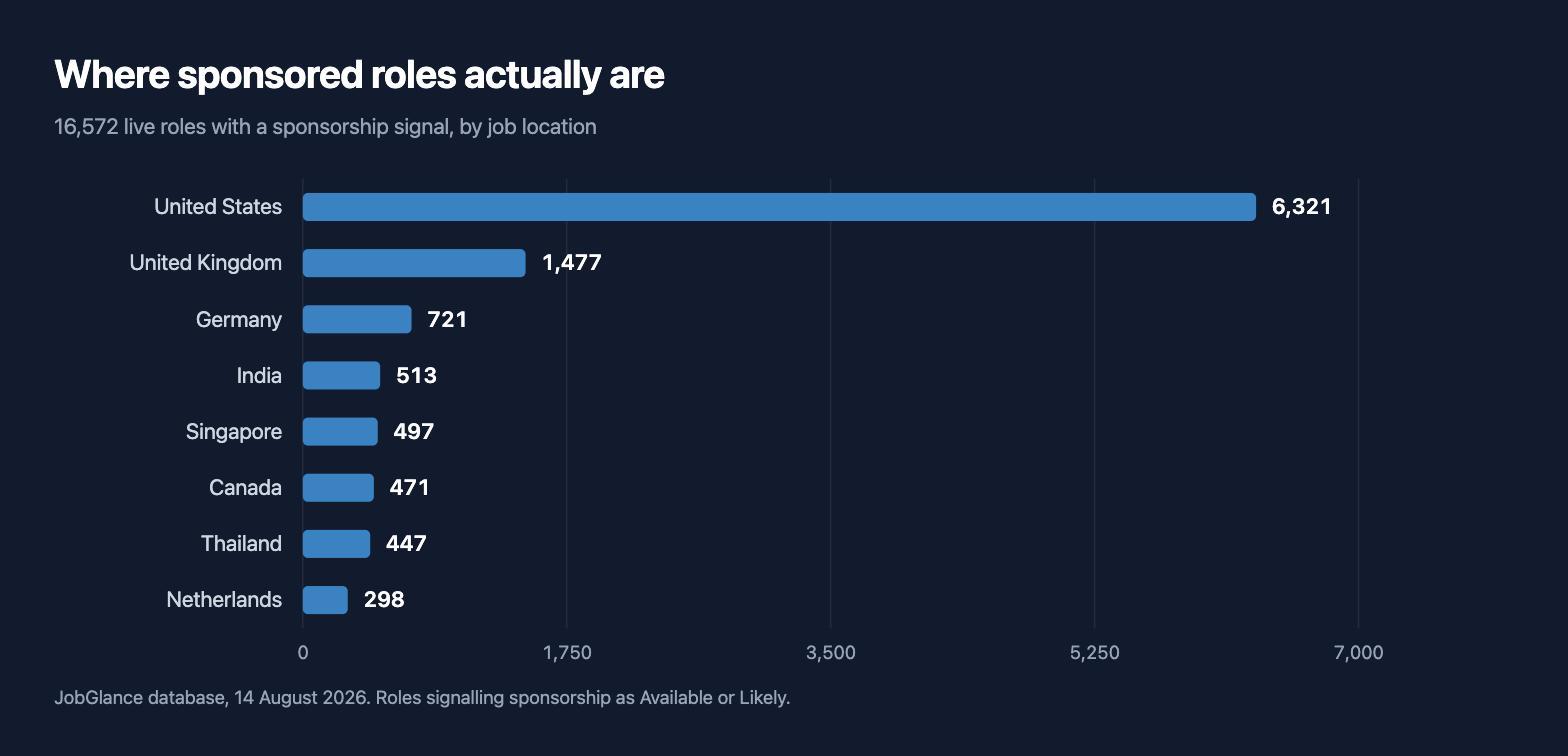
The United States dominates in absolute terms, but most of it sits behind the H-1B cap — 65,000 new visas a year plus 20,000 for US master’s graduates, allocated by a registration process that from FY 2027 is weighted toward higher-paid roles rather than drawn at random. Volume on a job board doesn’t translate into odds. The UK, Germany and the Netherlands run capless routes, which for most people is a better bet than the raw counts suggest.
Sponsorship also isn’t only a move-to-the-West story — India, Singapore and Thailand each carry hundreds of sponsored roles, usually with shorter processing and lower salary thresholds than the popular destinations. We broke the destinations down in the top 5 countries for visa sponsorship.
Who has to do the work depends on the country
The UK model — employer holds a licence, employer issues your certificate — is not universal. That matters, because it changes who you actually need to convince.
Germany’s EU Blue Card is applicant-led. You apply. The employer supplies a qualifying job offer and contract, not a licence, and there is no sponsor register they need to be on (BAMF). For a company that has never hired internationally, that is a far smaller ask than the UK equivalent — worth saying out loud when you’re the one raising it.
The Netherlands depends which route you’re on. The commonly used highly skilled migrant permit requires the employer to be an IND recognised sponsor, and the employer submits the application. The EU Blue Card route does not require recognised-sponsor status. Same country, same candidate, materially different amount of work for the company.
Your field changes the odds, and sometimes it’s written into the law. Germany sets a lower Blue Card salary threshold for maths, IT, natural sciences, engineering and medicine than for other fields. If you work in one of those you are cheaper and simpler to hire — not by reputation, by statute. The same pattern runs through shortage-occupation lists in most points-based systems. Check whether your role is on one before assuming sponsorship is a long shot.
How to tell whether a job actually sponsors
Practical tactics, roughly in order of how much time they save.
Check the official sponsor register first. The UK publishes a register of licensed sponsors — every organisation permitted to sponsor a worker, free to search. If a company isn’t on it, they cannot sponsor you in the UK, whatever the post implies. No other five-minute check rules out as many applications. Several countries publish equivalents.
Read the negative statements carefully. “Must have the right to work in the UK” is a no. “Must have the right to work in the UK or be eligible for sponsorship” is a yes, phrased defensively. These sit one word apart and the difference is your entire application.
Decode the relocation wording. Relocation and sponsorship are not the same thing, but they correlate strongly — a company willing to pay to move you has usually already solved the legal side. The exact phrasing carries most of the information:
- “Full relocation package” usually means what it says: visa and application costs, flights, and temporary accommodation. Short of an explicit sponsorship statement, this is the strongest signal there is.
- “Relocation support” or “relocation package” with no qualifier is genuinely ambiguous. It might be a lump sum, shipping costs, or a hotel for two weeks. It does not confirm sponsorship. Ask.
- “Domestic relocation”, or relocation “within the UK”, is not for you. It’s for candidates already in the country moving between cities, and it generally assumes you already hold the right to work. This is often the clearest signal that international candidates aren’t in scope at all.
Look at the careers page, not the listing. Companies that sponsor routinely say so once, centrally, rather than on every post — a large part of why the “not mentioned” pile is so big. Large employers, universities and hospital systems are the best prior when you’re deciding where to spend an evening.
Ask in the first round, plainly. “Is this role open to candidates who’d need visa sponsorship, and does the relocation package cover visa costs?” is not rude and it isn’t a red flag. Ask in the first conversation rather than saving it — vague relocation wording is exactly what a recruiter can clear up in one sentence. The worst outcome is a fast no, which is a good outcome.
Or have something read them for you. Everything above is you doing the reading. A board with a real sponsorship filter does it instead: JobGlance reads the full description of every listing it aggregates and grades the sponsorship signal, so the 61.5% that say nothing get sorted rather than skipped. One toggle and you are looking at sponsored roles across 100+ sources, ranked against your own resume — the work above, done in a few clicks instead of an evening of tabs.
”Will you now or in the future require sponsorship?”
Almost every application form asks some version of this, and it causes more anxiety than anything else in the process.
Answer honestly. If you’d need sponsorship now or later, say yes.
Answering no to get past the filter reliably backfires — it surfaces at offer stage during right-to-work checks, after you’ve spent weeks and burned credibility you can’t rebuild. A company that would have sponsored you doesn’t stop because you ticked yes. One that wouldn’t was never going to.
The question exists so employers can filter early. Used honestly, it filters for you too.
What visa sponsorship is not
Not a job guarantee. It makes you hireable. You still have to be the candidate they want.
Not a work permit you already hold. Permanent residency, a spouse visa or a working-holiday visa that permits employment means you don’t need sponsorship — say so clearly, because it makes you dramatically easier to hire.
Not permanent by default. Sponsored visas are usually tied to the employer and the role, so changing jobs often means a new sponsor and new paperwork.
Not family or student sponsorship. Same word, different process and rules. Most glossary results conflate them.
Frequently asked questions
Does visa sponsorship cost me money?
Less often than people assume. The employer covers their own licence and fees; the visa application fee and health surcharge fall to you on paper. But many sponsoring companies reimburse them, and some pay upfront where a relocation package is involved. It’s rarely advertised — ask in the first round.
How long does visa sponsorship take?
Weeks to several months, depending on country, route and time of year. Ask the employer whether they’ve sponsored before — a first-timer will be slower than a company that does it routinely.
Can a small company sponsor a visa?
Yes — nothing restricts it to large employers. In practice small companies sponsor less often because the cost and admin land harder on them.
What happens if I lose a sponsored job?
Sponsored visas are usually tied to the sponsoring employer, so there’s normally a limited window to find a new sponsor or leave. The specifics are country-dependent and matter enormously — get proper advice, not blog-post guidance.
Is “visa sponsorship available” the same as relocation support?
No — but they correlate strongly enough to be worth reading as a signal. Sponsorship is the legal right to work; relocation support is money for flights, shipping or temporary housing. A role can offer either, both or neither. In practice a company paying to move you has usually already solved sponsorship, so “full relocation package” is a good sign even when sponsorship isn’t stated. “Domestic relocation” is the opposite signal. See the wording guide above.
Do I always need an employer to sponsor me?
No. Some countries run applicant-led routes where you apply for the permit yourself and the employer only provides the job offer and contract — Germany’s EU Blue Card works this way, and so does the Blue Card route in the Netherlands. Others, like the UK, require the employer to hold a licence and issue your certificate. Which model applies is worth checking before you decide a company “can’t” sponsor you: sometimes what they actually can’t do is the UK version, and the route you need asks much less of them.
Why do so few job posts mention sponsorship?
Because job posts are written for the domestic majority. Only 4.1% of the posts we checked stated it outright and 61.5% said nothing — not because those employers all refuse, but because it never occurred to them to address it.
One note on the numbers above: they describe our database on one day, skewed toward the major boards and ATS platforms we aggregate. A large current sample, not a census — we’d rather show a real one and say what it is than quote a rounder number from somewhere else.
The visa sponsorship job pages are free to browse without an account.
Keep reading


