10 International Job Search Engines for 2026


On this page
More than 4.1 billion job searches run across digital platforms each month, with 310 million job postings processed annually worldwide, according to online job marketplace data. That scale creates a problem international candidates can’t solve by collecting more tabs. The question is whether a role is legally and practically actionable from your country.
The best international job search engines must therefore be judged on more than inventory. This comparison looks at source breadth, sponsorship signals, genuine work-from-anywhere eligibility, regional and language strength, freshness, salary context, application friction, and the research needed before you commit time to an application.
No single engine should carry the entire search. A broad aggregator can reveal the market, LinkedIn can expose recruiter and referral paths, specialist boards can clarify remote geography, and company research can test whether an employer is credible. Eligibility still needs verification because “remote” may mean remote within one country, while sponsorship may never appear in the job title or standard filters.
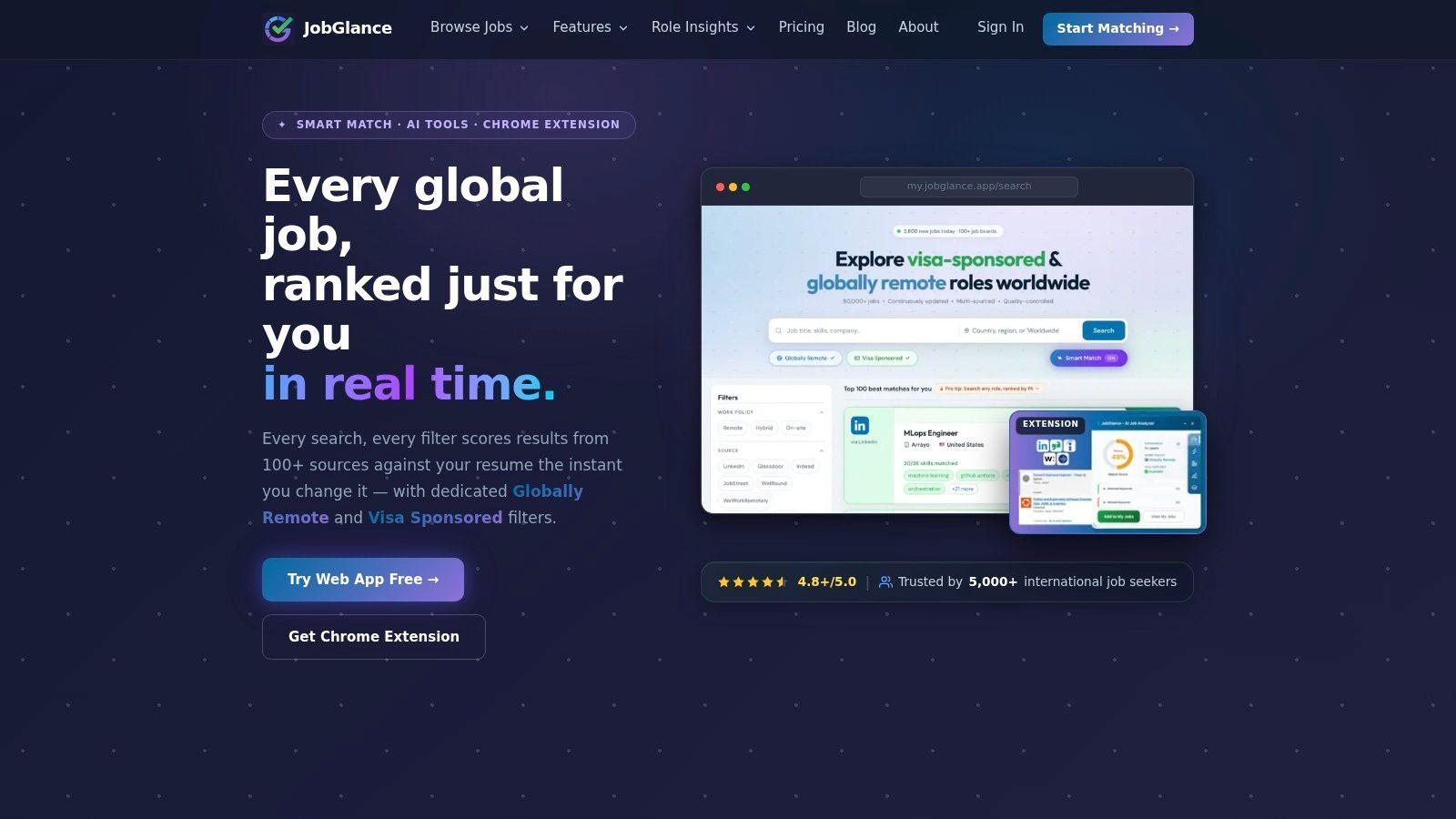
JobGlance is designed around that handoff. Its web app aggregates 50,000+ active roles from 100+ sources, ranks listings against an uploaded resume with Smart Match, and provides dedicated Visa Sponsorship and Work-From-Anywhere filters. The practical workflow is layered: discover broadly, narrow by eligibility, investigate the employer, tailor the application, and verify the final requirements directly with the company.
1. JobGlance
JobGlance is the strongest fit when eligibility and personal relevance must be evaluated together. The web app aggregates 50,000+ active roles from 100+ job sites, deduplicates them, refreshes the database every 24 hours, and purges expired roles within 24 hours. That gives international candidates one discovery layer instead of forcing the same search across a long list of separate boards.
Its central advantage is Smart Match. Every result receives a 0–100 score against your uploaded resume, and the result set is re-ranked when you change the query, a filter, or the resume. This is materially different from relying on posting date or paid placement to decide which listings appear first. A broad search becomes useful only when the strongest-fit roles rise above the inventory.
Eligibility is a first-class filter
JobGlance treats Visa Sponsorship and Work-From-Anywhere as dedicated filters that stack with any query. That distinction matters because remote work is often geographically limited. A 2025 dataset found that 88% of remote jobs were tied to one country, 10% were open to several countries, regions, or time zones, and only 2% were remote from anywhere, as reported by Jobgether’s global hiring analysis.
The platform also grades sponsorship signals. A listing can show sponsorship as Available when the posting states it, or Likely when the employer has a relevant sponsorship track record. That’s more useful than treating sponsorship as a keyword, although candidates should still verify the employer’s current requirements before applying.
Practical rule: Use JobGlance to reduce the pool to roles you might actually be able to take, then confirm work authorization, location, and sponsorship with the employer.
The application workflow continues beyond discovery. JobGlance includes an unlimited ATS Resume Builder, five ATS checks, single-column PDF exports, job-specific cover letters, company research with evidence and confidence levels, Similar Jobs Across Sites, Career Gap Analysis, and account-based application tracking. The Chrome extension carries match scores, sponsorship and remote detection, skill-gap highlights, and one-click saving onto job pages elsewhere on the web.
The trade-off is browser and usage scope. The extension is Chrome-first, including Chromium browsers, while the web app’s free tier limits heavier searching. Pro costs about $12.99 per month, or $10.39 per month billed quarterly, according to the supplied product information. The extension is free and unlimited, and JobGlance says the resume is used locally for scoring, never sold, and never used to train models.
Visit JobGlance when you want discovery, eligibility signals, resume tailoring, and application tracking in one workflow.
2. LinkedIn Jobs
LinkedIn Jobs is less a conventional job board than a professional identity and recruiting network with a job engine attached. Its value rises when a cross-border application depends on visibility, referrals, recruiter outreach, or a warm introduction. Employer-posted roles sit alongside aggregated listings, while recommendations use signals from your profile, skills, and activity.
LinkedIn reports about 930 million professional members globally and roughly 15.7 million active jobs worldwide, figures included in international job search statistics. That scale creates network effects that specialist boards can’t replicate. A candidate can find a vacancy, identify the hiring manager, inspect the team, and ask for context without leaving the same professional ecosystem.
Where LinkedIn earns its place
The platform works especially well for mid-to-senior roles, product positions, technology, consulting, sales, and other fields where recruiters search proactively. Easy Apply reduces application friction for selected roles, while direct employer applications preserve the more complete company process. Company pages add alumni insights, reviews, salary ranges, and employee context, although the depth varies by employer and region.
LinkedIn’s Premium Career features can help active searchers with recruiter messaging, InMail, and additional discovery insights. They’re most defensible when you’re already targeting named employers or need direct access to people, not when you’re merely browsing a large volume of generic results.
The weakness is noise. Broad searches can mix domestic-remote roles with internationally accessible roles, and a polished profile may attract irrelevant recruiter contact as easily as useful outreach. LinkedIn also doesn’t make sponsorship a universal, reliable eligibility field, so candidates must read the posting and verify the hiring geography.
Use LinkedIn after identifying a target role or company. Search for employees in the relevant team, compare the role against Product Manager job openings, and ask focused questions about location, hiring entity, and work authorization. LinkedIn is excellent at opening doors, but it doesn’t decide whether immigration conditions are satisfied.
Website: LinkedIn Jobs
3. Indeed
Indeed is the broadest generalist starting point for many candidates. It combines employer listings with postings aggregated from job boards and applicant tracking systems, then adds filters for salary, remote or hybrid work, location radius, and posting details. Its global reach makes it useful for testing whether a role exists across several countries rather than assuming one market reflects the whole opportunity.
Indeed is repeatedly reported as the category leader, with 300 million unique monthly visitors globally and 96.7% reach among U.S. online job seekers, according to the job search statistics source. Those figures indicate distribution strength, not eligibility quality. A large audience can help uncover roles, but it also means popular jobs attract intense competition.
Best for breadth and alerts
Indeed’s saved searches and alerts are practical for candidates monitoring several locations or title variations. Salary snapshots, company reviews, and Easy Apply on selected roles add useful context before an application. Recent profile controls also include features such as blocking specific employers and AI-guided application tailoring.
The main drawback is triage. Broad queries may contain duplicates, stale posts, and roles copied across several sources. “Remote” can still mean remote only within a specified country, and sponsorship language may be absent even when an employer has a history of sponsoring workers. Candidates should treat Indeed as an inventory source, not as a legal eligibility checker.
A better workflow is to use separate searches for each target country, preserve the original job URL, and compare posting dates and employer names before saving. Then use visa sponsorship job listings to narrow the search around a dedicated eligibility signal rather than relying on repeated keyword combinations.
Indeed is strongest when you need market coverage and dependable alerts. It’s weaker when the search depends on precise international eligibility, duplicate control, or a clean path from discovery to a bespoke application.
Website: Indeed
4. Google Job Search
Google Job Search is a meta-search layer inside Google, so its strength is cross-site discovery rather than candidate management. It consolidates postings from company career pages and major boards, applies structured filters, and can deduplicate similar listings. For an international candidate, that makes it a useful first sweep across employer-direct and third-party sources.
The interface can filter by location, posting date, job type, employer, and commute time. Opt-in personalization can also use prior searches to improve recommendations. The most important benefit is reach without requiring a separate account on every job board.
Use it to find the original source
Company-direct listings deserve attention because they often provide fuller requirements, clearer hiring entities, and the employer’s actual application process. Google Job Search can surface those postings alongside aggregated results, which helps candidates avoid assuming that the first visible board owns the vacancy.
The trade-off appears after discovery. Google doesn’t provide native application tracking, and clicking a result sends you to the source site or employer ATS. Sponsorship and work-from-anywhere eligibility also aren’t guaranteed to appear as structured filters. Availability varies by country and language, which matters for candidates searching beyond major English-language markets.
Use Google Job Search to build a market map. Search the same title with different country names, inspect whether the destination is a company career page, and record the employer’s stated work location. Then verify whether the employer can hire in your country, because a search result can show relevance without establishing permission to work.
Website: Google Job Search
5. Glassdoor
Glassdoor is most valuable when the application decision includes employer risk, compensation, culture, and relocation trade-offs. Its job search sits beside company reviews, salary estimates, benefits information, and interview insights. That combination changes the question from “Can I find this job?” to “Is this employer worth pursuing in this market?”
Candidates considering a move can use company pages to investigate how employees describe management, workload, interview processes, and benefits. Salary context can support negotiation and reveal whether an advertised role aligns with the cost and complexity of relocating. Those signals are especially useful when sponsorship involves a significant investment of time.
Research is the differentiator
Glassdoor’s strength isn’t necessarily maximum international inventory. It’s the ability to compare a job posting with employee-generated context before investing in a custom application. Selected roles support Easy Apply, while alerts and saved searches make monitoring straightforward. Integration with Indeed also makes the broader search ecosystem easier to use.
Reviews require judgment. Some may be dated, polarized, or specific to one office rather than the legal employer offering the role. Salary estimates can also vary by location, seniority, and reporting quality. Treat them as context, not a promise.
For international candidates, the best sequence is simple. Find the role on a broad engine, research the employer on Glassdoor, inspect the relevant country or office, and then confirm the hiring entity and sponsorship position directly. Glassdoor can expose warning signs that a job description won’t mention, but it can’t replace immigration verification.
Website: Glassdoor
6. Jooble
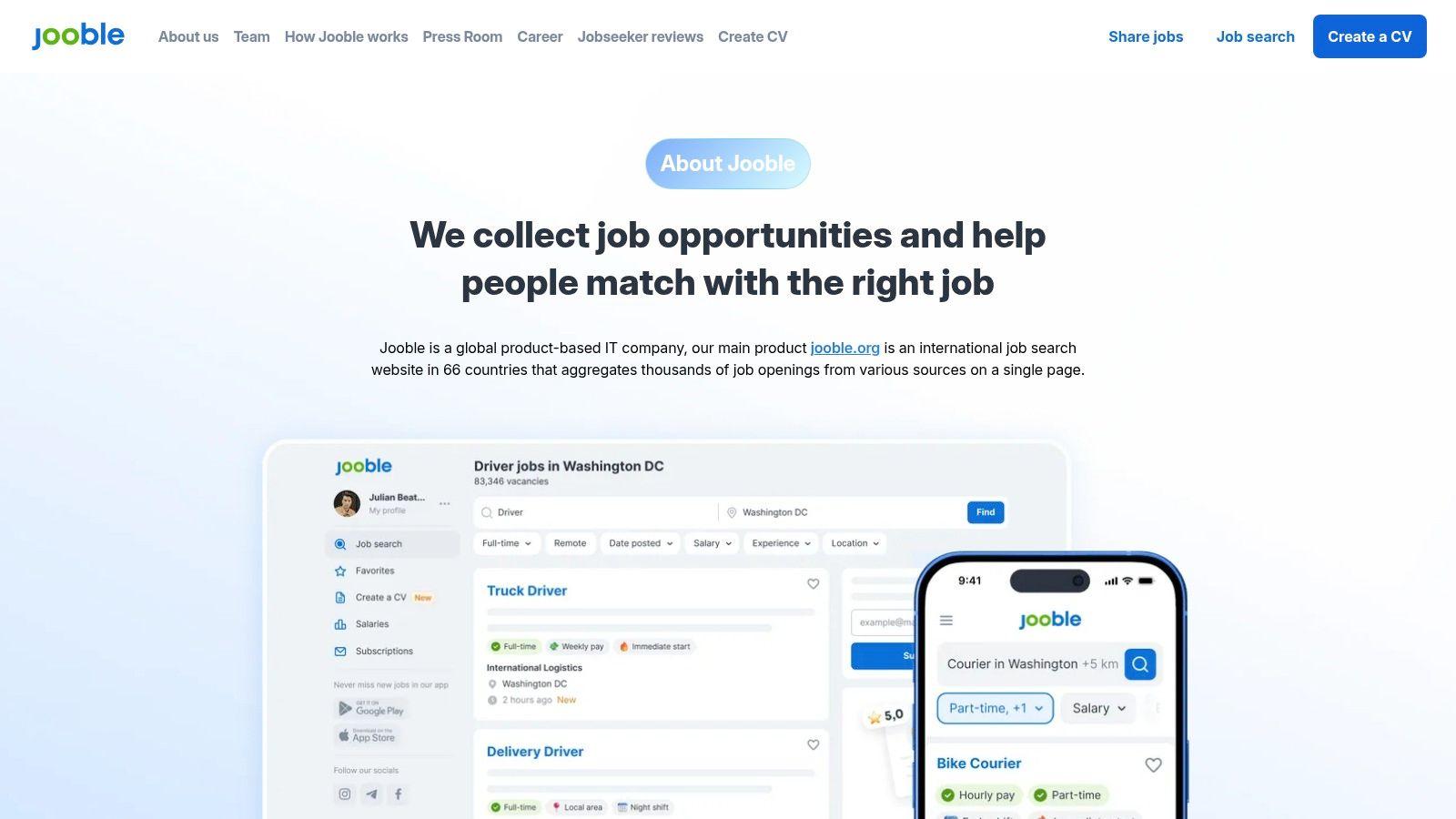
Jooble is a long-running international aggregator built for multi-market discovery. It pulls listings from career sites, boards, and classifieds into country-specific portals, making it useful when a search extends beyond U.S.-centric platforms. Its country coverage and mobile apps support candidates who are comparing several destinations at once.
The platform’s regional structure is its practical advantage. A candidate can search locally relevant terms, inspect country-specific results, and set alerts without rebuilding the entire process on multiple national sites. That matters because job titles, spelling, language, and employer publishing habits differ between markets.
Broad reach, imperfect handoff
Jooble is efficient for finding roles that may not appear prominently on larger English-language engines. Quick filters and alerts help with discovery, while mobile access suits candidates monitoring openings across time zones. Its traffic position also reflects meaningful scale, with 34.20 million monthly visits in June 2026, according to global job-search website traffic data.
The cost of aggregation is duplication and external application friction. Several versions of the same vacancy may appear from different sources, and the final application can move through a third-party flow with inconsistent quality. Sponsorship may also require reading the original listing rather than trusting the aggregator’s summary.
Use Jooble to test regional coverage, then deduplicate by employer, title, location, and original posting. Save the source URL, identify the hiring entity, and verify whether the role accepts candidates from your country before tailoring your resume. Jooble helps answer “Where else is this role visible?” It doesn’t fully answer “Can I legally take it?”
Website: Jooble
7. Adzuna
Adzuna stands out for candidates who need salary context alongside job discovery. Its country-specific sites and market insights help compare roles across regions, particularly in the UK, Europe, Australia, and New Zealand. That regional orientation makes it more useful for compensation benchmarking than a general search page that shows a salary field when an employer provides one.
Salary intelligence matters because international candidates compare more than nominal pay. Tax, currency, benefits, relocation costs, and employment structure can change the practical value of an offer. Adzuna can provide a starting point for that analysis, but candidates still need to check whether figures describe the same role level and geography.
Stronger in selected markets
Adzuna’s localized filters and research reports support country-by-country searches. It can help a candidate spot whether a title is common in a target market and whether advertised compensation appears consistent with the local market. Those insights are especially useful before a candidate decides which applications deserve extensive tailoring.
Its U.S. inventory is smaller than Indeed or LinkedIn, and some applications click through to employer or partner sites. That means Adzuna works best as a regional intelligence tool rather than the only source for a global search.
Use it after defining the countries you’re willing to consider. Compare equivalent titles, note the location attached to each salary signal, and separate advertised ranges from verified employer offers. Then investigate sponsorship and employment eligibility independently. Adzuna can improve the financial decision, but salary transparency doesn’t establish immigration permission.
Website: Adzuna
8. Wellfound
Wellfound is built around startups, so its value comes from company-stage context and remote hiring geography rather than sheer generalist inventory. It’s particularly relevant for technology, product, data, design, growth, and other roles where early-stage companies recruit internationally or offer distributed work.
Startup profiles can show funding stage, equity, and where the company can hire. That last signal is critical. A company may describe itself as remote-friendly while restricting employment to specific countries, regions, or time zones because of payroll and compliance requirements. Wellfound’s hiring-geography information helps candidates identify that distinction earlier.
Best for direct startup access
Candidates can often reach founders or recruiters more directly than on a large aggregator. The platform’s candidate-friendly profiles also make it easier to judge whether the role matches the company’s stage and operating model. Curated remote categories add useful focus for engineering, product, and AI or machine-learning searches.
The trade-off is concentration. Attractive startup roles draw competitive applicant pools, while non-technical functions can vary with funding cycles and local hiring needs. Startup enthusiasm also isn’t the same as sponsorship capacity. A small company may want international talent but lack the infrastructure or willingness to sponsor.
Before applying, check the company’s authorized hiring locations, legal employer, compensation structure, and sponsorship wording. Treat equity as a separate risk factor from salary, and don’t infer work-from-anywhere access from a general remote label. Wellfound is a strong specialist board for startup discovery, but the final eligibility decision still belongs to the employer and relevant authorities.
Website: Wellfound
9. We Work Remotely
We Work Remotely is a remote-only board, which gives it a higher starting signal for candidates who don’t want to sift through office-based listings. It covers engineering, product, design, marketing, support, and other functions, while region filters and GeoLock options indicate where an employer can hire.
That distinction is more valuable than the word “remote” alone. One 2025 dataset found that only 2% of tracked remote postings were remote from anywhere, as reported by Jobgether’s remote-work analysis. A remote-only board can reduce irrelevant inventory, but it can’t make every listing globally accessible.
Read the geography, not the headline
We Work Remotely’s listing-level region information helps candidates assess country and time-zone restrictions earlier. The community, newsletter, and alerts also support recurring searches in a focused remote market. For people seeking genuine distributed roles, that’s a cleaner discovery experience than a generalist engine with a remote checkbox.
The limitation is inventory depth compared with mega-aggregators. Some postings still restrict hiring to a country or region, and the board isn’t a sponsorship database. A candidate outside the listed geography should not apply on the assumption that remote work removes employment-law requirements.
Use the platform to identify remote-first employers, then check the exact eligibility language. Ask whether the company hires through a local entity, employer of record, contractor arrangement, or sponsorship route. Those structures affect whether “remote” is workable from your country.
Website: We Work Remotely
10. Remote OK
Remote OK is useful when a candidate needs granular signals for time zone, salary, technology stack, worldwide access, and sponsorship. Its categories cover engineering and product as well as non-technical remote roles, while practical tags can distinguish worldwide listings from region-specific opportunities.
The platform’s tagging system helps turn an ambiguous remote search into a constrained one. Candidates can look for time-zone compatibility, relevant technologies, salary information, and tags such as worldwide or visa-sponsored. That’s more actionable than searching for “remote” and hoping the description explains the legal arrangement.
Practical filters still need verification
Remote OK syndicates jobs through APIs, increasing distribution and helping employers maintain visibility. That can support freshness, but external ATS flows vary in quality, and employer promotions can affect listing visibility. A tag is a useful lead, not a binding immigration commitment.
The platform’s traffic also shows why remote specialists remain relevant. Remote OK recorded 10.30 million monthly visits in June 2026, according to job-search website traffic data. That audience creates discovery value, particularly for technology and startup roles, but candidates should still compare the listing with the employer’s own careers page.
Use Remote OK for targeted searches, then capture the employer’s exact location and time-zone rules. Remote job listings can add another discovery layer when you want to compare remote roles across sources. Before applying, confirm whether “worldwide” means employee hiring, contractor engagement, or permission to work from any country where the company already has compliance coverage.
Website: Remote OK
Top 10 International Job Search Engines, Comparative Overview
| Product | Core features (✨) | Quality (★) | Price / Value (💰) | Target (👥) | Unique selling points (✨) |
|---|---|---|---|---|---|
| 🏆 JobGlance | Smart Match 0–100 real‑time ranking; 50k+ aggregated roles; Visa & Work‑From‑Anywhere filters; ATS Resume Builder; AI Toolbox | ★★★★☆ (match accuracy; 24h refresh) | 💰 Free tier; Pro $12.99/mo ( $10.39/qtr) | 👥 International & remote job seekers; visa applicants | ✨ Real‑time re‑ranking; first‑class visa/WFA filters; extension match on any site; privacy‑first |
| LinkedIn Jobs | Network-driven listings; Easy Apply; company pages & recommendations | ★★★★☆ (strong network effects) | 💰 Free; Premium paid features | 👥 Mid‑to‑senior professionals; networked candidates | ✨ Recruiter outreach & referrals; rich company/alumni signals |
| Indeed | Massive aggregator; salary/remote/hybrid filters; alerts & Easy Apply | ★★★★☆ (breadth of listings) | 💰 Free; sponsored listings for employers | 👥 Generalists; local + international job hunters | ✨ Huge inventory + reliable alerts for broad searches |
| Google Job Search | Meta‑search with dedupe; structured filters; surfacing company‑direct posts | ★★★★☆ (cross‑site reach) | 💰 Free | 👥 First‑sweep researchers; those seeking company‑direct roles | ✨ Consolidation & deduplication across many sources |
| Glassdoor | Job posts + company reviews, salaries & interview insights | ★★★★☆ (employer due diligence) | 💰 Free; employer features paid | 👥 Candidates researching culture, pay, relocation | ✨ Rich salary & interview context for offer negotiation |
| Jooble | Aggregation across 60+ country portals; mobile apps; alerts | ★★★☆☆ (wide international reach) | 💰 Free | 👥 Multi‑country job searchers | ✨ Country‑specific portals that surface non‑US markets |
| Adzuna | Salary statistics & market insights; country sites & reports | ★★★☆☆ (pay benchmarking strength) | 💰 Free | 👥 Candidates benchmarking pay across regions | ✨ Salary intelligence and localized market reports |
| Wellfound (AngelList) | Startup jobs; remote‑hiring geography; equity & stage filters | ★★★★☆ (startup concentration) | 💰 Free | 👥 Startup‑focused candidates (tech/product/data) | ✨ Remote‑hiring transparency; direct founder/recruiter contact |
| We Work Remotely | Remote‑only curation; region filters & GeoLock eligibility | ★★★★☆ (remote role signal) | 💰 Free to search; paid employer posts | 👥 Remote job seekers across functions | ✨ Remote‑only board with clearer location eligibility |
| Remote OK | Time‑zone, salary & tech‑stack filters; tags for worldwide & visa | ★★★★☆ (practical remote filters) | 💰 Free; paid postings/syndication | 👥 Remote tech & startup applicants | ✨ Granular timezone/sponsor/worldwide tagging for practical fits |
Build a Search Stack, Not a Single Tab
International job searching works better as a stack of tools with separate jobs. Broad engines maximize discovery. Professional networks create relationship paths. Specialist boards clarify remote geography or startup context. Research platforms test employer quality and compensation. None of those functions automatically verifies whether you can work legally from your country.
Start with a broad engine such as Indeed, Google Job Search, or JobGlance. Use multiple title variations and search each target country separately. The market is already saturated with volume. One 2026 market summary estimated the online recruitment market at more than $58 billion by 2027, while another industry source reported 4.1 billion monthly job searches and 310 million annual job postings processed worldwide in the online job marketplace data. The practical conclusion is that ranking and eligibility filters matter more than collecting every possible listing.
Then add LinkedIn for recruiter signals, referrals, and company-level intelligence. Follow the employer, inspect the team, and look for people who can clarify the hiring entity or location. Use regional and specialist boards to fill gaps. Jooble can reveal country-specific inventory, Wellfound can expose startup hiring geography, and We Work Remotely or Remote OK can narrow a remote-first search.
Salary and employer context should come before heavy tailoring. Glassdoor can help assess culture, benefits, and interview signals, while Adzuna can support regional pay comparisons. Neither tool should be treated as a definitive source for immigration permission or a guarantee that an advertised salary applies to your seniority and employment structure.
Sponsorship deserves its own verification step because supply is narrow and uneven. In a 2026 Europe-focused dataset covering more than 18,000 early-career roles, explicit sponsorship appeared in 1.1% of German roles, 4.2% of UK roles, 5.8% of Irish roles, and 8% of Polish roles, according to international graduate sponsorship data. Those figures don’t tell you whether one specific vacancy is actionable, but they do show why sponsorship should be treated as a hard filter rather than an assumed benefit.
The U.S. picture is similarly constrained. In May 2025, sponsorship appeared in 3.2% of physician and surgeon postings, compared with 1% in therapy and 0.6% in dental roles, according to JobGlance’s sponsorship market coverage. Sponsorship access depends on destination, occupation, employer, seniority, and current policy. A keyword match alone can’t resolve those variables.
Use a simple application record for every serious role:
- Record the source: Keep the original employer or ATS URL and remove duplicate copies.
- Record eligibility: Note the stated country, time zone, employee or contractor model, sponsorship language, and hiring entity.
- Record freshness: Check whether the vacancy is still open before tailoring your materials.
- Record evidence: Save the wording that supports remote or sponsorship assumptions, then mark anything that still needs confirmation.
- Record progress: Track application date, contact person, follow-up, interview stage, and outcome in one place.
Tailor the resume only after a role passes that initial screen. A relevant title isn’t enough if the employer can’t hire in your location. Match the resume to the actual description, address missing skills directly, and prepare a role-specific cover letter when the application asks for one. If the job came through an aggregator, apply through the employer’s verified process whenever possible.
The most efficient stack is therefore sequential, not simultaneous. Discover broadly, rank by fit, filter by eligibility, research the employer, verify the work arrangement, tailor the application, and track the result. That process prevents the most expensive mistake in international searching, spending hours on a role you were never able to accept.
JobGlance brings cross-site discovery, resume-based Smart Match, dedicated visa sponsorship and work-from-anywhere filters, and application tools into one workflow. Visit JobGlance to compare actionable international roles, detect eligibility signals earlier, and move from a saved listing to a better-prepared application.
Keep reading


