How to Find Hidden Jobs: A Step-by-Step Playbook


On this page
“Network more” is the most popular advice about how to find hidden jobs. It’s also incomplete. Without a target employer, a useful question, and a way to verify whether you can take the role, networking becomes another form of unfocused job searching.
The practical alternative is to find opportunities that other candidates overlook, check whether they’re real and accessible, and reach the people who understand the hiring need. That takes a repeatable process, not a larger collection of connections.
Why the Hidden Job Market Is a Distribution Problem
The claim that 70–80% of jobs are never advertised doesn’t have a consistent, rigorous basis. Don’t build your search around that percentage. The useful question isn’t how many jobs are supposedly secret, but which relevant opportunities you aren’t reaching through your current search habits.
A role can be public and still be difficult to discover. An employer might publish it only on its careers page, an employee might share it before it reaches a large board, or a recruiter might use a title you wouldn’t normally search.
Visibility isn’t the same as access
The U.S. Bureau of Labor Statistics recorded 10.1 million openings alongside 6.7 million hires in June 2021, illustrating why a vacancy count isn’t a count of completed hiring opportunities (BLS job openings and hires). Those figures don’t measure hidden jobs. They show why finding a vacancy and getting hired are separate tasks.
For an international candidate, there’s another distinction: a discoverable role might still be inaccessible. The employer’s location requirements, work-authorization rules, or hiring timetable may rule it out before your experience gets serious consideration.
| Search obstacle | What to establish |
|---|---|
| Unfamiliar title | Whether the responsibilities match your function |
| Unclear location | Where the employee must physically work |
| Missing sponsorship language | Whether the employer will consider your circumstances |
| Reposted vacancy | Whether the requisition is still active |
| Unnamed team | Who owns the work and hiring decision |
If relocation is part of the decision, use ReloMaps to compare places to live before treating every eligible destination as equally suitable. Keep your location preferences separate from the employer’s legal eligibility requirements.
Practical rule: An opportunity belongs in your active pipeline only when you can explain both why you fit and what still needs verification.
A useful hidden-job search combines employer research, relevant contacts, broader discovery, and direct checks. You’re not hunting for a secret inventory. You’re improving how you find, understand, and act on hiring information.
Build a Target Company List Before You Search
Start with employers, not an endless feed of vacancies. A company list gives every search and conversation a purpose: find the team, understand its needs, and establish whether you’re a plausible hire.
A manageable working target is 20–40 employers, using the company-focused approach described alongside the research on networking and job-search outcomes. Treat that as a planning range, not a scientifically optimal list size.
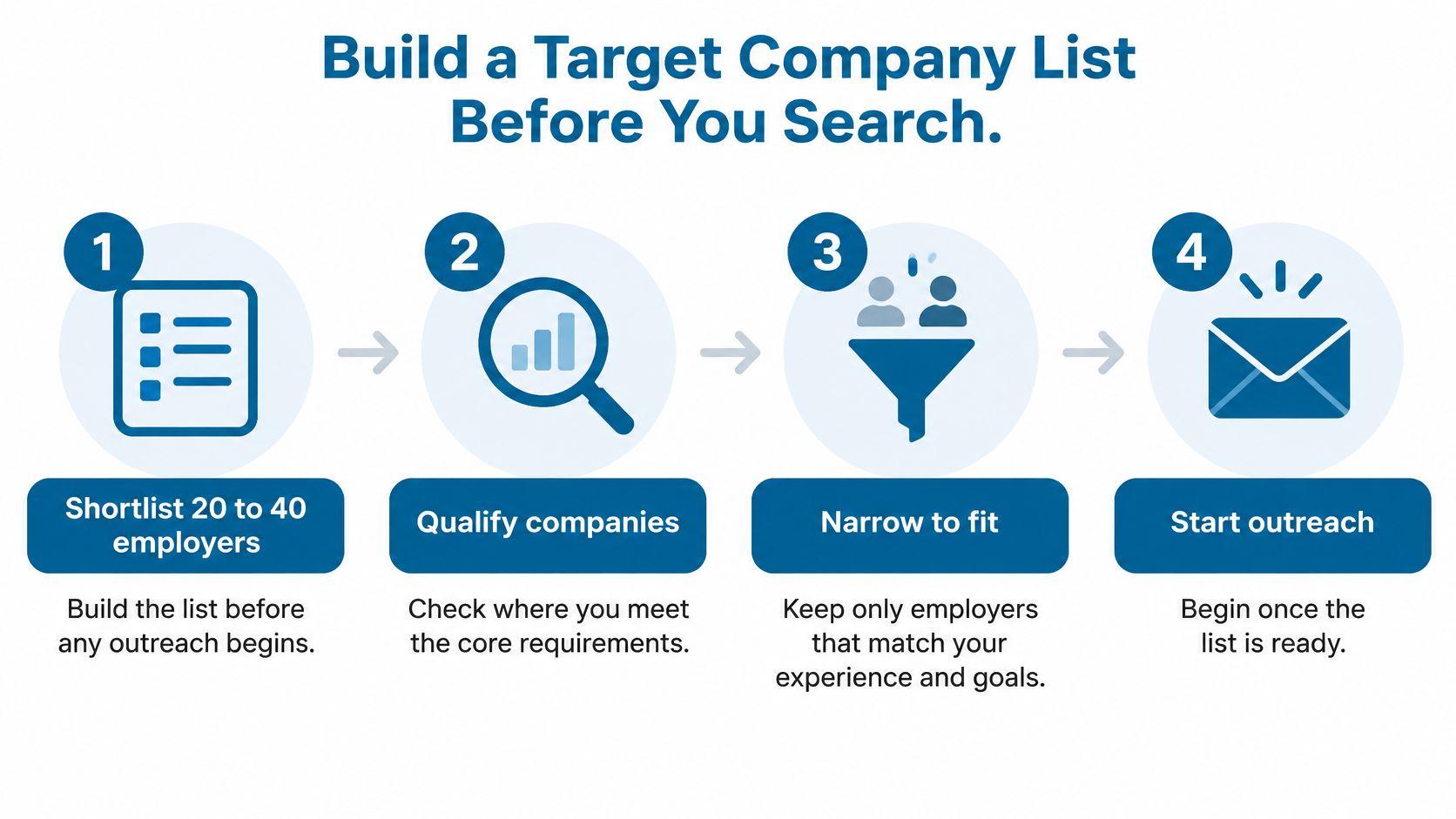
Qualify employers before investing in them
Build your list around constraints you can explain clearly.
- Function and level: Identify work you can credibly perform now. Separate a change of industry from a change of profession, especially if you’re attempting both.
- Employment location: Check where the position is employed, not merely where the company has customers or offices.
- Work authorization: Record whether you already qualify, need sponsorship, or need clarification.
- Evidence of fit: Save a project, achievement, or work sample that connects your experience to the employer’s likely needs.
For remote searches, browse remote job categories to identify possible employers, then inspect the individual vacancy. “Remote” is a starting description, not an eligibility decision.
Read beyond the title
The description should help you identify the department, reporting relationship, customer type, and business problem. A vacancy emphasizing implementation, onboarding, and customer training may deserve attention even if its title differs from your previous role.
Look for the hiring manager’s function rather than guessing a person’s identity. If the listing says the role reports to the head of analytics, your research has a direction. If it says nothing, record the team as unconfirmed.
Consider a hypothetical research sprint starting with 200 possible company names. Don’t investigate each equally. Remove employers outside your employment geography, set aside those with unresolved authorization restrictions, and retain the companies whose actual work matches your evidence.
That’s a filtering example, not a promise about how quickly you’ll finish. The useful output is a short, qualified list, not a large spreadsheet.
Keep unknown and ineligible separate. A company with unclear sponsorship belongs in a verification queue. A company that explicitly excludes your circumstances belongs outside the active list, unless a relevant person confirms an exception.
Drop an employer when a required condition fails. Don’t keep it because you’ve already spent time researching it.
Find Referral Paths Through Weak Ties
A referral is useful when the employee can provide information that your application alone doesn’t contain. That might be knowledge of your work, context about the team, or an explanation of why experience from another industry transfers.
Employer adoption and hiring outcomes measure different things. 71.3% of surveyed employers used current-employee referrals in iHire’s recruitment research, while referrals represented 1.64% of applications and 17.09% of hires in Gem’s recruiting benchmark.
Those findings make referrals worth pursuing. They don’t prove that an individual candidate will get the same advantage, or that most jobs are never posted.
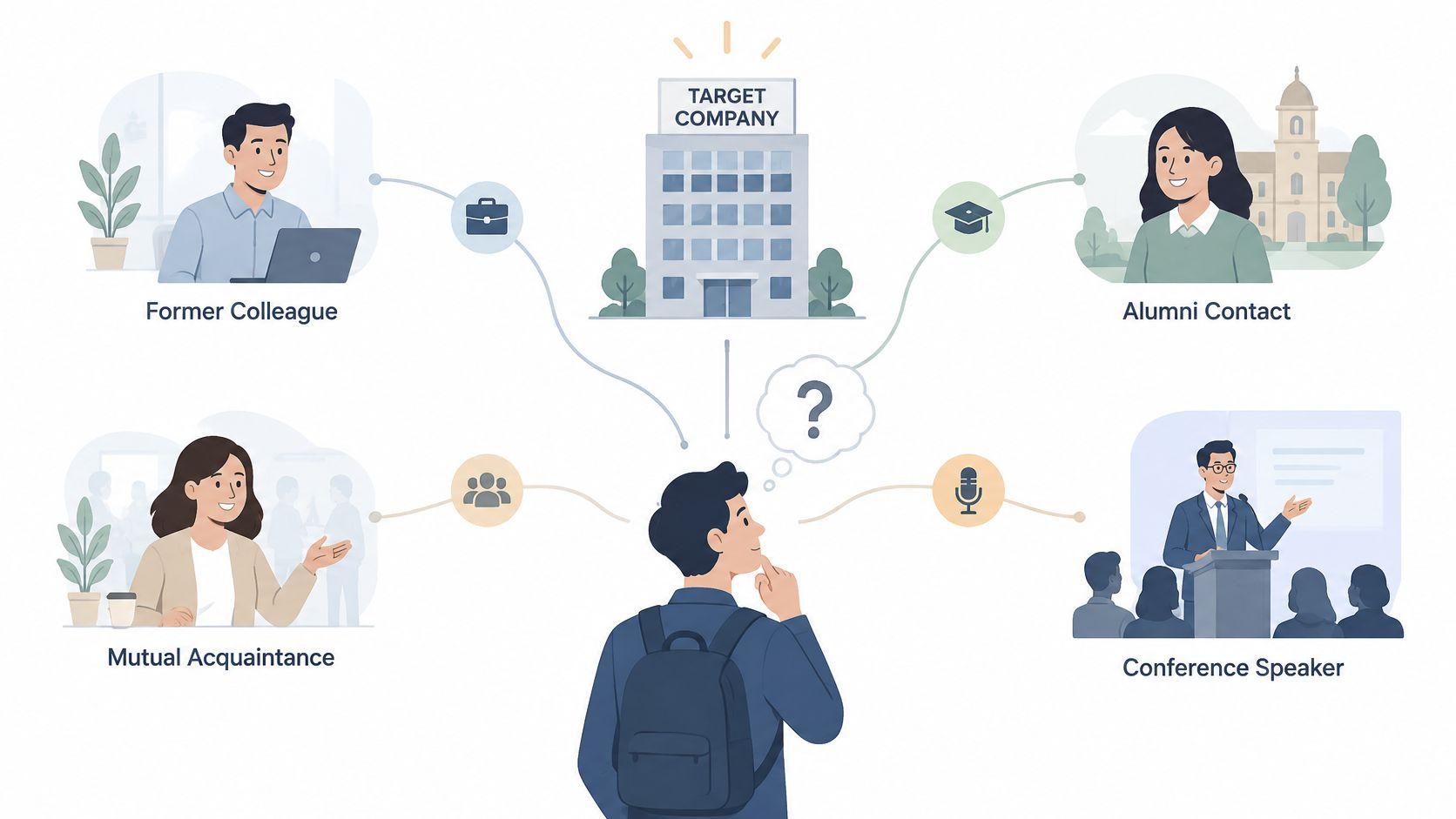
Rank contacts by relevance, not influence
Start with people who can connect your experience to the work.
| Contact type | Useful request | Limitation to respect |
|---|---|---|
| Former colleague | Assess fit or introduce you to a relevant team | May not know current hiring plans |
| Alumni connection | Explain the function and hiring process | Shared education isn’t an endorsement |
| Professional-community member | Clarify skills and team needs | Keep the request within the relationship |
| Open-source collaborator | Discuss relevant technical work | May have no recruiting involvement |
| Conference speaker | Answer a specific question about their specialty | Don’t turn a public talk into a referral obligation |
Weak ties are useful because they can connect you with information beyond your immediate circle. You don’t need to pretend that an acquaintance is a close relationship. State how you know each other and make a proportionate request.
Distinguish an introduction from a forwarded résumé
An employee forwarding your document may help with routing. A substantive introduction goes further: the person explains why the hiring team should consider you and what they can personally verify.
Before asking for either, find out whether the employee knows the function and whether the company accepts referrals for the role. Give them room to decline an endorsement they can’t make.
Ask for information first. Let a referral follow from credible fit, rather than making it the price of answering your message.
Candidates without established professional networks can build these paths through public communities, alumni events, shared projects, and substantive discussions. Contribute something relevant before making a request, but don’t treat unpaid work as an admission fee.
Track which contact routes produce useful replies and interviews. A prestigious contact who can’t assess your work may be less helpful than a former collaborator who can explain it accurately.
Write Outreach That Earns a Reply
A useful message reduces the recipient’s work. They should understand why you chose them, what you can do, and what kind of answer would help.
Don’t send your employment history and expect a stranger to identify the opportunity. Write a role-specific reason for contact, a compact fit summary, and a request they can answer without arranging your job search.
Replace a broad favor with a specific question
A weak message looks like this:
Hi, I’m looking for opportunities. Please review my résumé and let me know if anything is available.
The recipient has no function, location, or reason to prioritize the request. Even someone willing to help must first interrogate you.
A more useful illustrative message is:
Hi Alex, I noticed your team is hiring for implementation work. My background includes customer onboarding and documenting technical workflows, and I can share a relevant project summary. Does this opening focus more on customer training or technical configuration?
This doesn’t guarantee a reply. It gives the recipient a clear question and enough context to answer it.
Adapt the request to the relationship
To a former colleague
“Hi Priya, I saw the operations opening on your company’s careers page. The process-improvement work we did together seems relevant, particularly the handover documentation. Would you be comfortable checking whether the team is considering profiles like mine and, if appropriate, referring me?”
This works when the person knows the work you’re referencing. Attach a résumé and a short explanation of the connection, not a bundle of unrelated documents.
To an employee you don’t know
“Hi Sam, your team’s work on data quality caught my attention. I’ve worked on pipeline validation and can share a brief example. Is the team’s current priority improving existing systems or building new pipelines?”
Ask for insight before asking for sponsorship, an introduction, or a meeting. If a conversation would help, offer it as an option rather than requiring it.
To a recruiter after applying
“Hi Jordan, I applied for the listed analyst opening and wanted to clarify a potential fit. My recent work covers reporting automation and stakeholder requirements, which appear central to the description. Could you confirm whether applicants based in my location are eligible?”
Include the requisition identifier and your authorization status when relevant. Don’t make the recruiter search for information you could have supplied.
Follow up without creating pressure
A practical default is to follow up once after five to seven days, then stop unless the person has invited further contact. Keep the follow-up shorter than the original and add useful context only if you have it.
Apply when a suitable vacancy exists rather than waiting indefinitely for a reply. Direct contact and formal applications serve different purposes: the conversation clarifies context, while the application puts you into the employer’s process.
Silence isn’t an invitation to escalate across every channel. Move the opportunity to waiting, keep the record, and spend your next outreach effort elsewhere.
Find Roles Early With Advanced Search Tools
Manual employer research and aggregated search solve different problems. Career pages help you inspect a specific company closely. Aggregators help you discover relevant employers and equivalent roles you didn’t know to look for.
Neither removes the need to verify the original vacancy. A useful routine combines broad discovery with a final check at the employer.
Choose the search method for the task
| Method | Use it for | Trade-off |
|---|---|---|
| Employer careers page | Checking a target company’s current vacancies | Requires repeated visits |
| Google X-ray search | Finding indexed career-page listings | Results still need freshness checks |
| Aggregated search | Comparing opportunities across sources | Coverage isn’t universal |
| Employee conversation | Understanding team needs and timing | Depends on the contact’s knowledge |
For a manual X-ray search, use a query such as site:myworkdayjobs.com "Project Manager" Remote. Replace the title with the function you want, then vary responsibilities and location language instead of repeatedly running the same query.
Search for equivalent work, not just equivalent titles. Someone targeting customer success might also inspect implementation or onboarding roles, while checking whether the actual duties match.
Use ranking after eligibility filters
JobGlance is one aggregated option: its web app search and ranking tools combine listings from 100+ job sites, deduplicate and refresh the database every 24 hours, and use Smart Match to score results 0–100 against a résumé, re-ranking when the query or filters change. Its sponsorship and work-from-anywhere filters narrow the pool before ranking.
The Chrome extension carries match scoring and sponsorship signals onto other job pages. Similar Jobs Across Sites can help locate equivalent roles with different wording, while openings grouped by role offer another way to explore adjacent titles.
A match score is a reading priority, not a hiring decision. Inspect the responsibilities, missing requirements, and location conditions yourself. A sponsorship signal based on an employer’s history is a reason to investigate, not confirmation for that requisition.
Run a weekly discovery session across broader sources, then revisit the career pages of your highest-priority employers. Before contacting anyone, confirm that the application page still works and that the role’s location, requirements, and identifier match what you saved.
Early discovery helps only when you avoid acting on stale or mismatched information.
Common Mistakes That Keep Hidden Jobs Hidden
Activity isn’t the same as progress. A crowded sent folder and a long application list can hide the fact that you’re learning very little about employers or improving very few hiring decisions.
The most expensive mistakes usually happen before the interview: an unclear request, an unsupported endorsement, or an application routed through the wrong process.
Replace volume habits with decision checks
- Mass outreach with a generic résumé: Tailor the reason for contact and the evidence you include. If you can’t explain why this person is relevant, don’t send the message yet.
- Contacting only close friends: Use the contact map rather than asking the same circle repeatedly. Familiarity and job-relevant knowledge aren’t interchangeable.
- Treating a referral as an exception: Don’t assume an employee can override location, authorization, or qualification requirements. Resolve those questions before requesting an endorsement.
- Calling every vacancy hidden: Focus on whether your research produces useful information or access. The label doesn’t improve the opportunity.
- Expecting an interview from an introduction: An introduction earns consideration, not a guaranteed outcome. Keep preparing evidence for the employer’s actual selection process.
These aren’t reasons to abandon outreach. They’re reasons to make it selective enough that the recipient can help.
Follow the employer’s routing instructions
Referral procedures deserve their own check. Ask whether you should use a referral link, wait for the employee to initiate the process, or apply directly using the exact requisition identifier.
In Jobvite’s 2021 survey, 79% of organizations offered employee-referral programs, demonstrating how established the channel was in that sample (Jobvite Recruiter Nation Report). That doesn’t mean every employer follows the same submission sequence.
Before submitting: Confirm the role, eligibility, referral route, and application destination. Don’t ask the employee to repair an avoidable routing mistake afterward.
Check whether you’ve already applied before sending another version through a different route. If the instructions are unclear, ask the recruiter or referring employee rather than guessing.
Keep the tone professional when a referral doesn’t progress. The contact helped create a route into consideration; they don’t control every assessment, budget decision, or competing application.
Track and Prioritise Your Pipeline Each Week
Your pipeline should tell you what to do next, not merely document what you’ve already done. A record without an owner, unresolved question, or next action is difficult to use.
Keep employers, contacts, and applications connected. If a conversation reveals that a team isn’t hiring, that information should change the application priority rather than remain buried in your inbox.
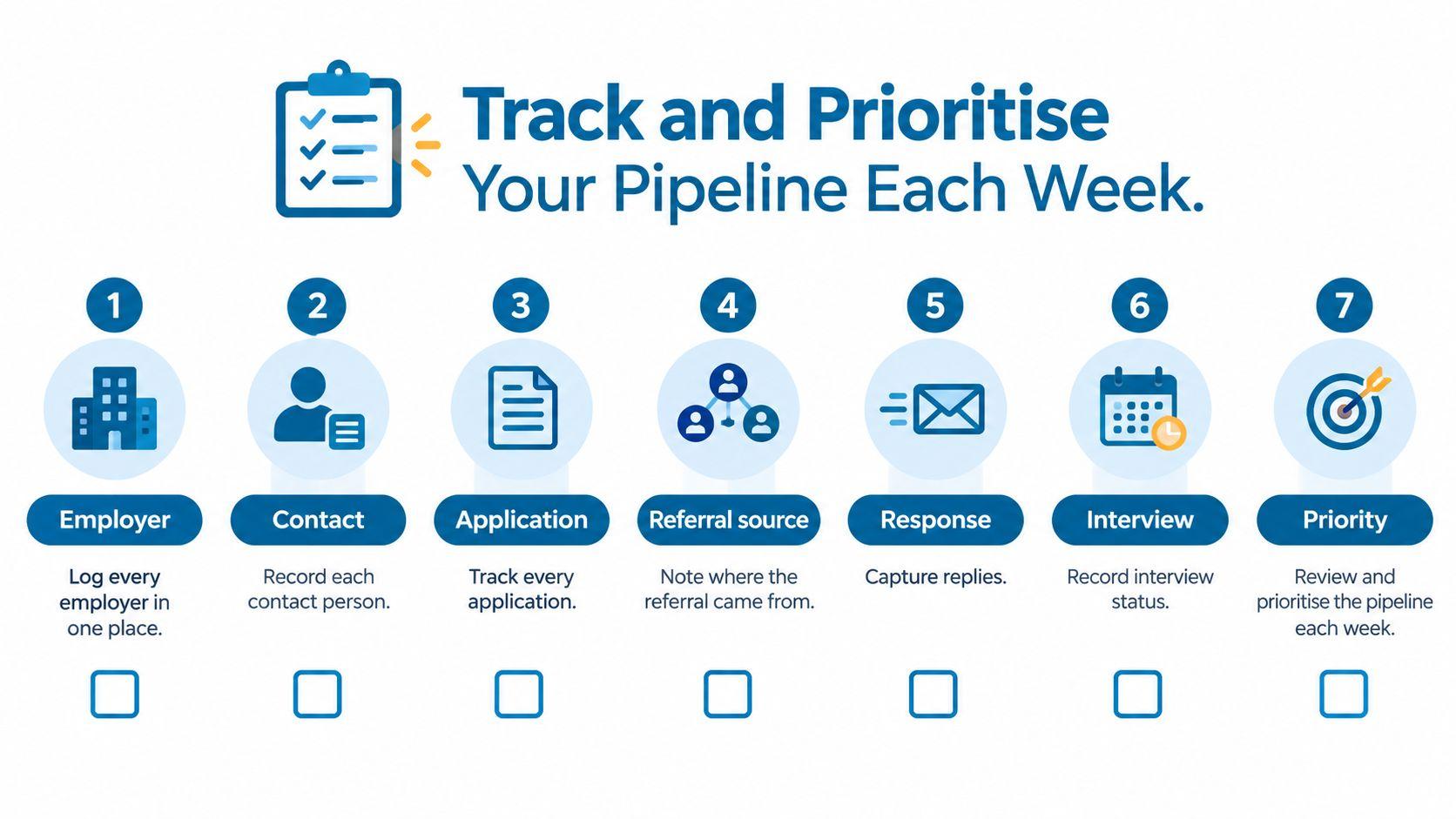
Record outcomes by route
Use a spreadsheet or application tracker that lets you distinguish cold applications, direct employer outreach, introductions, and employee referrals.
| Field | What to record |
|---|---|
| Employer and role | Company, function, vacancy identifier |
| Contact and source | Person, relationship, discovery route |
| Eligibility | Confirmed conditions and unresolved questions |
| Evidence | Relevant résumé version or work sample |
| Outcome | Reply, referral, interview, offer, or rejection |
| Next action | Specific task and when to revisit it |
Compare response rate, referral rate, interview conversion, and time spent by route. Keep the underlying counts visible so a small sample doesn’t look more conclusive than it is.
Don’t combine a helpful informational reply with an interview invitation. Both matter, but they represent different progress. Likewise, record a confirmed referral separately from a message that merely asks for one.
Choose a storage model deliberately
The extension’s application pipeline stays in the browser and doesn’t sync to the cloud. That suits candidates who want local storage, but you shouldn’t expect it to appear automatically on another device.
The web app’s account-based tracking syncs across devices. Choose according to how you search, and avoid maintaining conflicting statuses in separate systems.
Career Gap Analysis can identify requirements that recur across saved roles. Use those patterns to decide whether you need better evidence, a narrower target, or deliberate skills development, rather than rewriting your résumé after every rejection.
Make the weekly review change your priorities
Give attention to strong-fit opportunities with confirmed eligibility and a clear next action. Keep unresolved sponsorship cases in a separate queue, using visa-sponsorship job categories for discovery rather than treating a category label as final approval.
Archive closed roles and stop pursuing contacts who haven’t responded after your planned follow-up. Revisit weak-fit targets instead of increasing outreach around them.
This week, build your first 20-employer list, choose two relevant referral contacts, and send three specific messages. Those are starter actions, not performance benchmarks. Finish with a pipeline that shows what you know, what needs checking, and where your next useful conversation should happen.
JobGlance brings aggregated discovery, résumé-based ranking, and sponsorship and global-remote filters into the same search workflow. Visit JobGlance to identify relevant employers, compare less-visible opportunities, and build a shortlist you can verify before reaching out.
Keep reading


