
Highly Skilled Migrant Netherlands: Salary, Sponsors, Jobs


On this page
The highly skilled migrant permit — kennismigrant in Dutch — is the Netherlands’ main work visa for people hired above a set salary threshold by an employer the IND has already approved. There is no points test and no lottery, and the employer does not have to apply for a separate work permit on top of it.
As of 1 July 2026, the gross monthly salary you need is:
| Your situation | Gross monthly salary |
|---|---|
| 30 or older | €5,942 |
| Under 30 | €4,357 |
| Graduated in the Netherlands, or finished a PhD within the last 3 years | €3,122 |
All three exclude holiday allowance. That last row is a genuinely large discount and it is the one most people miss.
But the salary is not the part that decides your job search. This is: your employer has to be a recognised sponsor before you apply. Not willing to become one. Already registered.
What “recognised sponsor” actually means
An employer is either an erkend referent — a recognised sponsor — or they aren’t. It’s a status they applied for in advance, independently of you and long before you existed as a candidate. If they hold it, hiring you is administratively routine. If they don’t, you are asking them to start a registration process that has nothing to do with how much they like your CV.
So the question “will this company sponsor me?” has a factual answer that exists before you apply.
And you can look it up. The IND maintains a public register of recognised sponsors, updated monthly, split into Work, Exchange, Study and Research. If a company isn’t in the Work section of that register, a highly skilled migrant application through them is not a near-term option.
Every guide on this topic tells you your employer must be a recognised sponsor. Almost none of them mentions that you can check, in advance, for free, before you spend an evening on a cover letter.
And this isn’t a Dutch quirk, which matters if you’re weighing more than one country. The UK runs the same structure under different vocabulary: an employer holds a sponsor licence — issued to the organisation, valid for as long as they keep meeting the requirements — and issues a certificate to individual workers once they have it. The Home Office publishes its register too. Check first, apply second, in both places.
What this changes about how you search
Most job-search advice for the Netherlands has you apply widely and raise the visa question later — usually at the point where it becomes a disappointment.
The register turns that around. Sponsorship stops being a thing you negotiate and becomes a filter you apply first. Three practical consequences:
- Company size matters less than you’d think. Recognition is a registration, not a scale test. Plenty of mid-size Dutch companies hold it; plenty of large ones with no international hiring history don’t.
- Sector matters more. Recognised sponsors cluster where international hiring is normal — tech, finance, research, logistics, and the multinationals around Amsterdam and Eindhoven.
- A “no” is often about status, not about you. If a company isn’t registered, that’s an administrative fact, not a verdict on your application.
What the sponsored Dutch market actually looks like
Here is the part the government pages can’t tell you, because it isn’t their job.
I checked our own database on 16 August 2026. Of 1,123 active job posts in the Netherlands, 298 carry a visa sponsorship signal — about one in four. Fifty-four say so explicitly. Those 298 roles come from 72 different companies across 15 cities.
That ratio is worth sitting with. It’s meaningfully better than the global picture: across all 57,277 active roles in the database on 14 August 2026, only 4.1% stated sponsorship was available. The Netherlands is not a typical market for this.
The roles are also concentrated, which turns out to matter more than the headline number. Seventeen of those 72 companies account for 206 of the 298 roles — roughly a quarter of the employers, seven in ten of the jobs. Thirty-three companies posted exactly one.
What those employers are hiring for, by how often a skill appears across the sponsored Dutch roles:
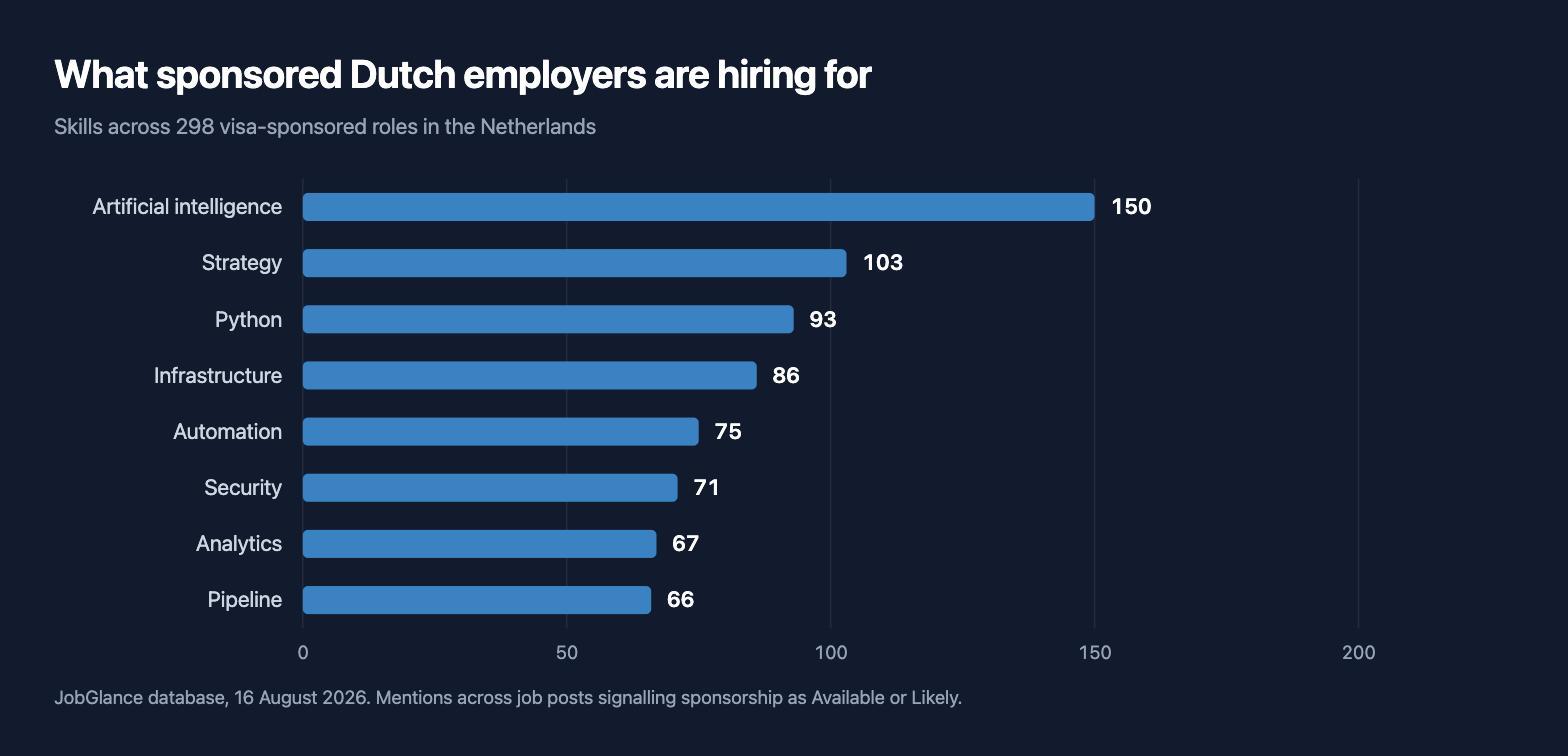
Ninety-six of those 298 roles are senior-level, which is the other half of why that graduate threshold matters. If you’re early in your career you are competing in the thinner part of this market, and the €3,122 rate is what makes the door passable at all.
Worth being straight about what this is and isn’t. It’s a snapshot of what we had indexed on one day, weighted toward roles that get posted in English on the boards we cover — so it skews technical, and it under-represents sectors that hire locally through Dutch-language channels. It is not a census of the Dutch labour market. It’s a reasonable picture of what an international candidate searching in English will actually run into.
What the permit gives you
The permit is valid for the length of your contract, up to five years. The IND application fee is €423, and the legal decision period is 90 days.
That 90 days is worth planning around rather than discounting. You will read in a lot of places that applications through recognised sponsors come back in about two weeks. The IND does publish faster target periods for some routes — research applications have a two-week target — but it publishes no such target for the highly skilled migrant permit, only the 90-day legal period. Treat the fast timelines as other people’s experiences, not as a commitment.
One structural point that matters for later: the permit’s condition is an employment contract with a recognised sponsor. That condition doesn’t stop applying once you’ve arrived, so a future employer has to satisfy it too. What the IND doesn’t spell out on its public pages is the mechanics of moving between employers, so check that with them directly rather than assuming it’s automatic.
The EU Blue Card, briefly
You may also see the EU Blue Card mentioned. It’s a parallel route with its own threshold — €5,942 gross monthly, or €4,754 under the reduced criterion as of 1 July 2026 — and it is for work requiring a high level of education, where the highly skilled migrant route sets no qualification condition of its own.
For most people being hired by a Dutch company, the highly skilled migrant permit is the simpler path. The Blue Card’s advantage is mobility across other EU countries. If both are open to you, that mobility is the thing to weigh.
Jobs in the Netherlands for foreigners: where to start
If you’re at the beginning of this, the order that wastes the least time:
- Work out which threshold applies to you. Under 30, over 30, or the graduate rate. It sets your realistic salary floor before you look at a single listing.
- Search roles that already signal sponsorship, rather than applying broadly and asking later.
- Check the employer against the IND register before you invest in an application.
- Ask about language early, before you’re deep in a process.
That last one deserves more than a bullet, because it cuts against the optimistic version of this advice. Plenty of roles advertised in English still expect Dutch, sometimes at a specific level, and job posts are inconsistent about saying so. An ad written in English is weak evidence about the language of the workplace. Ask directly rather than inferring.
The part that’s actually yours
That’s a lot of rules for one job search, and you can’t influence any of them — not the threshold, not the register, not the 90 days. What you actually do is narrower: find a role, at an employer that sponsors, and be good enough that they want to hire you. That stage is the one that asks something real of you.
What comes after it happens alongside a company that has done this before, which is the practical value of the concentration in the numbers above. The seventeen employers holding two-thirds of these roles are not working the process out for the first time. Somewhere in the building is a person whose job includes exactly this, and they know which document comes next.
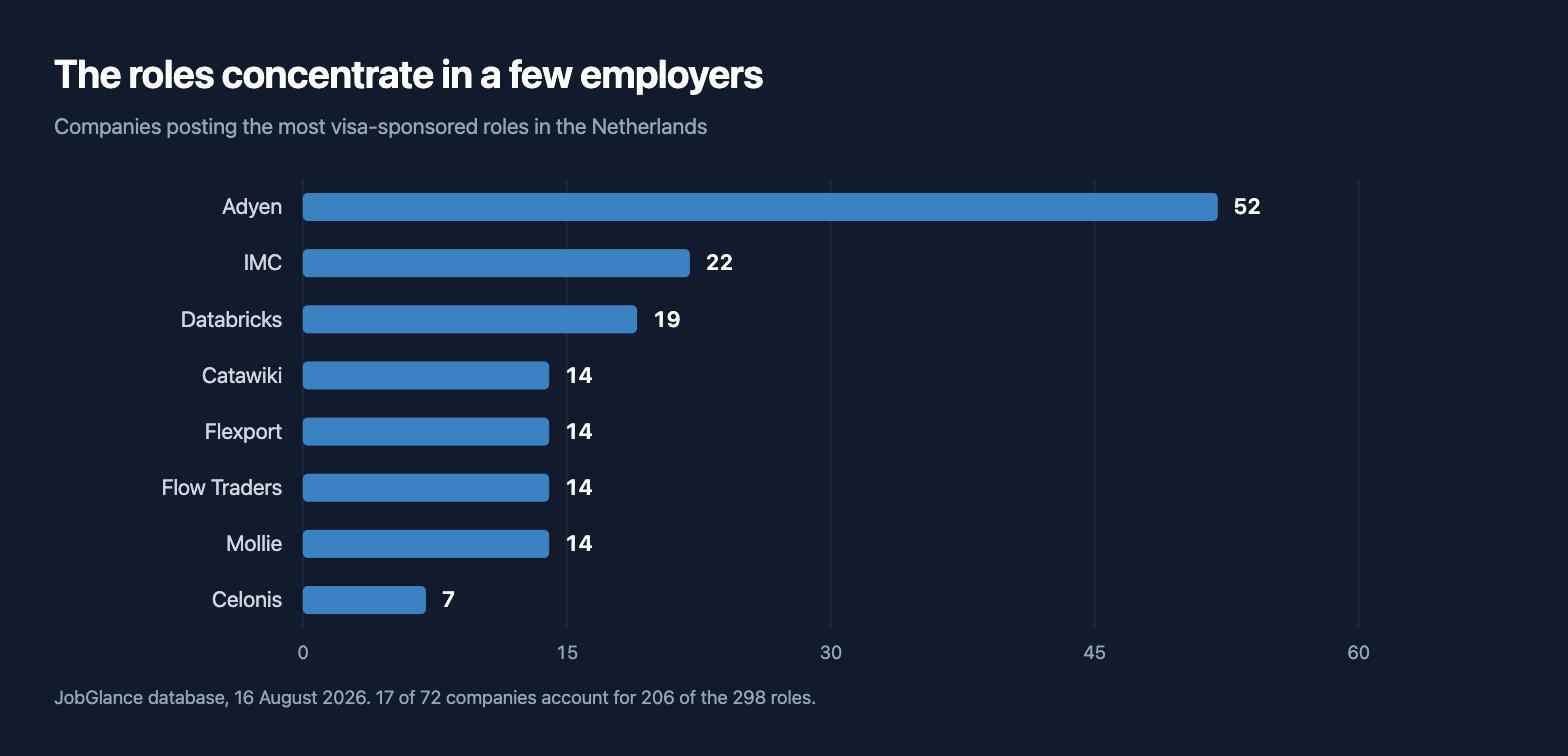
Read it as a map of where international hiring is normal, not a sponsorship league table — posting many signalled roles shows a company hiring across borders now, which isn’t a track record we can verify.
Their incentive points the same way as yours, too, which is rare in a job search: they chose you, they need the role filled, and the paperwork is the last thing between them and a hire they already want. That doesn’t make it effortless, and the permit is still a separate decision by a separate body no employer controls. But you’ll be doing it with guidance, on a path the company has walked before.
So the hard part isn’t the process. It’s finding the employers already inside it, and those roles sit across hundreds of company boards, mostly unlabelled. That’s what our visa sponsorship jobs in the Netherlands page does — signalled roles and the companies posting them, refreshed daily, with the same view for Germany and Europe. One limit, stated rather than buried: most job posts say nothing about sponsorship either way, so no signal is a reason to ask, not to skip.
Frequently asked questions
What qualifies as a highly skilled migrant in the Netherlands?
There’s no skills list or qualification test. You qualify by being hired by an IND-recognised sponsor at or above the salary threshold for your age band. That’s the whole definition — which is why the salary figure does so much work in this route.
What is the minimum salary for a highly skilled migrant in the Netherlands?
As of 1 July 2026: €5,942 gross per month if you’re 30 or older, €4,357 if you’re under 30, and €3,122 if you graduated in the Netherlands or completed a PhD within the last three years. All figures exclude holiday allowance, and the IND updates them twice a year — check the current amounts before relying on them.
What jobs are considered highly skilled in the Netherlands?
Any job can be, if the salary clears the threshold. The route is defined by pay, not occupation — unlike the UK, where the role itself must sit at degree level (RQF 6) since July 2025. In practice the Dutch roles that clear the threshold concentrate in tech, finance, engineering and research.
What jobs are in high demand in the Netherlands?
Among the 298 sponsored roles in our database on 16 August 2026, the most common skills were artificial intelligence (150 mentions), strategy (103), Python (93), infrastructure (86) and automation (75). That’s an English-language, board-posted view of the market, not a national statistic.
Do I need to speak Dutch?
Not for the permit — there’s no language requirement attached to it. For the job, it depends entirely on the employer and the sector, and job ads are unreliable on this. Ask before you get far into a process.
Can my partner work?
Your partner needs their own residence permit, and whether that permit allows them to work without a separate work permit depends on its type. We could not confirm a single clear answer on the IND’s public pages, and it is too consequential a question to guess at — ask the IND or your employer’s immigration contact directly before you plan two careers around it.
How long does the application take?
The legal decision period is 90 days. The IND publishes shorter target periods for some routes but not for this one, so plan on 90 days even though many people report much faster decisions. We have no data on individual outcomes and won’t guess at them.
What if my employer isn’t a recognised sponsor?
They can apply to become one, but it’s a registration process with its own requirements and timeline, and it’s a business decision rather than a hiring one. Realistically, if you need to move soon, focus on employers already in the register.
Salary thresholds, fees and permit conditions in this post were checked against IND and Dutch government sources on 16 August 2026. These change — the IND revises the salary amounts twice a year — so check the official pages before acting on anything here. Job-post figures come from the JobGlance database on 16 August 2026 and describe roles we had indexed on that day, not the Dutch labour market as a whole.
Keep reading


