Ghost Jobs: How to Spot Them in 2026


On this page
At least 70% of companies on Greenhouse’s platform posted at least one ghost job in the second quarter of 2024, according to reporting on Greenhouse’s platform figures in The Independent. That’s not a national rate, and it doesn’t mean 70% of ads are dead. It means the practice is ordinary enough that you can’t treat a polished listing as proof of a live requisition. The useful question isn’t whether ghost jobs exist. It’s whether this URL deserves your evening, and that call comes from stacked signals, not from one date or one badge.
How Common Ghost Jobs Actually Are
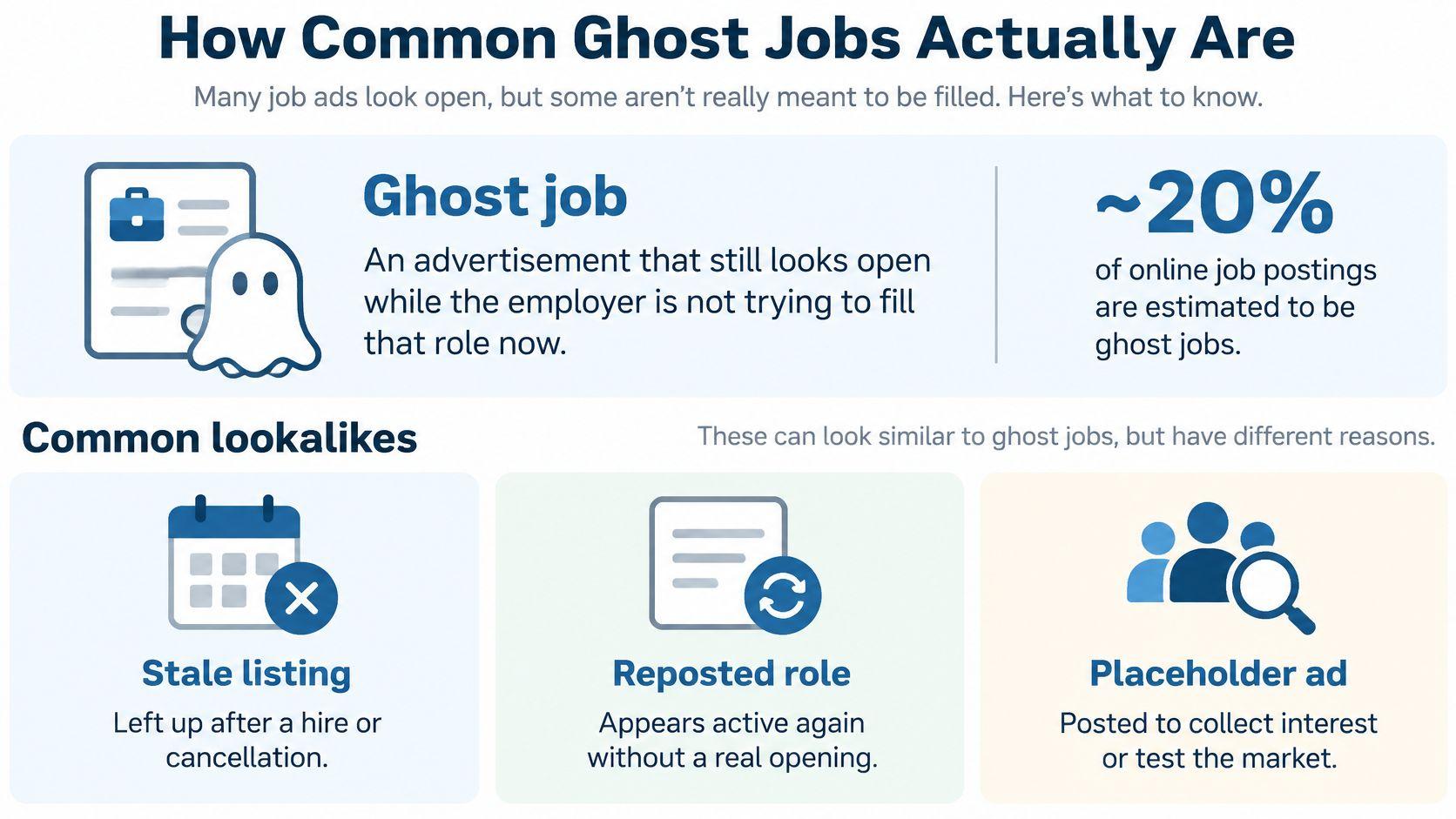
Approximately 18% to 22% of postings on Greenhouse’s recruiting platform in any given quarter were classified as ghost jobs, according to Greenhouse’s 2024 State of Job Hunting report. That figure describes postings on one platform, not the share of all job ads or the status of a particular role. The report also found that 3 in 5 candidates, or 60%, suspected they had encountered a ghost job. Suspicion can reflect a real lack of response, but it cannot establish an employer’s intent.
A ghost job is an advertisement that appears open while the employer is not trying to fill that role. Several lookalikes can create the same impression. A stale listing was once genuine but remained online after a hire or cancellation. A pipeline listing gathers résumés for a possible future opening. A scraped or sponsored duplicate copies an ad to another board and can remain visible after the original changes, sometimes with a newer date.
Read Each Figure for What It Measured
Different measures answer different questions. A platform classification estimates the share of postings that fit its criteria. Candidate surveys capture suspicion, while employer surveys ask respondents about their companies’ behavior. Those results cannot be treated as interchangeable rates for all vacancies.
| Source | What was measured | Reported figure |
|---|---|---|
| Greenhouse platform, 2024 | Share of postings classed as ghost jobs in a quarter | 18% to 22% |
| Greenhouse companies, Q2 2024 | Companies that posted at least one ghost job | At least 70% |
| Greenhouse candidate survey, 2024 | Candidates who suspected a ghost job | 60% (3 in 5) |
The platform estimate is the most direct measure of postings in this section, but it still cannot identify whether a specific URL is active. The company figure measures whether companies posted at least one such listing, not the share of their ads. The candidate figure measures suspicion, not confirmed ghost jobs.
The Official Gap Is Structural
Official labor statistics cannot reveal an employer’s intent. Labor-market measures count openings or hiring activity, not whether an individual advertisement is duplicated, left online after a role closes, or used to gather résumés. Comparing openings with hires can show that fewer openings convert into hires, but it cannot identify which listings caused the difference.
That limits what any broad estimate can tell a job seeker. A rate from one platform provides context, not a verdict about an employer or requisition. Even a listing that looks plausible may be stale; a newer date does not prove it is live.
No row in the table can label a single listing. Each figure gives context for the market, while the listing itself must supply the evidence about its status.
Ghost status is best treated as a confidence score built from stacked signals, not a verdict based on age alone. A recent date or polished description may count as one signal, but neither establishes that hiring is active. The practical question is whether the available evidence makes this particular URL worth the time required to apply.
Why Listings Stay Up With No Hire
Five mechanisms produce a live looking ad with no current hire. They overlap, but each leaves a different trace, and the trace matters more than the motive when you’re deciding whether to apply.
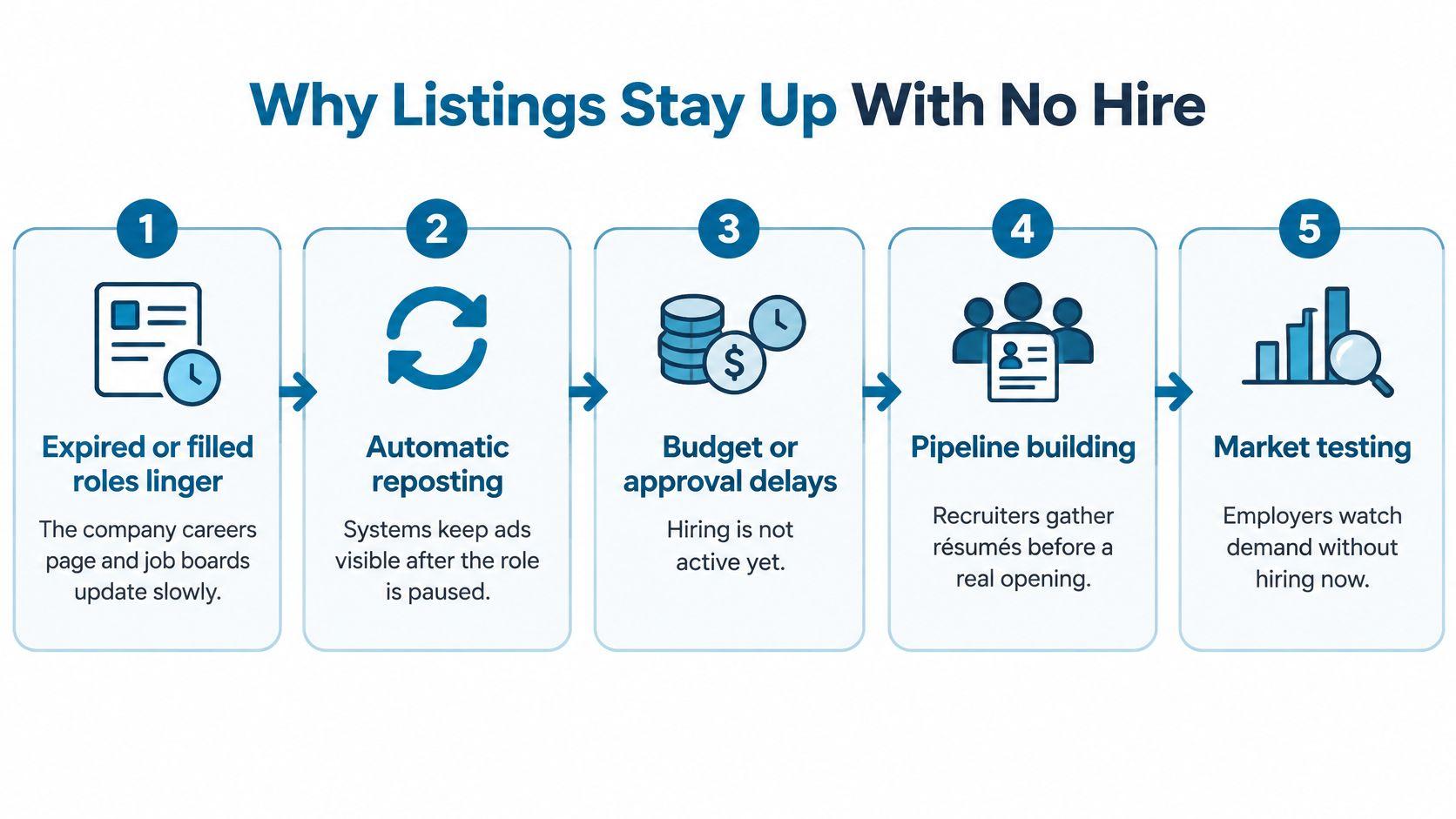
System lag is the most common one you’ll meet. A hiring manager closes a requisition in the applicant tracking system. The company careers page updates, but an outside board, an aggregator, or a sponsored feed keeps circulating the old copy. Nobody decided to deceive you. Nobody removed the ad either, so the cost lands in the same place.
Employer branding is a decision. A company keeps attractive roles visible because applications, followers, and search presence signal growth to candidates, customers, and investors. The ad performs even if no interviewer is assigned, and activity metrics can look healthy while hiring is frozen.
Pipeline Building and Approval Delays
Talent pipelining sits between those two. Recruiters collect résumés before budget or headcount approval clears, so they can move quickly if approval arrives. The Apollo Technical summary of ghost job statistics and survey findings lists the reported motivations plainly: employers may keep a role online while budgets or approvals are uncertain, maintain a talent pipeline, signal organizational growth, collect résumés, or fail to remove a filled or canceled posting. That single list explains why intent is so hard to infer from silence. A pipeline ad and a stale ad look identical from the applicant side of the screen.
Scraping and syndication then multiply the problem. One description gets copied across boards, each copy carries its own date, and a refresh stamp can make a months old requisition look newly approved. Three copies don’t mean three openings. They often mean one feed reached three places at three different speeds.
Paid promotion finishes the set. A sponsored slot buys placement until the campaign ends or someone pauses it. If recruiting stops first, the ad keeps its premium position and its authoritative look, even though the budget is now promoting a closed door.
- Deliberate non-hiring: branding, pipelining, and market testing keep an ad useful to the employer without a current offer at the end of it.
- Operational non-hiring: stale feeds, scrapes, and unpaused campaigns keep an ad visible after the decision to hire has ended.
For you, the distinction changes the moral judgment, not the economics. Both consume research, tailoring, and waiting, and neither returns feedback you can learn from. Don’t spend your time proving why the ad exists. Spend two minutes checking whether a live requisition backs it, because that’s the only part that determines whether an application can succeed.
Signals That Separate Stale From Live
Age is a screen, not a guilty verdict. BBC Worklife’s reporting on a Clarify Capital survey of 1,000 hiring managers found that nearly seven in ten jobs remained open for more than 30 days, while 10% stayed unfilled for more than six months. Sit with what that means for the popular rule that anything older than a month is fake. If nearly seven in ten surveyed roles cross that line, age alone would condemn most of the market, including real searches for scarce skills.
Two Thresholds, Two Different Responses
Use 30 days as the point where you stop trusting the board and start verifying the employer. Use six months as a high risk screen, unless the employer can show recurring intake. Long duration can reflect a hard search, an approval freeze, résumé collection, or a posting nobody removed. The date tells you to ask the question. A second signal answers it.
| Signal | What you see | How to read it | Effect on confidence |
|---|---|---|---|
| Past 30 days | Date and body unchanged for a month | Verify; nearly 7 in 10 surveyed roles lasted this long | Mild raise, not proof |
| Past six months | Same ad still up after half a year | 10% of surveyed roles lasted this long, including scarce skills | Strong raise unless evergreen |
| Identical repost | New date, same sentences | Refresh, not a new requisition | Raise |
| Missing on the careers page | Live on a board, absent on the employer site | External copy is likely leftover | Strong raise |
| No owner and no close date | Anonymous post, no timeline | Nothing to show active recruiting | Moderate raise |
| Same text, several ages | Copies across boards | Syndication or a scrape | Raise; apply once if the employer page is live |
| Evergreen team language | Always hiring, recurring intake | Real cycle hiring lowers the score | Lower if a current req exists |
| Promoted badge on an old body | Sponsored label, stale text | The badge buys reach, not freshness | Raise |
Which Second Signal Changes the Call
The strongest combination is old ad plus missing careers page requisition. Either one has an innocent explanation. Together, they mean the employer’s own system doesn’t corroborate the board copy, and the board copy has had months to be corrected. That’s a skip for full tailoring.
An identical repost works differently. Compare the sentences, not just the date. If the responsibilities, punctuation, and oddly specific phrases are unchanged under a new date, you’re looking at a refresh. A genuine new requisition usually brings a new requisition number, an updated team name, a changed location line, or a named hiring contact, because a new approval passes through people’s hands.
The signals that lower confidence need evidence too. An employer can write “always hiring” on a dead page. What lowers the score is a current requisition on its own careers page, an intake period you can name, or a recruiter who confirms interviews are running. Evergreen language without a req is just better written ghost copy.
Practical rule: One signal sets your effort to low. Two independent signals set it to zero, unless the employer’s own careers page contradicts them with a current requisition.
Don’t confuse visibility with life. A promoted badge proves someone paid for reach at some point. Identical copies on four boards prove syndication worked. Neither proves a hiring manager is reading applications this week, and both are cheap for a dead listing to keep.
How to Check a Role Before You Apply
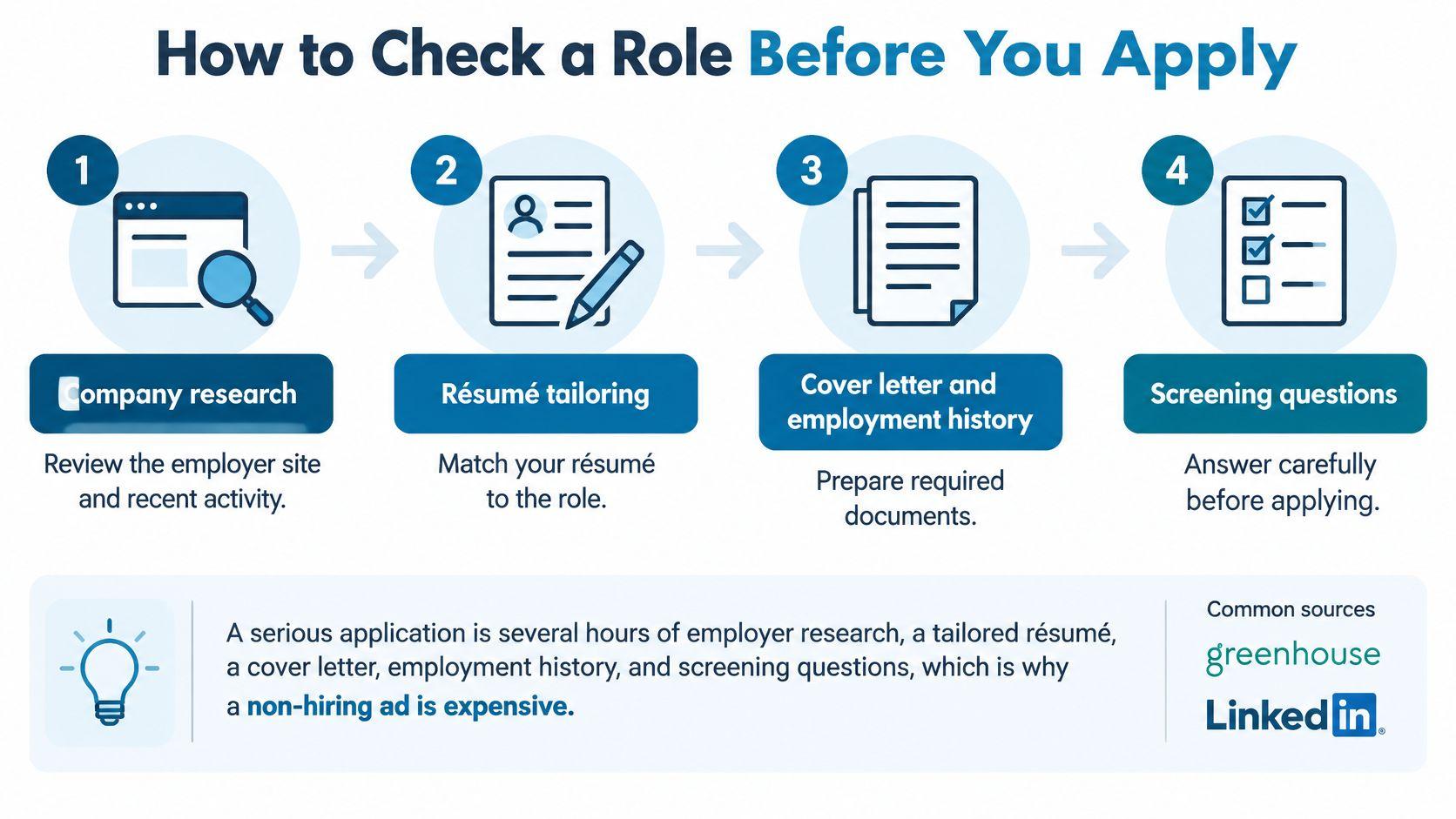
The cost side of the calculation is concrete. BBC reporting on ghost jobs and application time notes that applicants may spend several hours on one application researching the employer, tailoring a résumé and cover letter, listing prior employment, and completing screening questions. The same reporting puts the background risk in range: Greenhouse research across the United States, the United Kingdom, and Germany found up to 22% of online jobs advertised in the prior year were listed without an intent to hire, while a separate UK study estimated 34%. Both are private figures, not official rates. Together with several hours per application, they make verification cheaper than hope.
The Six Checks in Order
- Open the employer careers page first. Find the same title and, if shown, the same requisition number. A similarly worded ad on a board isn’t confirmation, because boards carry copies. If you’re comparing across countries, the visa sponsorship jobs browse path is useful for narrowing by destination, but the employer’s own page still decides whether a specific req is live.
- Reconstruct the first date. Search the exact title plus the company name and look for the oldest version of the text. Treat any “posted today” stamp as the last refresh, not the birthday. Past 30 days means verify. Past six months means high risk until the employer proves recurring intake.
- Search for a closed state. Look for the same role marked closed, a new hire announcement naming that job, or a newer requisition replacing it. One filled announcement ends the debate faster than any guess about recruiter intent.
- Ask one factual question. If a recruiter is named, send a short note asking whether the requisition is approved and interviewing now. If you only have a phone number from a posting or a contact card, phone number searches for LinkedIn profiles can help you confirm you’re messaging the person formally attached to the role before you send it. Ask about the req status, not about your fit. Fit questions invite polite replies that tell you nothing.
- Cap effort when nothing confirms. No matching req and no answer means you either skip the role or submit a short, generic application. Don’t write a custom cover letter for an unconfirmed opening. Reserve the full customized version for a live req, and build that version using the structure in this guide to an ATS friendly résumé so the hours you do spend survive screening software.
- Log the verdict. Record each role as applied, no req found, reposted, or replied. Your log stops you from preparing a second full application for the same ghost when it resurfaces next month under a new date, which is exactly how these ads collect repeat effort from the same people.
The routine gives you three outputs, not a feeling. A yes gets full tailoring. A maybe gets a capped, low effort submission only when the careers page shows a req. A skip gets nothing beyond a line in your tracker. That discipline feels harsh on a promising description. It feels different after you’ve priced the evening.
Tactics for Visa Remote Entry-Level and Tech
The general check protects your time. Your situation determines what a ghost costs you, because an eligibility failure and a freshness failure produce the same silence. Check eligibility first, then freshness, so you don’t mistake an impossible role for a live one.
Visa Seekers Verify the Obligation, Not the Sentence
Treat any sponsorship sentence as a claim to verify against the current requisition. Some branding posts mention sponsorship because it widens the applicant pool. Many genuine sponsors never write the sentence at all, because their template doesn’t include it. Before you spend a night on an unconfirmed posting, read what sponsorship requires the employer to file in this explainer on what visa sponsorship means. If the live req doesn’t state sponsorship and the recruiter won’t confirm it, the role is a skip for you regardless of how fresh it is.
Remote and Entry-Level Candidates Filter the Geography First
Remote candidates have to split two different offers. “Remote inside one country” is an eligibility rule. “Work from anywhere” is a different one. A duplicated US only ad costs the same evening as a ghost if you live elsewhere, and no amount of tailoring fixes residency. Browsing remote entry-level roles is a sensible starting set for early career candidates, but check the country line on the employer page before you read the requirements list.
Entry-level candidates face the highest volume and the lowest reply rates because employers maintain ongoing funnels for high turnover graduate roles. Your advantage isn’t applying to more of them. It’s applying fully to fewer roles with a confirmed req, and when a role does confirm, you can build a resume with ParakeetAI to produce a clean customized version quickly instead of reformatting by hand for every posting.
Tech and data candidates should separate a genuine contract bench, where a firm hires every quarter against client demand, from one senior requisition reposted for months with no interviewer named. Specialized roles legitimately stay open longer, which means your second signal matters more than your date threshold. A named hiring manager and a current req outweigh an old board date. Neither, plus identical repost text, means skip.
| Audience | Extra check | Where to look |
|---|---|---|
| Visa seekers | Confirm the current req states sponsorship before reading the full description | Visa-sponsorship country pages |
| Remote candidates | Split remote inside one country from work-from-anywhere before applying | Remote browse path |
| Entry-level candidates | Apply only to roles with a confirmed req on the careers page, not evergreen graduate posts | Employer careers page requisition list |
| Tech and data candidates | Separate a quarterly contract bench from a single senior req reposted for months with no interviewer named | Posting detail and recruiter contact on the employer site |
A perfect skills match that can’t sponsor you, can’t hire in your country, or has no requisition is still a skip. Role pages that summarize what live ads ask for will tell you more about current demand than rereading one old description for the third time.
Three Listings and What They Cost
Say a software role has carried a promoted badge for about 90 days. The same paragraph appears on two boards, word for word, and the company’s careers page has no matching job. The candidate researches the team, rewrites a résumé around the stack in the ad, writes a cover letter, and hears nothing. Score the stack fairly. An old body, a paid badge, and a missing req are three independent signals pointing the same way, and no fresh date on either board changes them. Call: skip. The evening bought no information, because silence from a dead req can’t tell you whether your résumé was weak.
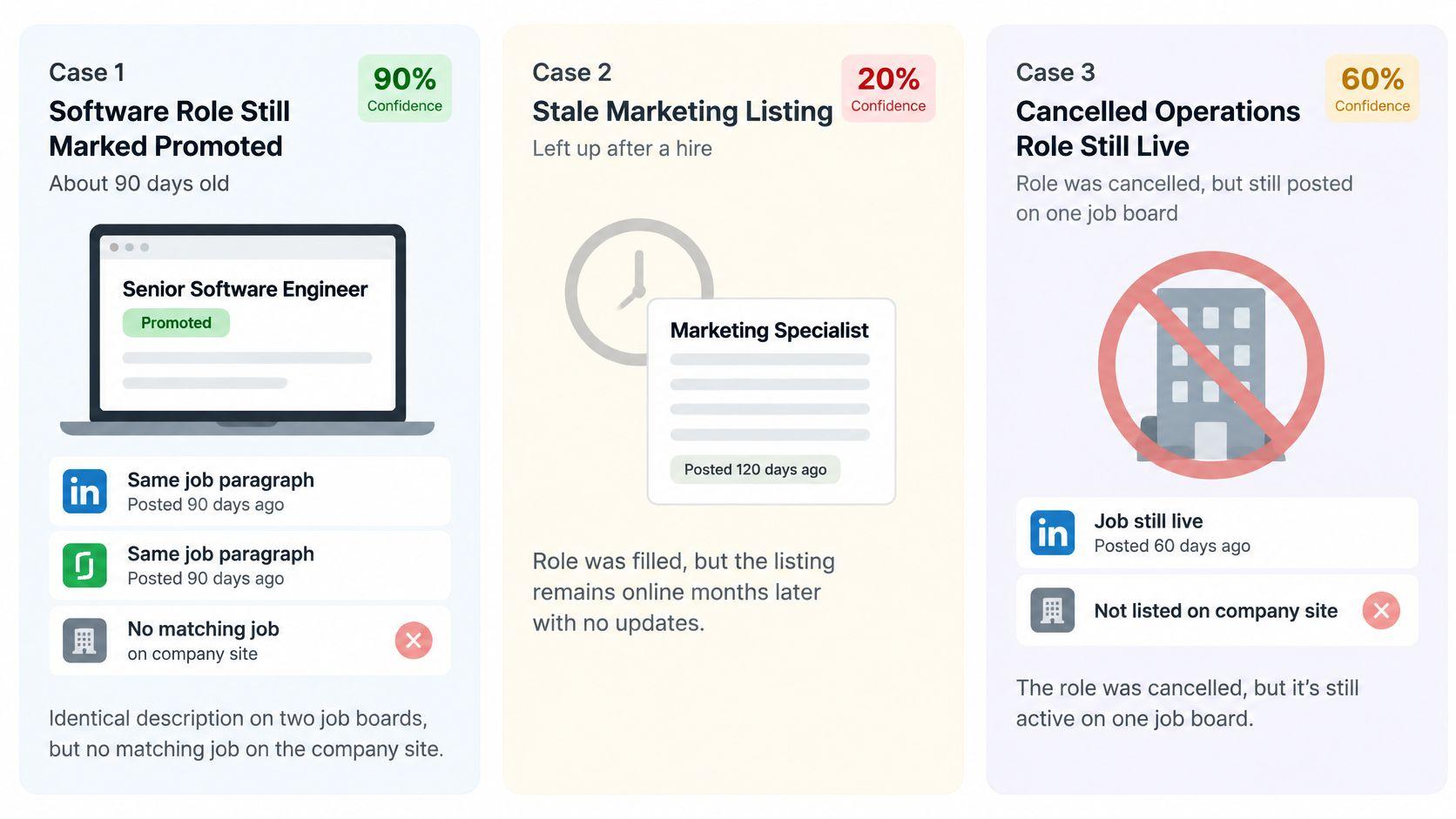
Now say a consulting firm always posts analyst roles. The board date is old enough to trigger suspicion, but the careers page shows a current requisition and a recruiter confirms a quarterly intake with a named start window. Age alone would have killed a real cycle hire. Call: apply at standard effort. Send a solid, lightly customized application. Don’t build a custom project for a funnel role, because the employer’s screening volume means your extra hours have a low chance of being seen.
The third case is a visa sponsored data role copied onto three sites with three different dates. The employer page shows one requisition posted last week. Before applying, scan the data engineer role page if that title matches your target, so you know which tools live ads keep requesting. Call: apply once, to the employer’s req. Three dates are one opening with two stale copies, and applying on all three doesn’t create three chances. It creates duplicate records in one system.
Set those costs against the market. CNBC’s reporting of Revelio Labs figures on hires per posting found the number fell from eight hires per ten postings in 2019 to four hires per ten postings in 2024. Even a live ad is a long shot in that market, and the ratio can’t prove which postings were ghosts. It does tell you that a dead one is pure cost. One old date is a question. An old date plus a missing careers page req is an answer. A named intake schedule is a reason to stay.
A Freshness Workflow That Saves the Hours
Manual checks inspect one listing at a time. A search system can reduce that work before a closed role reaches you if it refreshes its pool daily, removes expired postings quickly, and responds when users find a listing closed. Freshness depends on a process, not a promise.
JobGlance uses a specific closure signal: when a user views an expired or closed job on a supported site, the extension hides it from the Global Job Hub, and the listing is permanently deleted within 24 hours. A paid placement does not override that signal. The point is practical: the posting’s status should depend on whether the role is open, not whether it was promoted.
Build the Daily Routine Around Fit Then Freshness
Rank roles by their match to your résumé, then check freshness before investing in an application. Review visa sponsorship and work-from-anywhere signals early, and exclude roles limited to residents of one country from a global remote search. If a board’s copy appears closed, search for an equivalent role elsewhere rather than treating the first listing as your only option. Keep applications and your freshness assessment together, so a repost does not prompt a second round of tailoring.
To use JobGlance on another site, click the JobGlance icon or right-click the page and select “Turn on JobGlance.” If the extension does not appear right away, refresh the page.
Start with five saved roles. Check each employer’s careers page, remove listings that fail that check, then use the time saved to search current visa-sponsored and remote roles. No workflow guarantees an interview. Its value is more limited and measurable: fewer hours spent on postings that are not hiring, and a shorter list of applications with a clearer reason for pursuing each one.
Questions the Numbers Do Not Answer
Is every old posting a ghost job? No. A listing older than 30 days is a reason to check; one older than six months is a stronger warning. Neither age alone proves the employer has stopped hiring. Evergreen recruiting, slow approvals, and scarce skills can keep a genuine role open. Treat age as one signal in a confidence score, not a verdict.
Are ghost jobs the same as scams? No. A ghost job may come from a genuine employer that is not currently hiring for that role, costing you time. A scam asks for money, gift cards, banking passwords, or identity documents before a real hiring step. Stop if that happens. A stale ad and a fraudulent one call for different responses.
A reposted date is not a new job, and three copies of one requisition are one chance, not three.
Should you apply in case the pipeline opens later? Keep the effort low, and first check that the employer’s careers page still lists the requisition. Spending hours tailoring an application to a missing requisition has little expected value. If the pipeline reopens under a new requisition, you can apply to that role instead.
Can a board or agency settle it for you? You can flag a listing or tell the employer its external copy appears stale; sometimes the copy is removed. Official labor statistics such as JOLTS cannot establish an employer’s intent for an individual URL. No single age threshold or total settles that question. When independent signs point in the same direction, weigh them together, and prioritize a requisition the employer confirms is open.
Ghost status is a confidence judgment built from stacked signals, not a label that age or labor statistics can prove. JobGlance refreshes its database every 24 hours and purges expired roles within 24 hours, giving your search a more current pool. Confirm each requisition on the employer’s careers page before investing full effort. Visit JobGlance to search, then verify the role directly with the employer.
Keep reading


