How to Get a Product Manager Job in 2026: What Works

On this page
U.S. product-management compensation had a median of $234,000 in 2025, up from $220,000 in 2024, according to Mind the Product’s 2025 compensation data. That number explains the queue outside every PM opening.
The queue is the problem. Companies still advertise product work in volume, but the seats behind those ads are fewer and more carefully scrutinized than they were three years ago. The candidates who get offers aren’t the ones who applied most. They’re the ones who could prove, in a document and then in a room, that they make good product decisions.
Producing that proof is what how to get a product manager job means in practice, from a market scan through a resume aimed at one posting to an interview loop you’ve already rehearsed.
Where PM Openings Are and Which Ones You Can Reach
A 2026 labor-market analysis indexed 60,640 unique Product Manager postings during a 90-day window, roughly 4,337 new listings a week, and found hiring spread across countries rather than pooled in one (getuhired’s Product Manager role analysis). The country split is the useful part.
| Market | PM postings |
|---|---|
| United States | 23,685 |
| India | 4,958 |
| United Kingdom | 4,658 |
| All other markets (remainder of the sample) | 27,339 |
| Total | 60,640 |
Those counts are automated estimates, not an official census of every vacancy, so treat them as directional. Direction alone should change your behaviour. A search covering one country and one job board is a fraction of the market, and the remainder line above is where most of the volume sits.
Widen the net before you open a listing
- Adjacent titles: product analyst, growth product manager and technical program manager all carry product work under a different label.
- Company type: logistics firms, health systems, banks and agencies hire PMs and rarely compete with big tech for the same candidates.
- Regions: if you can work across time zones, your address stops being the limiting factor.
Widening is the easy half. Location, work authorization, seniority and required domain experience eliminate most postings before you write a single customized sentence, so run those four checks first. For international candidates that means reading the sponsorship line and checking whether “remote” means remote in your country or remote within theirs. Filtering early isn’t pessimism. It’s the difference between twenty live applications and two hundred ignored ones.
Search where the listings start
Most product roles are published on the company’s own careers page first, which is why a database drawn from 100+ sources surfaces openings a single board will never show you. Domain experience is the other gate, and the fastest way through it is to learn how one industry writes its PM ads. The Blockchain Jobs Web3 product manager guide is a working example, showing how crypto and web3 teams describe the role and what they assume you already know.
Start from Product Manager job listings once your filters are set, and keep a shortlist rather than a wishlist. Then run a three-part check: list the markets you’re targeting, mark which postings you’re eligible for today, and keep only the roles whose core requirements you can already meet in part.
Choose the PM Entry Route That Fits Your Background
Four routes lead into product work, and they don’t demand the same evidence.
| Entry route | Best-fit background | Proof you need | First title to target |
|---|---|---|---|
| Internal move | Engineering, design or data inside a company | Shipped features and known customers | Associate PM or PM on your current team |
| Adjacent role | Marketing, operations, customer success or analyst | Product outcomes you drove in your current job | Associate PM, product analyst or PM at a smaller company |
| Career switch | Work from outside tech with no PM title | Two or three evidence-backed case studies from real work | APM program or PM role at a startup |
| Experienced PM move | Current PM moving to a new company or region | Metric-backed launches and senior ownership | PM or senior PM at a new employer |
The route decides what you do for the next three months. It decides which titles you search, which stories you rehearse, and how much evidence you have to build before anyone agrees to interview you.
The internal move is the cheapest route you’ll ever get
If you already work in engineering, design or data inside a company, an internal transfer beats a cold application because a hiring manager there can verify your judgement in one conversation. Ask for ownership of a small surface. Ship something with a number attached. Apply with that number in the first line. You’re converting trust you already earned instead of asking a stranger to grant it.
Adjacent roles move faster than they look
Marketing, operations, customer success and analyst work contain product decisions that were never labelled that way: a conversion change, a redesigned process, an onboarding flow you rebuilt yourself. Point at the outcome, not the job title. Business analyst roles on JobGlance are a common bridge, because the work sits close to product without demanding a PM history.
Career switchers from outside tech need a heavier evidence set, and a startup or an APM program usually moves first. Experienced PMs changing region should lead with ownership and metrics.
What the numbers say about timing
PM openings grew 56% since the beginning of 2023 against 43% for engineering, and PMs’ share of core product hiring rose from 16% in 2021 to 21%, yet US technology-company PM headcount was reported 28% below its 2022 peak by June 2026 (a 2026 analysis of PM hiring). More ads, fewer seats, deeper competition per seat. A 2025 hiring-trends report from the Institute of Product Leadership recorded a 42% year-over-year increase in product-management hiring, driven mainly by senior and leadership roles (Top Tech Transition’s PM role guide). Entry-level candidates should read that as a signpost pointing at which door is open.
Pick two routes, not four. Choose one primary route and one fallback, and put applications for both in the same week. A single-route search ends the moment that route closes.
How to Build PM Evidence Without a PM Title
Most guides stop at learn Agile, sketch a roadmap, network, build a portfolio. That describes the job rather than proving you can do it. A 2026 Product Leadership hiring report says employers increasingly reward demonstrated capability over credentials, and evaluate candidates on product thinking, technical understanding and execution quality, with structured thinking and the ability to explain decisions as the differentiators (Product Management Hiring Trends report).
That leaves one practical question: how do you demonstrate product judgement when no employer has given you the title yet? Build a repeatable evidence set, in this order.

-
Collect ten job descriptions for roles you want. List the requirements that repeat across all ten: roadmap ownership, A/B testing, SQL, user research, stakeholder management. Tools count too, since one dataset of PM postings counted Jira in 6,691 listings and SQL in 4,868 (UXCam’s product management statistics). If eight of your ten ads mention experimentation, your first case study should be an experiment.
-
Turn five to eight past achievements into decision bullets. Each one needs the decision you made, the trade-off you accepted, what shipped and the metric it moved. A model: “Chose a checkout fix over a loyalty feature after reviewing 40 support tickets, cutting checkout drop-off by [your measured figure].” Keep the bracket until you have a real number.
-
Write two case studies from work you’ve already done. Volunteer projects, internal tools and customer experiments all count if they were real. Use one structure: the problem, the customer evidence, the alternatives you rejected, the trade-offs, the success metrics, and what shipped.
-
Include one failure and what you’d change. Hiring managers use it to see whether you can discuss a decision without defending it. A candidate who names the signal they misread and what they’d instrument next reads as more senior than one with a spotless record.
-
If you have AI work, compress it into a single case. Cover the user problem, whether AI was necessary at all, the evaluation metrics, hallucination and privacy risk, cost and latency, human fallback, and post-launch monitoring. An LLM course is weak proof on its own, even though recent hiring data shows LLM has become the most-mentioned skill in product-manager job descriptions (Lenny’s Newsletter on the late tech job market). The course proves attendance. The case proves judgement.
-
Label every estimate. Where you lack a measured result, write “estimated from two weeks of support tickets” and explain the baseline. Never invent a figure. One fabricated metric under follow-up questions ends the loop.
A concise, evidence-backed account of one real decision persuades more than a polished fictional portfolio, and it survives the questions that come after it. For most hiring managers, evidence of judgement outweighs the title on your last business card.
Tailor Your Resume to Each Posting
Tailoring starts with a matrix, not a rewrite. Build three columns: each high-priority requirement in the posting, in the employer’s own words; the evidence you have against it; the gap. Twenty minutes of that shows you which skills the role wants, both the ones you already hold and the ones you’re missing, and it stops you applying where the gap is structural.
Turn duties into decisions
A bullet earns its place when it names the problem, the decision and the result.
Before: Responsible for onboarding improvements. After: Prioritized onboarding fixes using activation data, increasing week-one activation by 18%.
The second version tells a hiring manager what you chose and what it produced. The first tells them what your job description said.
Mirror the employer’s terminology for roadmap ownership, experimentation, stakeholder management and metrics only where you have real experience behind it. Keyword stuffing is visible in the interview, when someone asks you to expand on a claim you can’t support.
Know what the screening layer actually does
Recruiters reportedly spend an average of 7.4 seconds on an initial resume screen, according to AllthingsPM’s product manager resume examples. The same research indicates applicant tracking systems generally store and search applications rather than automatically rejecting every resume, which means the risk isn’t a robot hating your formatting. It’s knockout criteria: work authorization, location, certifications. Those can eliminate you early, so check them against the posting before you spend an hour tailoring.
Submit early, then stop thinking about speed
Recruiter survey data summarised by AllthingsPM found 52% believed early applications help. Treat that as a prioritisation tactic, not a substitute for fit. An early application to a role you can’t do is still a rejection, just a faster one.
Two habits do more than any keyword tool. Keep one resume per role family rather than a fresh document per posting, and write a short cover letter that names one product decision you would make in your first ninety days. That second habit is rare enough to be memorable.
Prepare for Each PM Interview Round
Product-manager loops are staged, and each stage tests something different.
| Round | What it tests | Preparation focus |
|---|---|---|
| Recruiter or HR screen | Fit, motivation and eligibility | A two-minute career pitch and your work authorization status |
| Hiring-manager interview | Scope and past decisions | Four or five SAR-L stories with metrics |
| Product sense | Users, problems, MVP and success metrics | Clarify the user, segment needs and define metrics |
| Execution | Diagnosing a metric change and prioritizing | Hypotheses, impact-versus-effort logic and instrumentation |
| Strategy | Market, competition and positioning | A defensible choice with named risks |
| Behavioral or panel | Conflict, influence without authority, failure and ethics | Stories that show the learning, not only the result |
| Take-home or assessment | Written product thinking | A one-page memo with a recommendation |
Loops rarely test one competency at a time. Reported interview-loop data identifies stakeholder management in 47% of loops, cross-functional collaboration in 42%, product management in 34%, product strategy in 31% and requirements gathering in 20% (Dataford’s PM interview data). Weight your stories toward stakeholder and collaboration work first. Most candidates over-rehearse product sense and arrive with nothing prepared for the two competencies that appear most often.
Practise in the order the rounds arrive
Product sense comes first: clarify the user and the problem, segment the needs, choose a target segment, define an MVP, state success metrics. Execution next: diagnose a metric change, form hypotheses, prioritise with explicit impact-versus-effort logic, specify the instrumentation. Strategy after that: market, competition, positioning, risks, and a choice you can defend. Behavioral leadership last, covering conflict, influence without authority, failure and ethical judgement.
Use one structure for every case: clarify constraints, state assumptions, identify the decision, compare alternatives, make a recommendation, and name leading and lagging indicators. The target is a complete answer in 30 to 45 minutes that still lands on a recommendation at the end.
Score yourself instead of trusting success-rate claims
Record your mock answers and grade them on problem framing, prioritisation, quantitative reasoning, communication and trade-off quality. Repeat the weakest category until it stops slipping. Online “overall success rate” figures aren’t benchmarks; a 70% PM interview success figure published on Jobicy’s PM interview prep page is an unattributed commercial estimate, not an independently validated rate.
Build six stories in Situation, Action, Result, Learning format, each with a baseline and, where you can, a counterfactual explaining what would have happened otherwise. Then run a plan you can keep: two recorded mock sessions a week for three weeks, followed by one full loop simulation. If the phone screen is where your answers collapse, PrayerPetals’ phone interview tips cover settling nerves and structuring answers before you dial.
Confirm Your Shortlist and Start This Week
Four sections of preparation are worth nothing until they turn into a list and a calendar. Do this in order.
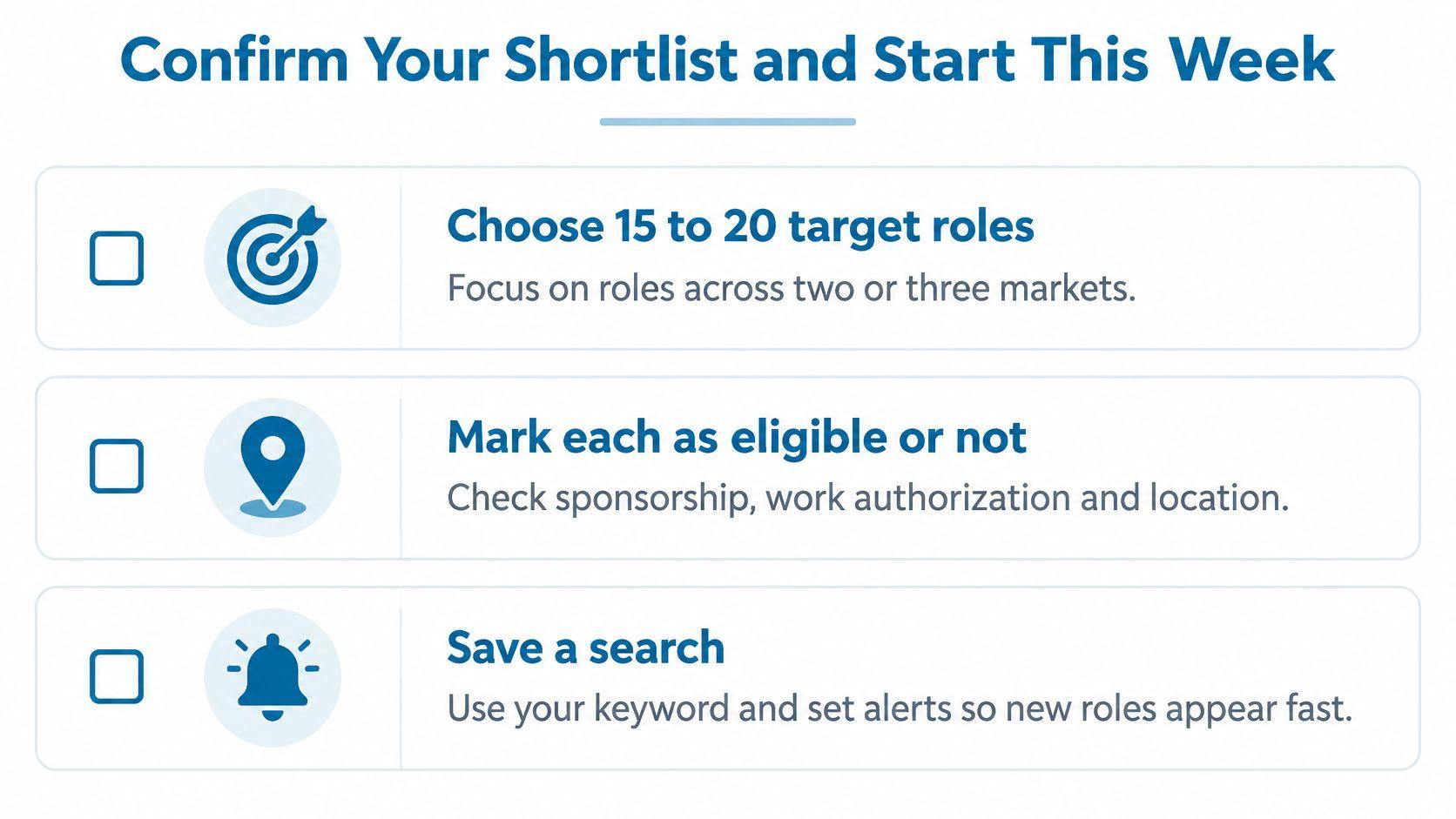
- Choose 15 to 20 target roles across two or three markets, then mark each eligible or not on sponsorship, work authorization and location. A role you can’t legally accept isn’t a target.
- Save the search as an alert. In the JobGlance web app, the “Get these jobs in your inbox” row under the results opens an alert pre-filled with that search, filters and all, so new matches arrive as one digest instead of you re-running the same query.
- Customize the top five using the evidence inventory and the requirements matrix. Five well-customized applications beat forty generic ones.
- Track each application weekly with five columns: role, eligibility, evidence used, status, next date. The next date is what keeps a stale pipeline from sitting untouched for a month.
- Run one product-sense case a week and record it. That habit is the only interview prep that compounds.
If you’re early in your career and location is the constraint, entry-level remote roles on JobGlance are the right starting filter, and they stack with a sponsorship filter rather than replacing it.
A realistic first month: week one builds the evidence inventory and the shortlist, week two tailors five applications, week three runs two mock interviews, week four reviews which applications got responses and adjusts the route if the answer is none. Many candidates skip week four, which is why they repeat the same month four times.
Fewer, better-matched applications beat volume. The candidates who get PM offers in a contested market are the ones whose evidence fits the posting, not the ones who sent the most.
JobGlance is built for exactly this search: 50,000+ active roles from 100+ job sites, each one scored against your resume so the best-fit product roles sit at the top instead of wherever they landed by posting date. Visa sponsorship and work-from-anywhere are dedicated filters rather than keywords, which is the difference between a list you can act on and a list you have to research line by line. Upload your resume at JobGlance and build this week’s shortlist from roles you’re eligible for.
Keep reading


