English Speaking Jobs in Germany: Where to Look in 2026


On this page
“Move to Berlin and apply to startups” is incomplete advice for finding English-speaking jobs in Germany. Start with the occupation, not the postcode: can you perform the actual work without German, and does the employer hire internationally? A software team, a hospital and a logistics company can all advertise in English while setting very different conditions for applicants.
The useful distinction isn’t whether a vacancy looks international. It’s whether language, occupational eligibility and immigration requirements line up for you. Use the field verdict below to decide where English-only applications are worth your time.
English-Speaking Fields and How Much German They Need
English working language and German expectations by field
| Field | English as working language | German expectation | English-only competitive | Typical roles |
|---|---|---|---|---|
| Software, data and AI | Common in international teams | Often optional outside customer-facing work | Often yes for experienced hires; explicit no-German vacancies remain a narrower subset | Software engineer, data engineer, ML engineer |
| Research and academia | Common in international labs | German often needed for administration or teaching | Sometimes, by institute and duties | PhD researcher, postdoctoral researcher |
| ICT service management | Possible in multinationals | German preferred for local stakeholders and service delivery | Selective | IT service manager |
| Engineering, architecture and transport planning | English working language in some international teams | Often needed on site and with authorities | Limited without German-facing duties being covered | Architect, transport planner |
| Healthcare | Rarely sufficient for patient-facing work | German required by regulation for applicable licensing and professional practice | No for patient-facing roles without meeting language requirements | Physician, dentist, veterinarian, pharmacist, nurse, midwife |
| Education | Rarely sufficient in mainstream school settings | German required by regulation where professional recognition and school requirements apply | No for most school roles without meeting applicable requirements | Teacher, education professional |
| Customer service and logistics | Limited to particular international operations | German often required for customers, local coordination or safety | Rarely, unless the role explicitly serves an international operation | Customer service agent, logistics coordinator |
These are screening verdicts, not guarantees about every employer. The distinction between an English internal workplace and work accessible without German is central to Workingermany’s guide to working without German: licensing, safety, local clients and public interaction can create German requirements even inside an international organization. That distinction also matters in construction and public services, where local communication can be integral to the job.
Read the table through four statuses: English working language, German preferred, German required by regulation, and realistically open to English-only candidates. The first describes how colleagues communicate; the last describes whether you can compete for the vacancy. They aren’t interchangeable.
Technical work offers access, not automatic eligibility
Software, data and AI deserve an early place in an English-only search, but don’t treat every technical vacancy as accessible. Indeed Hiring Lab’s occupational breakdown, published in October 2024 and summarized by JobLumi’s Germany jobs guide, found that 3.7% of software-development advertisements on Indeed in Germany from September 2023 to August 2024 were marked as requiring no German.
That measure is narrower than the number of advertisements written in English. It also doesn’t tell you the language policy of every employer whose advertisement omitted a requirement. The practical response is to distinguish explicit permission to work without German from an assumption based on the job title.
Research requires the same discipline. An international lab may use English for experiments and publications while assigning German-language teaching or administration to the position. For adjacent corporate work, browse titles such as product manager, then examine who the role serves: an international development team and a domestic customer portfolio imply different language demands.
Practical rule: Classify the tasks, not just the employer. An international brand doesn’t make every department English-only.
English proficiency isn’t vacancy accessibility
European Commission survey data summarized by Language Knowledge’s Germany profile show that 42% of residents could hold an English conversation in 2024, up from 37% in 2012; 41% reported good or very good competence as non-native speakers, approximately 1% spoke English as a mother tongue, and 63% of Germans aged 15–34 reached the conversational level, compared with 42% nationally.
Those findings describe residents’ language ability, not employers’ permission to conduct a role entirely in English. A colleague’s ability to chat in English doesn’t establish the language used for patient records, safety instructions, customers or official submissions.
The Federal Employment Agency’s Blue Card guidance identifies shortage categories including academic STEM professionals, ICT-service managers, architecture and transport-planning professionals, physicians, dentists, veterinarians, pharmacists, nursing and midwifery professionals, and education professionals. The important inference is that a shortage designation is not an English-language designation.
Start with globally operating employers, technical teams and research-intensive organizations. Then identify any German-language task involving customers, compliance, safety or team integration. Where German is preferred, a strong technical match may justify applying; where a mandatory professional requirement applies, enthusiasm and an English CV aren’t substitutes.
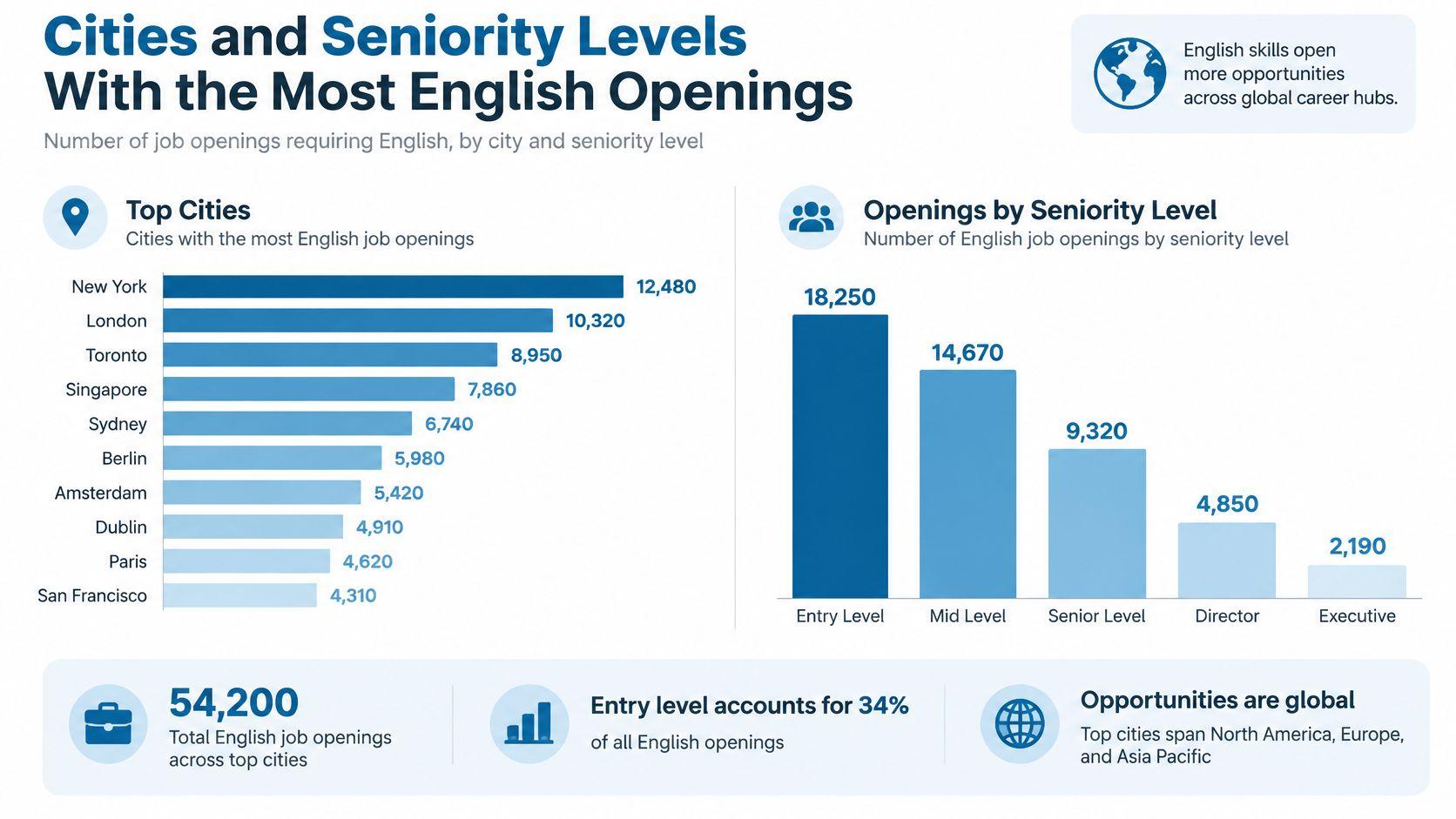
Cities and Seniority Levels With the Most English Openings
Berlin, Munich and Hamburg are sensible starting points, but their totals need careful labeling. A November 2026 vacancy snapshot from MySeera’s English-speaking jobs page identified 7,416 open roles from 1,832 employers, including 2,144 positions in Berlin, 1,751 in Munich and 466 in Hamburg; its seniority breakdown was 37% mid-level, 47% senior or more experienced, and 16% internships or junior roles, while its pre-location-merge sample contained 7,918 English-posted vacancies, or 14% of 56,975 open postings.
Match the city to the field verdict
Berlin’s concentration reflects its startup and technology economy. For an experienced software or data applicant, that makes it a logical place to search for teams where English is already the working language.
Munich’s multinational and engineering base creates a different shortlist. An international technical role may be suitable, while site coordination, local customers or regulatory submissions can move an otherwise attractive vacancy into the German-required category.
Hamburg’s international commerce and logistics sectors warrant attention, but international trade doesn’t make every operational role English-only. Separate global corporate functions from jobs that coordinate local drivers, customers or facilities.
Use city totals to choose where to search first, not to estimate your personal chance of getting hired.
Seniority is the stronger filter
The seniority distribution is the more consequential finding for an applicant choosing where to invest effort. Experienced candidates can target specialist responsibilities; newcomers must compete within a smaller junior pool and shouldn’t assume that a large city total means abundant graduate openings.
Treat these figures as a live-market snapshot, not an official census. Indexing methods, duplicate-location rules and the distinction between English-written and explicitly German-free advertisements all affect the count.
For planning, use the merged role and employer totals rather than the larger pre-merge inventory. Keep city, field and experience level together: a broad Berlin search is less useful than a focused search for an international role you can already perform.
Visa Salary Thresholds That Filter Your Shortlist
Blue Card and Opportunity Card thresholds for English-speaking roles
| Case | Gross annual minimum | Condition |
|---|---|---|
| Standard EU Blue Card | €50,700 | German employment contract must match your qualifications |
| Shortage occupation or recent higher-education graduate | €45,934.20 | Occupation or graduate status must qualify |
| Experienced IT professional without a degree | €45,934.20 | At least three years of relevant experience in the previous seven years; the job and pay must qualify |
| Opportunity Card | Proof of financial means, applied instead of a salary floor | Funds shown through a blocked account or a formal declaration of commitment; basic German or stronger English satisfies its language criterion |
The German Foreign Office’s EU Blue Card guidance sets the 2026 standard gross annual minimum at €50,700 and the qualifying lower minimum at €45,934.20, including the route for IT professionals without a degree who have at least three years of relevant experience acquired during the previous seven years. The federal government’s Opportunity Card guidance treats solvency separately: applicants show they can support themselves while searching, so the table above has no salary figure for that row.
Match the route before negotiating
For non-EU applicants who need this residence route, salary functions as an eligibility check before it functions as compensation. The standard case requires both sufficient remuneration and a contract aligned with your qualifications.
For a shortage occupation or recent graduate, don’t assume the lower minimum applies because the employer says it needs staff. Establish which qualifying category covers you and whether the offered position fits it.
The non-degree IT route is especially relevant to experienced developers and technical specialists. Assemble evidence of relevant employment and duties before relying on it, rather than expecting a recruiter to infer your eligibility from a skills list.
The Opportunity Card sits in a different decision box. Its language criterion accepts basic German or stronger English, which makes it the more accessible route for a candidate still searching for an offer. Entry permission leaves workplace and licensing requirements untouched, and the solvency proof replaces the salary test rather than relaxing it.
Make compensation an early question
Use Germany visa-sponsorship openings to build an employer shortlist, then establish the contract details before investing in a lengthy application. Sponsorship interest alone doesn’t establish that the offered position qualifies.
Ask for the gross annual contractual salary, not an informal estimate of take-home pay. If the employer describes a package with variable compensation, clarify the guaranteed amount and how it will be documented.
For each posting, record:
- Language of work: Can you perform the stated responsibilities with your current languages?
- Occupational eligibility: Does the position fit the route and your qualifications?
- Annual gross pay: Does the contractual remuneration satisfy the applicable minimum?
An attractive English-language vacancy can still fail immigration checks. If another residence route may apply, assess it separately rather than treating the Blue Card as Germany’s only employment pathway.
Where to Search for English-Speaking Roles
Search with a city, occupation and eligibility combination, not a nationwide English-speaking keyword alone. Your first results should already resemble jobs you could accept.
Build a narrow search before expanding
-
Choose the city and title together. Start with Berlin, Munich or Hamburg, then add software engineer, data engineer, ML engineer or researcher. Add the technical specialization you offer, such as backend development or machine learning infrastructure.
-
Separate relocation from remote employment. Use the visa-sponsorship category when you need a German employment route, and the remote category when your priority is location flexibility. Our work-from-anywhere listings are a distinct starting point from domestic-remote vacancies, which may still require residence in Germany.
-
Repeat the title on Indeed and employer career pages. Check multinational and research employers directly, using the same field verdict rather than lowering your standards because a vacancy appears on a prestigious company website. Keep the employer’s application page as the reference for current duties and requirements.
-
Use shortage status as a supporting screen. It can help identify an immigration-relevant occupation, but it shouldn’t replace the working-language check. Patient-facing and public-facing positions need particular scrutiny rather than automatic inclusion or rejection.
-
Create a small, verified shortlist. Set aside advertisements with mandatory German you don’t meet, inadequate pay for your intended route, or unresolved qualification requirements. Save five plausible roles, then configure an alert around the title, city, visa needs and work policy.
Don’t confuse international hiring models
A company hiring across borders isn’t necessarily offering relocation to Germany. For example, employers exploring how to hire developers from latin america through HireDevelopers.com are considering a different talent-sourcing geography; that context is useful when distinguishing international remote recruitment from a Germany-based employment contract.
For your own search, ask where the employee must live, which entity signs the contract and whether relocation is part of the offer. A role can be English-speaking and globally connected while providing no route to German residence.
A search result is a lead. The employment location, contract and language requirements determine whether it’s an opportunity for you.
How to Verify a Role Before You Apply
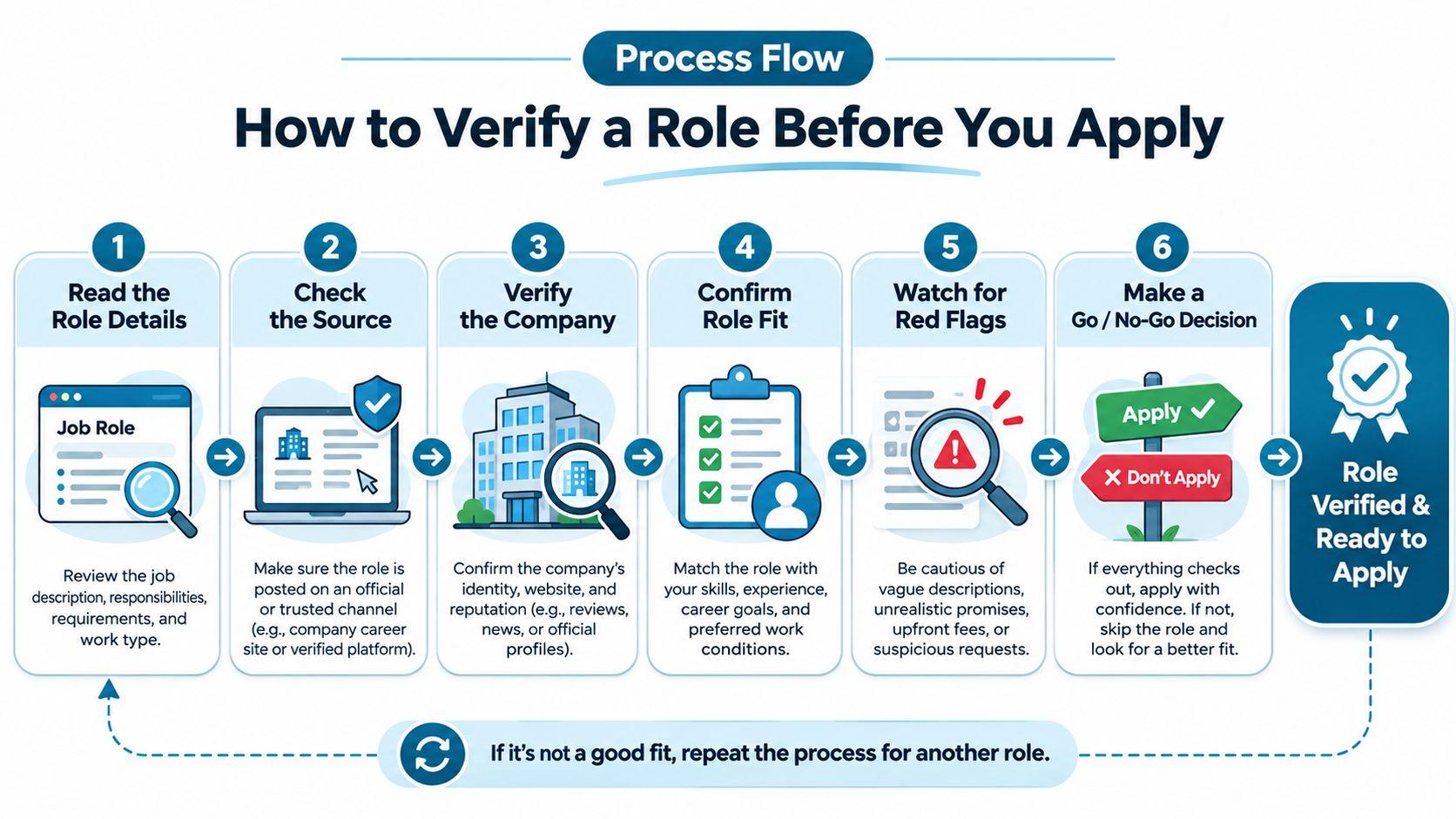
A good shortlist needs an evidence trail. Save the relevant wording from each posting so you can distinguish confirmed eligibility from unanswered questions.
Read for disqualifiers before tailoring
-
Search the entire advertisement for German requirements. Use your browser’s find function for German, fluent German, German required and Deutsch. Read the surrounding responsibilities too, especially references to local clients, documentation or authorities.
-
Assign a language classification. Record explicit English, explicit German, multilingual or language not stated. An explicit English requirement doesn’t automatically mean German is unnecessary, while an unstated requirement calls for clarification rather than guesswork.
-
Check the occupation and actual duties. Compare the position with the field verdict and relevant shortage category. A technical title can conceal German-facing implementation or customer responsibilities, so classify the work rather than relying on the title.
-
Confirm compensation for your intended residence route. Ask for gross annual contractual pay if the advertisement doesn’t state it. Mark an unconfirmed salary as unresolved, and exclude a below-threshold role if the Blue Card is the route you’re relying on.
Resolve the contract questions
-
Check qualification fit and recognition. Compare your degree or professional background with the offered responsibilities and any recognition requirement. For regulated work, identify the competent authority and required evidence before assuming the employer can solve the issue after hiring.
-
Ask about immigration support early. Ask whether the employer has hired a non-EU employee under the relevant route and who handles the documents. A useful response identifies a process and contact person, rather than just a willingness to consider international applicants.
-
Save the decision, not just the vacancy. Keep the language tag, salary, qualification status and outstanding questions alongside the posting. This lets you compare viable jobs rather than repeatedly reopening attractive but ineligible advertisements.
Keyword matching alone creates false positives because it identifies words, not permission to perform the job. A description may mention English as an additional skill while requiring German for the responsibilities that occupy most of the working day.
Visa and remote filters can narrow the initial pool, but they don’t replace checking the employer’s current advertisement and contract terms. Likewise, an employer’s previous international hire is useful process evidence, not proof that your particular offer meets every condition.
Decision rule: Proceed when language of work, occupational eligibility and gross annual pay all pass. Where evidence is missing, ask a focused question before treating the role as application-ready.
This isn’t a reason to avoid every ambiguous vacancy. It’s a way to reserve substantial tailoring effort for positions with a plausible path to employment.
How to Apply From Abroad and Choose This Week’s Roles
Say you’re an experienced data engineer applying from abroad. You find a Berlin vacancy whose responsibilities match your background, confirm that the team can operate in English, and establish that the contract is compatible with your intended immigration route. Your application should now make that fit easy to inspect.
Follow the recruiter’s reading order
Start with a single-column, text-based CV. Put your relevant role, strongest technical skills and most convincing achievements near the top, using the employer’s terminology where it accurately describes your experience.
If the vacancy emphasizes SQL, Python and data orchestration, show where you’ve used them and what you delivered. Don’t add tools you can’t discuss in an interview, and don’t rely on a graphic skills chart to communicate proficiency.
State your current location and relocation intention plainly. If your qualifications require recognition, use the official recognition portal to identify the responsible body and describe your actual status accurately: completed, underway or not yet started.
For an English posting, write the cover letter in English unless the employer requests otherwise. Mention German study or progress truthfully, but don’t imply that enrollment in a course satisfies a mandatory workplace requirement.
Make the email and interview practical
The email should identify the role, summarize the strongest match and point to the attached documents. StoryCV’s guidance on writing a short, sharp application email is a useful companion when you need to turn a focused application into a concise message rather than repeating the entire cover letter.
Before an interview, confirm the time zone and working language. Prepare to explain your availability, relocation constraints and documentation, and ask who would coordinate an international hire.
For an entry-level applicant, the same process needs a different shortlist. Keep roles that say German is preferred when you meet the core requirements; don’t spend the week trying to persuade employers to waive mandatory language or licensing conditions.
Our visa-sponsorship destinations include the United Kingdom, United States, Canada, Europe, Australia, Singapore, Germany, the Netherlands, Ireland, Spain, Poland, Japan, France and Asia. For this search, keep Germany separate from alternative destinations so that residence rules and employer expectations don’t get mixed together.
Choose this week’s applications
Run the eligibility check on five live postings and keep only those with a credible employment path. Tailor each surviving application, record unanswered questions, and prioritize the roles where your existing skills solve the employer’s stated problem.
We offer job alerts by Telegram or email with keyword, visa-sponsored or globally remote, location, and remote, hybrid or on-site filters, plus experience levels from entry level to expert and lead. Alerts retain your visa and work-from-anywhere filters, but their digests don’t show salary, so compensation still needs a separate check.
Visit JobGlance to narrow your Germany search by visa sponsorship, location and work policy, then compare the roles against your experience. Save the postings that pass the language, occupation and pay checks, and set an alert for new matches instead of restarting a broad search each day.
Keep reading


