
EU Blue Card Requirements: Complete Guide 2026


On this page
Germany’s common EU Blue Card salary threshold is about €48,300, while Bulgaria’s is €9,933, so there isn’t one European minimum to qualify against. The core rule is a qualifying job offer and a country-specific gross salary threshold set between 1.0 and 1.6 times the host country’s average annual salary under Directive (EU) 2021/1883.
That difference changes how you should search for work. A strong software engineer with the right qualification can be eligible for one country and immediately ineligible for another, even with the same job title, occupation code, and employment history. Treat the EU Blue Card as a market-by-market salary gate, not as a single Europe-wide visa.
What the EU Blue Card Actually Is
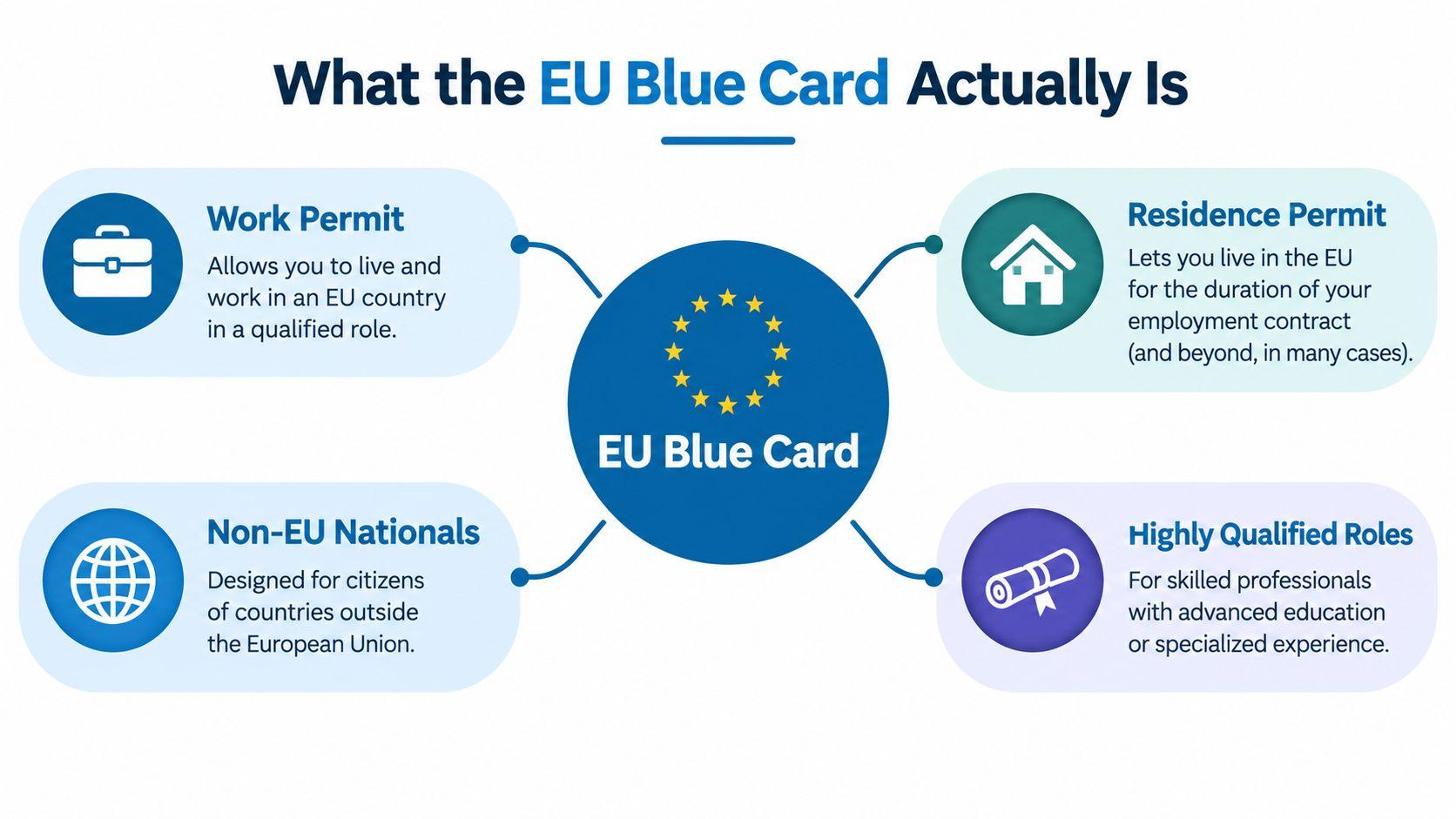
The EU Blue Card is an EU-wide work and residence permit for non-EU nationals taking highly qualified employment. It combines permission to live in the host country with authorization to work in the qualifying role. The European Commission describes the route as requiring a job offer lasting at least six months and a salary tied to the host country’s average gross annual salary, within the permitted national band. The European Commission’s EU Blue Card overview explains the framework and its country-specific operation.
The salary rule is the part that most affects your job search. Directive (EU) 2021/1883 requires each Member State to set its threshold at at least 1.0 and no more than 1.6 times the national average gross annual salary. Countries can choose the precise point within that band after consulting social partners, and they can publish a lower threshold for shortage occupations or certain recent graduates, provided the reduced figure still respects the directive’s floor. The directive also permits a recent-graduate threshold of 80% of the standard Blue Card threshold, subject to that minimum wage relationship. The directive’s compromise text sets out those calibration rules.
That’s why an identical profile can work in Germany but fail in Bulgaria, or qualify for a shortage route but miss a general threshold in the same country. Before you compare cities, employers, or relocation packages, check the host country’s current salary rule and whether your occupation fits an exception.
The Blue Card also differs from a national work permit. A national permit may use different salary, qualification, labor-market, or employer conditions. The Blue Card becomes especially relevant if you want a residence route designed for highly qualified work and possible movement to another participating Member State later. It doesn’t turn one approval into an unrestricted right to work everywhere, however. A move normally requires a new application under the destination country’s rules.
For an initial search, focus on employers and roles that openly support international hiring. Browse visa-sponsored jobs in Europe only after you’ve identified the countries whose salary gates match your profile.
Core Eligibility Requirements You Must Meet
Most EU Blue Card applications stand or fall on three pillars: your professional qualification, the job offer, and the salary written into the contract. If one fails, a polished application and an enthusiastic employer usually won’t rescue it.
Your qualification must support the role
The standard route generally requires a recognized higher-education qualification relevant to the employment. In practice, that means the authority must be able to understand what your degree represents and why it supports the proposed job. A computer science degree for a backend engineering position is straightforward. A less directly related degree may require stronger evidence connecting your professional history to the role.
Some national systems also recognize substantial professional experience in place of a formal degree for defined occupations. Germany, for example, has a route for certain IT specialists without a university degree, subject to its own experience and role conditions. Don’t assume that exception applies across the EU. Qualification rules remain country-specific, and regulated professions may require a separate professional license.
The offer must be binding and sufficiently long
You need a valid work contract or binding job offer for highly qualified employment. The European Commission’s framework requires the job to last at least six months. The contract should identify the employer, position, duties, working conditions, gross salary, and duration clearly enough for the authority to assess it.
A vague promise to hire later isn’t equivalent to a binding offer. Nor is a short consulting arrangement automatically suitable because the hourly rate looks attractive. Ask the employer to prepare a contract that states the fixed compensation and role precisely.
The fixed gross salary must clear the local gate
Authorities assess the applicable gross annual salary against the threshold chosen by the host country. The relevant comparison is not your take-home pay, signing bonus, or optimistic commission forecast. It’s the qualifying compensation documented in the employment agreement.
Shortage occupations can change the calculation. A technology, engineering, healthcare, or other eligible shortage role may receive a lower national threshold, but the reduced route still has conditions and may require occupation classification or authority review. A job title alone isn’t enough.
Use this pre-application check:
- Qualification: Can you document a recognized qualification or an accepted professional-experience route?
- Job: Is the offer binding, highly qualified, and at least six months long?
- Salary: Does the fixed gross annual amount meet the correct general or shortage threshold?
- Occupation: Does the actual job fit the relevant classification, not merely the title?
- Country: Have you checked the destination’s current rule rather than a neighboring country’s figure?
Practical rule: Don’t invest time in document legalization until the contract passes the country-specific salary and occupation check.
Country-Specific Salary Thresholds That Decide Your Strategy
The practical spread is wide enough to determine where you should apply first. In 2025, Germany’s common threshold is about €48,300, with a reduced figure of about €43,759.80 for shortage occupations, first-time employees, and some IT specialists. Brussels and Belgium can reach €66,377, while Bulgaria is listed at €9,933. Sweden uses 1.25 times average gross salary, and Austria ties its threshold to at least 1.0 times average gross salary. The Hamburg Blue Card guidance provides the Germany figures and context for the national variation.
EU Blue Card Salary Thresholds by Country (2025)
| Country | General Threshold | Shortage/Occupation Threshold | Notes |
|---|---|---|---|
| Germany | About €48,300 | About €43,759.80 | Reduced route can cover shortage occupations, first-time employees, and some IT specialists |
| Sweden | 1.25x average gross salary | Country-specific | Sweden reduced its threshold to 1.25 times average gross salary |
| Austria | At least 1.0x average gross salary | Country-specific | The threshold is tied to the national average |
| Belgium, Brussels | Up to €66,377 | Country-specific | Regional rules can produce a high salary gate |
| Bulgaria | €9,933 | Country-specific | The general threshold is substantially lower than in the markets above |
These figures aren’t interchangeable. A candidate earning near Germany’s reduced threshold might have a realistic path in a German shortage occupation but fail a general route elsewhere. Conversely, a salary that clears Bulgaria’s listed gate may still fall short in a higher-threshold market.
Start with a salary-band strategy:
- If your offer is around €9,933, Bulgaria is the only market in this comparison with a listed threshold at that level. You’ll still need to satisfy the qualification, job, and occupation rules.
- If your offer is around €43,759.80, Germany may be realistic where the reduced category applies. It isn’t enough to assume the reduction because your role sounds technical.
- If your offer is around €48,300, Germany’s common route becomes more plausible, while Brussels may still require a materially higher offer.
- If your offer approaches €66,377, Brussels becomes more accessible on salary, subject to the applicable regional conditions.
Germany remains a useful benchmark because its route has a clear general threshold and recognized shortage exceptions. Review visa-sponsored jobs in Germany with the salary requirement in mind, then validate the role’s actual classification before applying.
Required Documents and How to Prepare Them Correctly
A complete file is more than a pile of certificates. Authorities need to connect your identity, qualification, employment, salary, and eligibility route without asking you to explain basic gaps later.
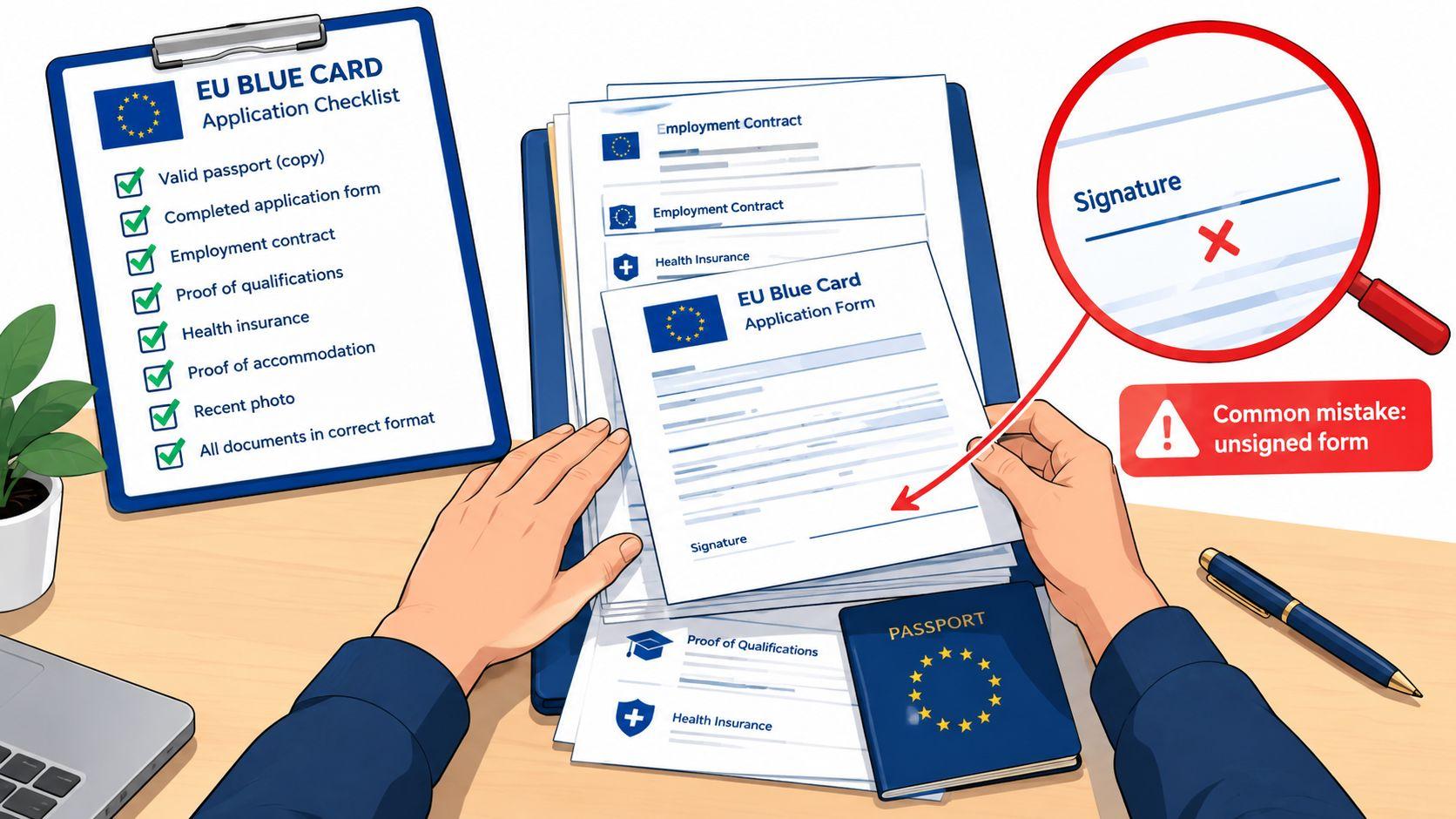
Prepare the file in this order:
- Passport and application form: Check that your personal details match every other document. Complete the form consistently, including employment dates and job titles.
- Qualification evidence: Provide the degree certificate, transcripts where requested, and any recognition or comparability decision. If you rely on professional experience instead of a degree, assemble employer letters, contracts, and detailed evidence of duties.
- Binding job offer: The contract should show the employer, role, duration, duties, and fixed gross salary. Ask the employer to correct vague wording before submission.
- Salary proof: Include the signed contract and any required employer declaration. The authority must be able to see how the annual amount reaches the applicable threshold.
- Professional authorization: Regulated roles may need a license or formal permission to practice. A recognized academic qualification alone may not authorize the work.
- Translations and authentication: Follow the destination authority’s rules for certified translations, apostilles, or legalization. Do not use an informal translation just because the document is easy to understand.
Germany applicants often need an Anabin result or a Statement of Comparability from ZAB when the foreign qualification isn’t already accepted through the relevant database route. Other countries use different recognition bodies, so copy-pasting a German document process into a Swedish or Belgian application can waste time.
Three mistakes cause avoidable trouble:
- Starting recognition too late: Recognition can take longer than the rest of the application. Begin it as soon as the job becomes credible.
- Submitting inconsistent employment history: Different dates or titles across your resume, letters, and application invite questions.
- Treating scans as final documents: Keep clear color scans, originals, certified copies, translations, and proof of authentication organized separately.
Use filenames that identify the document and date, then create a one-page index. The officer should be able to verify the salary route and qualification without searching through unrelated material.
Application Steps, Timeline and Where Delays Actually Happen
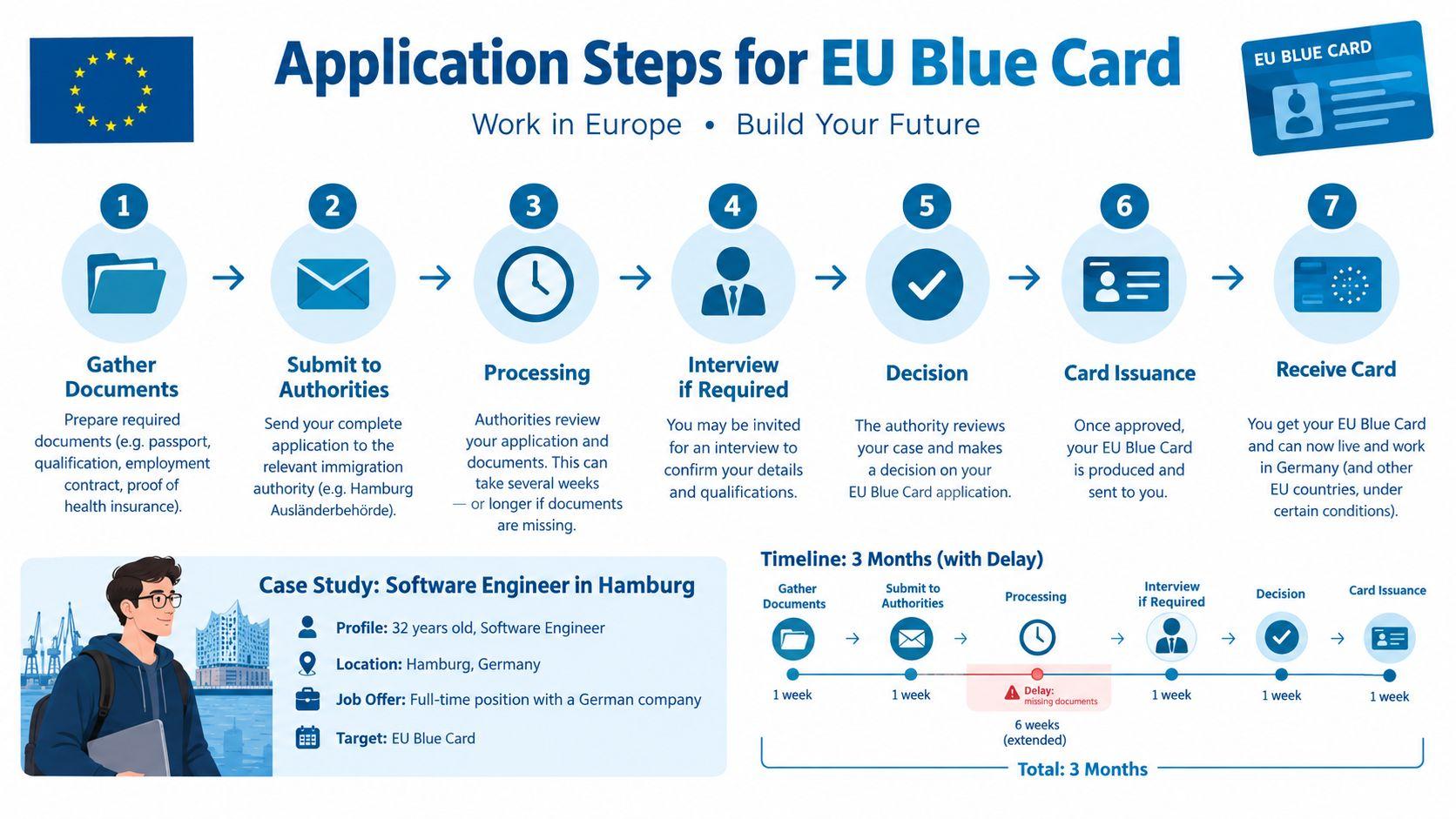
A representative software engineer applying through Hamburg might begin with a signed offer, prepare qualification evidence, submit the application, answer follow-up questions, and wait for the residence authority to issue the card. The sequence looks simple, but missing evidence usually creates a second review rather than a quick correction.
A workable process
First, confirm the route. Match the job, qualification, occupation category, and contract salary to Hamburg’s applicable rule. Get the employer to confirm that the contract language reflects the route you’re using.
Next, build and submit the file. Depending on nationality and residence status, you may apply through a consulate or directly with the competent authority after lawful entry. The authority will review identity documents, qualification evidence, the employment terms, and salary.
Then, respond quickly to requests. A missing transcript, unclear job description, or salary calculation can pause the file. Send a concise response with the requested evidence and a short index showing what changed.
Finally, complete issuance steps. After approval, follow the authority’s instructions for biometrics, payment, and collection of the residence card. Don’t book irreversible relocation arrangements until the authority confirms the relevant permission.
Where cases stall
The most common delay points are incomplete qualification documentation, questions about whether the salary meets the applicable threshold, and local immigration-office backlogs. These are different problems, so the fix differs. More emails won’t solve a missing recognition document, while a complete file can’t control an overloaded office.
Keep a dated log of submissions, requests, and replies. If the application has become unusually complex, compare the likely value of professional help with the immigration lawyer consultation cost before paying for a full representation package. A targeted review of the contract and qualification route often addresses the risk more efficiently than broad advice.
Renewal Rules, Permanent Residency and Common Misconceptions
The most damaging misconception is that holding an EU Blue Card automatically grants permanent residency after two years. It doesn’t. Permanent residence depends on the host country’s rules, continued compliance, residence history, language requirements where applicable, and contributions or other conditions set by that country.
Renewal is usually strongest when the employment relationship continues and the salary still satisfies the relevant threshold. A change in employer, a role that no longer matches the qualifying occupation, prolonged unemployment, or a contract that falls below the applicable gate can create refusal risk. Contact the competent authority before the current permission expires, rather than waiting for an administrative reminder.
Separate three decisions
Renew the card when the job remains eligible, the employer relationship is stable, and the documentation is current.
Prepare for permanent residence when you can document the required residence, language, employment, and social-contribution conditions in your host country. The timeline isn’t a universal Blue Card benefit, so verify the exact national route.
Reconsider the country when your career plan depends on moving soon, your employer can’t maintain the required salary, or another market offers a more sustainable qualification and salary pathway.
Mobility is also narrower than many applicants expect. A Blue Card issued by one Member State doesn’t automatically authorize employment in another. Moving to a second country generally means applying under that country’s Blue Card system, with its own threshold and profession rules. Treat mobility as a later application route, not a blank work authorization.
Practical Tips for International Applicants to Maximize Approval Chances
The strongest strategy is to eliminate ineligible applications before they consume your time. Start with the salary band, then test the occupation and qualification route, and only afterward invest in employer conversations and document preparation.
Use a decision matrix
| Your situation | Best first move | Main risk |
|---|---|---|
| Salary clears a country’s general threshold | Target standard Blue Card roles there | The job may not match the recognized qualification |
| Salary reaches a reduced threshold | Check shortage, graduate, or IT eligibility | The lower route may require specific occupation evidence |
| Salary is below your preferred market’s gate | Search countries with a lower calibrated threshold | A low salary gate doesn’t remove qualification conditions |
| Degree recognition is uncertain | Start the recognition process before applying widely | The employer may lose patience while evidence is pending |
| Employer has no sponsorship experience | Ask who prepares declarations and responds to authorities | Poor contract wording can create avoidable questions |
| Timeline is tight | Favor employers familiar with international hiring | Local authority backlogs remain outside your control |
Salary negotiation matters. Ask whether the employer can increase fixed gross compensation, because variable bonuses and informal promises may not satisfy the threshold calculation. Get the final figure and role description into the signed contract before you submit anything.
Shortage occupations can make a real difference, but don’t force your duties into an occupation category that doesn’t fit. Authorities assess the actual role, and a misleading classification can create a larger problem than a lower salary.
Start qualification recognition early, especially for Germany’s Anabin or ZAB route. Keep translated and authenticated documents ready, and ask the employer whether they’ve sponsored non-EU hires before. A company that knows the process can usually produce clearer paperwork than one that treats sponsorship as an afterthought.
Search broadly, but filter aggressively. The Netherlands visa sponsorship jobs category can help you compare opportunities, but you should still verify the salary, contract duration, and destination-country rules for every listing.
Finally, don’t choose a country from salary alone. Compare the offer with your professional recognition prospects, the employer’s administrative capability, your language plans, and whether the role supports your longer-term residence objective. The cheapest threshold may not be the easiest application, and the highest salary market may not be the best fit.
JobGlance helps international candidates find roles with visa sponsorship, compare realistic destinations, and prioritize openings by fit instead of scanning disconnected job boards. Visit JobGlance to filter sponsorship-ready opportunities, check how your resume matches each role, and focus your EU Blue Card search on jobs worth pursuing.
Keep reading


