Remote Jobs for International Applicants That Work


On this page
Most advice about remote jobs for international applicants starts in the wrong place. It tells you to search harder, apply faster, and hope the location field won’t matter, but location usually matters first. Recent job-market analysis found that fewer than 4% of remote postings were location-agnostic, while about 85% were restricted to a particular country and another 11% imposed timezone or regional limits. That means the key skill isn’t finding more remote jobs, it’s finding the ones you can truly take.
If you keep treating every role labeled “remote” as open to the world, you’ll waste time on listings that were never available to you. A better filter is simple, work out whether the role is country-restricted, region or timezone-limited, or work from anywhere, then check the hiring path behind it before you apply. JobGlance is built around that kind of search, with dedicated filters for work-from-anywhere and visa sponsorship, plus ranking that helps surface fit instead of noise.
The rest of this guide follows that order. First, you’ll learn how to read the remote model itself, then how to test your own eligibility in minutes, then how to separate payroll, tax, visa, and compliance questions so you stop guessing and start screening like someone who’s done this every day.
Why Most Remote Listings Are Closed to You Before You Apply
The biggest mistake international applicants make is assuming remote means global. It usually doesn’t. Many listings are remote in name but tied to one country, one timezone band, or one employer-approved set of jurisdictions, and the hiring team often knows that before the posting goes live.
That’s why so many applications disappear into silence. The role may be fully legitimate, but the legal and operational setup behind it is narrower than the headline suggests. A country-limited role can still be a great fit if you live in the approved market, but if you don’t, the application was dead on arrival.
Practical rule: don’t ask, “Is this remote?” Ask, “Remote from where, under what payroll route, and for which type of worker?”
This shift matters even more for international applicants because the best opportunities are often filtered before you ever see them. JobGlance’s workflow is designed around that reality, so you can separate work-from-anywhere roles from country-limited remote roles and then rank what’s left by fit. That saves you from building a long list of attractive but unusable jobs.
A clearer mindset helps, too. Instead of trying to maximize the number of applications, you’re trying to maximize the number of eligible applications. That’s the difference between feeling busy and moving toward interviews.
The Three Remote Models Every International Applicant Must Know
A useful way to think about remote work is to picture an apartment building. Some jobs are like one apartment, some are like one neighborhood, and some are open anywhere in the city. The label on the front door can say “remote” in all three cases, but the rules inside are very different.
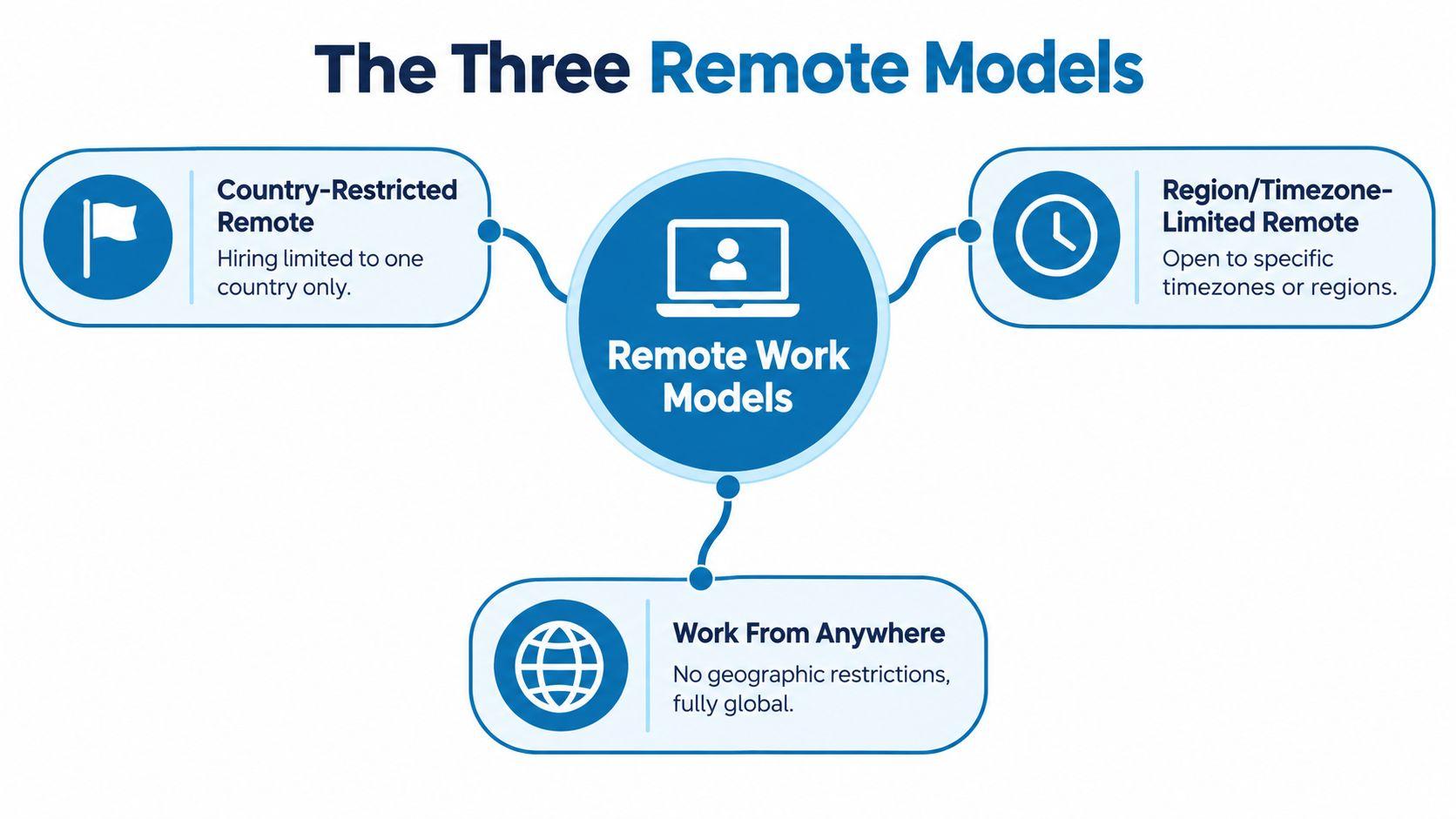
Country-restricted remote
This is the most common pattern. The employer wants someone who can work remotely, but only if that person lives in a specific country. The reason might be payroll registration, labor law, benefits, data access, or a local entity already in place.
The language often looks like “remote, US only,” “remote within Canada,” or “must be eligible to work in [country].” For an international applicant outside that country, the job is not really remote, it’s domestic remote. That distinction saves a lot of false hope.
Region or timezone-limited remote
This version is broader, but still bounded. The team may hire across several countries, or across a timezone range, because it needs overlap for meetings, support coverage, or client work. The posting might say “EMEA hours,” “Europe time zones only,” or “LATAM preferred.”
The restriction isn’t just a preference, it’s part of how the team runs. If your working hours don’t line up, you may be rejected even if your skills are strong. That’s why reading the location line is just as important as reading the responsibilities.
Work from anywhere
This is the rarest model, and it’s the one many applicants assume they’re seeing when they aren’t. A global listing usually says the employer will hire from any country, or it clearly states that geography doesn’t matter for employment eligibility. For international applicants, that’s the cleanest path, because the location barrier is intentionally removed.
For a plain-language breakdown of how employers describe these structures, the remote work model options guide is a useful reference point. Just keep one thing in mind, even a global-sounding role still has to survive payroll, tax, and legal checks.
Key concept: the place where you physically do the work matters more than the employer’s headquarters or the word “remote” in the title.
That’s consistent with OECD treaty principles, which note that the jurisdiction where work is physically performed may claim taxing rights, and that a common threshold is more than 183 days in a 12-month period, though other conditions can also trigger rights and obligations. OECD guidance shows why the label alone never settles the question.
How to Check If You Are Eligible in Two Minutes
Start with your own facts, not the job post. If you can’t state your residence country, your actual work country, and whether you’d be working as an employee, contractor, or through another arrangement, you’re not ready to screen the role yet. That’s the first pass international applicants need before they invest time in the rest.
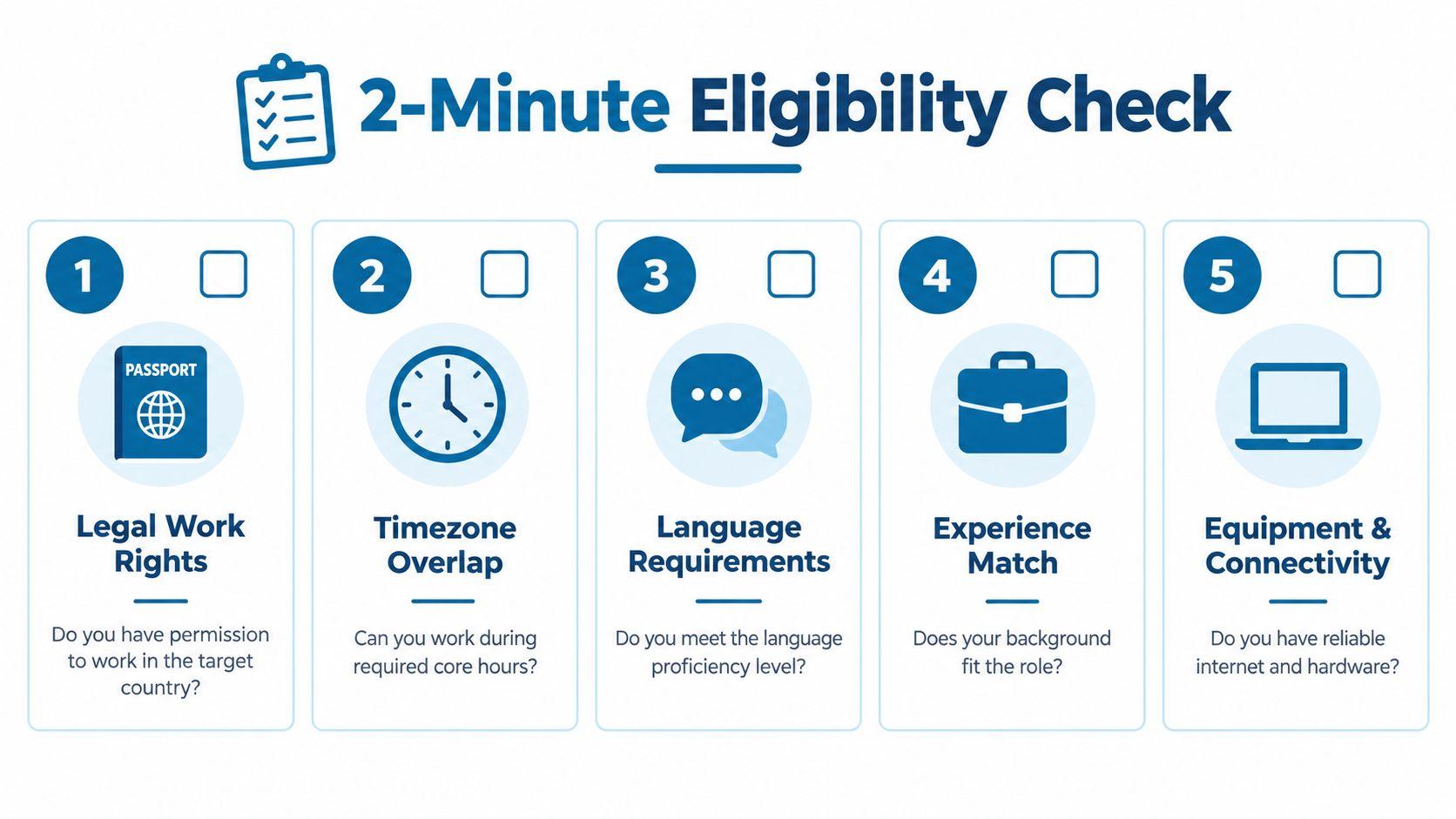
Run the quick test
Use five checks before you apply:
- Legal work rights: Can you legally work in the target country under the role’s setup?
- Timezone overlap: Can you work the core hours the team actually uses?
- Language requirements: Do you meet the language level the posting expects?
- Experience match: Do your skills map to the actual tasks, not just the title?
- Equipment and connectivity: Can you reliably handle the role from your setup?
That list looks simple because it should be. Many applicants overcomplicate remote applications by jumping straight into cover letters. The better move is to rule out the impossible first, then spend your energy on the jobs that remain.
Read the location evidence correctly
If a posting names a country, treat that as a hard limit unless the employer says otherwise. If it names a region, treat that as a narrower but still real filter. If it says “worldwide” or “any country,” verify that the wording is tied to the employment arrangement and not just to the ad copy.
The International Labour Organization defines cross-border remote employment as work done from a country different from the employer’s production unit, and it recommends measuring that separately from ordinary telework or working from home. ILO guidance matters because it shows why “remote” and “internationally portable” are not the same thing.
If the posting is vague, use the description to answer a few concrete questions. Where is the employer hiring? Is there an approved country list? Does the role mention relocation, contractor status, or a local entity? Those details tell you more than the headline ever will.
Timezone Payroll Tax and Compliance Rules That Limit Global Hiring
Employers restrict countries because cross-border hiring creates obligations fast. Once someone is working from another jurisdiction, the company may need payroll registration, withholding, labor-law compliance, benefits handling, social security coordination, and in some cases permanent-establishment review. That’s why a job can be remote in practice but still unavailable outside a short list of places.
The location question also changes by visa type and worker type. In the United States, the Department of Labor defines an H-1B “place of employment” as the physical location where the worker performs the job, and the employer must file a Labor Condition Application for the relevant geographic area. DOL guidance is a good reminder that moving the home office can create a filing issue, not just an address update.
Why time zones aren’t cosmetic
Teams say “must overlap with Europe” or “must cover US business hours” because the work depends on that overlap. It affects meetings, handoffs, customer coverage, and supervision. If your schedule can’t support the overlap, you aren’t eligible, even if the role is technically remote.
European cross-border telework shows the same logic. Under the Framework Agreement on Cross-Border Telework, eligible workers who live in a signatory country may generally remain insured under the employer-state system when teleworking from home between 25% and 49% of working time, subject to application and consent, while 50% or more usually shifts the social-security outcome. That’s why employers care about hours and work location, not just skill fit.
What candidates should ask before applying
Use the hiring contact to clarify the path, not just the title.
- Approved countries: Which countries does this role accept?
- Engagement model: Is this employee, contractor, or employer-of-record?
- Work location limits: Can the work be done from my home country, or only from a specific jurisdiction?
- Stay rules: Is there a maximum period I can work from abroad?
- Payroll route: Does the company already have a compliant way to pay in my country?
If the employer can’t answer those questions, the listing is not ready for an international applicant. You can still keep it on a watchlist, but you shouldn’t treat it like a live option.
For role browsing, a regional feed like JobGlance’s Asia remote jobs page can help you see how geography changes the pool before you spend time on the wrong type of listing. The point isn’t to find more results, it’s to find usable ones.
Rule of thumb: when a company hires across borders, the job description is only half the story. The other half is the compliance path behind it.
For payment logistics, a guide on choosing a payment platform can help once you know the role is open to your country and worker type.
Visa Sponsorship Versus Global Employment Compared Simply
Visa sponsorship and remote work solve different problems. Sponsorship helps you relocate or work in a specific country under the employer’s immigration process. Global employment, by contrast, is about whether the company can legally hire you where you already live, without moving you.
U.S. employment-based immigration generally depends on an employer-sponsored process rather than remote-work status alone. The American Immigration Council explains that most employment-based immigrants are sponsored by a U.S. employer, although some categories allow self-petitioning, and the categories differ in education, training, and experience requirements. American Immigration Council guidance makes one thing clear, a remote listing does not itself create work authorization.
Global hiring pathways at a glance
| Pathway | Where you live and work | Who handles compliance |
|---|---|---|
| Visa-sponsored relocation | You move to the employer’s country | The employer and immigration counsel |
| Direct local employment | You live in a country where the company has an entity | The employer’s local payroll and HR setup |
| Employer of record | You stay in your country, but a third party employs you locally | The employer of record handles employment administration |
| Independent contractor | You stay in your country and invoice for work | You usually handle your own tax and business setup |
The table is useful because it separates the question “Can they hire me?” from “Can they sponsor me?” A company can be open to one and closed to the other. That’s where international applicants get tripped up, especially when a posting says remote but doesn’t say which employment path it uses.
A company’s willingness to hire globally also doesn’t mean it can hire you in every format. A contractor role may not need sponsorship at all, while a direct employee role can trigger local obligations even if the work is fully remote. The correct next question is always, which entity is hiring me, and under what legal arrangement?
If you want to browse roles that are explicitly built around sponsorship pathways, JobGlance’s visa sponsorship jobs page is a practical starting point. That sort of filter is more useful than generic job boards because it separates relocation-friendly roles from broader remote listings.
Finding Verified Openings With Smarter Filters and Workflows
The fastest search process starts with two filters, not twenty keywords. Apply work-from-anywhere and visa sponsorship first, then layer the role title, seniority, and location only after you’ve removed the listings you can’t legally take. That keeps your shortlist small enough to review properly.
A 2025 global mobility survey reported that nearly 92% of organizations supported international remote-work requests, yet only 50% used dedicated technology, 29% operated without technology, and 12% handled requests ad hoc. KPMG’s global mobility survey shows why manual screening still exists, many employers want global flexibility, but they don’t all have the systems to execute it cleanly.
A cleaner weekly workflow
- Open with eligibility first. Search by the filter that matches your reality, not by the broadest dream role.
- Rank by fit. Use the match score to move the strongest openings to the top.
- Check the listing language. Look for country limits, timezone clues, and employment type.
- Verify the company. Read the employer profile, look for hiring patterns, and check whether the role is active.
- Save only the usable roles. Keep a small pipeline you can apply to well.
That same logic carries across boards and job sources. The JobGlance web app, for example, ranks openings against your resume, while the browser extension can surface sponsorship and work-from-anywhere signals on listings you find elsewhere. If you prefer a broad feed, JobGlance’s worldwide remote jobs page is closer to the right starting point than a generic search engine.
What to trust in a listing
Trust explicit wording more than implied flexibility. “Open to candidates in any country” is stronger than “remote” alone. “Must be based in [country]” is stronger than a recruiter’s casual message about flexibility. If the signal isn’t clear, treat the role as uncertain until someone confirms the actual hiring route.
That’s where structured search helps. It stops you from spending half a day on a post that looked global but wasn’t.
Your Eligibility First Plan for Global Remote Success
The clean rule is simple, verify geography first, then optimize for fit. That means separating country-restricted remote, region-limited remote, and fully global roles before you write a single application. It also means choosing the right hiring path, visa sponsorship, local employment, employer of record, or contracting, instead of assuming one “remote” label covers them all.
Use a small weekly habit. Review a shortlist, tag each role by eligibility, discard the ones that don’t fit your country or engagement model, and only then tailor the resume and cover letter. That keeps your energy on opportunities that can move forward.
The same discipline protects you from the most common trap in this search, believing that more applications create more chances. They don’t if half the pipeline was never available to you. A narrower, verified pipeline is easier to manage, easier to tailor, and much more likely to turn into conversations.
If you want a faster way to work this way every week, JobGlance lets you screen remote and sponsorship roles with dedicated filters, ranking, and match signals so you can focus on openings available in your country.
Keep reading


