
Area of Expertise: How to Define, Find, and Showcase It


On this page
99.7% of recruiters use filters in their applicant tracking system, so your area of expertise isn’t just a description of what you’re good at. It’s a hiring signal that must match the skills, titles, certifications, and work conditions an employer is screening for.
That changes how you should define it. A broad label such as “marketing professional” or “technology specialist” may describe your background, but it gives a hiring system very little to rank. A useful area of expertise connects your professional identity to a specific business problem, recognizable skills, and a market where employers are actively looking.
For international candidates, the distinction matters even more. The International Labour Organization estimated 284.5 million international migrants worldwide in 2022, including 167.7 million people in the global labour force, making cross-border employment a structural part of the labor market rather than a niche career path (International Labour Organization labour migration data). Your expertise therefore needs to communicate not only what you can do, but also where and under what hiring conditions you can do it.
Why your area of expertise is a match rate, not a label
Recruiters don’t begin with an open-ended question about your professional identity. They begin with filters. Skills, education, job titles, and certifications are among the most common screening criteria, and 99.7% of recruiters use ATS filters before reviewing applications manually (ATS recruiter filter data). That means your area of expertise has a practical job: it must help your profile appear when the employer searches for a particular capability.
A label can be accurate and still be commercially weak. “Operations expert” might describe someone who has managed processes, vendors, reporting, and customer escalations. It doesn’t tell a hiring system whether to associate that person with supply-chain operations, revenue operations, customer success operations, or financial controls. The system needs the terms that appear in its structured fields and job description.
Expertise has three measurable parts
Think of match rate as the overlap between what you claim, what you can prove, and what the employer requests.
- Searchable language: The exact or near-exact terms used in the posting, such as “fraud analytics,” “product discovery,” or “Python.”
- Evidence: Projects, outcomes, certifications, and responsibilities that support the claim.
- Eligibility context: Location, work authorization, seniority, industry, and language requirements.
Recruitment systems typically score across structured fields including certifications, education, job titles, languages, management level, skills, and industries. Keyword match remains a dominant signal, while section completeness and recency can affect ranking (ATS resume ranking factors).
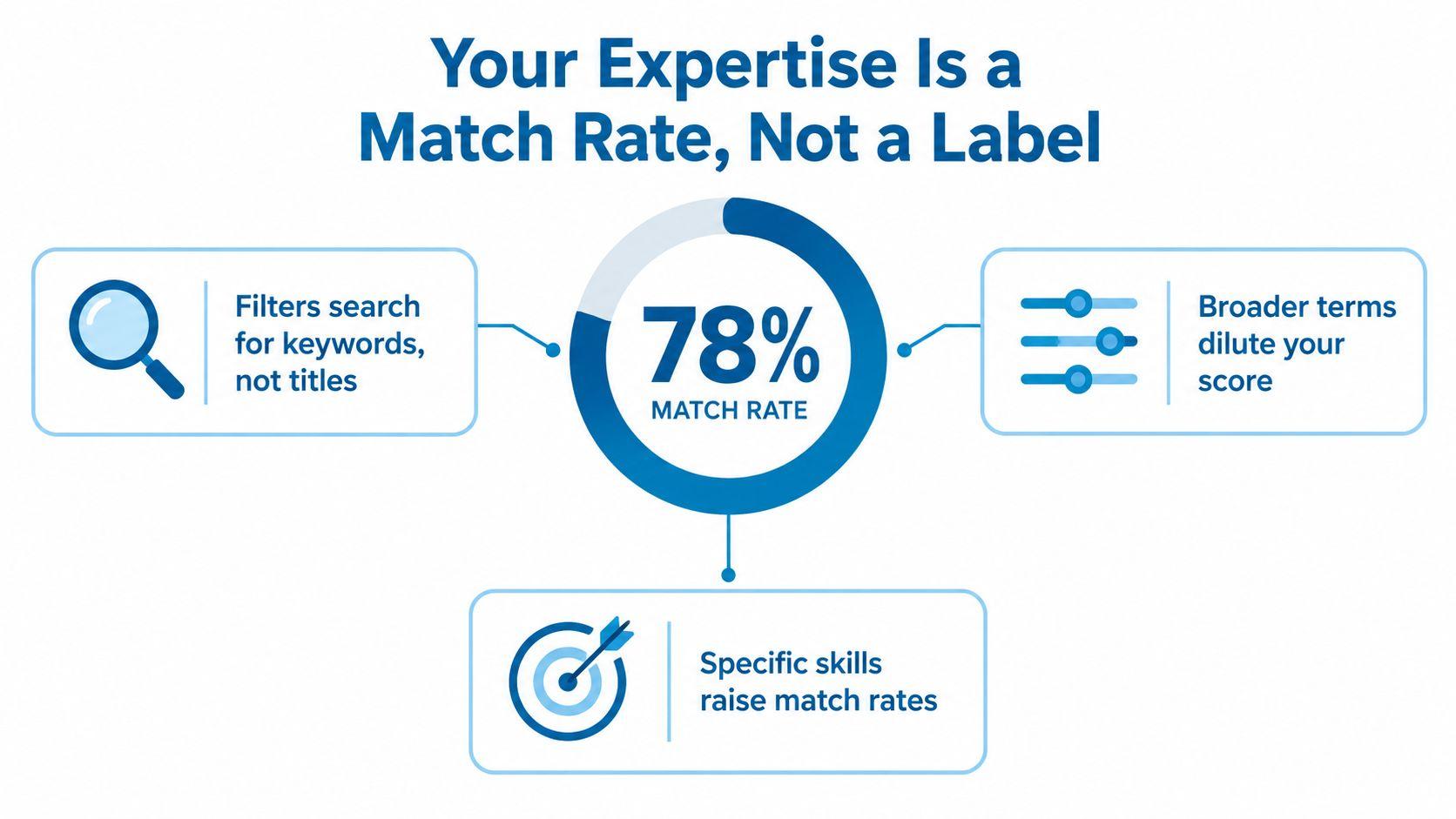
This is why a technically strong candidate can still be filtered down. If the resume says “customer data insights” while the employer searches for “customer analytics,” the underlying ability may be similar, but the match is less obvious to the system. Tailoring your wording isn’t dishonest when the terms accurately describe your work. It’s the process of translating experience into the vocabulary the market uses.
A concise LinkedIn headline can help reinforce that positioning, especially when it combines role, specialization, and market context. A headline generator for B2B marketers can help produce alternatives, but you still need to verify every phrase against your actual experience and target postings.
Practical rule: Don’t ask, “What am I good at?” Ask, “What would an employer search for if they needed someone who solves the problems I solve?”
The three layers of a real area of expertise
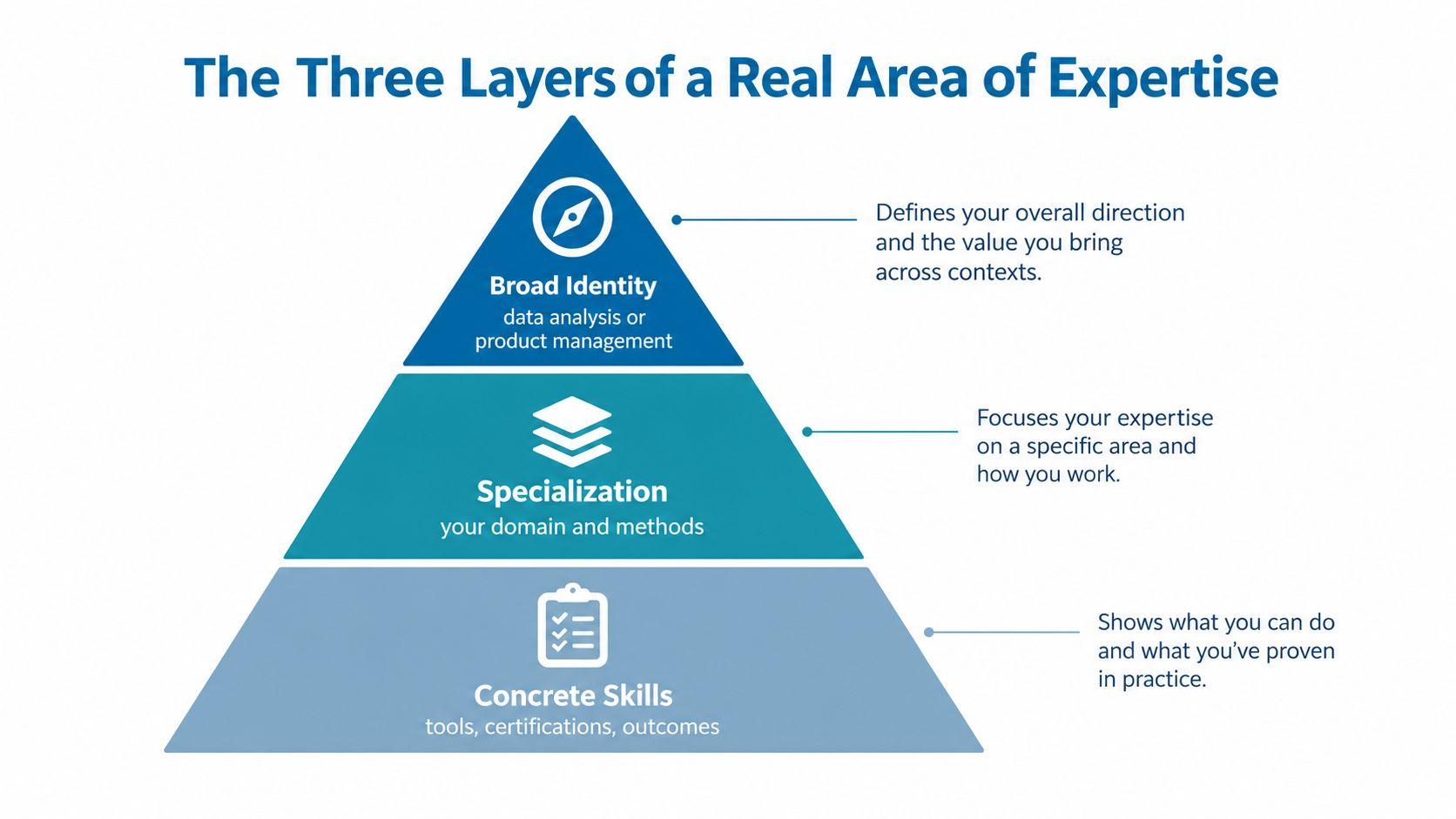
A defensible area of expertise usually has three layers. The first tells employers your broad professional identity. The second narrows the type of work you perform. The third makes the claim credible by naming the skills, tools, methods, or outcomes that support it.
Start with the broad identity
This is the category a recruiter understands immediately: data analyst, product manager, security engineer, content strategist, or financial controller. It makes your profile findable, but it isn’t distinctive enough by itself. “Product manager” tells an employer your general function, not the products, customers, or problems you understand.
The broad layer should be familiar rather than clever. Avoid replacing a recognized title with an invented phrase that sounds more impressive but doesn’t match job-posting language.
Add a functional specialization
The second layer describes the work inside that identity. A data analyst might specialize in fraud analytics, customer retention, or experimentation. A product manager might focus on B2B SaaS onboarding, payments infrastructure, or marketplace growth. A security engineer might work specifically in cloud detection and response.
This layer makes your experience easier to categorize because it connects a job family to a recurring problem. It also helps you decide which roles to ignore. If your strongest work is in fraud analytics, a generic analytics position may be less relevant than a role that explicitly asks for transaction monitoring, anomaly detection, and risk modeling.
Finish with market context and proof
The final layer explains where your expertise has value and what supports it. Context can include fintech, healthcare, highly regulated industries, visa-sponsored roles, or globally distributed teams. Proof includes tools, methods, certifications, languages, and outcomes.
A strong definition might look like this:
Product manager specializing in B2B SaaS onboarding and growth experiments, with experience translating customer research into measurable product improvements.
The sentence works because each layer does a different job. “Product manager” establishes identity. “B2B SaaS onboarding and growth experiments” narrows specialization. Customer research and product improvements provide evidence of the work.
A single-layer statement such as “strategic thinker” is difficult to search, verify, or rank. A three-layer statement gives employers a faster route from your profile to a plausible hiring decision.
How to identify your area of expertise from your own work
Start with your work history, not a list of skills you admire. Your strongest area of expertise usually appears in repeated patterns across projects, even when your job titles changed.
1. Find the work you repeat
Review your roles and write down the tasks that appeared more than once. Look for recurring combinations, not isolated duties. Perhaps you repeatedly cleaned fragmented data, built dashboards for commercial teams, and explained trends to nontechnical stakeholders. That pattern points toward business intelligence or decision-support analytics, not merely “Excel skills.”
Separate work you performed occasionally from work people relied on you to handle. Repetition is useful evidence because it shows that your capability survived different projects, stakeholders, or business conditions.
2. Replace duties with outcomes
“Managed campaigns” is a duty. “Built lifecycle campaigns that improved customer activation” is closer to an expertise statement because it identifies the business purpose. If you can’t disclose confidential figures, describe the outcome qualitatively and name the mechanism you controlled.
Use this prompt for each major project:
- Problem: What was not working?
- Action: What did you personally change?
- Method: Which tools, systems, or decisions made the change possible?
- Result: What improved, became faster, became clearer, or became less risky?
This process prevents “communication,” “leadership,” and “teamwork” from becoming substitutes for a real specialization.
3. Name the problem you solve
Employers hire capabilities in context. “Data analysis” is broad. “Helping subscription businesses identify churn signals and prioritize retention work” is specific enough to guide a search.
Try completing this sentence:
I help [type of organization or team] solve [specific problem] through [method or capability].
Then remove any phrase you can’t support with actual work. The final wording should feel narrower than your entire career. That is a feature, not a flaw.
4. Test the claim against live roles
Search for roles that appear to need this problem solved. Compare your statement with the language in their responsibilities and requirements. If every relevant posting uses “product analytics” while your profile says “user behavior insights,” keep your meaning but add the market term where it accurately applies.
For example, someone targeting a Product Manager role might discover that employers repeatedly ask for roadmap ownership, discovery interviews, experimentation, stakeholder management, and analytics. Those terms can refine the expertise statement and reveal gaps worth addressing.
Your final definition should pass three tests: a recruiter can categorize it, an ATS can parse it, and you can defend it with a concrete example.
ATS rules and the real keywords behind expertise
A resume can contain the right experience and still underperform if the system can’t connect that experience to the posting. ATS platforms parse structured fields such as certifications, education, job titles, languages, management level, skills, and industries. Formatting matters because a visually attractive document can become difficult to interpret when columns, graphics, headers, or unusual section labels disrupt extraction.
Match the employer’s vocabulary
Use the job description as a controlled vocabulary. Extract the terms that describe the role’s core work, then map them to your own evidence.
Suppose your expertise is in fraud analytics. A posting might use terms such as transaction monitoring, anomaly detection, risk scoring, SQL, Python, and regulatory reporting. If you have performed those activities, include the employer’s wording in the summary, skills section, and relevant experience bullets. Don’t scatter keywords into a dense list without context. Pair each important term with an action or result.
A useful bullet follows this pattern:
Built SQL-based transaction monitoring reports to help risk teams investigate unusual payment activity.
It contains a method, a domain, a recognizable task, and a business use. It is stronger than “Responsible for fraud data.”
Keep the document structurally plain
Use standard section names such as Summary, Skills, Experience, Education, and Certifications. Put the target job title in the headline when it accurately reflects your intended role. List tools beside the work where you used them, not only in a standalone skills block.
Your area of expertise should appear consistently, but not mechanically. The summary can state the positioning. Experience bullets can prove it. Certifications and education can reinforce eligibility. This gives the ATS several structured signals instead of forcing one paragraph to carry the entire argument.
The job roles directory can help you compare how different functions are described across postings. Use those descriptions to identify recurring language, then tailor only the terms that match your background.
ATS advice: Mirror the posting’s language where it is accurate, then prove the phrase with a specific action. Keyword repetition without evidence creates a weak profile for human reviewers.
Examples of expertise statements across applications
The same expertise should sound consistent across your resume, LinkedIn profile, and cover letter, but each format has a different job. A resume summary establishes scope. A headline supports discovery. A cover-letter opening connects your expertise to the employer’s immediate need.
Consider an international product professional who has worked on onboarding, experimentation, and subscription products. A generic profile may be technically true, but it doesn’t help an employer understand the candidate’s strongest match or whether the candidate has relevant experience for a distributed or sponsorship-dependent role.
Expertise presentation examples
| Component | Before | After |
|---|---|---|
| Resume summary | Product professional with strong leadership and communication skills. | Product manager specializing in B2B SaaS onboarding and growth experiments, translating customer research and product analytics into clearer activation priorities. |
| LinkedIn headline | Experienced product manager seeking international opportunities. | B2B SaaS Product Manager, onboarding and growth experimentation, customer research, product analytics. |
| Cover-letter opening | I am excited to apply because I have extensive product experience. | Your focus on improving onboarding matches my experience turning customer research, funnel analysis, and cross-functional experiments into product decisions. |
The improved versions don’t claim universal excellence. They choose a narrow combination that a hiring team can evaluate. They also avoid making work authorization the centerpiece of the expertise statement. Visa sponsorship and location eligibility matter, but they should be presented accurately in the application fields and supporting explanation rather than replacing the professional case.
For international candidates, add context only when it strengthens relevance. “Product manager with experience supporting teams across multiple time zones” is useful if true. “Global expert” is vague unless the resume shows the markets, users, or operating conditions involved.
The same principle applies to remote work. “Remote professional” describes a work arrangement, not an area of expertise. “Data analyst specializing in customer retention for distributed SaaS teams” combines function, specialization, and context in a way that can guide matching.
Before submitting, compare each version with the target posting. Remove broad claims that don’t help the employer classify you, retain concrete terms that accurately describe your work, and make sure every important phrase has supporting evidence elsewhere in the application.
Putting expertise into practice with visa and remote job search
A defined area of expertise becomes useful when it changes how you search. Instead of applying to every role that contains your job title, start with the intersection of specialization, eligibility, and evidence. A strong match is not just a role that sounds interesting. It’s a role where your expertise aligns with the work and the employer can legally hire you.
Remote work requires especially careful screening. Jobgether’s 2025 data found that 88% of remote jobs were tied to one country, 10% were open to several countries or regions, and only 2% were remote from anywhere (Jobgether remote-work distribution coverage). “Remote” therefore doesn’t automatically mean internationally accessible. Check the permitted work location, tax and employment setup, time-zone expectations, and whether the employer hires from your country.
Use match scoring as a diagnostic
A match score is most valuable when you treat it as feedback rather than a verdict. If a role matches your title but misses your specialization, your positioning may be too broad or the role may be wrong for you. If it matches your skills but flags missing eligibility information, the problem may sit outside your area of expertise.
Review three outputs:
- Matched terms: These show which parts of your expertise the role recognizes.
- Missing terms: These reveal language to add when it accurately reflects your experience, or skills to develop when it exposes a genuine gap.
- Eligibility signals: These clarify whether sponsorship, location, or remote access is available or only assumed.
Job-posting age also deserves skepticism. In a sample of 30,000 postings drawn from a corpus of roughly 250,000 listings, 2.6% first appeared within the previous day, 9% within seven days, and 56.5% had been listed for more than a month. A separate dataset reported a median confirmed-live posting age of 19 days, with more than one in eight postings older than 90 days (job-posting freshness analysis). A role that looks like a fresh match may have lost hiring urgency, so freshness and closure status should inform your application decision.
Separate explicit sponsorship from likely sponsorship
A posting that says sponsorship is available gives you a direct signal. Silence doesn’t prove that sponsorship is unavailable, but it shouldn’t be treated as approval either. Examine the employer’s hiring history, the role’s seniority, the destination country’s rules, and the business’s likely need for the specialization.
Digital nomad permits are a separate category from employer-sponsored work authorization. As of November 2025, more than 46 jurisdictions offered digital nomad or remote-work visas or permits, with Europe accounting for 38%, the Americas 29%, Asia-Pacific 19%, and Africa and the Middle East 14% of those programs (global workforce and immigration trends). Those permits may allow residence while working remotely, but they don’t automatically give an employer permission to sponsor a conventional employment visa.
Use a visa sponsorship job search to narrow the market before you tailor materials. Then refine the query around your three-layer expertise statement. The practical aim isn’t to maximize applications. It’s to find roles where your skills, wording, work location, and authorization are all plausible at the same time.

When a role repeatedly exposes the same missing skill, update your career plan rather than forcing the application. When your strongest matches cluster around one specialization, make that specialization more visible in your resume, headline, and search filters. Your area of expertise should evolve with the market, but it should remain specific enough for an employer and a matching system to recognize.
JobGlance aggregates international and remote roles, scores listings against your resume, highlights matched and missing skills, and provides dedicated filters for visa sponsorship and work-from-anywhere eligibility. Use JobGlance to test your area of expertise against live opportunities, refine your application language, and focus your search on roles you can realistically pursue.
Keep reading


