10 Interview Preparation Tips for Global Tech Roles


On this page
Most interview preparation advice starts too late. Rehearsing answers matters, but it’s wasteful if the role doesn’t accept candidates in your country, the employer can’t provide needed sponsorship, or the “remote” arrangement only applies within a different jurisdiction.
For international and remote tech candidates, preparation is an eligibility-to-offer workflow. First, confirm that the company and work arrangement are viable. Then turn the job description into a focused plan covering evidence, technical evaluation, communication, time zones, sponsorship, negotiation, and the post-interview decision.
JobGlance can help you compare role fit, inspect company signals, tailor application materials, and identify global-work constraints before you invest serious preparation time. A candidate who prepares for every listing spreads effort thin. A candidate who filters for sponsorship or work-from-anywhere eligibility can rank preparation by match, then save time with meeting prep tools once an interview is confirmed.
Interview preparation is now a mainstream hiring behavior. A 2024 survey found that 90% of hiring managers consider preparation a key factor in candidate success, while 71% of candidates research the company and 44% practice common answers. Candidates typically spend 5–10 hours preparing, and 32% conduct mock interviews, according to interview preparation statistics from OneHour Digital. The practical question isn’t whether you should prepare. It’s whether your preparation is aimed at a role you can accept.
1. Research the Company Within a Bounded Window
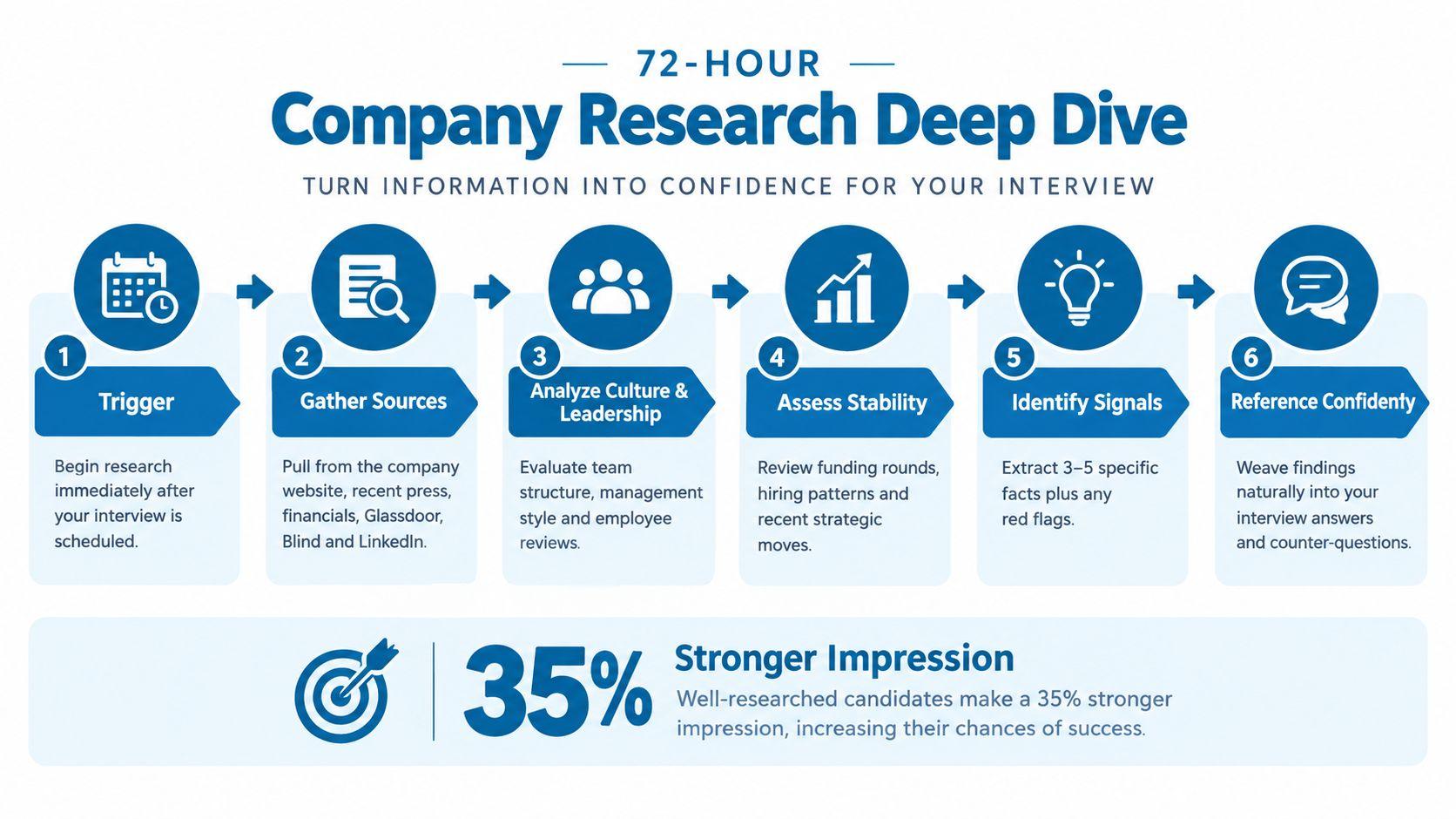
Company research should answer a practical question: what problem might this role be hired to solve, and can you work there under the stated conditions? Don’t collect trivia. Look for evidence about the company’s product, business direction, leadership, team structure, hiring location, work arrangement, and likely interview format.
Hays recommends a bounded research session of 60–90 minutes, covering the company website, recent news, social channels, one industry source, and employee reviews for recurring patterns. The same guidance recommends translating the research into 2–3 competencies from the job description and preparing five questions for the end of the interview, as described in Hays’ practical interview research guidance.
Build a decision-ready company brief
Use a single page with four areas:
- Business direction: Record recent product launches, funding announcements, acquisitions, strategic changes, or leadership movement. Treat these as context, not proof of company health.
- Role relevance: Connect the company’s visible priorities to your experience. A data engineer might focus on reliability, ingestion, warehouse architecture, or infrastructure scaling if those themes appear in the role and company materials.
- Work eligibility: Confirm whether the role is remote globally, remote within a named country, relocation-based, or connected to sponsorship. “Remote” alone doesn’t establish that you can work from your location.
- Interview signals: Note whether the process appears behavioral, technical, case-based, asynchronous, or multi-stage.
JobGlance’s Deep Company Research feature can synthesize listing legitimacy, company stability, culture indicators, and interview difficulty with confidence levels and cited evidence. Use it to accelerate review, then verify important eligibility and sponsorship details directly with the recruiter.
Practical rule: Research enough to tailor your evidence and questions, not so much that research replaces preparation.
Before the interview, write down 3–5 specific facts you can reference naturally. For example, an acquisition may justify a question about integration priorities. A new product direction may help you explain why a particular project in your background is relevant. Don’t present unverified assumptions as facts. Ask the interviewer to clarify what you’ve inferred.
2. Align Your Resume With the Actual Role
Your interview preparation starts with the resume that got you into the process. If the resume emphasizes the wrong experience, the interviewer may evaluate you against a weaker version of your background.
Extract the job description’s required skills, repeated phrases, tools, responsibilities, and outcome language. JobGlance’s Resume Match Score highlights matched and missing keywords inside the job description, while its ATS Resume Builder checks the resume against five concrete ATS criteria, rebuilds it in single-column templates, tailors it to a job, and exports a text-preserving PDF.
Turn keywords into interview evidence
Don’t copy keywords mechanically. Map each important phrase to something you can explain aloud.
- Technical alignment: If the role emphasizes Apache Spark cluster optimization, bring your strongest Spark example forward and prepare to discuss the bottleneck, your intervention, and the trade-offs.
- Product alignment: If the role stresses OKRs, explain how you defined, tracked, or adjusted objectives rather than relying on “led product strategy.”
- Global-work alignment: If the employer hires internationally, make legitimate experience with distributed teams, cross-border collaboration, or sponsorship processes easy to find.
A candidate targeting remote entry-level roles should use the same discipline as a senior candidate. The evidence may come from coursework, internships, open-source work, freelance projects, or volunteer delivery, but the connection to the job still needs to be explicit.
Create a small interview alignment sheet with three columns: job requirement, matching evidence, likely follow-up. For “build reliable data pipelines,” list the project that proves it, the architecture you used, and the failure or scaling question an interviewer might ask. For “work asynchronously across regions,” list the communication practice and the result.
Your action before the interview is simple. Read your resume beside the job description and circle every requirement you can defend in detail. Underline every important requirement you can’t yet support. That gap list should determine what you study, not a generic preparation guide.
3. Write a Short Opening Tied to the Job
“Tell me about yourself” isn’t an invitation to recite your entire career. It’s a test of relevance, structure, and communication under low pressure. Your opening should establish who you are professionally, show why your experience fits, and give the interviewer a reason to explore a specific achievement.
Write 3–5 sentences and practice until the response takes 45–55 seconds when spoken naturally. The structure is:
- Your professional identity.
- The experience most relevant to this role.
- One concrete achievement.
- Why this role makes sense for your next step.
A data engineer might say: “I’m a data engineer focused on building reliable infrastructure for high-volume systems. In my recent work, I’ve owned pipeline design, performance improvements, and collaboration with analysts and application teams. One project involved replacing a fragile batch workflow with a more maintainable architecture, which improved reporting reliability for stakeholders. I’m interested in this role because the description combines platform scale with close partnership across engineering and data.”
That example works because it’s selective. It gives the interviewer a clear path to ask about architecture, ownership, reliability, or collaboration.
Prepare versions for different rounds
The recruiter screen needs a broad fit signal. A technical interviewer needs a sharper connection to systems, tools, or problem-solving. An executive or final interviewer may care more about scope, judgment, and business impact.
Use JobGlance’s Resume Match Score to identify the role’s most visible skill priorities, then feature one of those priorities in the opening. Avoid generic claims such as “I’m a hard worker.” They don’t distinguish you from other candidates and give the interviewer no useful follow-up.
Practice with the same camera position, pacing, and eye line you’ll use in the interview. A strong opening can still feel unconvincing if you read it from a second monitor or rush through it. Record one version, remove unnecessary history, and keep one achievement that you can explain in depth.
4. Map Behavioral Questions to Competencies
Behavioral preparation becomes more efficient when you prepare for competencies instead of isolated questions. A role may repeatedly test ownership, technical judgment, conflict management, adaptability, communication, learning speed, or customer focus, even when the wording changes.
Start by identifying 5–7 core competencies from the job description. Include behaviors, not only tools. “Python” is a skill. “Explains technical trade-offs to nontechnical stakeholders” is a competency. For a global remote role, distributed communication and adaptability may be central even if the posting doesn’t label them as interview categories.
Create a reusable story bank
Prepare 1–2 stories per competency, allowing one story to demonstrate multiple strengths. A remote data candidate might build a bank around:
- Distributed communication: resolving ambiguity across time zones.
- Ownership: taking responsibility for a failing workflow.
- Technical depth: improving a pipeline or service.
- Rapid learning: becoming productive in an unfamiliar system.
- Cross-functional collaboration: translating technical constraints into business decisions.
Keep each story as a short outline, not a memorized script. Write the context, your responsibility, the actions you personally took, and the outcome. Add likely follow-up questions, such as what you’d change, who disagreed, or how you measured success.
Listen for the competency beneath the question. “Tell me about a difficult stakeholder” may be testing communication, judgment, conflict resolution, or ownership.
Validate your map against the job’s matched and missing keywords in JobGlance. Then practice choosing the right story quickly. You shouldn’t force a technical achievement into a collaboration question because it has impressive results.
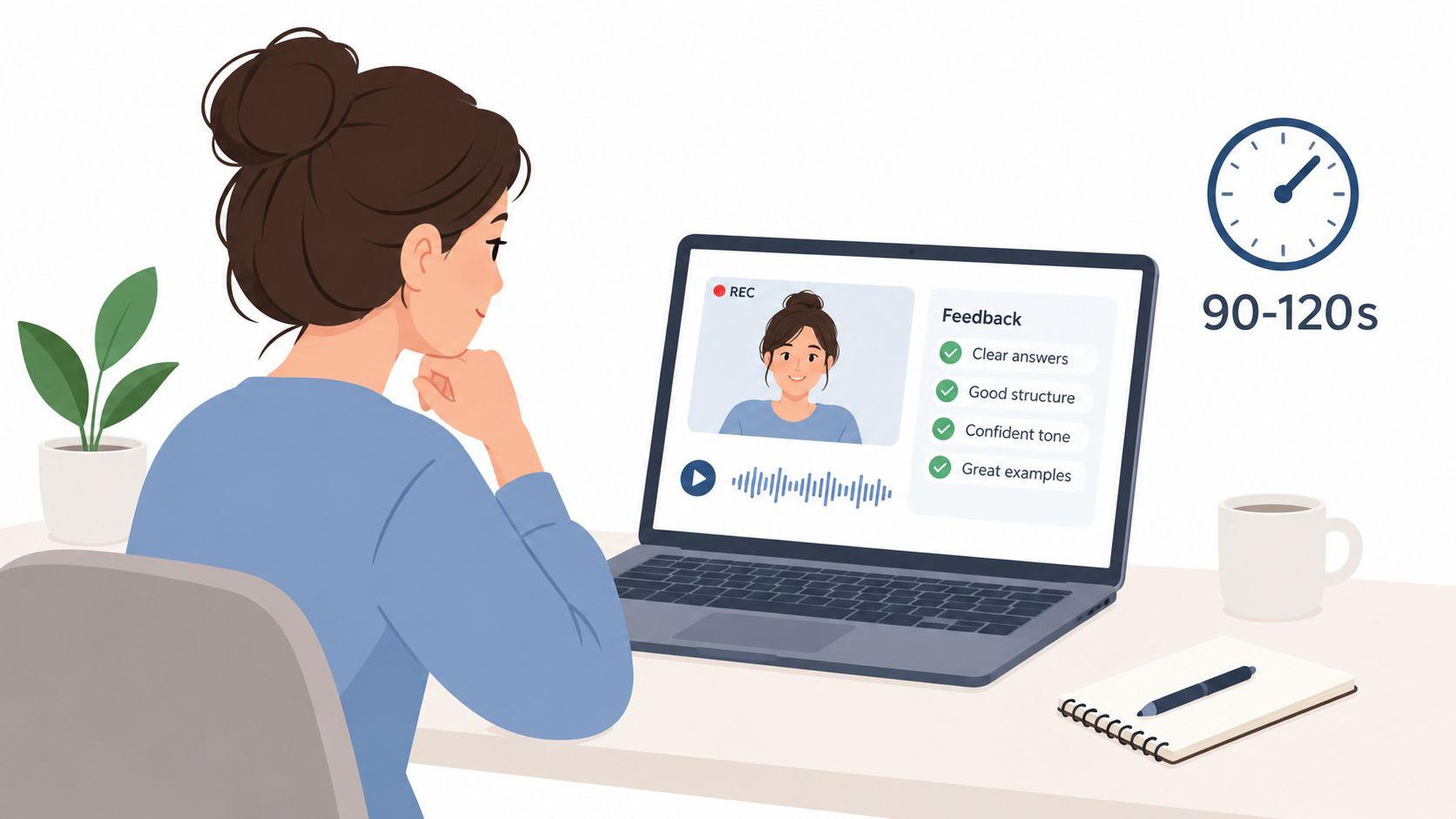
A useful rehearsal is to have someone ask behavioral questions in random order. Answer each in 90–120 seconds, then ask them which competency they heard. If they identify a different competency from the one you intended, revise the story’s emphasis rather than adding more detail.
5. Structure STAR Answers Around Action and Results
STAR gives behavioral answers a reliable shape: Situation, Task, Action, Result. Its value isn’t the acronym itself. The value is that it prevents candidates from spending the whole answer describing background while leaving their own decisions unclear.
MIT’s career guidance recommends a STAR distribution of 20% Situation, 10% Task, 60% Action, and 10% Result, with the Action section carrying most of the detail and the Result emphasizing measurable outcomes. Northwestern’s guidance uses a different split, 15% Situation, 10% Task, 50% Action, and 25% Result, but reaches the same practical conclusion: keep context short, explain what you did, and make the outcome clear. Compare the MIT STAR method guidance with Northwestern’s STAR breakdown.
Make the result defensible
Use numbers only when you know what they mean and can explain how they were measured. A result can be a time reduction, defect change, revenue effect, adoption outcome, delivery milestone, reliability improvement, or documented lesson. If confidentiality prevents you from naming an amount, describe the result qualitatively and explain the measurement method.
Weak: “I improved the onboarding process.”
Stronger: “The team was losing time because new hires lacked a consistent sequence of environment setup and product training. I mapped the recurring blockers, created a staged onboarding guide, and added an owner for each step. New hires reached independent work sooner, and the team had a repeatable process instead of relying on informal support.”
The stronger version makes your actions visible without inventing a metric.
Prepare stories for leadership, failure recovery, teamwork, technical achievement, conflict resolution, and innovation. Record yourself and listen for passive language, such as “we decided” when you need to explain your contribution. You can mention the team, but the interviewer needs to understand what you noticed, chose, built, changed, or learned.
6. Validate Skills With a Portfolio or Demonstration
A resume asserts capability. A portfolio lets the interviewer inspect how you think.
For technical candidates, that proof might be a documented GitHub project, a code sample, a data analysis, a system design explanation, or a dashboard built from public data. For product candidates, it might be a case study showing discovery, prioritization, trade-offs, launch planning, and outcomes. The artifact doesn’t need to disclose confidential work. An anonymized explanation of the problem, method, decision criteria, and result can demonstrate judgment without exposing protected information.
Build one artifact the role can evaluate
A data analyst could create a Tableau dashboard from public e-commerce data and explain the SQL logic, visualization choices, and business recommendation. A backend engineer could document a service with its API design, testing approach, failure modes, and operational trade-offs. A product manager could write a case study about a prioritization decision and show how customer evidence shaped the roadmap.
Candidates targeting product manager roles should make the product artifact easy to scan. Start with the problem, identify the users or stakeholders, explain the options considered, and show why you selected one path.
Add a short README or introduction covering:
- Problem: What needed to change?
- Approach: What did you build, analyze, or decide?
- Trade-offs: What did you reject, and why?
- Outcome: What changed, and how did you assess it?
- Reflection: What would you do differently now?
Keep the project aligned with the target role’s real skill distribution. A polished but irrelevant artifact won’t compensate for a missing core competency. During the interview, offer it as supporting evidence rather than forcing the interviewer through a presentation. Be ready to explain technical choices, uncertainty, collaboration, and what failed.
7. Prepare for the Role’s Actual Technical Evaluation
Generic technical practice can waste time if it does not match the interview format. For international and remote candidates, the goal is to prove you can handle the role’s evaluation process, not just solve isolated exercises.
Start by identifying what the company is likely to test. Engineering roles may focus on coding, debugging, system design, or architecture discussion. Data roles may center on SQL, statistics, experimentation, modeling, or a case study. Product roles may involve product sense, prioritization, metrics, execution, or a take-home exercise. Use the job description, recruiter notes, company research, and candidate reports to narrow the format before you study.
For a data engineering target, JobGlance’s Data Engineer role insights can help you compare the skills that recur across live listings. Use that comparison to find gaps, then verify the employer’s specific stack before you spend time drilling details.
Match practice to the evaluation
Use practice that mirrors the test you are likely to face:
- Coding: Work in the language named in the role and explain complexity, edge cases, and trade-offs aloud.
- System design: Review database scalability, caching, service boundaries, observability, and failure handling only if those topics fit the job.
- Data analysis: Drill SQL, metric definition, experiment design, and interpretation of ambiguous results.
- Product cases: Clarify the user, objective, constraints, success measure, and prioritization logic.
Practice under the same constraints you will face in the interview. If the company uses a timed exercise, rehearse with a shorter internal checkpoint so you leave time to review. If you will share a screen, narrate your reasoning while keeping the workspace readable. If your connection may be unstable, set up a fallback communication method and know how to reconnect without losing your place.
Breadth has limits here. Hiring teams usually screen for a narrow set of skills tied to the role, so spend most of your time on the areas they will score and the weakest point that could block an offer.
8. Use Recorded Mock Interviews to Fix Delivery
Strong candidates often know the answer but lose points in how they present it under pressure. A recording shows pacing problems, filler words, weak transitions, poor eye contact, and answers that sound clear in your head but not to the interviewer. For international and remote tech roles, it also reveals whether your delivery still works when the interview depends on video, not in-person cues.
Recorded rehearsal works because it separates performance from memory. You can replay the session, spot the exact point where your explanation drifts, and correct one problem at a time before the interview.
Review the recording like an evaluator
Use questions tied to the actual role, then record video, not just audio. The video matters because remote interviews also test posture, eye line, attention, and how you hold space while thinking.
Check the replay against a fixed rubric:
- Answer structure: Did you state the situation, your role, your actions, and the result?
- Pacing: Did you front-load the main point, or hide it in a long setup?
- Clarity: Could someone outside the project follow the explanation?
- Ownership: Did your part of the work come through clearly?
- Technical communication: Did you explain trade-offs instead of listing tools?
- Cross-time-zone collaboration: Did the answer show how you work across different schedules and communication styles?
Correct one issue per rehearsal. If you ramble, start with the conclusion and then support it. If you speak too fast, pause after the question and between major steps. If the explanation is dense, define the term once and keep going in plain language.
For coding interviews, add a screen recording. State your assumptions, ask clarifying questions, give a baseline approach, and explain complexity before you optimize. The Zemith coding interview tips give more practice ideas for explaining solutions instead of coding in silence.
9. Prepare Questions That Test Mutual Fit
Your questions can determine whether the role is eligible for you before you invest in later rounds. Verify the company, work location, time-zone expectations, technical environment, decision process, sponsorship path, and definition of success. These answers affect whether an offer would be usable, not whether the interview feels positive.
Prepare seven questions and select five or six based on the conversation. Hays recommends preparing five end-of-interview questions after researching the company, role, and industry context. Group them by interviewer: ask executives about priorities and direction, hiring managers about execution, and technical interviewers about systems and constraints.
Test the conditions behind the offer
Use questions that produce operational details:
- Role scope: “What problem should this person improve first?”
- Technical constraints: “Which part of the current system creates the most operational friction?”
- Remote collaboration: “How does the team decide what requires a meeting and what stays async?”
- Global work: “Which countries can this role be performed from, and are working hours tied to a specific region?”
- Sponsorship: “At what stage does the company confirm sponsorship eligibility and begin the application process?”
- Performance: “What evidence would show that the person in this role is succeeding?”
- Process: “What interview stages remain, and what timeline should I expect for a decision?”
Use your research to sharpen the questions. If a product launch, leadership change, or acquisition appears relevant, ask what changed operationally for the team. This reveals whether public company information matches daily work. Skip questions answered plainly on the website, and avoid forcing the interviewer to defend a decision before you understand its context.
Keep the final list beside your screen. Mark each answer against your requirements for location, communication, sponsorship, working hours, and technical expectations. After the interview, record any unresolved eligibility issue and request clarification before treating the role as a viable path to an offer.
10. Send a Follow-Up With Specific Conversation References
A follow-up email shouldn’t be a generic thank-you note. It should help the interviewer remember the conversation, reinforce one relevant capability, and address a concern if one surfaced.
Write notes during the interview about the team’s current challenge, the project discussed, the interviewer’s priorities, and any question where your answer felt incomplete. Draft the message within a few hours while the details are fresh, then send it within 24 hours. Keep it to 3–5 sentences, as recommended in the preparation plan, and address the person by name.
Use a simple evidence-based structure
- Thank the interviewer for the conversation.
- Reference a specific topic they raised.
- Connect that topic to one relevant example.
- Confirm interest and invite the next step.
For a backend role: “Hi Maya, thanks for the detailed conversation about the service migration and the reliability issues affecting invoice processing. Your description reminded me of a project where I worked on tracing and dependency failures during a similar transition. I’d be glad to discuss how that experience could apply to your team’s priorities. I’m excited about the role and available for the next step.”
If the interviewer questioned your remote collaboration, address it directly with evidence. If sponsorship was discussed, confirm your understanding of the process and your eligibility requirements without turning the email into a negotiation. If you gave an incomplete technical answer, add a concise clarification only when it improves accuracy.
The follow-up should sound confident, not desperate. Don’t repeat your resume or send a long essay. One specific conversation reference is more useful than broad enthusiasm.
10-Point Interview Prep Comparison
| Method | 🔄 Implementation Complexity | ⚡ Resource / Time | 📊 Expected Outcomes | 💡 Ideal Use Cases | ⭐ Key Advantages |
|---|---|---|---|---|---|
| The 72-Hour Company Research Deep Dive | High, multi-source analysis and verification | Moderate, 2–6 hrs manual; JobGlance saves 2–3 hrs | 📊 ~+35% stronger impression; reduces risk of scam/fit issues | Interviews where company signals, stability or recent changes matter (startups, acquisitions) | ⭐ Evidence-backed talking points; identifies red flags; enables targeted questions |
| Targeted Resume Alignment to Job Description Keywords | Low–Medium, systematic keyword mapping | Low, ~45 min per tailored version with tool; higher if manual | 📊 ~+40% callback; ATS pass-through improvements (22→52%) | High-volume applications; roles screened by ATS | ⭐ Increases ATS pass rate; highlights relevant metrics; speeds submissions |
| Scripted Opening Statement (30–60s) Tied to Job Requirements | Low, short, focused scripting and practice | Low, 1–2 hrs to craft and rehearse | 📊 ~+22% interview success; +38% initial impression | Initial screens and first-round interviews | ⭐ Sets confident tone; controls first impression; fully controlled by candidate |
| Behavioral Question Preparation Using Competency Mapping | Medium–High, extract competencies and build story bank | Medium, 4–6 hrs for thorough mapping and 1–2 stories per competency | 📊 ~+34% effectiveness answering behavioral questions | Roles emphasizing culture fit, leadership, cross‑functional work | ⭐ Eliminates “what story?” paralysis; ensures competency coverage |
| STAR Method Structuring with Quantified Outcomes | Medium, structure + quantify outcomes per story | Medium, prepare 8–12 stories, practice to 90–120s each | 📊 ~+28% success; increases recall of answers by ~65% | All roles where impact and metrics matter (tech, PM, ops) | ⭐ Clear, comparable evidence of impact; reduces rambling |
| Industry-Specific Skill Validation (Portfolio/Demos) | High, create case studies, demos, or curated portfolio | High, 10–20+ hrs to produce quality, ongoing maintenance | 📊 ~+64% more callbacks when tangible proof provided | Technical/design/analytics roles or roles requiring demonstrable output | ⭐ Concrete validation of claims; strong differentiator in interviews |
| Industry & Role-Specific Technical Preparation | Very High, targeted technical study (system design, coding) | Very High, 100+ hrs for serious prep; ongoing practice | 📊 ~+52% pass rate on technical rounds | Engineering, data science, senior technical PM roles | ⭐ Directly improves technical round performance; reveals knowledge gaps |
| Practice with Mock Interviews Using Recorded Feedback | Medium, set up, record, review, iterate | Medium, 2–3 hrs per prep cycle; 4–6 mocks recommended | 📊 ~+31% performance improvement; 2.3x retention via mirror-neuron effect | Near-term interviews across roles; candidates needing delivery polish | ⭐ Reveals verbal tics, pacing, body language; measurable improvement |
| Strategic Preparation of 5–7 Thoughtful Counter-Questions | Low, targeted research + question drafting | Low, 30–90 min to craft and tailor 5–7 questions | 📊 ~+37% hiring likelihood; +45% perceived competence | Final rounds, manager/executive interviews, culture-fit evaluation | ⭐ Demonstrates genuine interest; uncovers team priorities and fit |
| Follow-Up Email Strategy with Specific Conversation References | Low, write concise, personalized follow-up | Very Low, 15–30 min; send within 24 hrs | 📊 ~+26% offer probability when personalized | After any interview (screening → final) | ⭐ Opportunity to address concerns, reiterate fit, and remain memorable |
Turn Preparation Into a Repeatable Interview System
The ten interview preparation tips work best as a sequence, not as separate tasks. Start by verifying that the role is legitimate, open to your location, compatible with your work authorization, and realistic about remote geography or relocation. A role that fails this test doesn’t deserve the same preparation effort as a strong match.
Next, check the fit between your resume and the job description. Use matched and missing keywords to identify what the interviewer is likely to explore. Separate genuine gaps from wording gaps. If you have the skill but your resume doesn’t show it clearly, prepare the evidence and update the language. If you lack the skill, decide whether a focused review can help or whether the role is asking for experience you can’t credibly claim.
Prepare a short opening that connects your identity, relevant experience, one defensible achievement, and the reason you want this role. Then build a competency map from the job description. Create STAR stories that show ownership, collaboration, technical judgment, adaptability, failure recovery, and measurable outcomes where you have reliable evidence. Keep the Action section dominant, and don’t let background context crowd out your decisions.
Validate your technical evidence next. Review the employer’s likely evaluation format, then practice the actual skill distribution. A data engineer shouldn’t spend all preparation time on generic behavioral questions if the process includes SQL or system design. A product manager should be ready to defend prioritization and metrics, not only describe past launches. A remote candidate should rehearse explaining decisions clearly when the connection, screen, or communication channel introduces friction.
Record mock interviews on the device you’ll use. Review one delivery issue at a time. Confirm the meeting link, date, time zone, interview format, interviewer names, required software, screen-sharing expectations, and backup contact method. For international roles, ask directly about work authorization, sponsorship, employer-of-record arrangements where relevant, permitted work locations, and expected overlap hours.
Prepare questions that help you assess the offer before it exists. Clarify team priorities, technical bottlenecks, remote-work geography, sponsorship timing, compensation currency, benefits, decision timing, and the remaining process. Don’t accept an offer until the practical terms are clear in writing. The interview is also your due diligence period.
JobGlance can bring this workflow into one preparation path. Use Smart Match and the Resume Match Score to prioritize roles and identify missing keywords, the ATS Resume Builder to tailor and export a text-preserving resume, and Deep Company Research to review legitimacy, stability, culture signals, and interview difficulty with confidence levels and cited evidence. Its dedicated visa sponsorship and work-from-anywhere filters help you verify eligibility before preparation begins, while the Chrome extension carries match scoring, sponsorship detection, and AI tools onto job pages across the web.
The process becomes manageable when every preparation action answers a specific question: Can I take this job? What evidence proves fit? Which skill could eliminate me? Can I explain my work clearly under realistic conditions? What do I need to learn before accepting an offer? That is a better system than rehearsing answers for roles you were never able to accept.
Use JobGlance to filter for visa sponsorship and work-from-anywhere roles, score your fit, tailor your resume, research companies, and carry interview preparation tools onto job pages with the Chrome extension. Build your next interview plan around eligibility, role evidence, realistic practice, and informed decisions.
Keep reading


