Visa Sponsorship Resume Checklist: 10 Fixes Before You Apply


On this page
A good resume can still hide your eligibility. International and remote candidates must pass more than a skills review. The document needs to parse cleanly, match the specific role, and make work authorization, location, and availability easy to understand before a recruiter has to infer anything.
That matters because applicant tracking systems now sit between many applications and human reviewers. A 2025 review of every Fortune 500 company found that 97.8% used an ATS, while multiple 2026 resume-statistics roundups report that about 75% of resumes are rejected before a human review (NovoResume). Your resume checklist therefore needs to function as an eligibility-and-matching workflow, not just a proofreading exercise.
The ten checks below move from machine readability to role alignment, sponsorship clarity, evidence, location, and final presentation.
1. ATS Compatibility and Formatting
A polished resume can still fail at the extraction stage. Applicant tracking system software reads text, identifies sections, and compares content with the vacancy. Columns may be read in the wrong order, text inside graphics may disappear, and headings in text boxes may be missed. The result is an incomplete record of your experience before a recruiter evaluates your eligibility or fit.
Use a single-column layout as the default. Label sections with familiar headings such as Summary, Experience, Education, and Skills. Choose a conventional font, readable spacing, and text that can be selected and copied. A simple Word document or text-preserving PDF generally gives a parser fewer opportunities to misread the content than a heavily designed template.
Two-column layouts cause the most common problems. A parser reads the file in the order the text was written, not the order your eye follows down the page. A sidebar of skills can end up spliced into the middle of a job description, or a date column can detach from the roles it belongs to. The resume still looks correct to you, and the extracted version the recruiter searches is scrambled. Layout simplicity is what decides whether your evidence reaches the matching process at all.
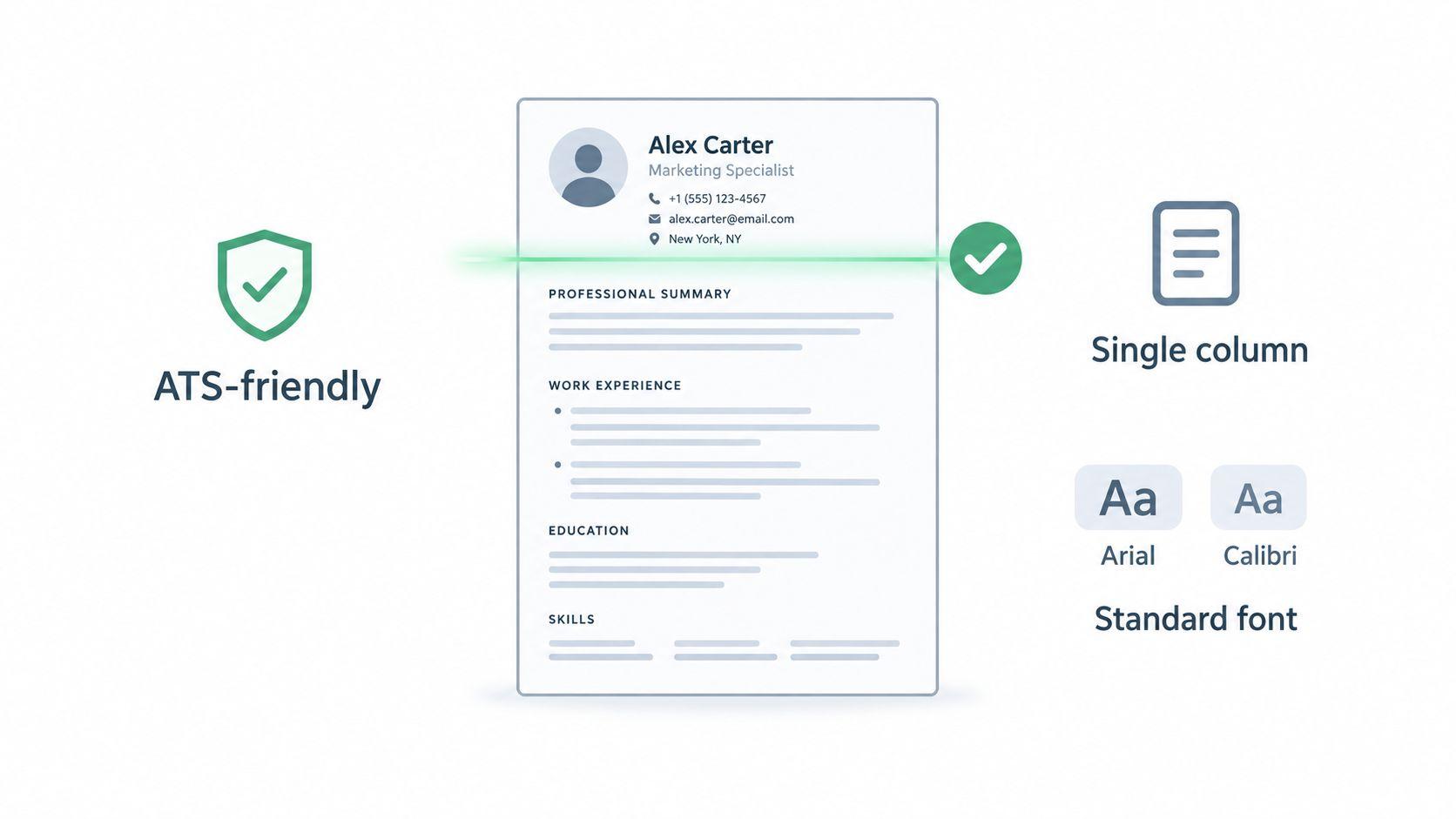
Remove parsing obstacles
Before submitting the file, verify these conditions:
-
The structure is single-column: Keep the reading order linear from the header through experience and education.
-
The text is selectable: Do not use scanned PDFs, screenshots, certificate images, or text embedded in graphics.
-
The headings are conventional: “Professional Experience” gives software a clearer classification than “My Journey.”
-
The contact details are plain text: Place your email, phone number, city, and professional profile link in the header without icons or decorative containers.
-
The file survives conversion: Open the export in another reader and paste its text into a plain editor. Confirm that names, dates, locations, and section content remain in the intended order.
Before you submit, check your ATS score as a separate validation step to catch parsing issues from another angle.
2. Keyword Alignment and Professional Summary Optimization
A resume summary should do more than sound polished. It has to show the employer that your profile matches the role being screened. If it only says you are “results-driven” or “seeking new opportunities,” it uses space without helping ATS parsing or human review.
Start with the job title only if it fits your background. Then name the tools, methods, and responsibilities that appear in the posting and that you have used. A product manager applying to a role focused on roadmap ownership, stakeholder communication, experimentation, and product analytics should use those terms where they reflect real experience. Review a live example of role wording in Product Manager roles on JobGlance.
Keyword alignment is a matching exercise, not a copy test. The point is to translate your experience into the employer’s language without adding claims you cannot support. So before you apply, read the posting next to your summary, skills, and top bullets, and check that the terms the employer uses for the work actually appear where you have done that work.
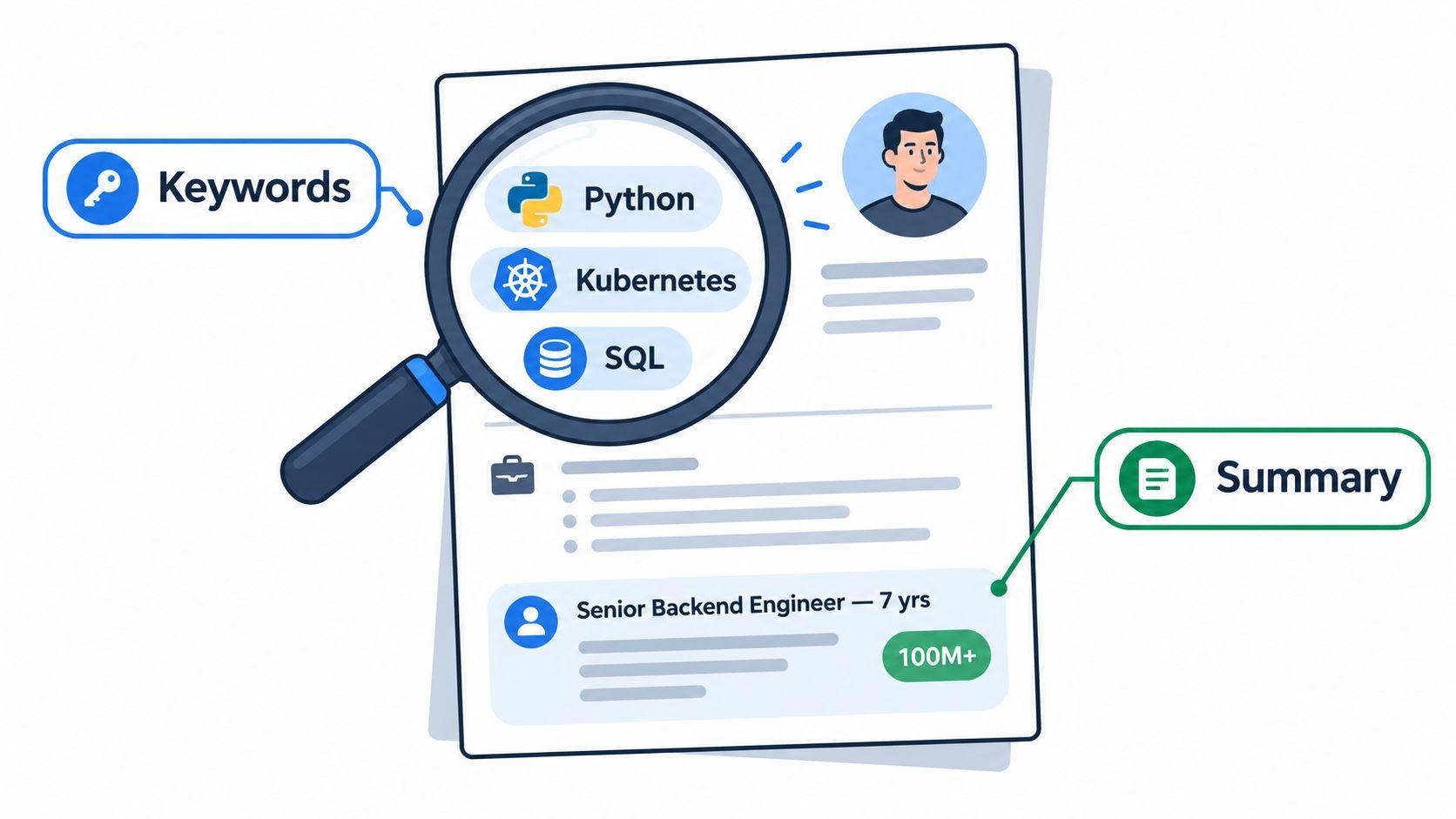
A strong summary usually answers four questions in one short block. What role are you targeting. What can you do. What evidence supports that claim. Can the employer hire you.
Use those questions as a filter, not a template. A backend engineer might write, “Backend Engineer specializing in Python microservices and Kubernetes orchestration. Built production systems and improved service reliability through automated deployment. Requires employer sponsorship and is available for roles in the target market.” The structure works because it ties title, capability, evidence, and eligibility together.
The same logic applies to any role. If your summary names the target role but leaves out the evidence or the hiring constraint, it helps neither ATS matching nor recruiter screening. When you find a role you want to pursue, use the JobGlance ATS Resume Builder to tailor your resume against that posting, spot keyword and skills gaps, and add relevant terms you can genuinely support. That way, you improve alignment by selecting real skills and experience to include, rather than stuffing keywords at random.
3. Visa Sponsorship Statement and Eligibility Clarity
Recruiters shouldn’t have to decode whether you can legally work in the target country. A resume that clearly shows sponsorship needs, current authorization, or eligibility gives the employer a usable screening signal. A vague phrase such as “open to international opportunities” doesn’t answer the operational question.
Put a concise statement in the summary or under a clearly labeled Work Authorization heading. Keep eligibility information separate from your skills evidence. The first line tells the employer whether a hiring pathway may exist. The rest of the resume should explain why you’re a strong candidate for the role.
Useful formats include:
-
Sponsorship required: “Requires employer-sponsored work authorization for employment in the United States.”
-
Current authorization: “Authorized to work in the United Kingdom under [visa type], valid through [month and year].”
-
Eligibility pathway: “Eligible for employer-sponsored work authorization in Australia, subject to role and employer requirements.”
-
Multiple targets: “Currently based in [city and country]. Targeting the United Kingdom and Ireland, with employer sponsorship required.”
Don’t claim eligibility unless you understand the relevant conditions. Visa rules vary by country, role, salary, credential, and employer. Country-specific guidance also recommends translating overseas experience into local employer language while keeping authorization information brief (NewCV guidance on UK visa sponsorship CVs).
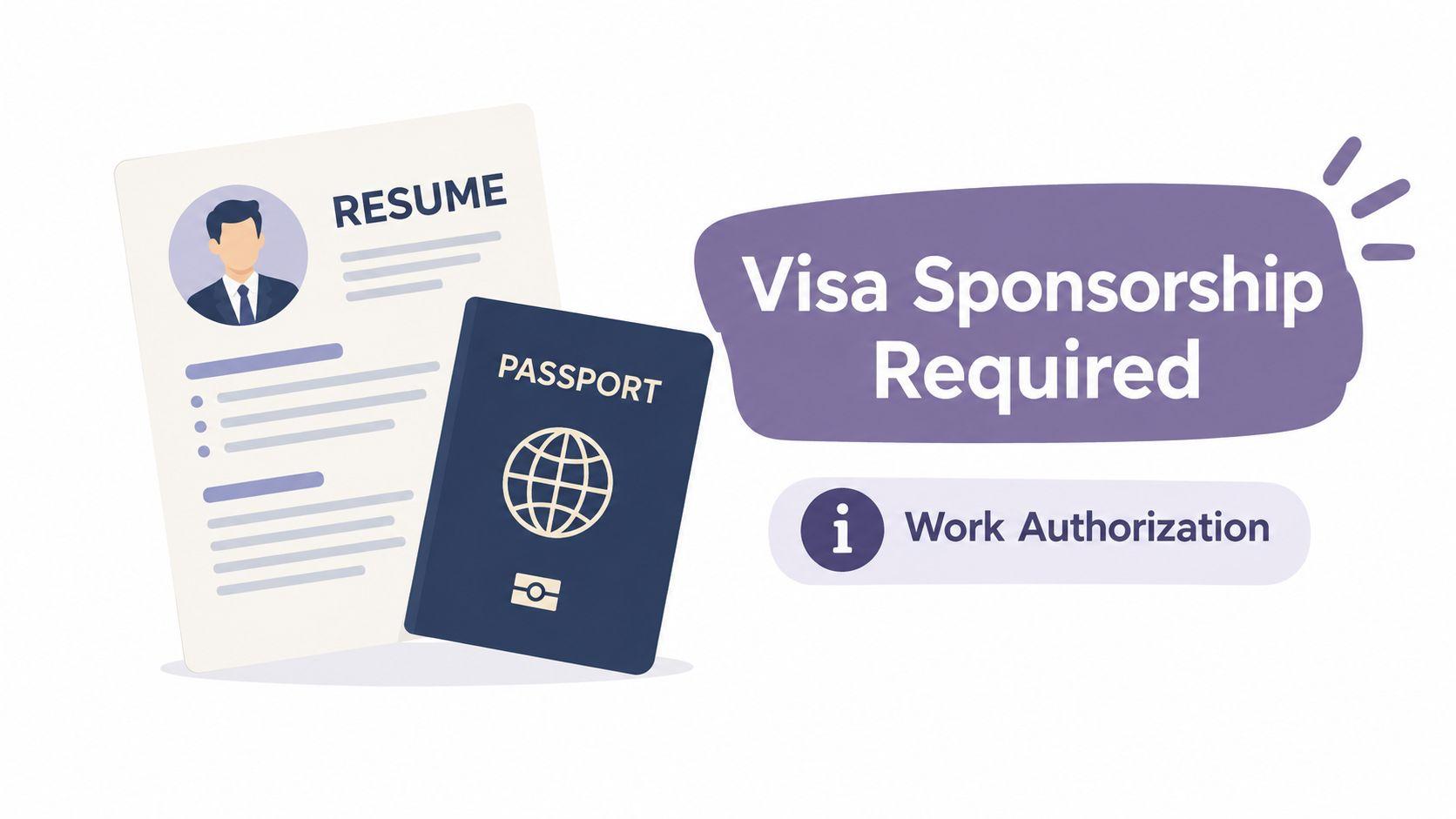
Make the statement visible, not dominant
Place the authorization signal early, but don’t let it become the main story. A software engineer can state the sponsorship requirement in the summary, then use the remaining space for systems built, tools used, and business outcomes.
If you’re pursuing permanent employment authorization through an employer process, use accurate terminology. For candidates navigating US employment-based processes, understanding what PWD status means for PERM can help prevent imprecise wording. Your resume isn’t a legal filing, so it should communicate status clearly without making legal conclusions you can’t support.
Relevant openings can be filtered through JobGlance visa sponsorship jobs. The key distinction is simple: eligibility clarity gets you considered for a viable pathway, while role evidence earns the interview.
4. Quantified Achievements and Measurable Impact
A sponsorship decision gives an employer more room for doubt than a standard application. Your resume should reduce that doubt by making the value of your work easy to assess. Duties show what you were asked to do. Achievements show what changed because you did it.
Use a tight action, method, result, and scope structure. Replace “responsible for database maintenance” with a concrete line such as: “Optimized production queries by restructuring indexes and reviewing execution plans, reducing response time from [before] to [after] across [system or user base].” The placeholders push you to find evidence instead of inventing it.
A quantified first line also helps during fast screening. Historical summaries of recruiting practice note that an initial scan may last only 6 seconds, while other 2024 to 2026 summaries place initial review at roughly 1 to 3 minutes. The same guidance says 71% of employers spend less than 15 minutes on a resume (Hyring). A measurable result near the top gives the reader a reason to keep going.
A number is not automatically better than a clear scope statement. Use metrics only when they are verified.
Pick evidence that a new employer can interpret
International employers may not recognize every company, title, or local term on your resume. Scope and outcomes make the work legible across markets. Use evidence such as scale, like records migrated, customers served, transactions processed, or systems supported. Use efficiency, like time, cost, error rate, or processing gains. Use commercial impact, like revenue influenced, retention improved, or waste reduced. Delivery, such as products launched or programs completed, and leadership, such as teams coordinated or vendors managed, also travel well.
Do not add a metric just because a bullet looks stronger with a number. Use a verified figure from your records. If the number is approximate, label it as such and explain the basis. If no exact figure exists, describe the scope accurately with terms like “high-volume,” “cross-functional,” or “multi-region,” then add concrete context.
5. Recency, Relevance, and Employment Gaps
A career gap is not an automatic eligibility failure. An unexplained gap creates uncertainty about availability, location, visa status, or current capability. Candidates seeking sponsorship should address those questions with a brief explanation and evidence of productive activity.
Use month and year for every role so an ATS and human reviewer can follow the timeline. Add one factual line beneath a relevant date range when context is needed: “Visa transition period with continued professional development” or “International relocation period, including certification study and contract project work.” Use either statement only when it accurately reflects the circumstances.
For each gap, check three points. The reason: state relocation, visa transition, or study when relevant. The activity: show contract work, learning, or volunteer contributions. The recency: make clear that your skills are current and your timeline is understandable.
Older experience should earn its space through relevance. De-emphasize unrelated history, group similar short-term work when that improves readability, and place recent, role-matched evidence first. The timeline, location context, and sponsorship language all need to be visible before you send.
6. Skills Section and Technical Proficiency Levels
A skills list is useful only when it supports eligibility and matching. It should help a recruiter answer two questions quickly: does this person have the required capabilities, and how extensively have they used them? A long, unstructured list can hide the terms that matter for the vacancy and gives little evidence of depth.
Group skills into categories such as Programming Languages, Cloud Platforms, Data Tools, Product Methods, or Security. Place role-relevant capabilities first, then apply proficiency labels only when you can defend them with specific work. The categories and wording should also remain clear to ATS software.
A practical structure is:
-
Advanced: Technologies you use independently in production and can explain through multiple examples.
-
Intermediate: Tools you’ve used in meaningful work, with less depth or ownership.
-
Learning: Technologies you’re studying or have used in limited practical contexts.
Years of experience can add context, but time alone does not prove mastery. “Advanced, production use” communicates the nature of the evidence more clearly than a bare “five years.”
Make every tier defensible
For a DevOps role, a skills block might place AWS, Docker, and Ansible under advanced capabilities, Kubernetes and Terraform under intermediate capabilities, and GCP under learning. Use labels that reflect your actual work rather than the requirements you hope to meet.
Connect the strongest skills to experience bullets. If PostgreSQL appears as advanced, show whether you designed schemas, optimized queries, operated databases, or resolved production issues. For stakeholder communication, identify the project or decision that required it. This connection helps reviewers assess both technical depth and role-specific evidence.
When space is limited, remove peripheral tools before removing a required capability from the target posting. Check whether the finished resume makes relevant skills, work location, and any sponsorship-related eligibility information easy to identify. The final test is whether the document presents a credible match, not merely a list of technologies.
7. Cover Letter Presence and Personalization
A cover letter earns attention only when it adds information the resume cannot show efficiently. Use it to clarify fit, explain location or sponsorship context, and connect your experience to a specific business need.
An effective letter should:
-
Refer to the specific role and company, with no generic placeholders.
-
Mention a real product, expansion, technical challenge, or business direction.
-
Explain the authorization you need or already hold without making sponsorship the whole story.
-
Highlight one or two pieces of evidence that matter for that role.
-
Close with a clear invitation to discuss fit.
For example, an applicant for an infrastructure role might connect a documented reliability improvement to the company’s current platform expansion, then state the authorization required for employment in that country. That combination gives the employer both role-specific evidence and practical eligibility information.
An AI tool can produce a first draft from the job description and resume. Edit every paragraph yourself. Remove unverifiable claims, generic praise, and wording disconnected from the employer’s work. Check the company name before sending. A polished letter with the wrong name signals poor attention.
Keep effective structures as templates, not completed letters. Every application needs a new opening, a role-specific evidence paragraph, and an accurate authorization statement. For international candidates, this limited customization can clarify genuine interest and hiring conditions.
8. Location Flexibility and Geographic Alignment
“Remote” describes the work arrangement, not automatically the hiring geography. Employers may limit remote hiring to a country, state, or approved payroll region. A resume that says only “open to remote work” leaves both ATS parsing and recruiter review without the location data needed to assess eligibility.
Separate three facts in a clear location line: where you live now, where you want to work, and what authorization you need. For example: “Currently based in São Paulo, Brazil. Targeting remote roles open to candidates worldwide. Available for collaboration across US and European time zones.” If relocation is realistic, name the destination, expected timing when known, and whether you require visa sponsorship. This makes your eligibility easier to match with the vacancy.
List only the countries or markets you plan to pursue. A long, undifferentiated list can suggest limited focus and obscure the authorization pathway that applies to you. Use the cover letter for the fuller explanation of relocation plans or why a particular location fits your career goals, while keeping the resume’s location and work authorization details direct.
Give remote employers operational detail
Remote readiness requires evidence. Identify the tools you used, the teams or time zones you coordinated, the written processes you created, and the results you delivered with limited supervision. Strong remote resumes typically show time zone overlap, remote tools, asynchronous communication, measurable outcomes, written communication, and self-management.
Review worldwide remote jobs on JobGlance to compare actual geographic requirements, then align your location line with the vacancy. The goal is a precise eligibility and matching document: state where you can work, when you can collaborate, and what authorization the employer must address.
9. Industry-Specific Credentials and Certifications
Credentials can reduce uncertainty when an employer is unfamiliar with your university, previous companies, or local professional standards. They also help match your resume to eligibility requirements for regulated roles, provided they support the vacancy rather than only filling space.
Select certifications that correspond to the work described in the posting. An AWS certification can support a cloud engineering application, while a security candidate may need a relevant security credential. A finance professional should place the license or certification recognized by the target market and employer where it is easy to find. Check each credential against the role’s responsibilities, authorization requirements, and ATS terminology.
Record each credential so it can be verified
Give recruiters enough context to assess its status and market relevance:
-
Credential: Use the official name, which also supports accurate ATS parsing.
-
Issuing organization: Identify the body that awarded it.
-
Date: Add the month and year when recency affects eligibility.
-
Status: Mark it as active, expired, in progress, or scheduled for completion.
-
Evidence: Include a verification link or digital badge when appropriate.
An unfinished certification must not appear complete. Label it “in progress,” add a realistic completion date, and be prepared to discuss the material. Remove credentials that no longer support the target role unless the employer requires them or they remain professionally relevant.
For candidates applying across markets, globally recognized credentials make qualifications easier to compare. They do not replace experience. Connect each certification to a work example, project, or technical capability elsewhere in the resume so the document shows both eligibility and evidence.
10. Consistent, Error-Free Formatting and Presentation
Formatting affects how employers and ATS software interpret eligibility evidence. A misspelled technology, conflicting employment date, unclear location, or damaged PDF can cast doubt on the rest of the resume. For visa-sponsored roles, those errors add friction to a review that already involves authorization, location, and role-fit checks.
Use three passes, each with a different purpose. Verify facts first: employer names, job titles, dates, locations, certifications, links, and work-authorization statements. Then review spelling, grammar, verb tense, and the parallel structure of achievement bullets. Last, compare the finished file against the target vacancy to confirm that role terms, location, and authorization details are still clear after editing.
Keep the presentation consistent without making it dense. Check:
-
Date format: Use one style throughout, such as “Jan 2023 to Apr 2024.”
-
Typography: Apply consistent fonts, sizes, margins, bullet indentation, and spacing.
-
Terminology: Spell tools, certifications, job titles, and visa categories correctly.
-
Claims: Retain metrics you can explain and support if an interviewer asks how they were measured.
-
Export quality: Open the PDF in more than one reader and test whether text can be selected and copied.
-
Cross-document consistency: Compare the resume with LinkedIn and the cover letter so dates, titles, locations, and authorization details agree.
Read the finished resume aloud after running spell-check. Hearing each bullet can expose missing articles, repeated wording, awkward phrasing, or weak action verbs that software may miss. Confirm that every bullet identifies an action and a relevant result.
Run the Checklist Before You Send
Use this final sequence before every application:
-
Parse: Confirm the file preserves text, order, headings, and contact details.
-
Match: Align real skills, titles, and evidence with the target posting.
-
Qualify: State your location, target market, authorization status, sponsorship need, and availability clearly.
-
Prove: Back each important claim with measurable or verifiable evidence.
If conversion changes page breaks, recheck the file in plain text to confirm that the name, contact details, section headings, dates, and bullets appear in the correct order. Remove columns, images, tables, text boxes, decorative headers, and unusual symbols if they interfere with extraction.
Then compare the resume with the job description line by line. Add only the terms you genuinely meet, and keep authorization wording specific to the country and role. For a final pass, the JobGlance ATS Resume Builder rebuilds the file in a single-column format and checks it against the posting you are targeting, so you can see which required terms are missing before you send it.
JobGlance helps international and remote candidates find roles with resume-based match scores, visa sponsorship and worldwide-remote filters, ATS resume rebuilding, and job-specific keyword validation. Visit JobGlance to prepare your resume and search for roles that fit your skills, location, and work authorization needs.
Keep reading


