Purpose of a Resume: What It Does and Why It Matters


On this page
64.9% of HR professionals make an initial resume decision in under 15 seconds, while 42% decide in under 10 seconds, according to a survey summarized by Novorésumé. That’s not enough time to appreciate a complete career story. It’s enough time to decide whether an application deserves closer attention.
The purpose of a resume is therefore more specific than “show your experience.” It’s a translation layer between your background, a recruiter’s decision criteria, automated screening, and the evidence an employer will eventually need to verify. For international and remote candidates, that translation must also make eligibility clear, not just professional ability.
What the Purpose of a Resume Really Is
A resume isn’t a personal biography. It’s an employer-facing summary designed to establish whether your qualifications, experience, and accomplishments justify advancing your application. Research on resume screening in the initial hiring process describes this early-stage function: helping employers identify applicants who should proceed to further evaluation.
That distinction changes what belongs on the page. An experience can be personally important without being decision-relevant. A short project can deserve prominent placement if it demonstrates a capability the employer needs.
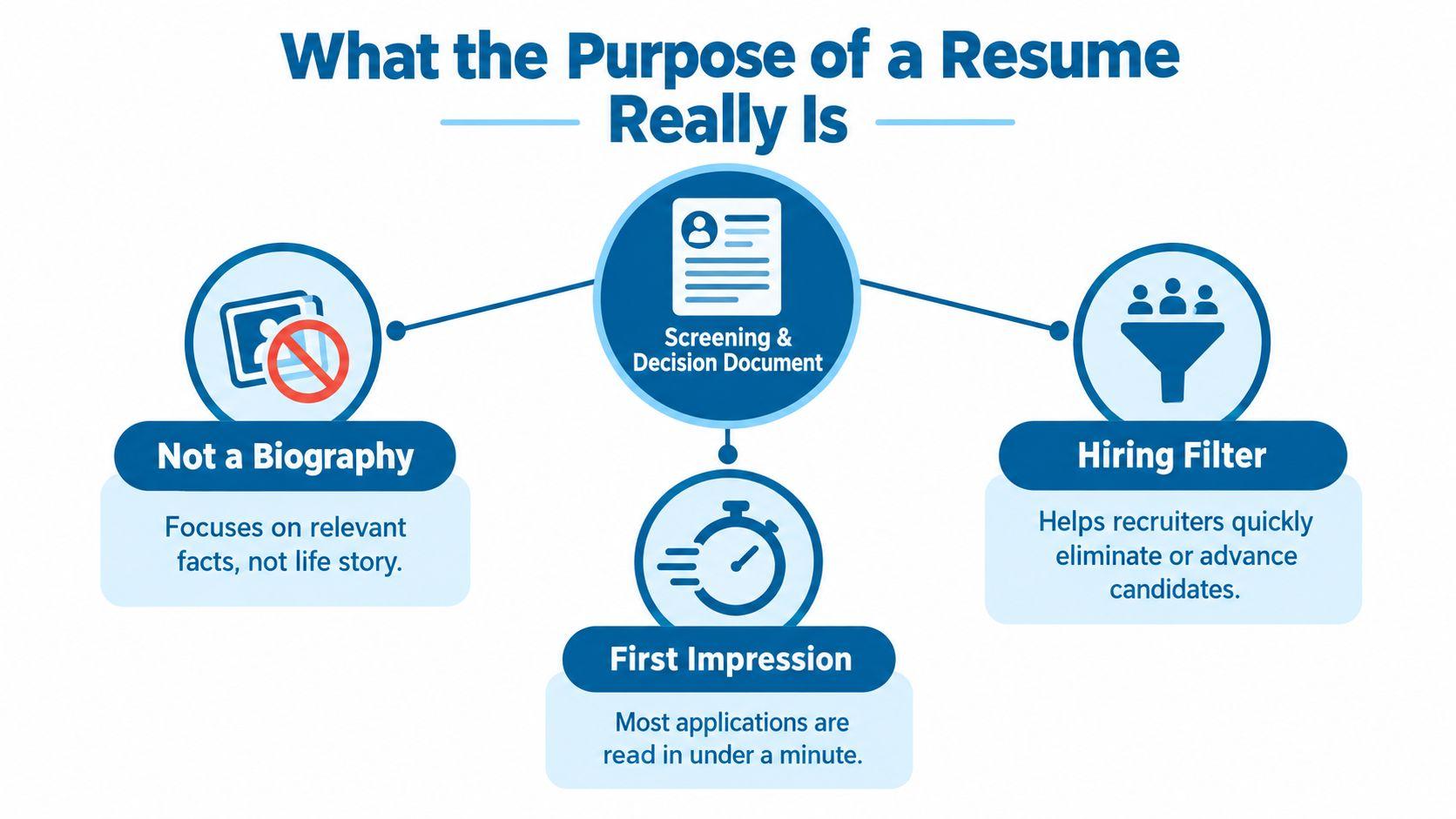
Selection matters more than completeness
Think of the document as a proposed reason to interview you. The employer should be able to identify your professional focus, recognize relevant evidence, and understand what remains to be tested.
That doesn’t mean leaving out inconvenient facts or disguising your history. It means choosing a defensible emphasis. For a data role, analytical projects may deserve more space than unrelated administrative tasks. For a management role, delivery responsibility and team leadership may matter more than a long inventory of software.
Core principle: The purpose of a resume is to be selected for further consideration, not to be exhaustive.
A useful editorial test is to ask what decision each line supports:
- Fit: Does this establish a required skill or relevant experience?
- Context: Does it explain the scope, environment, or difficulty of the work?
- Credibility: Does it give the reviewer something specific to verify?
- Eligibility: Does it resolve a practical condition of employment?
The strategic consequence is that a stronger resume may contain less information than a weaker one. Removing detail can improve the document when the remaining evidence becomes easier to interpret.
Don’t confuse that with making every career look conventional. A career changer should explain the connection between past work and the target role. An international applicant should make unfamiliar experience understandable. The objective is clear professional relevance, not a cosmetically perfect employment history.
How Recruiters Actually Read a Resume
In a quantitative eye-tracking study involving 30 professional recruiters over 10 weeks, recruiters concentrated on structured fields and spent an average of 7.4 seconds on an initial review, according to TheLadders’ recruiter eye-tracking study. The fields included names, current and previous job titles, employers, employment dates, and education.
The same research described erratic scanning and greater cognitive load with poorly organized resumes. The practical lesson isn’t that recruiters can assess your entire capability almost instantly. It’s that they first need to orient themselves before they can evaluate your achievements.
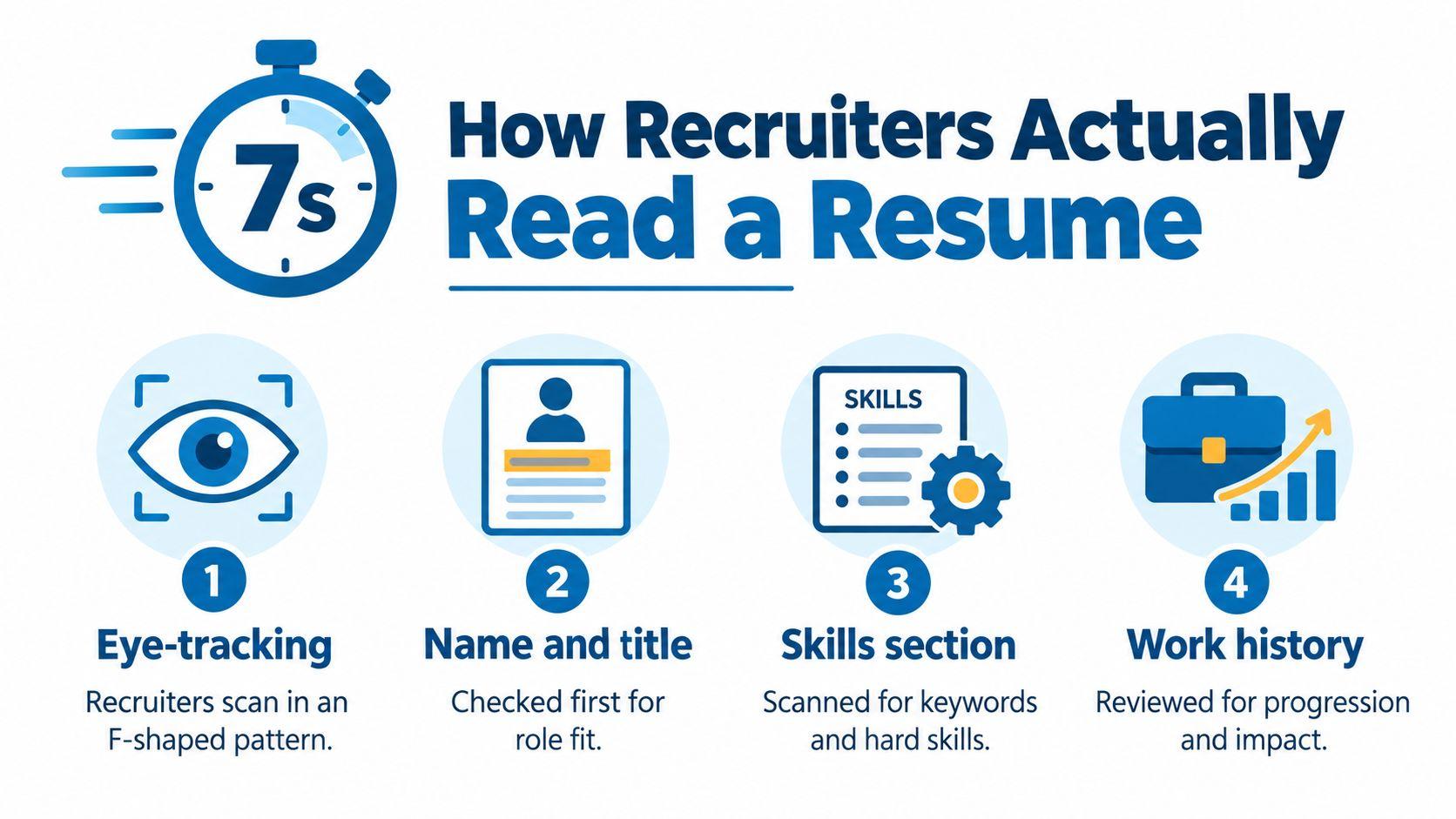
Make the professional outline obvious
Give the reviewer a stable route through the document. Use recognizable section labels, distinguish job titles from employer names, and put dates in predictable positions.
For international candidates, employer context deserves particular attention. If a company’s name won’t communicate anything to a reviewer abroad, add a brief, accurate description of its industry or product. Don’t assume an unfamiliar employer will receive the same recognition it enjoys locally.
Job titles need similar care. Keep your official title, but consider adding a truthful functional clarification when the title alone obscures what you did. The clarification should explain the role, not inflate its seniority.
Put the useful information at the start
An accomplishment bullet should reveal its subject before the reader reaches the end. Begin with the capability applied, the change made, or the outcome delivered, rather than introductory wording about being responsible for various duties.
For example, a truthful description of improving a reporting workflow is more informative than “responsible for reports.” Explain what you changed and how the result was verified. If you don’t have reliable measurements, describe the observable change without manufacturing a number.
Use this scanability checklist before sending:
- Hierarchy: Can someone distinguish headings, employers, titles, and bullets without decoding the design?
- Chronology: Are date formats consistent and employment transitions understandable?
- Relevance: Is your strongest role-related evidence easy to locate?
- Density: Have you replaced sprawling paragraphs with focused statements?
- Context: Can an unfamiliar reviewer understand your employer and responsibilities?
A recruiter shouldn’t have to reconstruct your career before considering your suitability. Structure is a way to reduce that unnecessary work, not a substitute for strong experience.
What an Applicant Tracking System Does to Your Resume
A published industry white paper reports that 98.4% of Fortune 500 companies use ATS technology and that 15% of submitted resumes pass the initial screening stage, according to TalentTuner’s ATS screening white paper. These are industry-reported figures, not a universal probability that applies to every employer or application.
The screening figure does not establish that software automatically rejects every other resume, or that those applications never receive human attention. Treating every unsuccessful application as an ATS rejection confuses the technology with the employer’s wider selection process.
Separate parsing from selection
The useful model is a sequence of distinct operations: extracting information from a document, storing it in candidate fields, retrieving applications through searches or filters, and supporting review. Don’t assume every employer configures these operations identically.
A Jobscan recruiter study reported that 99.7% of surveyed recruiters use ATS filters. That finding supports the importance of searchable information, but it doesn’t imply a single secret scoring formula shared across hiring systems.
The practical question is whether your actual qualifications survive the transition from document to searchable record. A skill buried in an image or expressed only through an unusual abbreviation may be harder to retrieve than an explicit, accurate description.
Optimize for legibility, not a supposed loophole
My recommendation is to use a single-column structure, conventional headings, and selectable text. Keep essential information out of decorative graphics, and follow the employer’s file-format instructions.
Before uploading, copy the document’s text into a plain-text editor. Check whether the reading order still makes sense and whether titles, dates, and skills remain recognizable. This is a useful inspection, not a guarantee that every parser will behave identically.
Practical rule: Make your qualifications recoverable from the text itself. Don’t require software to interpret the design.
Avoid hidden keywords, pasted job descriptions, and skills you can’t defend. Even if a term improves retrieval, it creates a problem when a person asks how you used it.
ATS-friendly doesn’t mean visually careless. You can use spacing, restrained typography, and clear emphasis while maintaining a logical reading order. The goal is a document that remains understandable when an employer handles it as structured information rather than as a designed page.
The Resume as a Searchable Skills Claim
In 2025, 85% of employers reported using skills-based hiring, while resume use fell from 73% to 67%. Only 48% of U.S. employers considered resumes effective for determining capability, according to The State of Skills-Based Hiring 2025.
The same report found that 76% used skills tests, with 36% using them before screening resumes. The strategic implication is narrower than “resumes are obsolete”: your document needs to identify capabilities and direct attention toward evidence, without pretending that a written claim demonstrates performance.
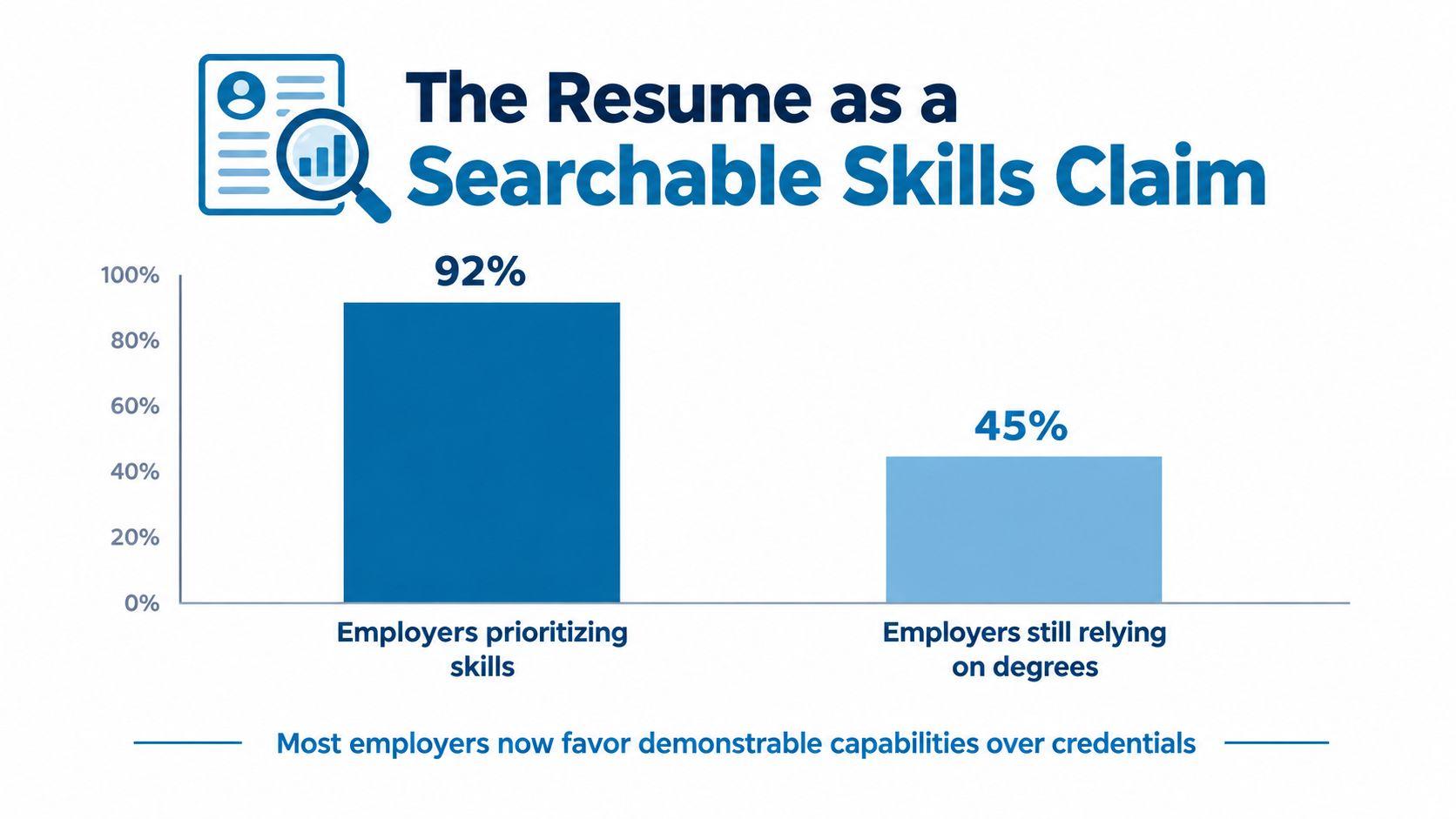
The chart’s figures aren’t substantiated by the evidence cited above and shouldn’t be used for decision-making. The report’s findings support the distinction between describing skills and demonstrating them.
Put the claim and its context on the resume
A skills entry should help an employer understand what you can do. Experience and project descriptions should establish where you applied that capability, what you personally contributed, and what evidence exists.
For a self-taught developer, listing a programming language communicates a claim. Explaining a relevant application and directing the reviewer to inspect its code provides a route to verification. Neither should imply commercial experience if the work was a personal project.
| On the resume | Demonstrated elsewhere |
|---|---|
| Relevant skill and usage context | Work sample or assessment |
| Project scope and personal contribution | Repository, portfolio, or walkthrough |
| Certification name and relevance | Credential verification |
| Claimed outcome and how it was measured | Interview explanation or supporting evidence |
Don’t make credentials carry the whole argument
Career changers can use the resume to connect transferable work with the new role. International candidates can explain unfamiliar qualifications rather than relying on recognition alone.
Keep relevant education and certifications, but don’t let them replace evidence of application. Equally, don’t imply that a portfolio eliminates every formal qualification requirement. Read the vacancy and distinguish mandatory credentials from capabilities the employer is willing to assess directly.
The resume should make your strongest claims easy to investigate, not easy to assert.
Why Tailoring Is the Resume’s Real Job
An analysis of 1.7 million applications reported interview conversion rates of 5.8% for customized resumes versus 3.73% for non customized resumes, a relative difference of roughly 55%, according to Huntr’s analysis of resume tailoring. That comparison supports customization as a practical strategy, though it doesn’t prove that editing alone caused the entire difference.
A generic resume asks the employer to work out the connection between your experience and its vacancy. A resume adapted to the role makes that connection explicit. The underlying history stays the same; the selection and emphasis change.
Start with the employer’s actual requirements
Choose a concrete vacancy rather than optimizing for an abstract job title. Browsing openings by role can help you distinguish related positions before deciding which one your document should address.
Read the posting for required capabilities, expected outputs, seniority, and constraints. Then compare each requirement with your evidence. Separate demonstrated strengths from transferable experience and genuine gaps.
- Match terminology accurately: Use the employer’s term when it describes work you have performed.
- Prioritize relevant evidence: Move applicable accomplishments ahead of less useful detail.
- Preserve scope: Don’t turn participation into ownership or exposure into expertise.
- Leave gaps honest: A missing requirement is information, not an invitation to invent experience.
Separate versions are justified when roles require materially different evidence. A data analyst application and a data engineering application may draw from overlapping experience, but they shouldn’t make identical arguments.
Write statements an interviewer can probe
Use a skill–action–result pattern. Identify the capability, explain your intervention, and state the outcome you can substantiate.
For example, if accurate, a reporting bullet might describe using SQL to replace manual reconciliation and explain how the new workflow improved consistency. A reliability-focused application might emphasize incident investigation instead. These are different interpretations of relevant work, not permission to change what happened.
Honest tailoring changes the emphasis. Dishonest tailoring changes the facts.
Quantify only when you have a defensible measurement. Without one, specify the users served, process changed, artifact produced, or limitation resolved qualitatively.
A useful final test is to rehearse the follow-up questions: What did you personally do? What was difficult? How did you know it worked? If the bullet becomes uncomfortable under those questions, revise it before applying. A searchable phrase is useful only if the underlying claim survives scrutiny.
Anatomy of a Modern Resume
Build the document around the questions an employer needs answered. The conventional sections aren’t administrative decoration; each should resolve a different uncertainty.
The earlier scanning evidence supports recognizable organization. My recommended order is contact details and location, target title, a brief summary when useful, experience, skills, education, and relevant optional evidence.
Resume Sections and Their Decision Job
| Section | What it answers |
|---|---|
| Contact and location | How can we reach you, and where are you based? |
| Headline or title | What professional role does this application target? |
| Summary | What relevant combination of experience and strengths do you offer? |
| Experience | What have you done, in what context, and with what results? |
| Skills | Which relevant capabilities can we search for and discuss? |
| Education | Which qualifications have you completed? |
| Projects and certifications | What additional evidence supports your fit? |
| Languages | Can you meet the role’s communication requirements? |
A summary earns its space when it clarifies your positioning. Omit generic claims about being motivated or results-driven if they add nothing beyond the experience below.
Projects are useful when they supply evidence missing from employment history. Label personal, academic, volunteer, and commercial work accurately so the reader can interpret each contribution.
Choose a length you can justify
As an editorial default, aim for one page for most candidates, with two pages acceptable for senior specialists whose relevant evidence needs the space. This is a recommendation, not a universal hiring rule. Don’t compress useful information into unreadable text merely to meet a page target.
Prefer a text-preserving PDF unless the posting specifies another format. Remove dated or irrelevant detail, maintain consistent dates, and retain only measurements you can explain.
For applicants translating their experience into English, Englify’s CV advice for Moroccan job seekers offers a context-specific resource to consult alongside the employer’s own instructions.
Proofreading deserves a separate review. Experimental research found an 18.5-percentage-point reduction in interview probability for resumes containing spelling mistakes compared with error-free versions, according to the PLOS ONE study on resume errors.
Check names, terminology, grammar, and consistency after the final export. A polished source document won’t help if the submitted file contains a broken line, missing word, or incorrect employer name.
Resume, CV, and LinkedIn for International and Remote Candidates
Don’t assume the word “CV” tells you how long the employer expects the document to be. Follow the vacancy’s instructions and the context of the application.
For private-sector applications, use a concise, targeted document unless the employer asks otherwise. For an academic or research application requiring a full CV, include the relevant scholarly record rather than forcing it into a commercial resume template. International terminology varies, so the requested contents matter more than the label.
Make employment conditions explicit
For cross-border applications, I recommend clearly labeled information about location, work authorization or sponsorship needs, remote-work scope, and time-zone compatibility. These details help the employer resolve eligibility questions without guessing.
- Location: State your current country and city where relevant.
- Authorization: Describe your actual permission to work, without implying rights you don’t have.
- Sponsorship: Make a requirement clear rather than leaving it for a later surprise.
- Availability: State genuine working-hour overlap or relocation flexibility.
If you’re targeting worldwide remote openings, still inspect each listing’s geographical and contractual restrictions. Don’t treat a remote label as permission to work from any country.
Use LinkedIn as a supporting record
My recommendation is to treat LinkedIn as the discoverability layer, not as a substitute for the requested application document. Keep its headline, About section, dates, and experience consistent with your resume.
Consistency doesn’t require identical wording. LinkedIn can present a broader professional identity, while the submitted resume focuses on a particular vacancy.
For cross-border applications: State what the employer needs to know, not what you hope they’ll assume.
If your public profile presents a different level of seniority or contradictory employment dates, resolve that discrepancy before applying. The objective is to give reviewers complementary information, not competing versions of your career.
Putting It Together to Earn More Interviews
A resume can’t guarantee an interview. You can, however, make it easier for an employer to understand your fit and harder to dismiss your application because of preventable ambiguity.
The most productive editing session starts with a real vacancy. Don’t keep refining a general document without checking whether its evidence addresses the work you want.
Run a focused application audit
- Choose an eligible target: If sponsorship is necessary, start with visa-sponsorship opportunities and verify the individual listing’s conditions.
- Audit the anatomy: Check that every section performs a useful decision job and remove details that distract from the application.
- Build the argument: Select relevant evidence and write defensible skill–action–result statements.
- Inspect the export: Confirm that text remains selectable and the reading order stays understandable.
- Check eligibility signals: Make location, authorization, and availability unmissable where relevant.
- Prepare verification: Be ready to explain every skill, contribution, and outcome you’ve claimed.
Treat missing requirements as a separate decision. Some may justify learning or a project; others may mean this isn’t the right vacancy. Don’t solve either problem by adding unsupported language.
Final editing test: What uncertainty does this line remove for the person evaluating my application?
The purpose of a resume is to earn further consideration through clear, credible relevance. Every edit should strengthen that argument, whether the next reader is reviewing your professional outline, searching for a capability, or preparing to test your claims.
JobGlance combines international and remote job discovery with resume matching and an ATS Resume Builder that can tailor a document to a selected role and export a text-preserving PDF. Visit JobGlance, choose a vacancy that fits your eligibility, and use its requirements to turn your resume into a focused case for an interview.
Keep reading


