Job Search by Skills That Actually Gets You Interviews


On this page
39% of workers’ core skills will change by 2030, so searching only by job title is too narrow. The roles you can qualify for are often hidden behind adjacent skills, different titles, and eligibility rules that a title search can’t see.
Why Job Search by Skills Beats Title-Based Searching
The labor market is moving away from fixed occupational labels and toward changing skill combinations. That matters because a title usually captures only one slice of the work, while the hiring signal sits in the underlying capabilities. The World Economic Forum’s 39% core-skill shift by 2030 makes that plain, and it’s why a job search by skills surfaces matches that a title search misses entirely. World Economic Forum analysis of core-skill change by 2030
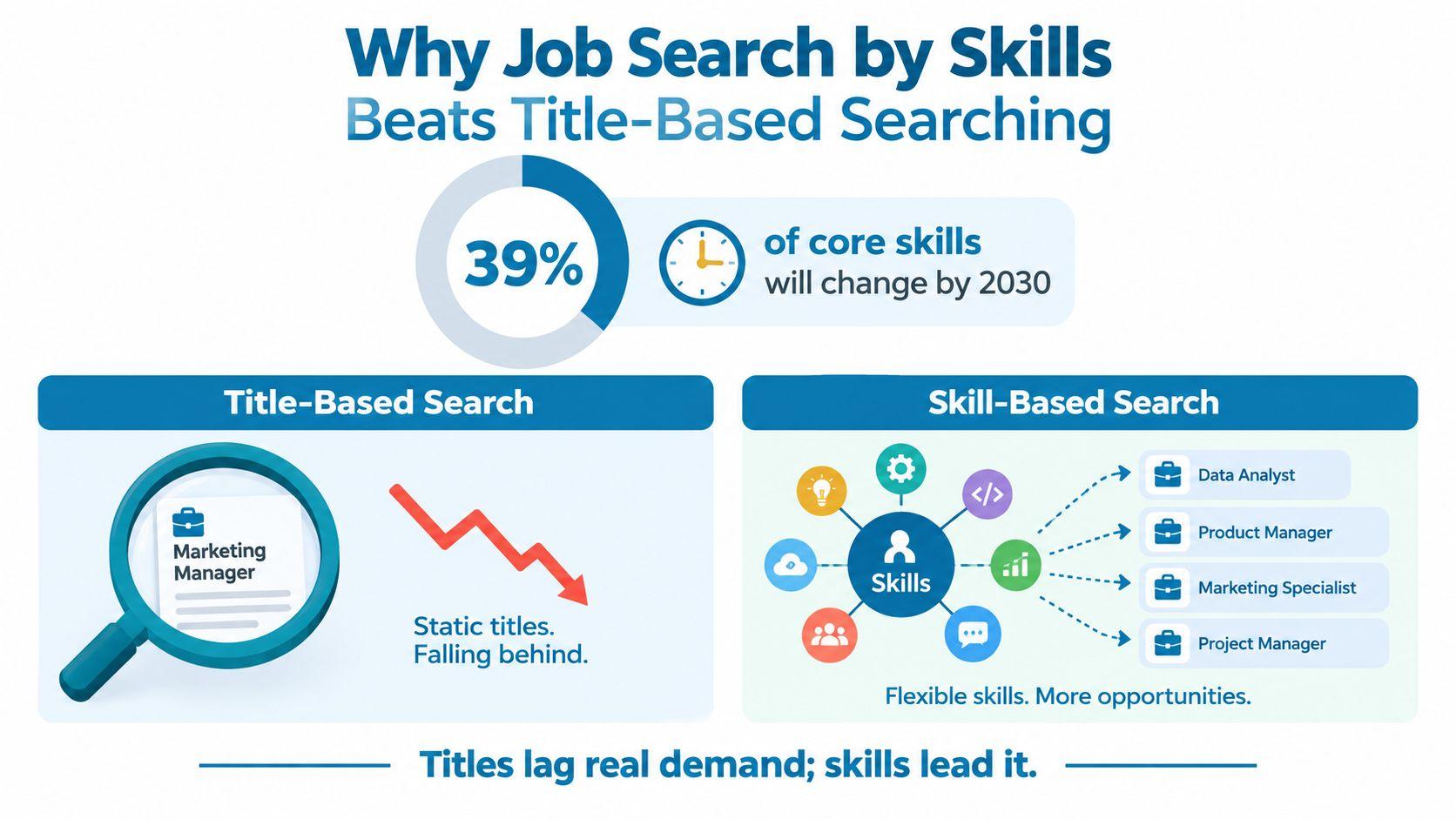
A title-only search also collapses nuance. The same capability can show up under different labels depending on the company, team, or industry, so a search for one title excludes roles that would be a fit on substance. Skills-first search replaces that brittle shortcut with a more useful unit of analysis, the competency itself.
What skills-first actually means
A real skills-first search treats each capability as an object with weight, evidence, and recency. Weight tells you whether a skill is central or peripheral. Evidence tells you whether you can prove it. Recency tells you whether the proof is current enough to matter.
Practical rule: if you can’t show the skill in a project, work sample, certification, or interview story, it’s not ready to drive an application.
That approach is more demanding than keyword matching, but it’s also more honest. For adults rebuilding their search after a layoff, career change, or long gap, a structured training path can help turn vague interest into proof, and find workforce training for adults is one place to look for that kind of support.
The rest of the search should follow a funnel: discovery recall, precision weighting, eligibility gating, tailoring, gap tracking, and then an audit of what moved the needle. If a search doesn’t do all six, it’s just a broader version of the same old title hunt.
Build a Competency Map From Target Postings
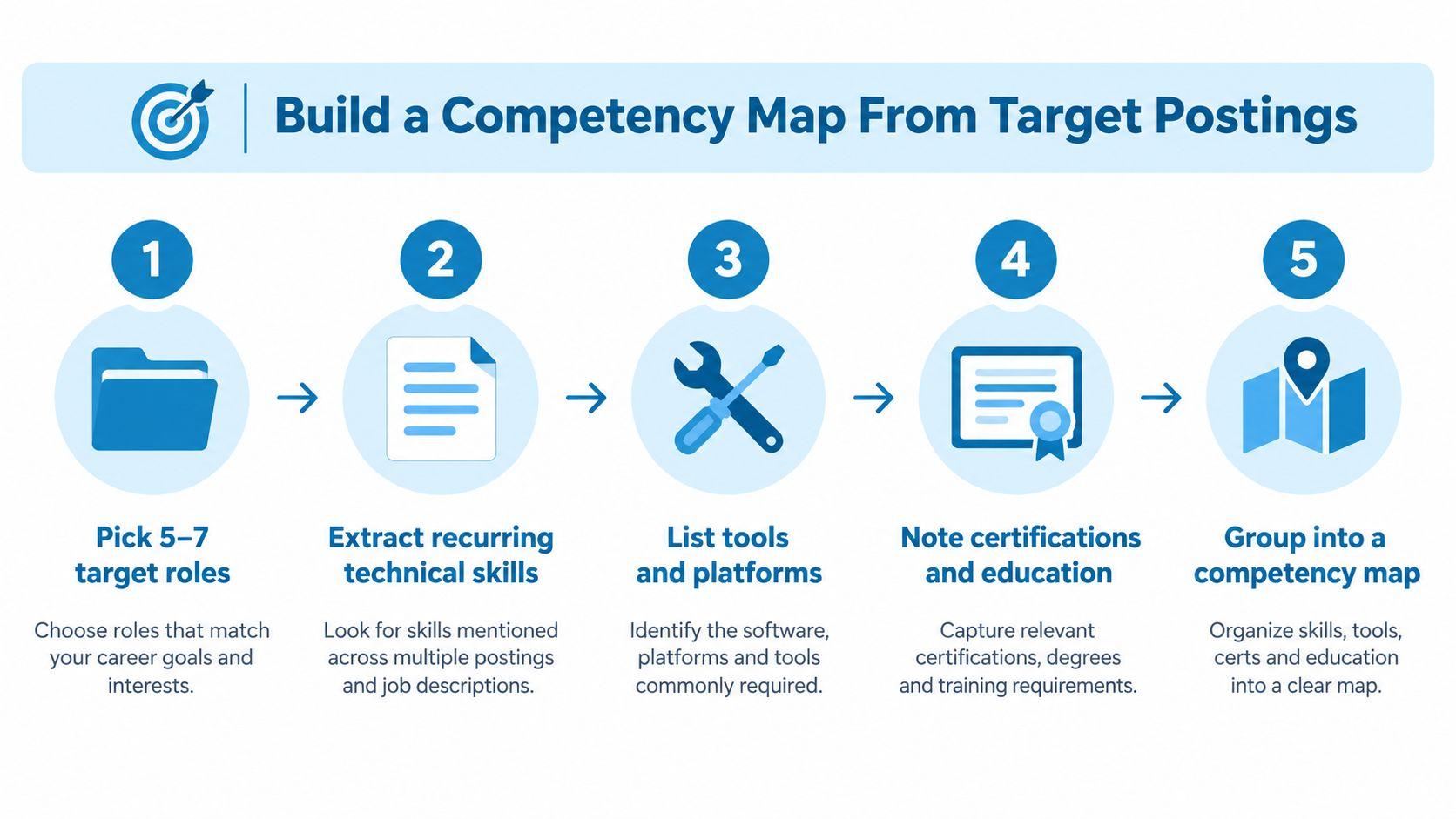
Start with a short list, not a giant keyword dump. Pick 5 to 7 target roles that sit near your current level or the level you want next, then pull the recurring language from those postings into a single competency map. The point isn’t to copy every term. The point is to see which capabilities keep showing up across multiple employers.
Sort the language into three buckets
Every posting contains three different kinds of information, and mixing them together causes bad decisions.
- Must-have skills: These are the essentials that appear repeatedly and define role eligibility.
- Preferred skills: These help you rank higher in the pile, but they shouldn’t block a sensible application.
- Evidence-only phrases: These are signals that matter for interpretation, not for resume real estate, like vague culture language or “passion for clean code.”
A backend developer search makes this concrete. Python, PostgreSQL, and REST API design usually belong in must-have territory. Kubernetes and gRPC often belong in preferred territory. “Passion for clean code” is usually evidence-only, because it describes a preference, not a capability you can rank on by itself.
Build the map from recurring patterns
Extract technical skills, tools, certifications, behavioral capabilities, and outcome verbs from each posting. Then group them by frequency, not by what sounds impressive. If a term shows up in one posting and nowhere else, it doesn’t deserve the same weight as a skill that appears in four or five of your target roles.
Discipline that prevents keyword stuffing: only must-have and preferred skills earn resume real estate, and only must-have skills should gate the application.
That rule keeps the search honest. It also makes the later steps faster, because you’re no longer deciding role by role from scratch. You’re applying a reusable map to every posting, every search, and every resume edit.
Run Skill Queries With Search and Rank
Skills-first search works only if you handle recall and precision separately. During discovery, widen the net on purpose. Before applying, narrow it hard. That split matters because LinkedIn Economic Graph analysis found that skills-first search can expand the modeled pool of matching people by nearly 10 times on average compared with searches based on job title or direct work history. LinkedIn Economic Graph analysis summarized here
Search wider than the exact title
Use the competency map to create search inputs from several layers of language:
- Exact tools: Postgres, dbt, Airflow, Kubernetes.
- Adjacent frameworks: orchestration, observability, data modeling, API design.
- Transferable capabilities: analysis, debugging, stakeholder communication, production support.
That gives you more surface area without getting sloppy. A candidate who only searches for a current title will miss roles that ask for the same work under another label. A candidate who searches every plausible synonym without rank discipline ends up with a noisy pile.
Use ranking to separate discovery from application
JobGlance’s Search & Rank takes a skill query and ranks results against the uploaded resume in real time. Its Top Matches view skips the query entirely and surfaces best-fit roles from the whole database, which is useful when you want to see where your profile already fits before you start refining a search. If you’re testing the interface against a concrete role type, the data analyst role page is a practical starting point.
| Entry point | Best use | Input | Output |
|---|---|---|---|
| Search & Rank | Exploring a known skill area | Skill names, tools, adjacent frameworks | Ranked role list by resume fit |
| Top Matches | Checking broad fit before searching | Resume only | Best-fit roles from the full database |
| Role-specific search | Narrowing to a target field | Role language plus skills | A focused, ranked set of openings |
Re-run the ranking every time the filter changes. A results page is only useful for the exact query that produced it.
That last point sounds small, but it’s where a lot of searches go wrong. People trust a stale results page, then wonder why the shortlist doesn’t hold up when they open the postings.
Layer Eligibility Filters Before Skill Fit
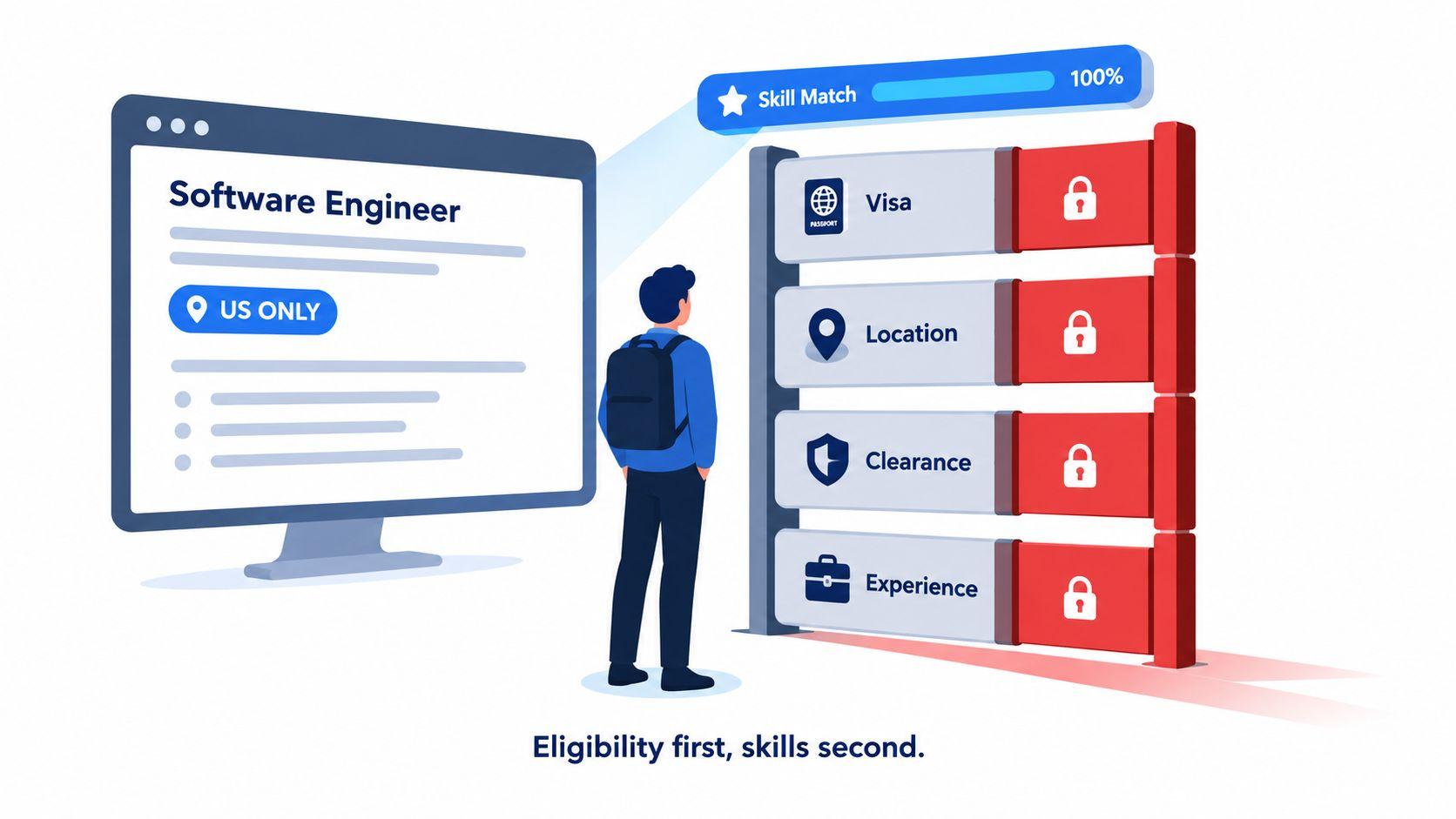
A strong skill match is useless if the role is outside your legal or location constraints. A perfect fit on a U.S.-only posting is still a zero-probability application for someone who needs sponsorship, and “remote” doesn’t always mean open to every country. KPMG’s 2025 mobility report makes the regional variation explicit, which is why location eligibility has to be checked separately from the remote label. KPMG’s 2025 Global Mobility Benchmarking Report
Put hard gates first
The right order is simple:
- Location eligibility first.
- Sponsorship status second.
- Skill query third.
- Ranking last.
That order saves time and avoids false hope. A UK-based data engineer who needs sponsorship should filter for country fit and sponsorship possibility before caring about whether the role is a near-perfect technical match. If the role fails the first two gates, the rest of the scoring doesn’t matter.
Separate remote from work-from-anywhere
JobGlance treats visa sponsorship and work-from-anywhere as dedicated filters, which is the right design choice because the two conditions solve different problems. A role can be remote and still restricted to one country. A role can also be open globally, but only if the employer’s hiring structure allows it.
The platform’s sponsorship track-record layer is especially useful when the posting doesn’t mention sponsorship at all. That happens often. A company may still be a realistic candidate because it has hired internationally before, even if the listing itself stays quiet about it. Use the filter stack first, then rank the survivors by fit.
Tailor Your Resume to Each Posting With Match Score
A resume should mirror the posting, not copy it blindly. The difference is subtle but important. Mirror the employer’s terminology where it is accurate, and leave out language you can’t support with truthful evidence. That keeps the resume aligned with both ATS parsing and human review.
Use the score to see what’s missing
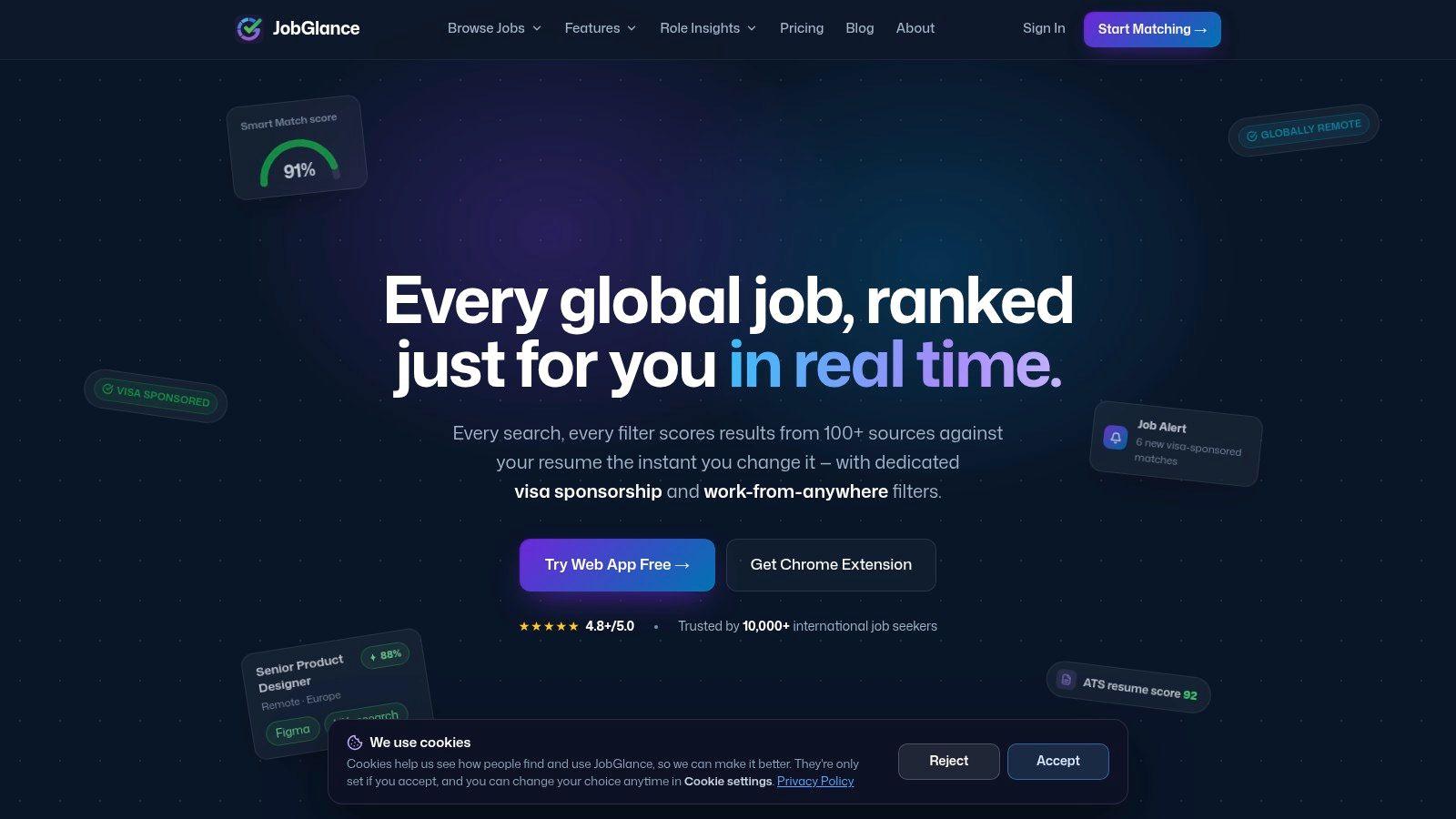
JobGlance’s ATS Resume Builder rebuilds a resume in single-column templates, checks it against five ATS criteria, and exports a text-preserving PDF. The per-job Resume Match Score then highlights matched and missing keywords inside the job description itself, which is more useful than a generic skills list because it shows exactly where the resume already lines up and where it still needs proof.
A common example is a data engineer who has used dbt and Airflow in production but buried that work in a project bullet. The match score makes the gap visible, which tells the candidate to surface those terms in the skills section or experience summary, as long as the wording is truthful. If the work is real, it belongs in the foreground. If it isn’t, don’t pad the resume to fake a higher match.
Keep a log of every change
Tailoring gets messy when people edit by instinct. Keep a simple record for each application:
- Which keywords were mirrored
- Where they were placed
- What evidence supports them
- What was left out and why
That logging habit matters, because it turns tailoring into a repeatable process instead of a one-off rewrite. For candidates who are changing fields, Christian career advice for job seekers can be a helpful companion resource for shaping the narrative around a transition without losing credibility.
Track Skill Gaps With Career Gap Analysis
The fastest way to waste time is to learn whatever sounds useful today. A better approach is to let the roles you want tell you which gaps keep recurring. JobGlance’s Career Gap Analysis collects missing skills across every saved role, so you can see which capabilities keep appearing instead of guessing from one posting at a time.
Close the few gaps that matter most
Run a short cycle over about two weeks:
- Save 25 to 40 relevant roles.
- Run the analysis.
- Sort gaps by frequency and job score.
- Pick the top 3 to 5 skills to close first.
That sequence works because it blends demand and fit. A skill that appears often but only in weak matches may not be worth immediate effort. A skill that appears repeatedly in your best-fit roles deserves priority.
The evidence rule matters here. The World Economic Forum says 81% of employers expect to rely on work experience through 2030, while only 48% expect to use skills assessments. World Economic Forum workforce strategies report That means a gap isn’t really closed until you can show proof of the skill, not just name it.
A keyword on a resume is not the same as a skill a hiring manager can trust.
A project, a quantified outcome, a portfolio artifact, a certification, or a structured interview example does that work better than a bare list of terms. That’s the part many candidates miss. Better matching doesn’t improve outcomes unless the match is legible to a human who still needs evidence.
Audit the Funnel and Run the Loop Again
Treat the whole search as a weekly operating system. Refresh the competency map, run new skill queries, stack eligibility filters, save the strongest roles, analyze the gaps, tailor the resume, and apply to a focused set. If you keep that rhythm, the process gets more accurate every week instead of more random.
Diagnose the failure point
Audit results by funnel stage, not by application count:
- Eligible roles found
- Applications submitted
- Recruiter screens
- Technical assessments
- Interviews
- Offers
That sequence tells you where the problem sits. If discovery is thin, widen the search terms and adjacent skills. If precision is weak, tighten the eligibility filters and the evidence standard. If applications aren’t converting after a strong search, the issue is probably parsing, resume structure, or interview performance, not the search strategy itself.
For live starting points, the visa sponsorship roles page and the remote jobs page give you a faster first pass than a blank search bar. Use them as entry points, then rerun the funnel against your own competency map.
Run this loop every week, not once. The market changes, the role language shifts, and the evidence you can show gets stronger when you keep updating it. Visit JobGlance if you want a search flow that ranks roles by fit, filters for eligibility, and keeps the whole application process tied to the skills you can prove.
Keep reading


