Job Interview in Germany: Stages, Questions and Etiquette


On this page
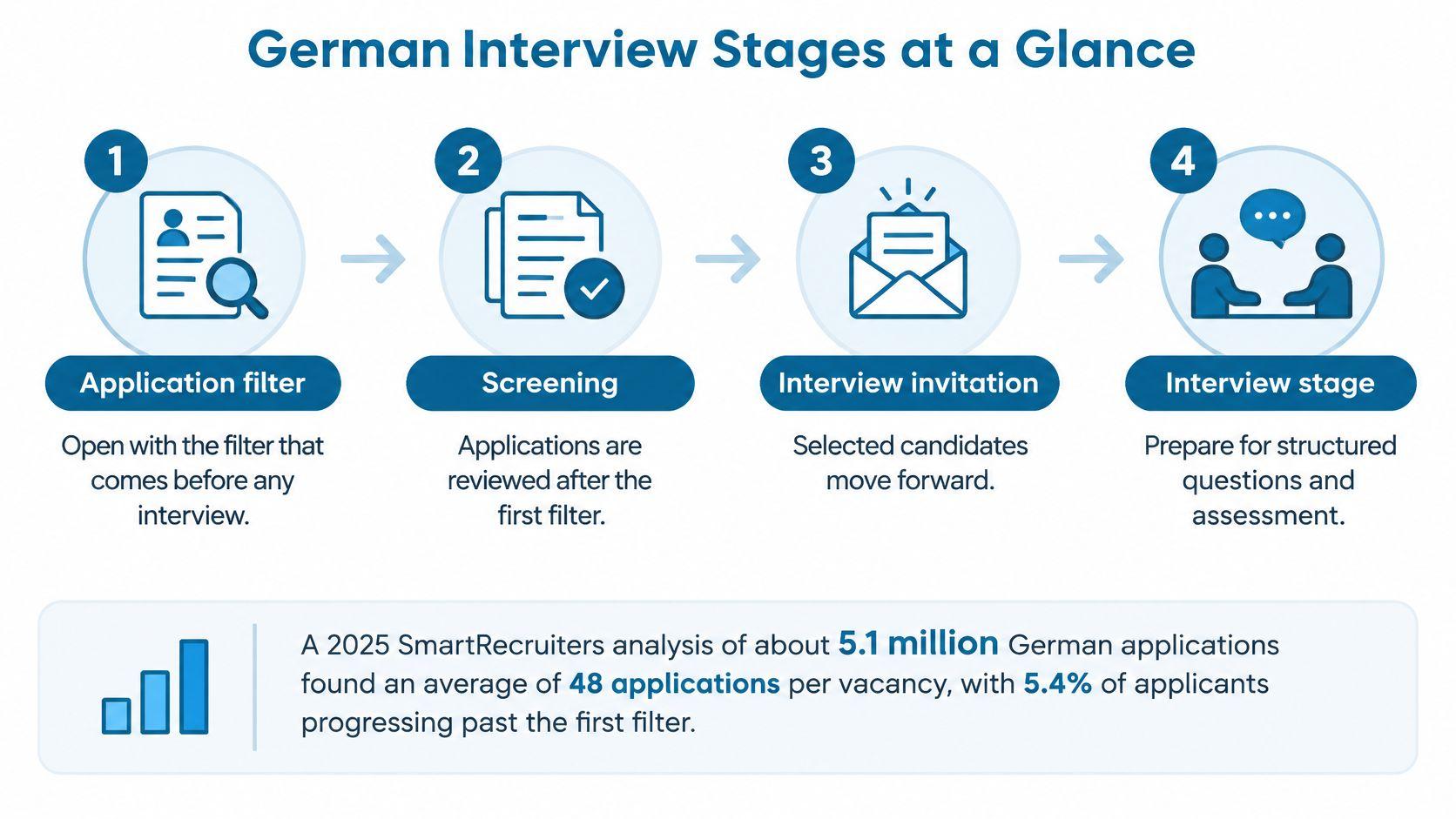
Only 5.4% of applicants reached an interview in a 2025 SmartRecruiters analysis of approximately 5.1 million job applications in Germany, while 1.4% received an offer, according to the analysis reported by HRTech Edge. Preparing for a job interview in Germany therefore starts before anyone invites you to a call. Your first task is to make your qualifications, work authorization and salary requirements clear enough that a recruiter can justify moving you forward.
For international candidates, a polished interview won’t fix an employment arrangement that can’t work legally or financially. Treat preparation as two separate jobs: establish that you’re employable for this vacancy, then demonstrate that you can do the work.
German Interview Stages at a Glance
The first filter isn’t a conversation. It’s a recruiter comparing your application with the vacancy and deciding whether your experience, availability and eligibility make sense together.
A foreign job title without an explanation creates extra work for that recruiter. So does a relocation statement that says you’re flexible but doesn’t identify your current location, permission to work or realistic start-date constraints. Remove uncertainty before trying to impress.
Once you’re invited, ask who will attend, what format they’ll use and whether an assessment is involved. An invitation from HR doesn’t necessarily mean the hiring manager has evaluated your technical suitability.
Typical German interview stages and what each one assesses
| Stage | Who runs it | What they assess |
|---|---|---|
| Recruiter or HR screen | HR or recruiter | Eligibility, motivation and salary range fit |
| Hiring manager interview | Team lead or manager | Role-specific experience and decision-making |
| Work sample or technical test | Team or specialist | Observable capability through a coding test, case or presentation |
| Internal approval | Management and, where applicable, the Betriebsrat | Sign-off before an offer is made |
| Offer and contract | HR and hiring manager | Terms, start date and notice period |
Not every employer uses every stage, and some combine conversations. Technical positions are particularly suited to work samples because the panel can inspect your reasoning rather than rely on your description of it.
The sequence changes what a good answer looks like. HR needs a clear explanation of fit and practical feasibility. A manager needs evidence of judgment, while a specialist needs to see how you approach the actual work.
Practical rule: Prepare for the decision your next interviewer owns, not for a generic interview.
If you’ve just received your first invitation, begin with your career summary and employment logistics. If you’re meeting the team after an HR call, spend more time on examples, technical choices and questions about the work. Don’t assume a friendly conversation means the assessment is complete.
Eligibility and Salary Checks Before the Interview
A shortage of workers doesn’t mean every employer can hire every international applicant. Germany had about 402,000 registered jobs for skilled workers, specialists and experts in 2025, according to the Federal Employment Agency’s skilled-worker reporting. The useful question isn’t whether Germany needs your occupation, but whether this particular offer supports your employment route.
Occupation matters too. The Federal Employment Agency’s skilled-trades report recorded an average of 123,000 trade vacancies in 2025, with vacancies remaining open for 242 days on average. That doesn’t remove requirements for usable skills, credentials or immigration eligibility.
Check the route against the actual offer
The official professionally experienced workers visa guide sets the 2026 minimum gross annual salary at €45,630, alongside a concrete offer in a non-regulated qualified profession and at least two years of qualified experience during the previous five years; the salary condition can be waived where the employer is bound by, and pays under, a collective agreement.
The Federal Employment Agency’s EU Blue Card guidance gives 2026 thresholds of €50,700 for the standard route and €45,934.20 for qualifying shortage occupations and certain labour-market entrants, with Federal Employment Agency approval required for the lower threshold.
Gross salary thresholds for German work routes in 2026
| Route | Gross annual salary | Main condition |
|---|---|---|
| Work visa for professionally experienced workers | €45,630 minimum | Concrete offer in a non-regulated qualified profession and two years of qualified experience in the previous five years; salary condition waivable under a qualifying collective agreement |
| EU Blue Card, standard route | €50,700 minimum | Standard threshold for qualifying employment |
| EU Blue Card, shortage occupation or labour-market entrant | €45,934.20 minimum | Requires approval from the Federal Employment Agency |
These are checkpoints, not complete eligibility assessments. A sponsorship label alone doesn’t establish that a role qualifies.
Make your eligibility easy to assess
- Identify regulation: Establish whether your profession is regulated before presenting recognition as optional.
- State recognition status: Distinguish completed recognition, an application in progress and a step you haven’t started.
- Describe language ability clearly: State your working German or English level, supported by a certificate where available.
- Translate responsibilities: Keep your original job title, then explain its function in terms the recruiter understands.
When discussing pay, state your expectation and ask for the exact annual gross salary, job classification, collective-agreement coverage and support for any additional approval.
Separate that discussion from salary history. AcademyCon’s salary-document guidance explains that the EU Pay Transparency Directive prohibits pay-history questions, while reporting Germany’s transposition as still pending in July 2026; don’t assume identical enforceable rights in every situation.
A practical response is to explain that you’d prefer to discuss the role’s budget and responsibilities rather than provide previous payslips or bank statements. Browse Germany visa-sponsorship vacancies with these checks in mind, not as a substitute for them. We don’t guarantee job outcomes, interview success or hiring decisions.
How to Prepare Three Evidence Sets
German interview panels need different evidence at different stages. Expatrio’s guide to interviews in Germany describes recruiter screening, manager or team conversations, and assessments such as coding tasks, cases and presentations. Prepare material for each purpose rather than memorizing a single performance.
Build evidence the panel can use
-
Start with a concise career-fit explanation. As a practice target, write a 60-second introduction connecting your background to the advertised duties and explaining why this employer interests you. Lead with relevant work, not your full educational history, and finish with the contribution you’re ready to make.
-
Prepare five to six behavioral stories. Use situation, task, action and result, keeping the background short enough that your own decisions remain visible. Include a genuine measure where you have one, such as team size, delivery time or costs, but don’t invent precision when the result was qualitative.
-
Create a role-specific demonstration. A developer might walk through a design decision, a data analyst might explain how they checked an unreliable dataset, and a product manager might defend a prioritization choice. Show assumptions, alternatives and validation, not just a polished final slide.
-
For skilled trades, assemble practical proof. Bring relevant certificates, safety-training records and examples that clarify which tasks you can perform independently, alongside your availability. Explain unfamiliar qualification names rather than expecting the interviewer to understand another country’s training system.
-
Rehearse aloud with a timer. Have a practice partner interrupt with questions about your personal contribution, the rejected alternatives and what failed. If you can only deliver an answer from its opening sentence, you’ve memorized a script rather than prepared evidence.
Make supporting material easy to inspect
A portfolio should help the interviewer verify a claim, not create another browsing assignment. Choose work that resembles the vacancy, explain your contribution and remove confidential information before sharing it. For help organizing that evidence, own.page explains how to build a portfolio site recruiters open.
A useful work sample makes your reasoning inspectable. Attractive formatting can’t replace an explanation of what you decided and why.
Keep a private preparation document with the job description, your application and prompts for each example. Mark the evidence that supports each major requirement, and flag any requirement you can’t yet demonstrate.
Don’t use the same story for every question. A successful project can show delivery, but the panel may also need evidence of conflict handling, learning and responsible failure. With distinct evidence sets ready, you can adapt to the interviewer without losing the substance of your answer.
Typical Questions and Which Ones You Can Decline
Most of the interview will be ordinary, and that is where offers are won. Expect requests to introduce yourself, explain why you want this company, describe a disagreement or a missed deadline, and work through a realistic technical problem. International candidates should also expect a direct question about work authorization. It is a legitimate check, and a clear answer with your status and timeline does more for your chances than any polished story.
A strong answer addresses the concern behind the question. A conflict question tests how you work with others, so skip the portrait of the unreasonable colleague and show your handling instead. A start-date question requires an accurate account of notice periods and practical constraints, never an optimistic promise a visa appointment cannot keep.
Questions that assess job fit
- Career summary: Select the experience that explains your fit for this vacancy, and translate unfamiliar titles or employers into scope, team size and results the panel can place.
- Employer motivation: Connect a specific product, customer problem or responsibility to work you want to do.
- Behavioral evidence: Explain your action and the outcome, including what you would change.
- Technical scenarios: Clarify assumptions before proposing a solution.
- Availability: Separate confirmed commitments from dates that depend on external decisions, such as a visa appointment or your notice period.
Questions you can decline
German law limits what an interviewer may ask. The General Equal Treatment Act, commonly called the AGG, protects applicants against discrimination based on age, disability, ethnic origin, gender, sexual orientation, and religion or belief. Interview questions need a close, factual connection to the position and a justified employer interest. Questions about pregnancy, family planning, marital status, religion, political affiliation, trade-union membership or sexual orientation are generally impermissible unless a legally recognized occupational requirement makes the information relevant.
| Topic | Permitted? | How to respond |
|---|---|---|
| Work authorization and right to work | Yes | Answer directly with your status and timeline |
| Job-relevant language proficiency | Yes, if proportionate to the role | State your level and show evidence |
| Qualifications and experience for the role | Yes | Map each one to the advertised duties |
| Native language or ethnic origin | No as a general screening topic | Redirect to the language skills the job needs |
| Pregnancy, family planning or marital status | Generally no, unless legally relevant to the role | Decline politely and return to job fit |
| Religion, political affiliation or trade-union membership | Generally no, subject to legally recognized occupational exceptions | Decline politely and return to job fit |
| Age, disability or sexual orientation | Generally no as personal screening topics; specific lawful job-related exceptions require care | Decline; you may seek advice from the Antidiskriminierungsstelle |
Applicants generally don’t have to answer impermissible questions truthfully. Use that protection calmly. A composed redirect guards your privacy while keeping the conversation workable, which matters because the same panel usually decides on your offer.
A practical phrasing: “I’d prefer to keep personal circumstances private, but I’m glad to confirm I can meet the schedule and travel requirements.” If the interviewer persists, ask how the information relates to the duties, answer only what the role requires, and make a factual note of the exchange afterward.
Communication Style and Etiquette in German Interviews
Direct, structured answers are a safer default than elaborate self-promotion. State the point, give relevant evidence and finish with the outcome. A panel’s neutral expression or detailed follow-up questions usually signal engagement, not disapproval.
Treat cultural advice as a starting point rather than a description of every German interviewer. A startup founder and a formal corporate panel will communicate differently, and the invitation itself often gives useful clues about the expected tone.
Use formality without becoming stiff
In a German-language interview, use formal Sie unless invited to use du, and begin with titles and surnames unless the interviewer establishes another convention. In English, follow the panel’s introductions rather than forcing German forms of address into the conversation.
I recommend arriving ten minutes early for an in-person interview and testing your video platform, microphone and camera twenty minutes early. These are preparation buffers, not rules about German employers; don’t enter a virtual meeting far ahead of the scheduled time unless invited.
- Dress for the setting: Business attire is a safe option for formal sectors such as banking or insurance; smart casual often fits a technology team better. Match your formality to the sector and the interview setting described in the invitation. If choosing an outfit is slowing you down, The Dressed Man helps readers find outfits for specific events.
- Keep introductions simple: Use a brief, firm handshake when offered, make comfortable eye contact and learn the interviewers’ names.
- Use humor sparingly: Build rapport before relying on jokes, especially across languages.
- Avoid inflated claims: Describe what you personally owned and acknowledge what colleagues contributed.
Close with questions about the work
Ask two or three focused questions rather than reading a long list regardless of what the panel has already explained. Useful topics include team structure, what successful performance would look like in the first six months, and how the team resolves competing priorities.
Listen to the answers and ask a relevant follow-up. Interviewers can learn more from a thoughtful question about an actual constraint than from a rehearsed statement about your enthusiasm.
Follow-Up Timing and What the Wait Means
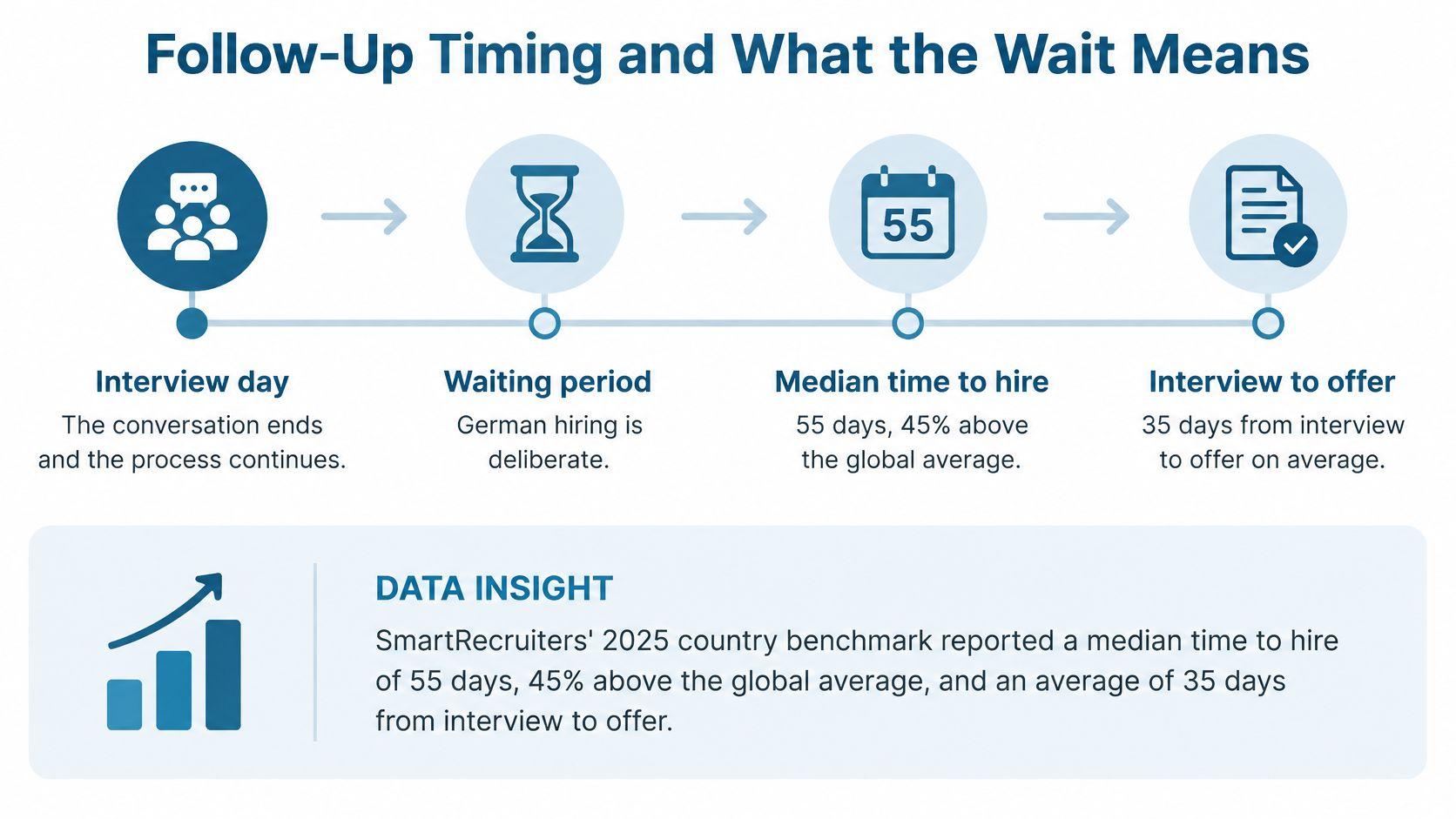
Silence after a German interview isn’t automatically rejection. SmartRecruiters’ 2025 Germany benchmark reported a median time to hire of 55 days, 45% above the global average, and an average interview-to-hire interval of 35 days, compared with 24 days across other countries in the benchmark.
The benchmark attributes part of the delay to works council involvement in relevant hiring decisions. A manager may support your application while approvals, consultation and contract preparation remain unfinished.
Post-interview follow-up schedule
Use the employer’s stated timeline first. The schedule below is a practical cadence, not a prediction of when your decision will arrive.
| Timing | Action | Purpose |
|---|---|---|
| Same day | Thank-you email to each interviewer, where you have their contact details | Keeps your name fresh while the interview is recent |
| When the stated timeline has passed | One short check-in asking about next steps | Shows interest without pressure |
| Around 35 days after interview | Second follow-up asking for a decision date, if appropriate | Uses the German interview-to-hire average as a check-in reference, not a deadline |
Keep messages brief: acknowledge the conversation, mention a specific discussion point and ask about next steps. For a later check-in, ask whether the expected decision date has changed and whether the employer needs anything further.
Keep options open: An encouraging interview isn’t an offer, and an offer isn’t the same as a completed employment and immigration process.
Don’t send repeated messages merely because you’ve become anxious. If another employer gives you a genuine deadline, tell the recruiter plainly rather than manufacturing urgency.
Continue applying while you wait. If relocation timing is uncertain, consider worldwide remote vacancies where your location is eligible. Plan notice periods, visa steps and moving commitments around confirmed milestones, not the warmth of the final conversation.
Next Steps and Related JobGlance Pages
Start with a shortlist, not another folder of interview advice. Choose vacancies whose duties you can explain, whose requirements you can evidence and whose employment arrangements could realistically work for you.
Use the visa-sponsorship categories to compare destinations and openings. If moving isn’t currently feasible, the remote job categories provide another route to explore, but read location restrictions carefully. Remote work doesn’t necessarily mean an employer can hire someone in your country.
Turn vacancies into a preparation plan
- Shortlist three roles today. Save the full job descriptions so you can prepare against the actual requirements, even if the listings later change.
- Run the eligibility checklist. Record profession regulation, recognition status, language requirements, proposed employment route and unanswered salary questions for each vacancy.
- Identify the first evidence set. Decide whether your next task is a recruiter introduction, behavioral examples or a practical demonstration.
If your overseas title doesn’t map neatly to German listings, browse the role categories by function. Compare responsibilities rather than treating an exact title match as proof of fit.
Separate missing evidence from genuine ineligibility
A missing explanation can often be fixed in your application. Add a plain-language description of an unfamiliar qualification, clarify the scope of a previous role or state the status of a pending recognition process.
A legal or contractual mismatch requires a different decision. Don’t spend days rehearsing for a position whose employer can’t offer a workable arrangement, and don’t conceal the problem hoping enthusiasm will overcome it later.
Keep your preparation notes factual and reusable. For every shortlisted role, you should be able to identify what the employer needs, what evidence you can offer and which unresolved question could prevent an offer. That’s a more useful starting point for a job interview in Germany than memorizing perfect answers to every possible question.
JobGlance helps international and remote job seekers find roles with dedicated visa-sponsorship and work-from-anywhere filters, then assess how those roles match their experience. Visit JobGlance to build your shortlist, check the employment conditions and prepare evidence for the interviews worth pursuing.
Keep reading


