How to Get a Job in Germany as a Foreigner: Visa Routes


On this page
Germany issued about 97,000 employment-related visas, vocational training included, in 2021, and 172,000 in 2024. That is a 77% increase in three years (Federal Ministry of the Interior).
Politicians quote that growth as proof the door is open. It proves the door exists. Every one of those visas sat behind a specific legal route with its own pass-or-fail conditions, and the applications that fail usually fail there, on a job the chosen visa cannot cover, not on a weak CV.
So the order of work is route first, gates second, applications third. That is the whole method behind how to get a job in Germany as a foreigner without burning six months, and the rest of this guide runs it in that sequence.
Which German Work Route Fits Your Situation
A salary that clears one German work route can fail another. Five routes cover almost every foreign hire into Germany, and each one sets a different entry ticket, so the comparison has to happen before you open a job board.
German work routes compared
| Route | Who it suits | Core condition | Key figure |
|---|---|---|---|
| EU Blue Card | Graduates with a binding job offer of at least six months | Degree match plus a salary above the annual threshold, with a lower threshold for shortage occupations and recent graduates | The largest single share of EU Blue Cards issued in 2024 |
| Opportunity Card | Qualified people searching without an offer | Six points plus at least A1 German or B2 English | About 11,500 visas by mid-2025 (Make it in Germany) |
| Recognition before employment | Regulated professions such as nursing, teaching and medicine | Full equivalence or a compensation measure before you start | Roughly 45% of completed 2025 procedures ended in a compensation measure rather than full equivalence (recognition statistics) |
| Recognition partnership | Third-country workers who start work and finish recognition after arrival | Employer support for completing the recognition steps | Live since March 2024 |
| Employer-sponsored skilled worker permit | Non-regulated roles with a qualifying offer | Offer meets occupation and salary rules; EU and EFTA nationals need no permit | 419,000 foreign nationals received an employment residence permit in 2023 (Make it in Germany) |
The Blue Card is where most foreign professionals land, and the scale explains why. Germany issued 56,252 of the 78,096 Blue Cards granted to non-EU citizens across the whole EU in 2024, 72.0% of the total and more than nine times the 5,853 issued by Poland, the next-largest country. The standard German salary threshold that year was €45,300, and the card requires a recognised or comparable higher-education qualification plus an employment contract or binding offer (Eurostat).
That combination acts as a filter on your shortlist. A strong candidate in a modest-paying occupation fails the Blue Card on salary alone, while an average candidate in a shortage occupation clears it comfortably. The route is not paperwork you handle after the offer arrives. It decides which offers are worth chasing at all.
Route first, CV second. An application that fails an immigration gate is not a strong application. It is unusable.
A decision rule you can apply in a minute
- Offer in hand and a degree? Start from the Blue Card. It is the fastest of these routes to permanent residence.
- No offer yet, qualification recognised at home? The Opportunity Card gives you a financed search year inside Germany, with part-time work allowed.
- Nursing, teaching or medicine? Check recognition before you spend an hour on the application, because no employer can hire around a missing licence.
- An employer willing to support recognition after arrival? The recognition partnership gets you working while the file is still open.
- A non-regulated job below the Blue Card floor? The employer-sponsored skilled worker permit is the route that still works.
One route, followed properly, beats five routes considered in the abstract. Pick the single route your situation clears, then run only its pass-or-fail gates against every job you find. The shortlist you can act on shows up when you browse visa sponsorship jobs in Germany and filter by destination rather than by hope.
Recognition Rules for Regulated and Unregulated Jobs
Recognition is mandatory for regulated professions such as nursing, teaching and medicine, and often unnecessary for non-regulated jobs. Germany’s official recognition portal adds a detail most guides skip: the procedure applies regardless of nationality, residence status or place of residence, so you can start it from abroad instead of waiting until you land.
The volume shows this isn’t an administrative footnote. About 76,200 recognition applications were submitted in 2025, up 7% year over year and nearly double the level five years earlier. Roughly 45% of completed procedures ended in a compensation measure rather than full equivalence, which means extra exams, adaptation courses or supervised practice before a licence is granted (Federal Administration recognition service).
That 45% is the number to plan around. It means a partial decision is the normal outcome, not a disaster, and the timeline has to include the remedy.
The four paths and who each one fits
- Direct employment. For a non-regulated job where the visa route doesn’t require recognition. A backend engineer with a compliant offer usually takes this path and never opens a recognition file. Skipping it saves months.
- Recognition before arrival. For regulated work where the licence must be held or obtainable when the visa is filed. Nurses and doctors use it, and it is slow. Start it before you start interviewing.
- The recognition partnership. Since March 2024, certain third-country workers can enter Germany, take qualified employment and complete recognition after arrival with employer support. This is the route that gets a good candidate onto a ward or into a classroom months earlier than a full pre-departure file, and it is the single most underexplained option in German immigration.
- A compensation measure. When the decision comes back as partial equivalence, you complete the prescribed measure and apply again. It’s a detour with a known exit, not a rejection.
A hospital that wants you next month is offering a job, not a licence. Only the recognition decision issues the licence.
Gather diplomas, transcripts, evidence of work experience and certified translations before anyone asks for them, and identify the competent body for your occupation and target state at the start. Finding out in week six that the file went to the wrong authority is the most avoidable delay in the whole process.
Run the Eligibility Gates Before You Apply
Pick your route first. A Blue Card candidate and an Opportunity Card candidate face different pass-or-fail tests, and applying to jobs your visa cannot cover wastes the strongest months of a search. EU and EFTA nationals can skip this section entirely, because they have unrestricted access to the German labour market. Everyone else stops at the first gate that fails. Not the second, not the last.
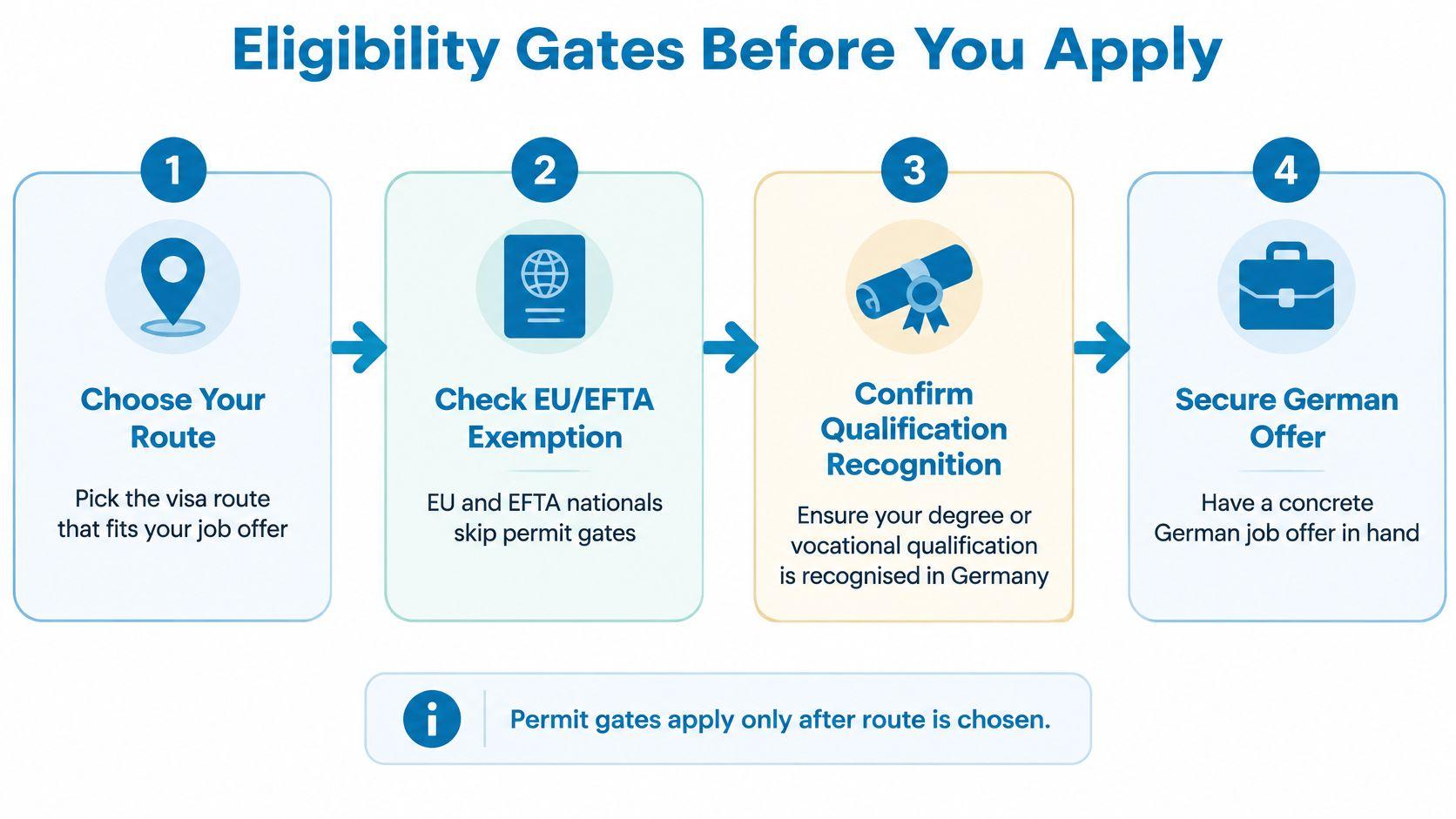
The gates, in order
- The job is in Germany and lasts at least six months. A twelve-month contract in Zurich with a German entity named in the footer is not a German job.
- The role matches your academic or tertiary qualification. The Blue Card is built around a qualification match, and a mismatch is the most common reason a strong profile stalls. A mechanical engineer applying as a project manager is the classic failure here.
- The gross salary clears the floor. For 2026 the standard threshold is €50,700, or €45,934.20 for shortage occupations and recent graduates, subject to Federal Employment Agency approval. The standard threshold in 2024 was €45,300, so a stale advert on a company site proves nothing about today’s bar, and the market is tilting toward exactly those shortage roles: foreign workers’ share of German employment in shortage occupations roughly doubled from 7% in 2014 to around 14% in 2025 (Blue Card guidance, Federal Foreign Office).
- No degree? Test the IT route. At least three years of comparable IT experience in the previous seven, a relevant contract, and a salary of at least €45,934.20.
- Regulated work needs a licence, held or obtainable at filing. Don’t wait on recognition for a non-regulated role, and don’t file for a regulated one without a plan for the licence.
- The employer supports the visa. Before the third interview, get salary, title, location and contract length in writing. An offer that names a salary below the floor is not an offer your visa can accept.
The English-language trap. An advert written in English is a language signal, not work authorisation.
Two phrases sink more applications than any other: “English-speaking” and “remote”. Neither establishes eligibility for German employment. A posting can be written in English and still require a permit you don’t qualify for, and a remote label tells you where the desk is, not whether the employer can hire you in Germany. Run the gates on the role, not on the language of the advert.
When an advert names a German level, translate it before you self-reject. Requirements vary by role, and guides to the CEFR levels needed for jobs can help you read what an employer is asking for. The gap between B1 and B2 is usually the difference between documenting work and presenting it, so check whether the posting demands the higher level or merely lists it as an advantage.
Using the Opportunity Card While You Search
The Opportunity Card (Chancenkarte) is a residence title under Section 20a of the Residence Act, built as a search permit with limited work rights. It gives qualified non-EU, non-EEA and non-Swiss nationals time inside Germany to look for work or complete a qualification measure. Choose it only after its own gates clear: a recognised foreign academic or vocational qualification, with vocational training generally lasting at least two years, then, on the points route, at least A1 German or B2 English and six points (Opportunity Card requirements).
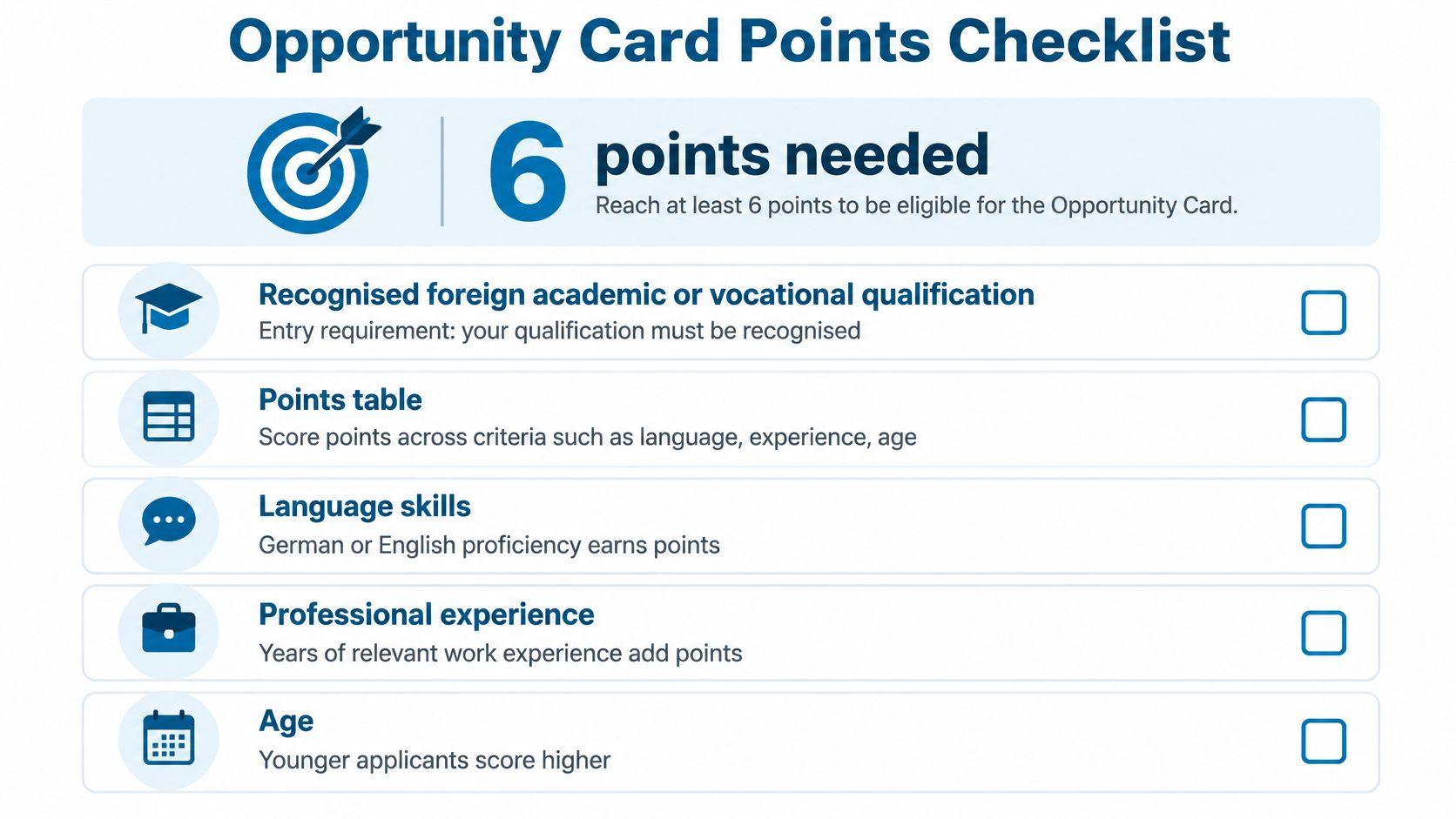
The six-point arithmetic
Opportunity Card points for the six-point threshold
| Criterion | Points awarded |
|---|---|
| Five years of professional experience within the previous seven | 3 |
| Two years of professional experience within the previous five | 2 |
| German at B2 or higher | 3 |
| German at B1 | 2 |
| German at A2 | 1 |
| Total needed to qualify | 6 |
The table is a threshold. Points combine, so five recent years of experience (3 points) plus B1 German (2 points) leaves you one short, while B2 German plus five years clears six without leaning on any other factor. A candidate with a recognised qualification can still strengthen eligibility through recent experience and language ability where Germany has not yet granted full recognition (points mechanics).
What the card requires of you while you search
- One year maximum. The card is initially issued for up to a year, and the clock does not pause.
- Proof you can live on it. You must show maintenance for the search year, commonly through a blocked account; a declaration of commitment or qualifying employment income can replace it. Use the current level required at filing and budget against that figure.
- Twenty hours a week. Part-time work during the search is capped there. Treat it as financing for the search, not permission to take a regular role.
- A switch at the end. Once you secure qualified employment, you apply for the appropriate residence permit, either an employment residence title or, where the conditions are met, an EU Blue Card (Opportunity Card job search rules).
Run only this route’s gates before spending the savings. If the qualification is already fully recognised and language is at the floor, the arithmetic is easy and the card can be worth the money. If recognition or points are still short, apply from abroad through a route whose gates already pass, because the search year consumes funds while every offer still has to clear the permit’s salary and recognition tests.
Applications Interviews and the Move After an Offer
Mass applying is the expensive mistake. The Federal Employment Agency turns down a substantial share of labour-market-permit applications every year, and even the approvals it issues hinge on one test that sits upstream of everything else: a third-country worker’s conditions must be no less favourable than those for comparable domestic workers (EU Blue Card route, Make it in Germany). A role that pays below what a German hire would earn for the same work fails that test regardless of how strong your CV is.
That changes how a week should be spent. A rejected application costs nothing in postage and a great deal in time, so screen hard before you write anything. Apply only where your chosen route’s gates pass.

The six-step funnel
- Filter by fit before you filter by ambition. Keep roles that match your qualification, your experience and the route you already chose. A brilliant job that fails the salary floor is a hobby.
- Write one CV, single column, machine-readable. Mirror the vacancy’s own terminology, quantify outcomes, and keep it to two pages with the newest role first.
- Add a short cover letter that answers the logistics question. Say when you can relocate and name the residence route you’ll use, so the recruiter knows which permit the offer has to support.
- Ask for the numbers before the late-stage interview. Gross salary, job title, work location, contract duration and sponsorship route together, in one email. Hiding visa needs until the offer stage wastes everyone’s time, including yours.
- Check the contract is compliant. Vague contractor arrangements often cannot support the residence permit you need, and that is the trap that catches experienced IT and logistics hires most often.
- After the yes, file documents. The contract or binding offer, role and salary details, and proof of remuneration. Nothing else moves until these exist.
Sort out the practical side of the move before the flight. A hiring manager’s call should not arrive while you’re queueing in the terminal, and prepaid data for German trips covers the interview week and the first month of flat hunting, when a missed call costs the most.
Ask for the gross salary, the title and the contract length before the final round. If the answer is vague, the permit isn’t the bottleneck.
For the search itself, start from a list of visa-sponsored software engineer roles rather than typing “visa sponsorship” into a search bar. Use remote job listings only to test whether the wording allows work from outside Germany, then apply on the employer’s own career page.
Build a Shortlist You Can Actually Apply To
A usable shortlist starts with one legal route, then tests each job against that route’s pass-or-fail gates. Three applications that fit your permit are more valuable than a hundred speculative clicks.
The week
- List ten employers in your occupation. Include hospitals, school authorities, engineering firms, or product and IT companies if you are using the degree or three-year IT route.
- Remove jobs that fail a gate. Check location, contract duration, the salary floor for your route, and any licence you cannot obtain in time.
- Annotate the remaining jobs. Record the German or English level implied by the advert and whether the occupation is regulated.
- Send three customized applications. Use a one-column CV, quantified results, and a cover letter naming the route you will use. Germany’s official job-search guidance recommends a CV, a position-specific cover or motivation letter, and references that demonstrate your qualifications (Make it in Germany job search guidance).
- Check the employer. Where an official register exists for the occupation or sector, consult it. If the named employer has no verifiable presence, do not apply.
Start with visa sponsorship jobs in Germany rather than relying on sponsorship keywords alone. JobGlance’s visa sponsorship results use a hand-picked list of verified sponsors, cross-checked against official government registers where available. No credit card is required to start.
Keep the bar practical: every job on the shortlist should meet the route’s requirements, not merely match your skills. JobGlance’s web app ranks results against your resume, while the Chrome extension detects visa sponsorship on job pages as you read them. Its job search ecosystem covers Germany, the UK, the US and other destinations, so you can compare relevant roles without relying on ten separate tabs.
Use the shortlist to focus this week’s applications. A few well-matched submissions are more useful than a long list that fails the eligibility checks.
Keep reading


