Resume for UK Jobs: How to Write a UK CV That Gets Read


On this page
The UK decided 37,263 sponsor-licence applications in the year ending March 2025, down from 48,022 the previous year, according to GOV.UK immigration system statistics. Sponsorship hasn’t disappeared. Targeting has got sharper, and that changes how you write a resume for UK jobs.
Don’t just change the spelling on a US resume and rename the file. Build a UK CV as an evidence document. Translate unfamiliar titles and qualifications into skills a recruiter can assess, prove each claim with a result, and state your work authorisation so clearly that nobody has to guess.
The UK CV Layout and What to Drop From a US Resume
In the UK the document is a CV, written in reverse chronological order and adapted to each advertisement. The National Careers Service guide to CV sections recommends contact details, an introduction, education history, work history and references, with two to three lines per role on responsibilities and achievements. Treat that as your working template, not a biography.
Use this order for a standard resume for UK jobs, then cut the US habits in the third column.
| Section | What goes in it | US habit to drop |
|---|---|---|
| Contact details | Name, mobile, email, town and region; full street address optional | Photo and date of birth |
| Personal profile | Three to four lines naming role, years of experience and two proof points | Generic objective statement |
| Work experience | Reverse chronological roles with employer, title, dates and two to three lines each | Long lists of duties with no achievements |
| Education | Qualifications, institutions, years and UK degree class | GPA and coursework lists |
| Skills | Role-matched software, tools, languages and skills in the advertisement’s wording | Skill bars and rating scales |
| References | A single line such as ‘references available on request’ | Three named referees with phone numbers |
What Each Row Has to Do
Your contact details answer where you are and how to reach you. A town and region is enough. A full street address adds privacy risk and no hiring value.
Your personal profile isn’t an objective about what you want. It’s a claim about fit. Name the target role, your years of relevant experience, and your two strongest proof points, such as a budget owned, a system migrated, or a close cycle shortened.
Work experience carries most of the decision. Give employer, title, and month and year dates, then keep each role tight. If an old job doesn’t support the target, compress it to one line or cut it. Relevance beats completeness.
For education, UK readers think in degree classes such as First and 2:1, not GPA. Give the qualification, institution, and year. Expand unfamiliar abbreviations in full the first time.
The skills row should mirror the advertisement’s exact terms for tools and capabilities you have. Skill bars don’t tell a recruiter whether you can do the work, and they parse badly.
Also drop photographs, marital status, and named referees with phone numbers. If you want a wider sense-check on personal details and filler that weaken applications, work through how to avoid these resume mistakes before you send anything.
Ten-second test: Can a recruiter see your target role and strongest result within ten seconds of opening the page?
If not, your layout is burying the evidence.
Format Rules for Font, Page Size and Spelling
Get the document settings right before you rewrite a single line. Formatting is the first thing a UK recruiter sees, and a sloppy page gets read as sloppy work before anyone reaches your evidence.
| Element | UK convention | Why it matters |
|---|---|---|
| Paper size | A4 | Matches UK printers and template defaults |
| Body font | Calibri or Arial, 11pt | Easy to read on screen and parses cleanly in ATS |
| Margins | 2 cm on all sides | Keeps text clear of the page edge when printed |
| Date format | Month and year, such as March 2023 to May 2025 | Makes timelines and gaps easy to scan |
| Spelling | British English, such as organise, programme and licence as a noun | Signals the document is written for a UK audience |
| File type | PDF unless Word is requested | Keeps layout identical on every device |
| File name | FirstnameLastname-CV.pdf | Easy to find in a recruiter’s downloads |
Why These Settings Matter
A4 is the UK standard. A US Letter file can print with odd margins and white space you didn’t intend. Set the page size first, because changing it later shifts every line break in the document.
Calibri or Arial at 11pt is readable and boring in a good way. It survives copying, parsing and printing. Decorative fonts and mixed weights make dates and headings harder to scan, which costs you the fast first read a recruiter gives each application.
Use month and year for every employment and education date, and keep one style throughout. “03/2023” forces the reader to decode. “March 2023” doesn’t. If you’re converting from a US resume, check every date line rather than trusting find and replace, since American “03/04/2023” formats can slip through with the wrong meaning entirely.
British spelling is a localisation signal. Write organise, programme, analyse, and licence as the noun. Keep proper names as the organisation spells them, and don’t change a computer “program” into “programme.” The goal is consistency: one American spelling in a British document reads as a copy-paste job.
This isn’t cosmetic fussiness. In 2024, two in three hiring managers surveyed by CV Genius said they were less likely to hire an applicant whose CV was poorly formatted, in Onrec’s report of that survey of 625 UK and Irish hiring managers. A crowded page signals carelessness before anyone reads your achievements.
A Proofreading Routine That Works
Save as PDF unless the advertisement asks for Word, and name it FirstnameLastname-CV.pdf. Then read it aloud once. You’ll hear missing verbs and repeated words that your eye skips.
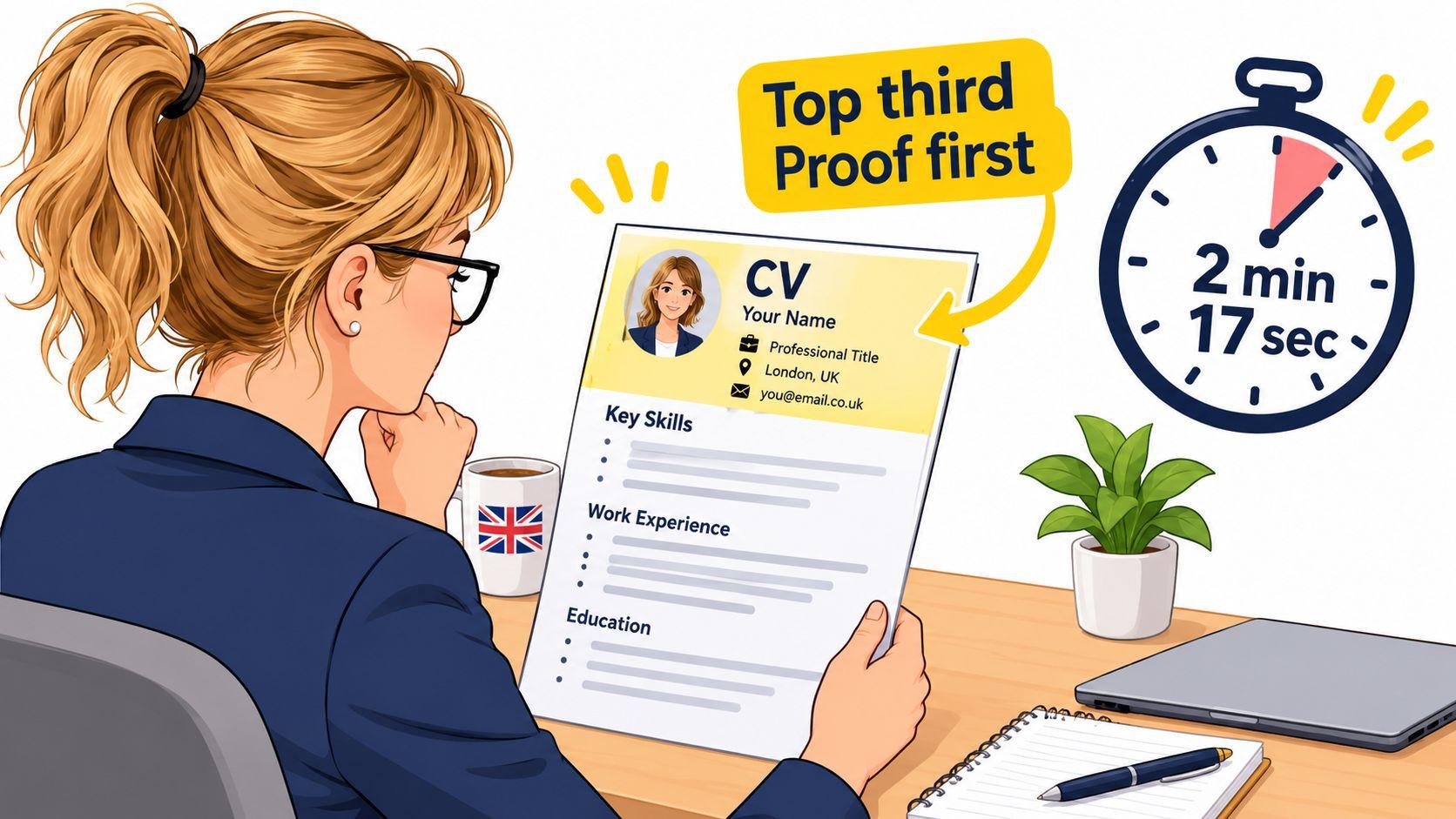
Run spellcheck set to English (UK), since most tools default to US English and will “correct” organise back to organize. Finally, give the CV to one person for thirty seconds and ask them to name your target role and best result. If they can’t, fix the top third, not the font colour.
How to Write Each Section With Proof
You don’t get a leisurely read. In 2024, hiring managers surveyed by CV Genius reported spending an average of 2 minutes and 17 seconds reviewing each CV, according to CV Genius’s survey of 625 hiring managers in the UK and Ireland. So your top third has to carry the proof, and every bullet has to answer “so what?”
Six Steps for Evidence Led Writing
-
Write a three-line profile: Name the target role, years of experience, and one measurable result. Before, “Experienced accountant looking for a new role.” After, “Management accountant with six years of month-end close for a 40-person group, cutting close time from nine days to five.”
-
Use action, method, result in every bullet: Write three to five bullets per recent role. “Cut invoice disputes by 30 percent by adding a three-way match check before payment” beats “responsible for invoices” because it shows how the result happened. If your bullets sound uneven when read in a run, sentence editing practice for students is a useful way to spot broken parallel structure before you tighten each line to start with the same kind of verb.
-
Quantify with volume, money, time, or team size: Use the actual figure where you have it. Where you don’t, state scope instead, such as “monthly payroll for three sites” or “first-line support for two product teams.” Scope is still evidence. Vague scale words like “large” and “many” aren’t.
-
Borrow the advertisement’s exact wording: Only for core skills you have. If the role asks for “month-end close,” don’t write “monthly accounting tasks” and hope the reader connects them. Keep the term, then prove it in the same bullet.
-
Put the most relevant material first: Your newest job isn’t always your best evidence for this vacancy. Lead its bullets with the duties that match the target, and cut tasks that no longer support the direction you’re applying in. Compression is editing, not dishonesty.
-
Keep education short: Qualification, institution, year, and degree class. A recent graduate can add a relevant project or placement. An experienced hire rarely needs coursework lists taking space from paid results.
Small Rules That Prevent Weak Bullets
Start every bullet with a verb, not “responsible for.” List no more than six skills unless the advertisement clearly asks for more. A long skills block reads like a keyword dump and invites questions you can’t answer.
Check each bullet with one question: so what changed because you did this? If nothing changed, you have a duty, not an achievement. Rewrite it around the outcome, the user helped, the risk reduced, or the time saved.
A CV claim should survive the interview that follows it. If you can’t explain the method behind a number, don’t put the number on the page.
That’s the standard. Proof first, polish second.
Translate Foreign Titles Into UK Evidence
UK hiring is getting harder to bluff with familiar sounding titles. 66% of UK organisations reportedly use a skills-focused approach, according to Michael Page’s report on skills-first hiring in the UK. At the same time, employers responding to the UK Government’s Employer Skills Survey judged that 1.26 million employees in the UK workforce had a skills gap in 2024, as shown in the Employer Skills Survey 2024. Your job is to make capability assessable in seconds, even when your job title, employer, or qualification comes from another system.
The Five Step Translation Method
-
State the role in one neutral phrase: Describe the job before you name it. “Ran daily office operations for a regional branch” is clearer than a literal title translation.
-
Name the UK-equivalent duty and keep the original in brackets: A “chief clerk” whose duties match can become “operations coordinator (chief clerk).” You’re translating duties, not inflating seniority. If the UK title implies line management you didn’t have, don’t use it.
-
Convert the qualification into level and subject: Write the award, subject, institution, and year in full. Add a formal comparability statement only where the employer asks for one. Don’t crowd the CV with process detail the recruiter hasn’t requested.
-
Turn the achievement into action, method, and result: “Reduced stock write-offs by 18 percent by introducing weekly count checks” tells a UK reader your skill and your level. “Handled inventory” doesn’t.
-
Map each item to one skill in the advertisement: Use the employer’s wording where it’s true, such as “stock control,” “supplier management,” or “month-end reporting.” One clear match per bullet is stronger than three vague ones.
Before and After
Before: “Responsible for client accounts in a regional office.”
After: “Account manager (equivalent of UK key account manager) for 60 corporate clients, renewing 92 percent of contracts.”
The second version gives the reader a recognisable function, a client volume, and an outcome. It also sets up the likely next step. Skills tests, work samples, and structured interviews increasingly sit behind the CV, so connect each claim to something you could demonstrate or explain under questioning.
Apply one test to every translated line: could a recruiter who’s never worked in your country name your skill, your level, and your result within ten seconds? If they need local knowledge to decode it, you haven’t translated it yet.
How to Tailor a CV to Each Job and Get Past Screening
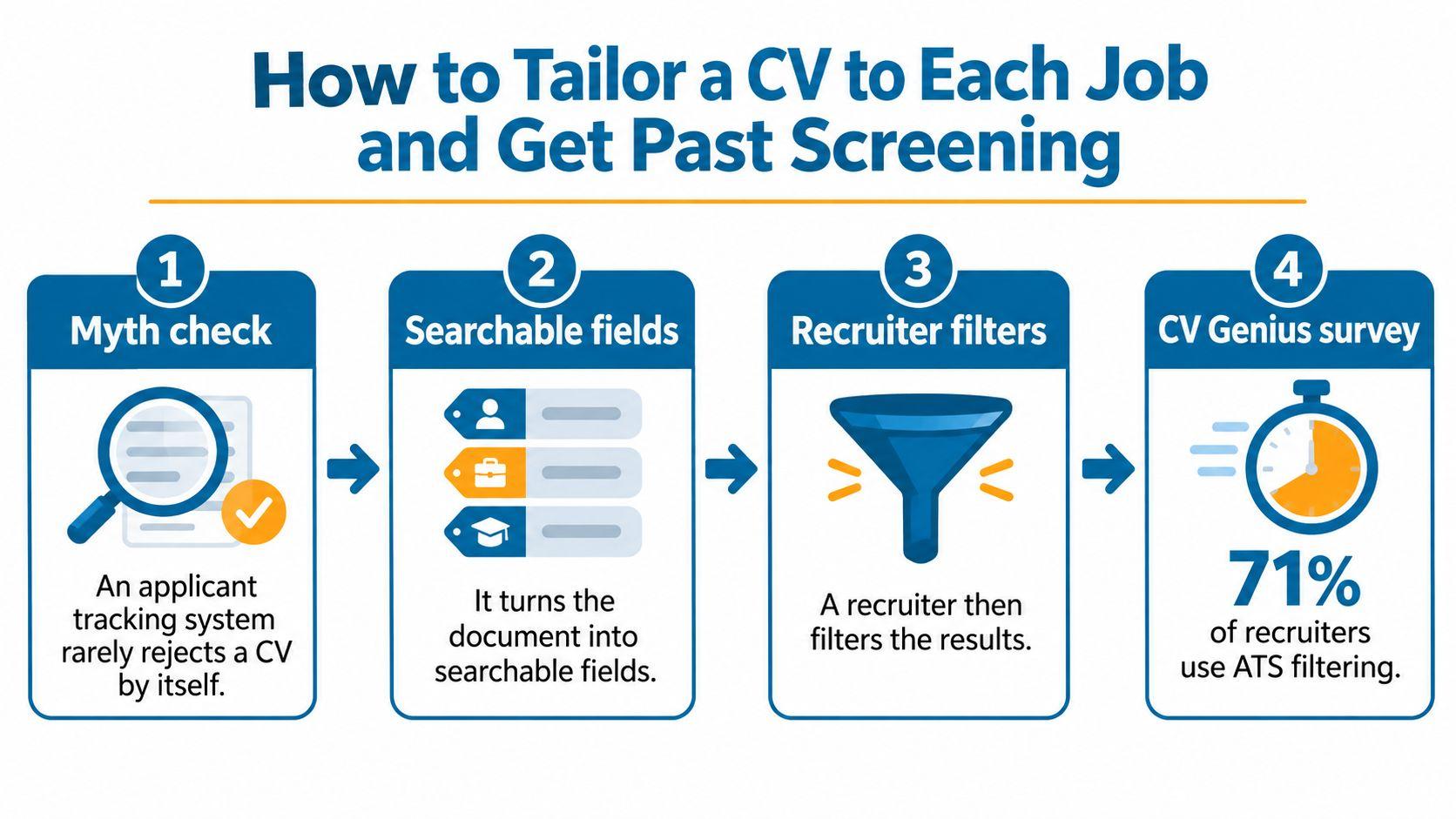
An applicant tracking system rarely rejects a CV by itself. It turns your document into searchable fields, and a recruiter filters what comes back. In 2024, 71% of hiring managers surveyed by CV Genius said they used an applicant-tracking system to screen CVs, according to CV Genius’s recruitment trends survey. The risk isn’t a robot hating your font. It’s unsearchable, scrambled, or missing text.
The Tailoring Procedure
-
Copy out the must-haves: Pull the essential requirements from the advertisement into a short list. Separate true essentials from “nice to have” items, because they deserve different amounts of space. An essential you meet gets a line with evidence. A nice-to-have you meet gets a brief mention at most.
-
Mirror exact terms you meet: One worked swap shows the principle. Replace “working with people” with “stakeholder management” if that’s the advertisement’s term and you can prove it. For a fuller walkthrough of matching language without stuffing, see how to tailor your resume for specific roles and then apply the same discipline in UK spelling.
-
Place those terms where screening looks first: Put them in the profile, the skills list, and the first bullet of your two most recent relevant roles. A keyword buried once on page two does less work, because recruiters skim the top third of page one before deciding whether to read on.
-
Use standard headings: Profile, Experience, Education, Skills. Creative headings like “My Journey” make parsing and human scanning harder.
-
Keep layout elements out of the text path: Don’t put key content in tables, text boxes, icons, headers, or footers. Contact details belong in the body of page one.
-
Run the plain-text test: Export the PDF, copy all its text into a plain text file, and check nothing is missing or out of order. If your dates detach from your job titles, a parser will struggle too.
Checking the Match Before You Apply
The same job hides under different titles. Browse likely openings by function on our job roles index to see how employers phrase the same work differently, then tailor to the specific posting in front of you.
JobGlance’s ATS Resume Builder scores a resume against five ATS checks and tailors it to a chosen job, while the Resume Match Score highlights matched and missing keywords inside the job description. JobGlance stores resume text securely to power its match scores and cover letter tool, never sells it, never uses it to train AI, and lets you delete it at any time. For the mechanics behind that check, read our guide to what makes a resume ATS friendly.
The rule doesn’t change: tailor the truth. Never add a keyword you can’t back up with an example in interview.
How to Explain a Career Break or Career Change
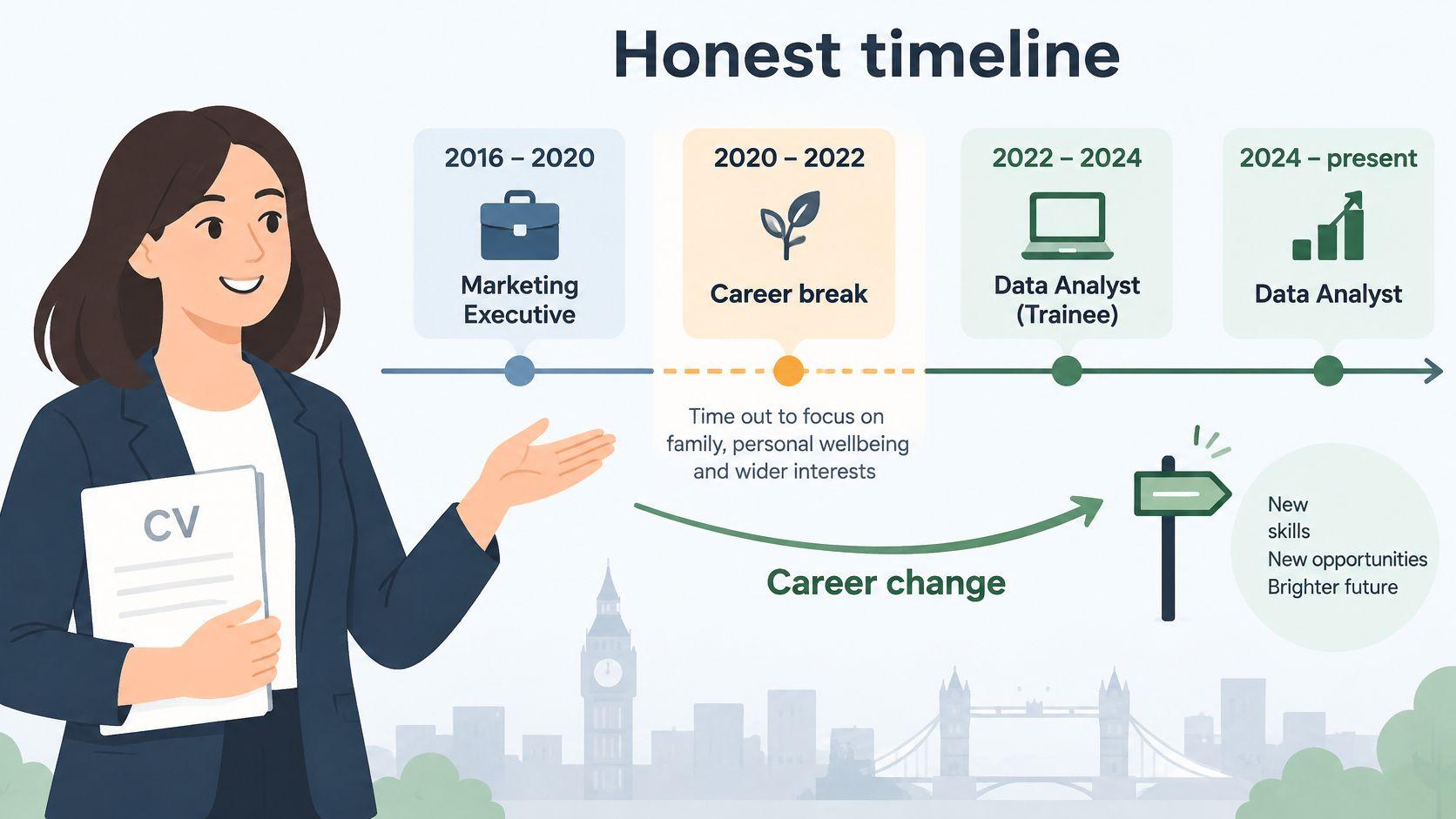
A gap isn’t the problem. An unexplained jump in dates is. Show the period transparently, label what you were doing, and state what it produced. That gives the recruiter a fact to assess instead of a silence to fill with doubt.
Label the Activity, Then Prove It
Use an honest heading such as caregiving, study, freelance projects, volunteering, or professional development. Then add the output. “Completed a 12-week data analysis course and built a sales dashboard used by three teams” is a complete answer in one line.
For a career change, do the same with transferable evidence. Don’t claim the new job title before you’ve held it. Show the bridge: the course finished, the portfolio built, the client served, the tool used in a real project.
Where a form allows it, describe experience by duration or years rather than unnecessarily precise dates. UK government guidance on reducing unconscious bias in CV screening cites evidence that this approach increased the chance of an interview or job offer by 15%. The same guidance reports that 53% of STEM returners in one UK study experienced negative bias because they lacked recent experience.
Put Current Capability Near the Top
If you’re returning, don’t make the reader dig for proof that you’re current. Lead with a targeted profile, then place recent courses or certifications, portfolio projects, current tools, and role-relevant achievements high on the page. Older experience can follow in compressed form.
International candidates get an extra benefit from this order. Translating an earlier title into the UK equivalent of the duty, with the original in brackets, stops a break and an unfamiliar title from compounding into one confusing story.
Finally, line up the versions. Your CV, application form, LinkedIn profile, and interview answers should give the same dates, the same label for the break, and the same outcomes. Inconsistency creates more suspicion than the gap ever would.
Right to Work, Sponsorship and Choosing Your CV Version
Split your status into three separate facts: your current right to work, any date or condition attached to it, and whether you’ll need sponsorship later. Vague wording like “eligible to work in the UK” hides exactly what a recruiter needs to know. Use one short, truthful line.
| Your situation | Wording to use | Where it goes |
|---|---|---|
| British citizen or settled in the UK | Right to work in the UK, no sponsorship required | Contact details |
| Time-limited UK permission, such as the Graduate route | Right to work in the UK until the expiry month and year on your permission | Contact details |
| Needs Skilled Worker sponsorship | Will require Skilled Worker visa sponsorship | Profile or application form |
| Remote role from outside the UK | Available for remote work from your country, with right to work there | Contact details |
| Graduate or PhD relevant to a reduced salary rule | Degree or PhD subject, institution and year | Education section |
Run the Sponsorship Check on the Advertisement
Start with salary and occupation, because a strong CV can’t fix an ineligible role. GOV.UK’s Skilled Worker job guidance states the standard requirement is whichever is higher: £41,700 per year or the occupation’s applicable going rate. Confirm the role is in an eligible occupation and the employer is an approved sponsor. Match your CV wording to the occupation’s actual duties, not just a similar sounding title.
Reduced rates have conditions. GOV.UK’s guidance on when you can be paid less says eligible applicants may be paid between 70% and 90% of the standard going rate if they earn at least £33,400 and meet criteria such as being under 26, recently graduated, or in professional training. It also sets 80% for relevant STEM PhDs and 90% for other relevant PhDs. Make graduate or doctoral status explicit where it affects eligibility.
Check the Immigration Salary List separately. GOV.UK’s Immigration Salary List states jobs on the list may qualify at 80% of the route’s usual minimum rate, with biological scientists showing a lower qualifying figure of £30,700. Don’t assume your title qualifies. Check the code and duties.
Choose the Right Version
Match the CV to location and work policy. A UK-only remote role is not the same as a globally remote one, and your status line should say which one you can do. Browse current visa sponsorship jobs in the UK alongside the wider visa sponsorship category and the remote jobs category to target employers whose hiring model fits your situation. Visa sponsorship jobs can be browsed for the United Kingdom, United States, Canada, Europe, Australia, Singapore, Germany, the Netherlands, Ireland, Spain, Poland, Japan, France and Asia.
For public-sector roles, check whether an anonymised CV is required. UK Parliament’s guidance on making your CV shine states the House of Commons accepts only anonymised CVs and asks candidates to omit name, age, home address, email address, telephone number, photograph and school, college or university. That version needs evidence mapped tightly to the essential criteria, and you may also need a separate personal statement.
Before you send, adapt the document to the chosen job and save a clean PDF under 5MB. A resume can be uploaded as a PDF or DOCX file to get an instant ATS score, and the Builder exports a text-preserving PDF once you’ve adapted it. Do one thing today: run the advertisement you want most through this checklist before you write another line.
Upload your CV to JobGlance, score it against live UK roles, and use the matched and missing keywords to tailor a text-preserving PDF for the exact job you want. Filter by visa sponsorship or genuine work-from-anywhere status first, then apply only where your evidence and your right to work both fit.
Keep reading


