How to Find Jobs Abroad That Actually Sponsor You


On this page
167.7 million migrants were participating in the labour force of destination countries in 2022, with 155.6 million employed and 12.1 million unemployed, according to the ILO’s global estimates framework linked through the OECD document library1/en/pdf). That’s the right starting point for how to find jobs abroad. You’re not entering a quirky side market. You’re entering a huge labour market that’s filtered by borders, sponsorship rules, payroll constraints, and employer willingness to hire across them.
Most candidates still search the wrong way. They start with job titles, then location, then salary, and only at the end ask the question that decides everything: can I legally take this role? By then, they’ve already wasted hours on jobs that were never open to them.
After screening cross-border listings, the pattern is obvious. The fastest international job search isn’t the one with the most applications. It’s the one that treats eligibility as the first filter, then ranks the remaining roles by fit.
Why Finding Jobs Abroad Starts With Eligibility Not Job Titles
In the UK alone, the pool of employers that can legally sponsor a Skilled Worker visa expanded to 110,500 registered organisations in 2024, up from 38,800 in 2021, while applications on that route rose from 127,300 to 256,300 over the same period, according to the National Audit Office’s review of the visa system. That gap explains why international job search works differently from domestic search. The contest is not just for a job title. It is for access to an employer, contract model, and country route that you can use.
That changes the order of operations.
A software engineer in Lagos, a marketer in São Paulo, and an analyst in Manila can all match the same posting on skills. The ranking still shifts immediately once work authorization enters the picture. One candidate may already have local work rights. Another may need sponsorship. A third may only be eligible if the employer hires through an Employer of Record or accepts work-from-anywhere arrangements. Same title, different odds.
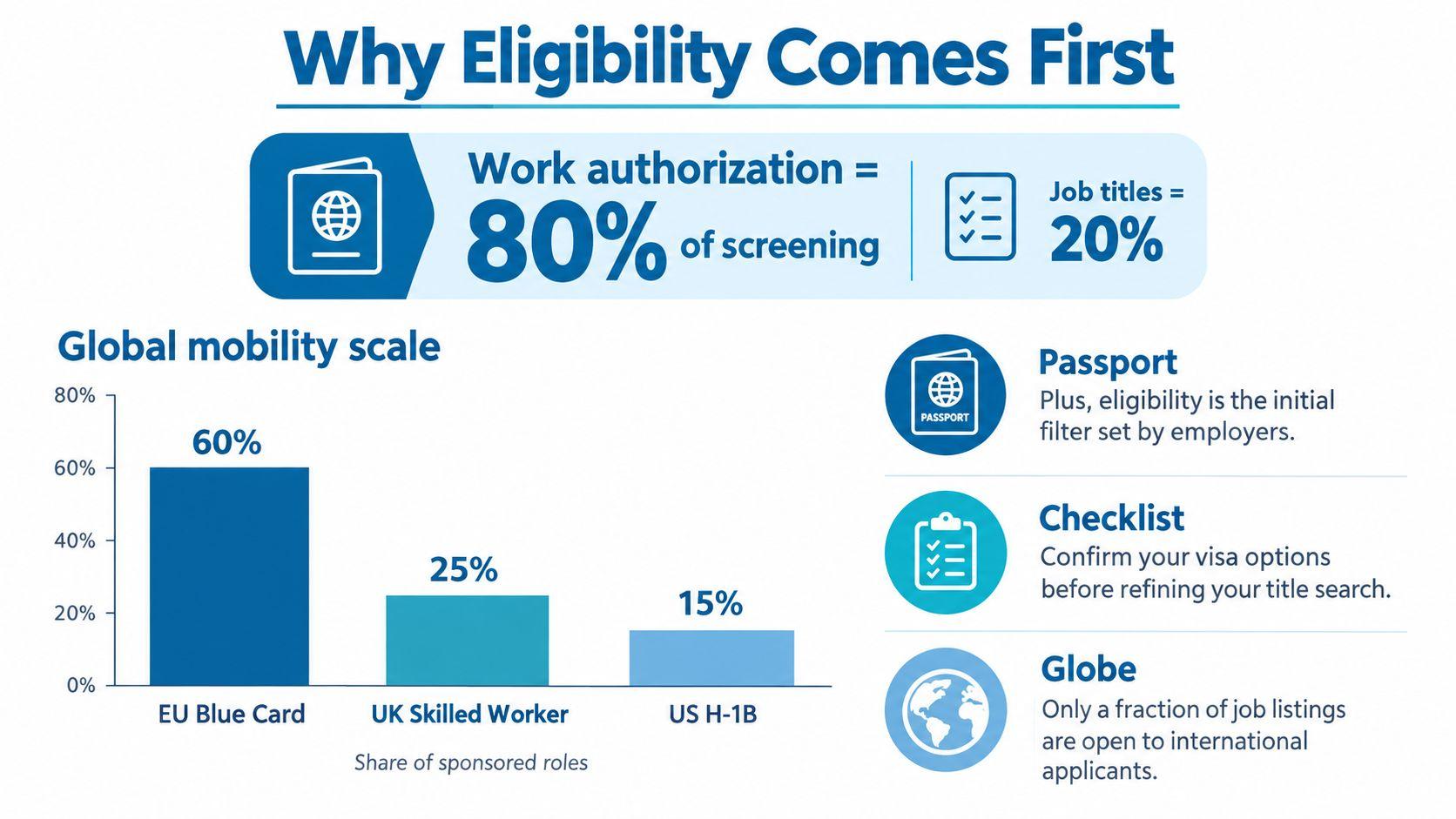
Eligibility shrinks the market before fit even matters
Cross-border listings usually pass through three filters before a recruiter reads your resume in detail:
-
Legal hiring scope
Can the employer hire only people already based in the country, or can it sponsor relocation or employ abroad? -
Operational hiring scope
Does the company have payroll, entity coverage, or an approved vendor that supports cross-border employment? -
Candidate fit
Once the first two are satisfied, does your background justify an interview?
Candidates who start with job titles reverse that sequence. They spend time tailoring applications for roles that were closed from the start.
The practical rule is blunt. If you cannot identify a legal hiring path, treat the role as unqualified demand, not a real lead.
Sponsorship capacity is a better signal than country interest
Broad intent like “I want to work in the UK” or “Australia is hiring” does not help you rank opportunities. Sponsorship infrastructure does.
For Australia, the government reported 132,148 places in the 2024–25 Skilled stream, equal to 71.4% of the total Migration Program outcome, in its Department of Home Affairs migration report. Useful as that is, country-level capacity still does not tell you which employers in your function sponsor, or which ones repeatedly hire from abroad. That is the level where search becomes efficient.
A better workflow is to start from eligible openings, then rank them by evidence. If you want that view first, review visa sponsorship jobs by country and check which employers appear repeatedly in your field.
Remote expands access only when the employer can hire across borders
“Remote” is one of the noisiest labels in international job search. In many listings, it means remote within one tax and payroll jurisdiction. A company may allow home-based work in Germany, for example, while rejecting applicants in Kenya or India because its employment setup stops at the border.
That is why visa sponsorship and work-from-anywhere signals should be stacked, not treated as separate searches. Start with roles that clearly indicate one of three things: sponsorship, international remote eligibility, or a compliant cross-border contract path. Then rank those roles by resume fit, seniority, and employer history. Candidates who apply in that order usually waste less effort and surface better odds faster.
Keyword stuffing does not solve an eligibility mismatch. Targeting employers with a documented path to hire people like you often does.
Map Your Target Countries and Sponsorship Pathways
Don’t build a target list from aspiration alone. Build it from entry mechanics. The right shortlist is usually three to five countries where your occupation, documents, and sponsorship odds line up well enough to justify serious effort.
Start with the hiring route, not the destination fantasy
Every country has its own gatekeeping logic. Some rely on employer sponsorship. Some support jobseeker visas. Some are easier through cross-border remote structures than through relocation.
A useful country map includes four fields:
-
Employer route
Is the usual path direct sponsorship, an Employer of Record setup, or a separate permit after arrival? -
Role eligibility
Does your profession commonly appear in sponsored hiring for that market? -
Document burden
What will employers or immigration authorities likely ask for early? -
Signal density
Can you find enough eligible roles to justify a focused campaign?
The UAE is a good reminder that basic eligibility can be specific before you even apply. Its jobseeker visa guidance says applicants generally need at least a bachelor’s degree or equivalent, the role must fall within skill levels 1, 2, or 3 under MOHRE classification, applicants may need proof of sufficient financial means, and a passport valid for at least six months plus supporting documents are commonly required, according to Gulf News’ summary of the UAE jobseeker visa requirements. That kind of rule should shape whether a country goes on your list at all.
Use live role concentration as a market sanity check
Before you commit to a country, check whether sponsored demand is visible right now. JobGlance’s visa-sponsorship category page listed 29,182 visa-sponsored roles, 1,025 hiring companies, and 7,453 roles added in the week shown, with the largest country pools in the United States, United Kingdom, India, Germany, Singapore, Canada, France, and Ireland, according to the live visa sponsorship jobs index.
Here’s the practical clustering from that dataset:
| Country | Sponsored Roles | Hiring Companies |
|---|---|---|
| United States | 13,907 | Included in overall pool of 1,025 companies |
| United Kingdom | 2,399 | Included in overall pool of 1,025 companies |
| India | 1,885 | Included in overall pool of 1,025 companies |
| Germany | 1,176 | Included in overall pool of 1,025 companies |
| Singapore | 864 | Included in overall pool of 1,025 companies |
| Canada | 734 | Included in overall pool of 1,025 companies |
| France | 643 | Included in overall pool of 1,025 companies |
| Ireland | 536 | Included in overall pool of 1,025 companies |
This table doesn’t tell you where you’ll get hired. It tells you where it’s worth digging deeper.
Countries with visible sponsored inventory give you something most advice ignores: proof that the market is active enough to search systematically.
Rank countries by sponsor behavior, not reputation
A polished economy isn’t automatically a good target if sponsorship is sparse in your segment. Recent European early-career data makes that plain. One 2026 snapshot reported that only 7.5% of early-career roles in Poland and 1.3% in Germany explicitly advertised visa sponsorship, while finance sponsored nearly twice as often as tech in that dataset, according to GetJobPing’s international graduate sponsorship analysis. The lesson isn’t “avoid Germany.” It’s “don’t search Germany the same way you’d search every other market.”
Use this ranking logic:
- Prioritize countries where your sector appears in sponsored hiring
- Favor employers with sponsorship history over fresh keywords
- Downgrade countries where early-career sponsorship is especially thin
- Keep separate lists for relocation markets and globally remote markets
That’s how to find jobs abroad without drowning in technically irrelevant listings.
Source Smarter With Aggregated Search and Real Time Ranking
Manual multi-site hunting feels productive because it creates motion. It rarely creates signal. You open one board, then another, then a niche site, then LinkedIn, and by the end you’ve re-read the same reposted job five times.
The better approach is aggregated sourcing plus ranking. One query. One filtered pool. Then sort by personal fit, not by recency.
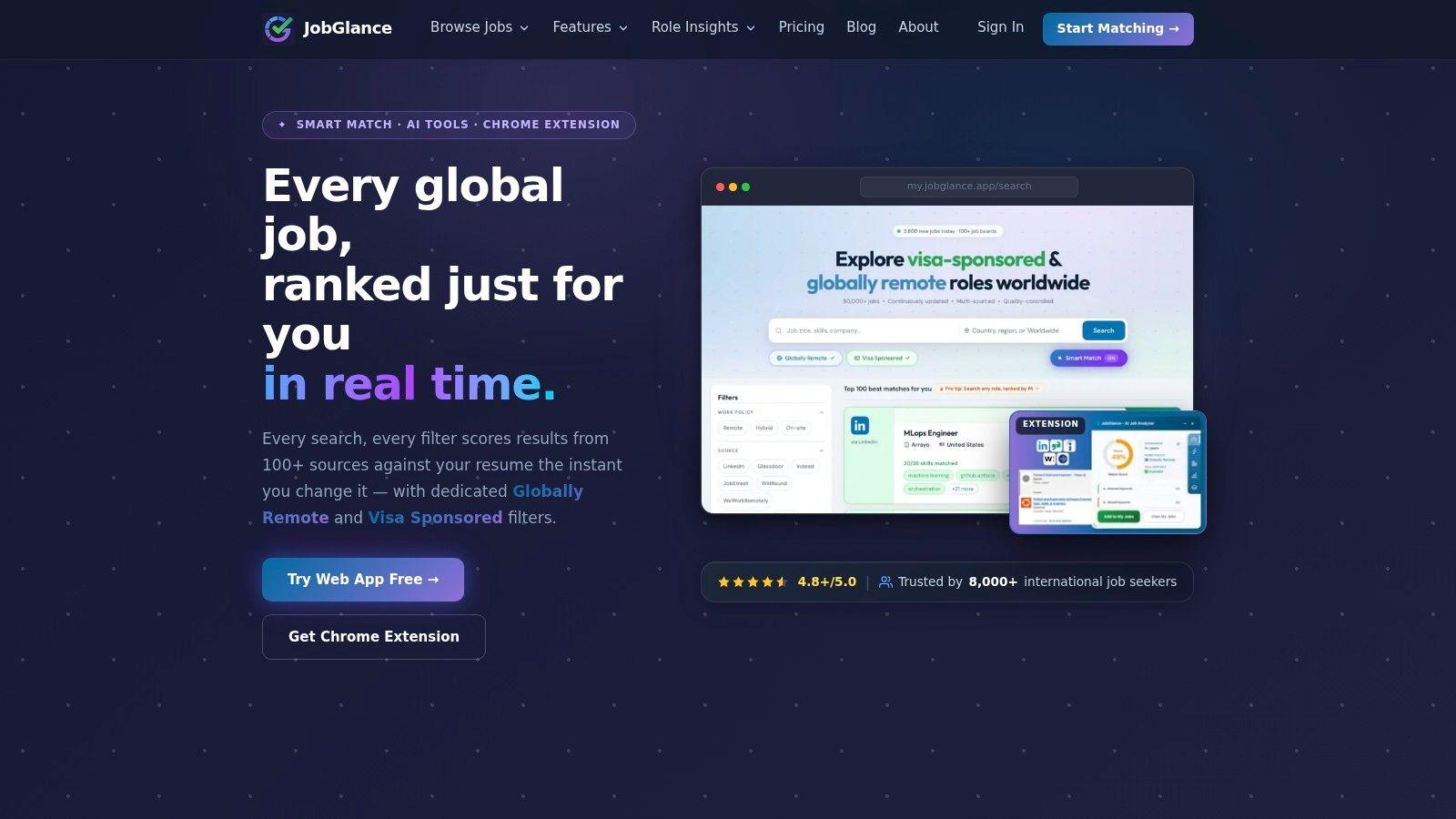
Why manual search breaks down in cross-border hiring
Cross-border search has more hidden failure points than domestic search:
- Duplicate inventory across multiple boards
- Country-restricted remote roles mislabeled as open
- Sponsorship ambiguity buried in the description
- Expired listings that still rank highly on large platforms
Those problems compound when sponsorship is already scarce. In the U.S., visa sponsorship appears in only 0.14% of job postings, rising from 0.04% in June 2021 to a peak of 0.16% in October 2024, according to JobGlance’s immigrant job-search analysis. That means broad search by title first is statistically the wrong move. The method has to filter for eligibility first, then rank the survivors by fit.
The remote distinction that changes everything
Remote isn’t one category. It’s at least two:
- Remote in one country
- Remote from anywhere or from multiple countries
One 2025 dataset reported that 88% of remote jobs were tied to one country, 10% were open to several countries, regions, or time zones, and only 2% were remote from anywhere, as cited in the same JobGlance analysis of remote eligibility constraints. If you ignore that distinction, you’ll overestimate your options immediately.
Tools matter. One option is to use an aggregated search product that treats visa sponsorship and work-from-anywhere as dedicated filters rather than search keywords. JobGlance does that while re-ranking the filtered result set against your resume, instead of leaving you with date-sorted results and manual triage.
Compare the two workflows
| Search method | What you see first | Main weakness | Best use case |
|---|---|---|---|
| Manual board-by-board search | Recent postings on each site | Repetition, poor eligibility filtering, stale jobs | Narrow company research after you already have targets |
| Aggregated filtered search | One pool narrowed by sponsorship or global remote status | Still needs human judgment on role quality | Initial sourcing and prioritization |
If a role only looks good when you ignore work authorization, it was never a strong lead.
Use manual search later, not first. It’s useful for checking company career pages, reading local-language listings, and validating whether a role appears in multiple places. It’s inefficient as your discovery engine.
Tailor Your Application to Beat Filters and Human Screens
Finding an eligible job isn’t the hard stop. It’s the start of a different bottleneck. International applicants lose ground when their resumes make the employer do too much inference. If your fit is real, your documents need to surface it fast.
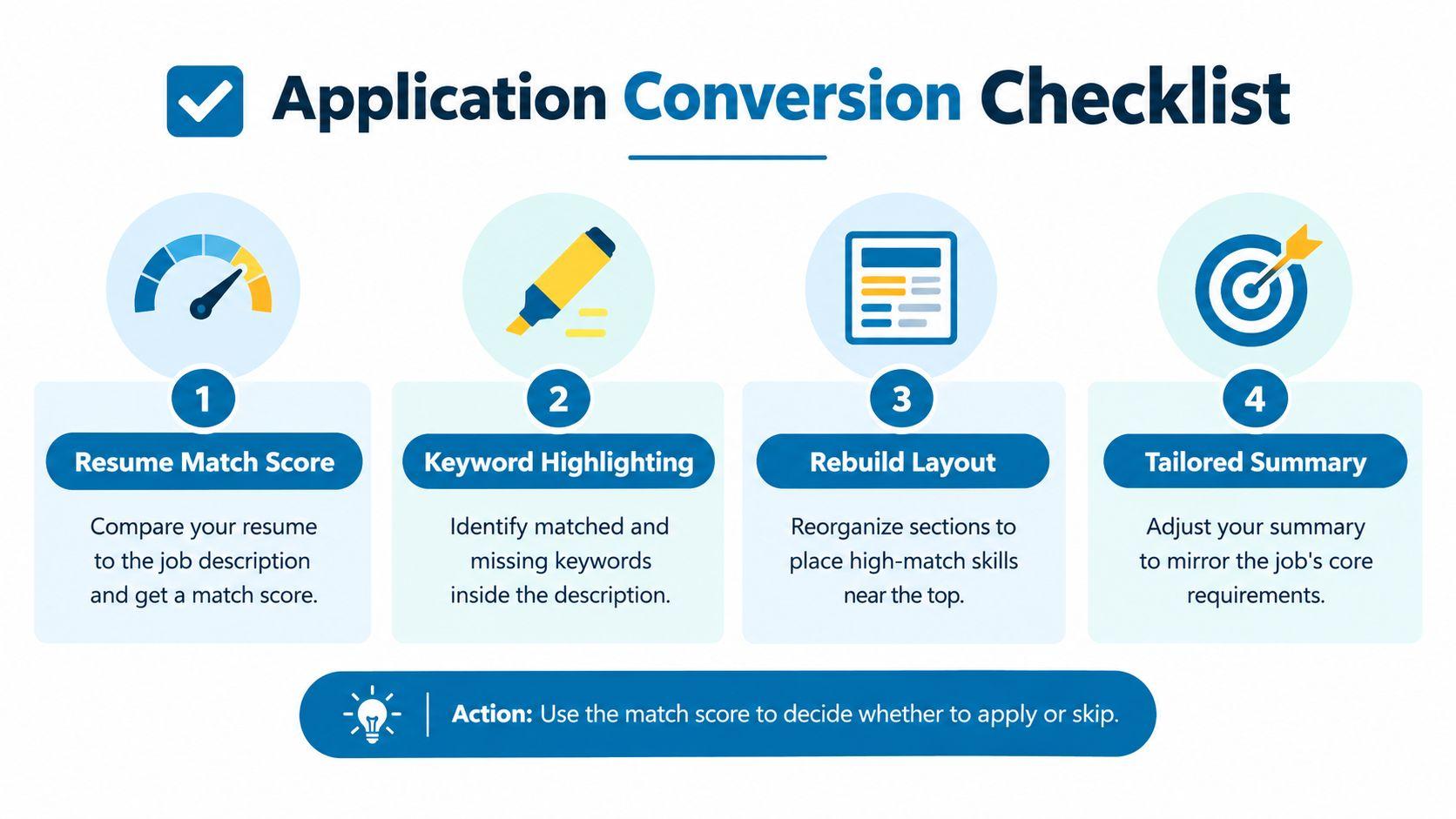
Tailor for evidence, not theatrics
Most candidates over-tailor the wrong parts. They rewrite their tone, inflate soft skills, and produce polished summaries that don’t change their relevance to the role.
What matters is whether the application clearly matches the posting’s core requirements. I’d handle each role in four passes:
-
Compare your resume against the job description
Look for matched and missing keywords, especially around tools, domain knowledge, and seniority cues. -
Rebuild the layout if needed
A single-column ATS-friendly format is usually safer than visually complex templates. -
Move proof upward
If the job asks for stakeholder management, SQL, or product discovery, those items should appear near the top if you have them. -
Write a specific cover letter only after the fit check
Don’t spend time on a custom letter for a role your resume barely matches.
Use tailoring to decide whether to apply at all
A resume match score is more than a polish tool. It’s a decision tool. If a role shows repeated missing requirements that you can’t truthfully cover, skip it and move on.
That’s especially important in cross-border hiring because the employer is already evaluating an extra layer of friction. A local candidate may get benefit of the doubt on a partial fit. An international candidate often won’t.
Use a role page with a clear skills profile when you need a baseline for what employers repeatedly ask for. For example, reviewing Product Manager role insights can help you check whether your resume reflects the recurring requirements attached to that path.
Application rule: Tailor the evidence. Don’t rewrite your history into something it isn’t.
Five checks before you submit
I use a blunt pre-submit screen:
- Keyword coverage: Does the resume reflect the role’s actual language where truthful?
- Top-third relevance: Are the strongest relevant skills and achievements visible early?
- ATS readability: Can a parser read section titles, dates, titles, and bullet points cleanly?
- Eligibility clarity: If sponsorship or location flexibility matters, is that handled cleanly in the application flow or cover note?
- Employer worthiness: Is the company and role strong enough to justify custom work?
That last point matters. Deep company research and similar-jobs comparison can stop you from overinvesting in weak listings. If the company looks unstable, the posting looks vague, or the same role appears elsewhere with clearer terms, redirect the effort.
A good international application doesn’t try to sound global. It makes qualification legible under tighter scrutiny.
Track Applications and Turn Referrals Into Interviews
Cold applying has a place. It just shouldn’t be your main engine once you know which employers are viable. In cross-border hiring, a referral often does two jobs at once. It validates your candidacy and lowers the risk perception attached to sponsorship or international onboarding.

Referral math is too strong to ignore
Independent hiring research found that employee referrals convert to hires at 28% to 34%, versus 2% to 7% for candidates who apply without a referral. Referred candidates are also roughly 40% likely to reach the hiring-manager stage, and referrals account for about 30% to 33% of total hires, according to FMC Group’s hiring conversion analysis. If you’re serious about how to find jobs abroad, this should change your operating model.
Don’t apply first and network later. Reverse it when possible.
Build a simple sponsor-first pipeline
Your tracker should capture more than status. It should tell you whether the lead is still worth pursuing.
Include these fields:
- Employer and country: Keep domestic-remote, country-remote, and relocation roles separate.
- Eligibility signal: Explicit sponsorship, likely sponsorship based on track record, or unclear.
- Resume fit: High, medium, or low based on your own review.
- Referral path: Employee contact, recruiter contact, alumni link, agency lead, or none.
- Freshness check: Whether the role is still active.
A browser-based workflow helps. If you’re opening jobs across LinkedIn, Indeed, and company sites, carrying match scoring and sponsorship detection onto the page saves you from re-triaging every listing manually.
Outreach before application beats outreach after rejection
I’d sequence outreach like this:
- Save the role and verify eligibility.
- Identify one recruiter and one likely team member.
- Send a short note tied to the role, your fit, and one relevant reason you’re contacting them.
- If someone responds or refers you, apply immediately after.
- Follow up only while the role is still open.
A referral doesn’t need to be dramatic. It just needs to make your application recognizable before it lands in the queue.
Agencies can also help in markets where sponsorship is concentrated among repeat international recruiters. But treat them as a channel, not a strategy. Your strongest pipeline will usually come from direct employer targeting plus warm introductions.
Your Next Moves to Land a Role Abroad
Making an international job search harder than it needs to be is common when running it like a domestic search with extra paperwork. That’s backwards. The legal and operational structure is the search.
Choose your lane before you multiply effort
You have two broad paths:
-
Relocation through sponsorship
Best when employers in your field regularly sponsor and you’re willing to move on the employer’s timeline. -
Cross-border remote through compliant hiring infrastructure
Best when your role is portable and the employer can hire internationally without relocating you.
Cross-border remote is no longer a niche edge case. Independent 2026 sources reported the Employer of Record market at about $5.97 billion, while cross-border hiring on major platforms grew 42% year over year through early 2026 and remote job postings with international scope rose 44% versus 2024, according to Stealth Agents’ roundup of remote hiring across borders statistics. That doesn’t mean every remote job is global. It means the infrastructure for hiring across borders is expanding, and your search should reflect that.
The compliance side still matters. One Europe-focused report cited there notes that under the EU Multi-State Worker Framework Agreement, workers spending at least 25% of time in their home country can remain in their home country’s social security system. Small legal thresholds can decide whether an arrangement works.
Run the week like an operator
A workable weekly cadence looks like this:
- Early week: Search only eligible pools and save strong matches
- Midweek: Tailor documents for the best-fit roles
- Same day as tailoring: Do referral outreach before or alongside applying
- End of week: Purge stale roles, update statuses, and tighten your country list
If you keep applying broadly across unclear listings, you’ll feel busy and get little back. If you filter hard, rank by fit, and only spend energy where hiring mechanics line up, the search gets narrower but much more real.
The shortest useful checklist is this:
- Pick three to five target countries or hiring structures
- Separate sponsored relocation from global remote
- Target employers with a sponsorship track record
- Rank roles by fit after eligibility, not before
- Push referrals ahead of cold applies
- Track every lead and remove dead ones quickly
That’s the version of how to find jobs abroad that survives contact with the market.
If you want one place to run that process, JobGlance aggregates international and remote roles, lets you filter for visa sponsorship and work-from-anywhere eligibility, and re-ranks results against your resume instead of by recency. It also gives you public category pages, role insights, and application tools that fit the way cross-border job search works.
Keep reading


