Why Am I Not Getting Interviews? Causes and Fixes


On this page
In 2025, only 19 percent of U.S. frontline applicants reached an interview, based on Fountain’s analysis of 12.5 million applications. The other 81 percent got silence, a generic rejection, or nothing at all.
Why am I not getting interviews? The honest starting point is that number, not your bullet points. The reflex is to rewrite the resume a fourth time, and that’s usually the wrong first move. Silence at the top of the funnel comes from four different places: a listing that was never live, a role that was never open to you, a file that never parsed, or a file that parsed cleanly and proved nothing. Better writing fixes two of those. It cannot fix a posting that was paused in March.
Treat this as a diagnosis. Each cause has a test you can run this week, and the first failing test is the one to repair.
Match Your Symptoms to the Likely Cause
Silence leaves a timestamp, and that timestamp usually identifies the stage that failed. A rejection inside 24 hours usually signals an automated or knockout screen. Weeks of nothing on roles you clearly match point somewhere else. Find your row before you edit another bullet.
| Symptom | Likely cause | First fix |
|---|---|---|
| No replies after 20 or more applications | Broad targeting or ineligible roles | Narrow to eligible roles and verify each listing is live |
| Automatic rejections within a day | Resume not parsed cleanly | Run the copy-paste text test on the submitted file |
| Replies from some roles but no interviews | Weak job-specific evidence | Attach measurable proof to the top five requirements |
| Interview requests stop after a phone screen | Evidence not shown clearly in conversation | Prepare two concrete stories for each key requirement |
| Applications to roles open for months | Ghost or paused posting | Check the careers page and listing age before applying |
| Applied late and heard nothing | Application entered after the first wave of applicants | Apply within the first two days for roles that fit |
Read the benchmark before you blame yourself
Hiring is a low-conversion funnel at every stage, and the first screen is fast. A lean resume can still reach an interview when the role is eligible, live and parsed. A stronger candidate gets ignored when the posting is stale, the visa or location line excludes them, or the file arrives in a format the system cannot read.
Do the arithmetic before the rewrite. Thirty applications with no replies means the problem sits upstream of your wording: targeting, eligibility, listing status or parsing. Thirty applications that produce interviews but no offers mean the document did its job and the proof in conversation needs work.
Instrument the search
Build a five-column sheet: date applied, source, role and company, eligibility pile, and outcome. Log every submission for three weeks without changing your approach. Add two tags while you log: “live?” after the careers-page check and “eligible?” after the legal and location check. The failing stage identifies itself, and broad appliers often learn that a large share of submissions went to roles they could not take or listings old enough to have a shortlist already.
Split rule: Silence after applying points at listings, eligibility and parsing. Interviews that never convert to offers point at the evidence you present in conversation. Fix them in that order.
Once invitations start arriving, preparation becomes the bottleneck, and Capstone Workforce interview readiness tips cover how to walk in ready rather than hopeful. Until then, resist the rewrite. Three weeks of logging will confirm the resume theory or kill it.
Check Whether the Job Is Still Open
Nearly every answer to this question assumes the application reached a live hiring process. Many don’t. Employers leave postings up while they delay a decision, build a pipeline for next quarter, or work through an internal candidate. A 2025 survey found one in four employers unsure when they would fill advertised roles, and nearly one in eight had left a posting open for more than four months, as Economic Times HR reported on ghost jobs in 2025. That reporting also cites a Congressional Research Service brief noting that no official statistic measures the scale of ghost jobs. Nobody is counting, so the verification lands on you.
The five-point listing check
- Careers page match. Confirm the title and location appear on the employer’s own careers page. An aggregator listing with no counterpart on the company site is a warning, not a lead.
- Duplicated text. The same description verbatim across several boards, especially with different posting dates, usually means automated syndication of a stale or pipeline role.
- Listing age. A posting unchanged for months has either a shortlist already or no active budget. Check the date before you check the requirements.
- Announced hiring. If the company is publicly talking about growth in that function, the role is more likely live. Silence on a team that just froze headcount tells you something too.
- Comparable roles. Look for evidence that similar roles at the company produced interviews or hires recently. Recruiters in your network will usually say whether a team is actively interviewing.
Say a data analyst role has been open for over a year, carries identical text on three boards, and has no matching opening on the company’s careers page. That belongs in the paused pile, not in your tailoring queue. An hour spent on it is an hour not spent on a live role.
Treat silence as a real rejection only after the listing has passed the check.
Drop Roles You Cannot Legally Take
The funnel is brutal and worth seeing plainly. In 2025, monthly hires across the total nonfarm economy ranged from 5.019 million to 5.391 million, and December 2025 alone recorded 5.272 million hires, according to the Bureau of Labor Statistics Job Openings and Labor Turnover Survey. Those are completed hires across every channel, including referrals, internal moves, agencies and direct outreach. The number of people applying for those and other advertised roles is far larger.
Submitting an application is not the same as entering an interview process. No amount of polish closes that gap. For international and remote candidates the addressable market shrinks a second time, because sponsorship and work-location rules remove roles before your resume is opened.
Eligibility checks before you apply
| Check | Pass condition | If it fails |
|---|---|---|
| Work authorization or sponsorship | Employer states sponsorship or is a recognised sponsor | Skip unless the employer is verified as a sponsor |
| Remote location | Posting is open to candidates in your country | Skip roles marked remote for one country |
| Time zone | Your working hours overlap the stated window | Skip unless flexibility is stated |
| Seniority | Posted level is close to your experience | Apply only if your evidence covers the core requirements |
| Must-have skills | You can show evidence for each must-have | Build the evidence first or skip the role |
Remote is not one thing
The most expensive misreading in a remote search is treating “remote” as a single attribute. “Remote, US only” and “open to candidates in any country” are different jobs with different eligibility. A posting can be fully remote and still exclude you on payroll, tax or data-residency grounds, and the location line sits near the top of the description while the responsibilities get all the attention. Read the location and authorization lines first.
Where a country publishes a public register of licensed sponsoring employers, check the employer against it before writing anything. Visa sponsorship roles listed by destination country shorten that work because the eligibility signal is attached to the listing rather than buried in paragraph nine.
Then sort what remains into three piles: eligible and strong, eligible but weaker, and ineligible. Apply broadly only to the first two. Count interviews per 20 to 30 applications separately for each pile, split by source and by whether a referral was present. If the eligible pile converts and the broad pile never does, the writing was never the problem.
Test Whether Your Resume Gets Parsed
An applicant tracking system extracts skills, education, experience and keywords into structured fields, then compares those fields against the job requirements. A 2024 resume-parsing study reported 96.2 percent parsing accuracy under its experimental conditions, which is strong and not perfect, as the Multimedia Tools and Applications resume-parsing paper sets out. The failures aren’t random: anything held in a table, a text box, a header, a graphic, an image-only PDF or an unconventional section title is the first thing extraction drops.
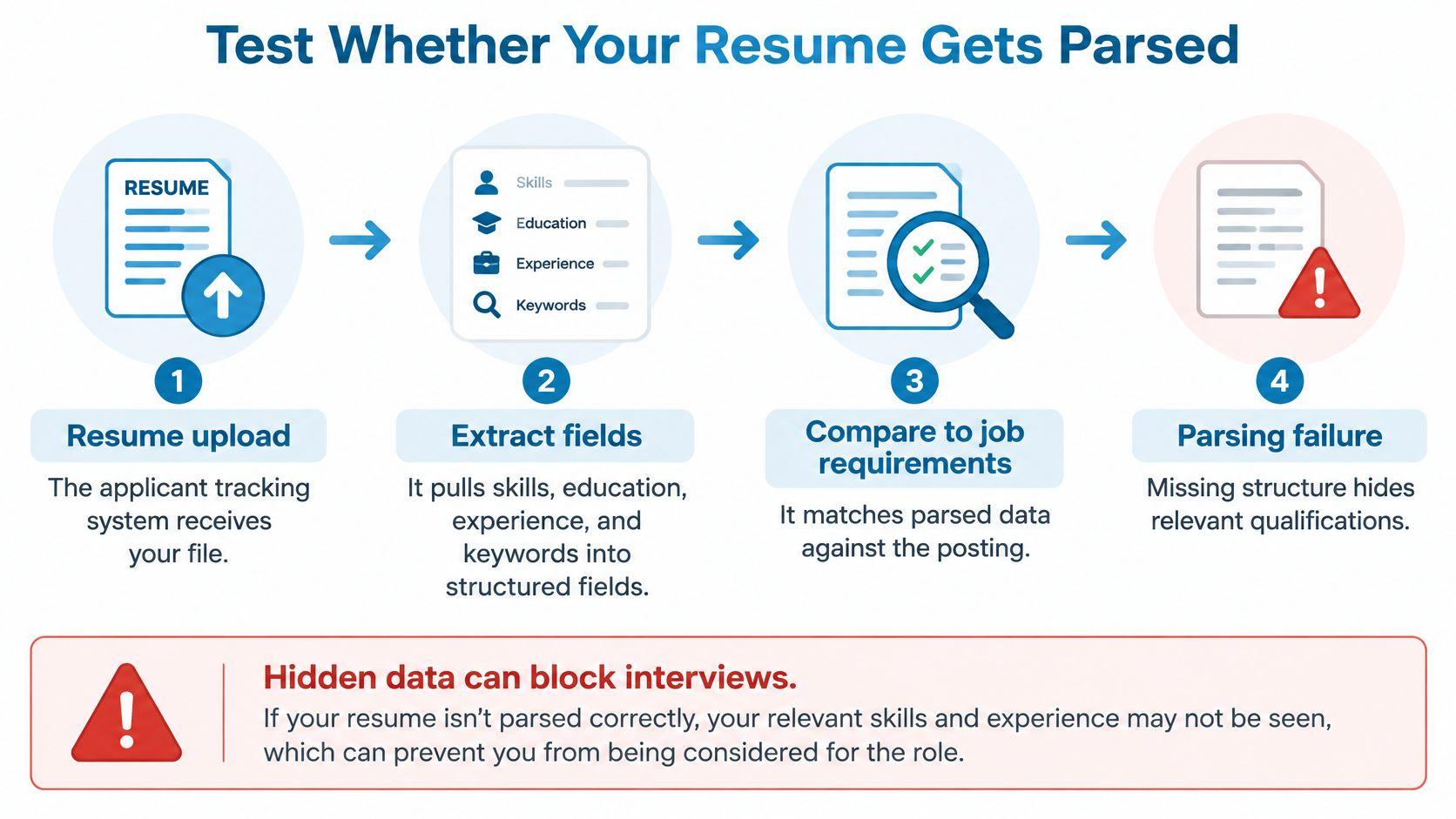
What the parser actually throws away
When extraction fails, downstream ranking treats the missing evidence as absent. A seniority signal that lived in a text box, a certification parked in a sidebar, a date range flattened by a two-column layout: gone. Nobody rejects you. The system never sees the qualification, and the recruiter’s filter runs on the fields, not on the document you so carefully designed.
Run the copy-paste test
- Export the exact file you submitted. Test the PDF the employer received, not the master document on your desktop. Older versions get uploaded more often than anyone admits.
- Select all the text and paste into a plain-text editor. Not Word, which can reinstate structure. A bare editor shows what a parser sees.
- Check the spine. Section order, employer names, job titles, dates and skills should come out in the right sequence. A sidebar that lands mid-employment-history is a broken file.
- Note what vanished. Tables, headers, text boxes, graphics and scanned image PDFs lose content first. If a skill lived only in one of those, it is invisible.
- Line up the posting. Copy the required and preferred lines into a list and mark every one that doesn’t appear in the extracted text. Those are the requirements a recruiter cannot find.
- Rewrite the misses in the posting’s words. Use the exact tool and technology names when they’re truthful, each attached to a measurable outcome inside a real role.
The common slip is repetition without proof. Repeating a keyword four times creates the appearance of a match and no evidence of capability, and it reads badly to the first human who opens the file. A clean extraction gets you into the pile. It is necessary and it is not sufficient, because the next filter asks whether you can do the work.
Prove Each Required Skill With Evidence
A resume that parses cleanly but proves nothing is the third leak in the funnel. Keywords get you into the pile. Evidence is what moves you out of it, and employers have shifted toward proof in a measurable way. NACE’s 2025 employer survey found almost two-thirds of employers using skills-based hiring in screening and interviews, as the University of Wyoming careers summary of the NACE survey reports.
The gap runs in both directions. In 2024, UK employers reported 250,500 skill-shortage vacancies, and 6 percent had at least one vacancy hard to fill because applicants lacked skills, qualifications or experience, per the UK government Employer Skills Survey. Employers can describe exactly what they need. Candidates keep failing to show they have it.
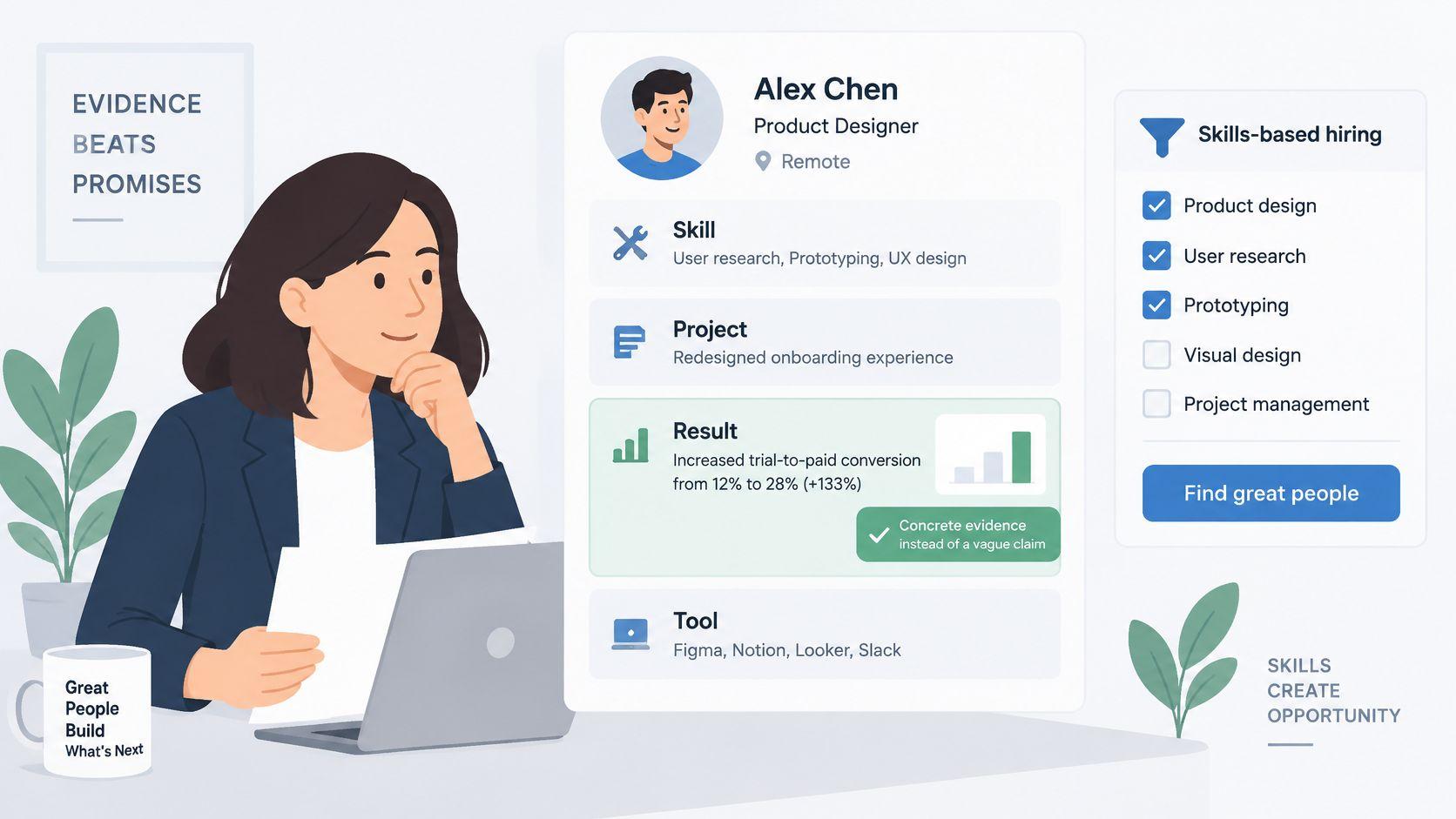
Three ways a skill fails to land
| Failure mode | What the resume shows | Fix |
|---|---|---|
| Skill absent | The requirement never appears | Add it only where you can prove real experience |
| Skill buried | It appears in a duties list with no result | Rewrite it as an outcome with scope and a measured change |
| Skill unsupported | A keyword list with no context | Add the tool, scope, metric, work sample or certification behind it |
Build an evidence map
Take the posting and list every high-priority requirement on its own line. Against each one, attach a single concrete item: an accomplishment with a number, an artifact, or an example you would be comfortable defending in an interview. Five evidence types cover almost every requirement.
- Scope. Team size, budget, revenue, ticket volume, number of markets. Scale tells a reader what level you operate at.
- Tools. Name the exact platform from the posting where you used it. SQL, Salesforce, Figma, whatever the stack is.
- Measured results. Before and after, with a number and a timeframe. A percentage with no baseline is decoration.
- Work samples. A dashboard, a campaign, a published analysis, a repository. Real output beats an adjective.
- Certifications. Relevant and current only. A lapsed certificate in an unrelated stack wastes a line.
A teacher moving into customer success shows how this works. The resume says “communicated with stakeholders” inside a duties list, which proves attendance rather than ability. Rewritten, it becomes a documented outcome from parent onboarding sessions: how many families went through the process, what the process changed, and what happened to drop-off afterward. Same job, provable claim. For international applicants, translate titles into the terminology the target market uses and keep the original in brackets so a background check still lines up.
Pick your three weakest requirements this week and build one evidence item for each. That work converts far better than another pass through roles sorted by career area with the same wording.
Get Referred and Apply Early
Referral status changes your odds more than any resume edit. In a Federal Reserve Bank of New York study of hiring data, referred applicants were only 6 percent of the applicant pool but 21 percent of interviewees, 27 percent of offer recipients and 29 percent of hires. A 10-percentage-point increase in the share of referred applicants was associated with a 0.88-percentage-point rise in an individual’s probability of getting an interview, per the New York Fed’s staffing study.
The volume effect is bigger than it looks. A 2016 analysis covering more than 14 million applications, 655,000 interviews and 329,000 hires across over 1,000 companies found employee referrals accounted for more than 30 percent of hires, according to SHRM’s talent acquisition reporting. A referral also hands the employer information they can’t get from a document, which is why two similar candidates get different outcomes.
Where introductions actually come from
Former colleagues top the list, including people you worked with briefly. Then alumni from your school, people on the hiring team itself, and the internal referral programs most careers pages list but few candidates use. Communities around your craft count too, if you’ve contributed something visible there.
The ask that works: one specific role, one proof point that matches it, and a small request. Never “let me know if you hear of anything.”
The structure is four lines: who you are and how you’re connected, the exact role with a link, one relevant result in the role’s own vocabulary, and the ask, which is either 15 minutes of their time or a referral if they think it fits. A product designer who sends six targeted requests to ex-colleagues at three target companies will outrun twenty cold applications to the same employers.
Timing decides whether you’re seen
Analysis of nearly 80 million applications linked to almost 10 million online job postings found that 41 percent of applications arrived within the first 48 hours and 56 percent within 96 hours, according to the St. Louis Fed’s analysis of application timing. Late applications join a pile that already has a shortlist forming.
Apply within the first two days for roles that fit, then spend the rest of the week on introductions. When looking across borders, globally remote roles keep you inside the pool that can hire you, which makes every early application count for more.
Run Your Two-Week Fix Plan
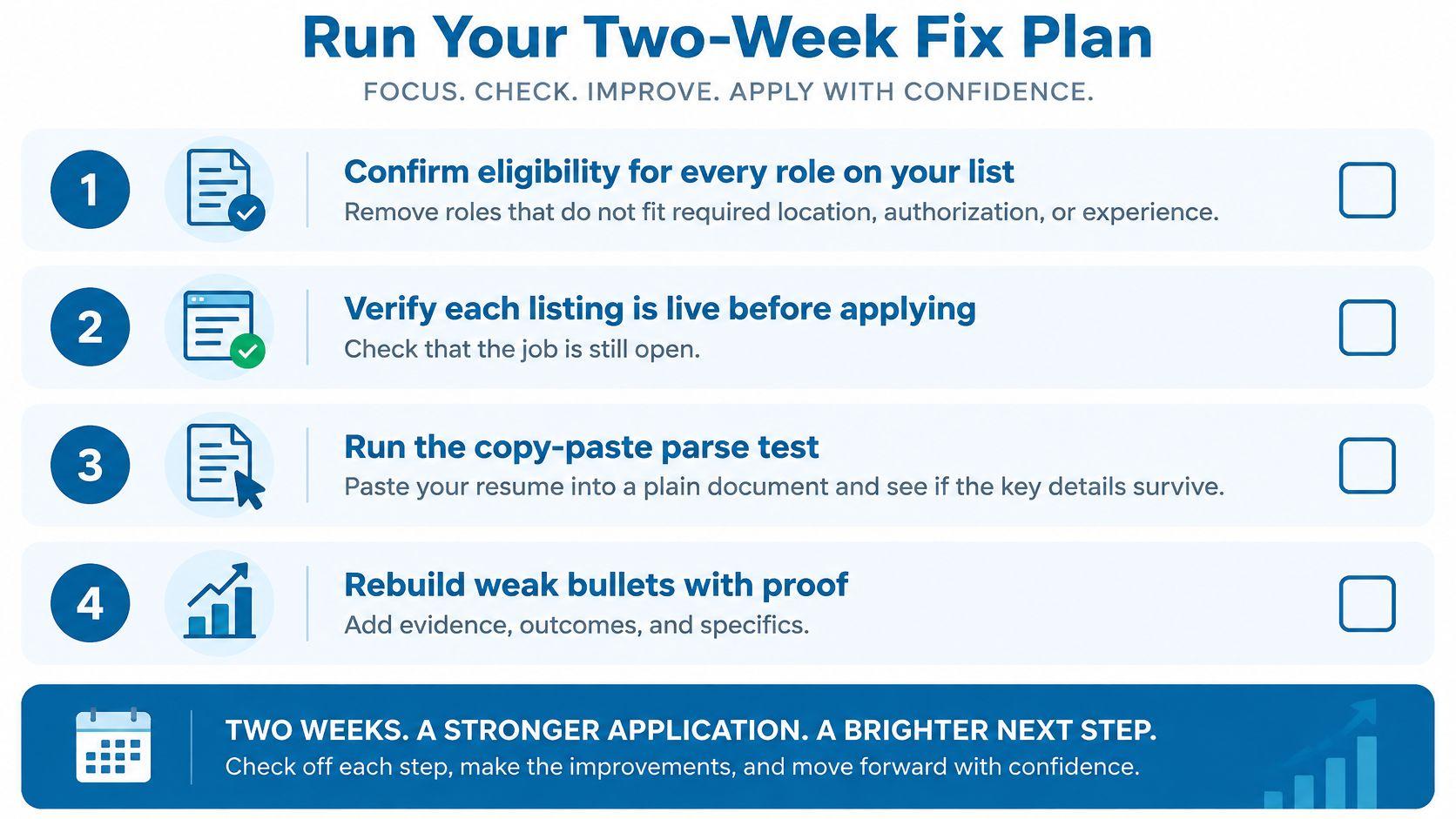
A stalled search rarely needs more effort. It needs the effort pointed at the actual break in the funnel. Run these in order, because each step protects the time you spend on the next one.
- Confirm eligibility for every role on your list. Remove anything that fails location, authorization, time zone or seniority before you write a word.
- Verify each listing is live. Careers page, text duplication, listing age, hiring signals. Cheap checks, and they save whole evenings.
- Run the copy-paste parse test. On the exact file you submit, not a draft.
- Rewrite your top five requirements with evidence. Scope, tool, measured result. One line each, inside a real role.
- Request two referrals per week. From people who can vouch for your work, with one proof point in the message.
- Apply within the first two days of posting. Set alerts so you see roles while they’re fresh, not after the shortlist forms.
- Log every application by source, pile and outcome. This is the instrument that tells you which change worked.
Give week one to items one through four. It is unglamorous work, and it eliminates the silent failures: dead listings, ineligible roles, unparsed resumes, unsupported skills. Give week two to items five through seven, where the interviews come from.
JobGlance is one option for the discovery half of this. You add your resume once, then type any title or skill and get matching roles back ranked best fit first, with visa sponsored and globally remote as filters read from the full job description rather than matched as keywords. A Chrome extension carries the same sponsorship signals onto listings you open elsewhere. It doesn’t guarantee interviews or hiring decisions, and no tool does; it removes the eligibility sorting and the unranked scrolling from your week.
Selection processes that publish their stages are easier to pace. SET selection and interview milestones lays out one formal pathway from application to placement. Your own process deserves the same clarity, and the log in step seven is what gives it to you: every application, its source, and its result in one place.
Measure the next block of applications against the previous one. If interview invitations rise as eligibility and evidence improve, you’ve found the cause. If they don’t, the remaining problem is the market or the level you’re targeting, and neither is fixed by another template.
JobGlance ranks 80,000+ active roles against your resume and shows visa sponsorship and work-from-anywhere eligibility before you invest an evening in an application. Upload your resume once, search any title or skill, and let the results come back ordered by fit rather than by posting date. Start at JobGlance and run the two-week plan against a ranked list instead of an endless search page.
Keep reading


