Resume Matching with Job Description: What Scores Mean


On this page
You’ve uploaded your resume, typed a job title, and now you’re staring at a list where the first role scores 92, the second 74, and a role you want sits at 58. It’s tempting to apply top down and trust the numbers. Don’t do that yet.
A match score is useful, but it’s only answering one question. It tells you how closely the evidence in your resume lines up with the words in one posting. It doesn’t tell you whether you’re eligible to be hired, whether a missing term is a real gap, or whether that posting describes the job accurately. Read it in that order and resume matching with job description text becomes a practical filter. Read it as a verdict and you’ll waste time on roles you were never eligible for.
What Resume Matching Measures Against a Job Description
Think of a matcher like a librarian with two cards. One card summarizes your resume. The other summarizes what a reader asked for. The librarian compares subject, level, and key terms, then decides how closely the book fits the request. That’s the basic job here.
Resume matching with job description scoring takes two inputs, your resume text and the posting text, and produces one output, a 0 to 100 score for that specific role. It compares skills, seniority, experience, and stated requirements. It doesn’t measure your overall worth as a candidate, and it doesn’t compare you with other applicants.

Why this comparison happens before a person reads your resume
Large employers sort applications digitally first. A 2022 review summarized in Coursera’s guide to resume keywords reported that approximately 97.8% of Fortune 500 companies used an applicant-tracking or recruiting-management system. Those systems organize applicant pools and commonly filter or rank applications using job-related fields and keywords.
That doesn’t mean a computer makes the final hiring decision. It means structure, search, and ranking happen before human review. If your skills are poorly represented, a recruiter may never see experience you have. If you’re curious how that screening work is changing on the employer side, Hirespot’s guide to AI recruiters explains what those tools do day to day.
For you as a job seeker, the gain is straightforward.
- Roles ordered by fit: You see relevant openings first instead of sorting by posting date.
- Less manual triage: You don’t have to open twenty listings to find three worth reading.
- Early gap visibility: Missing requirements show up before you invest time tailoring.
Formatting still matters, because a parser has to read the file before anything can be scored. Our ATS-friendly resume guide covers the layout basics that help systems extract your information cleanly.
A score measures fit to one posting’s text, not your ability to do the job well.
So what does the number mean? That depends on how the matcher compares the two documents.
How Keyword, Semantic and Hybrid Matching Compare
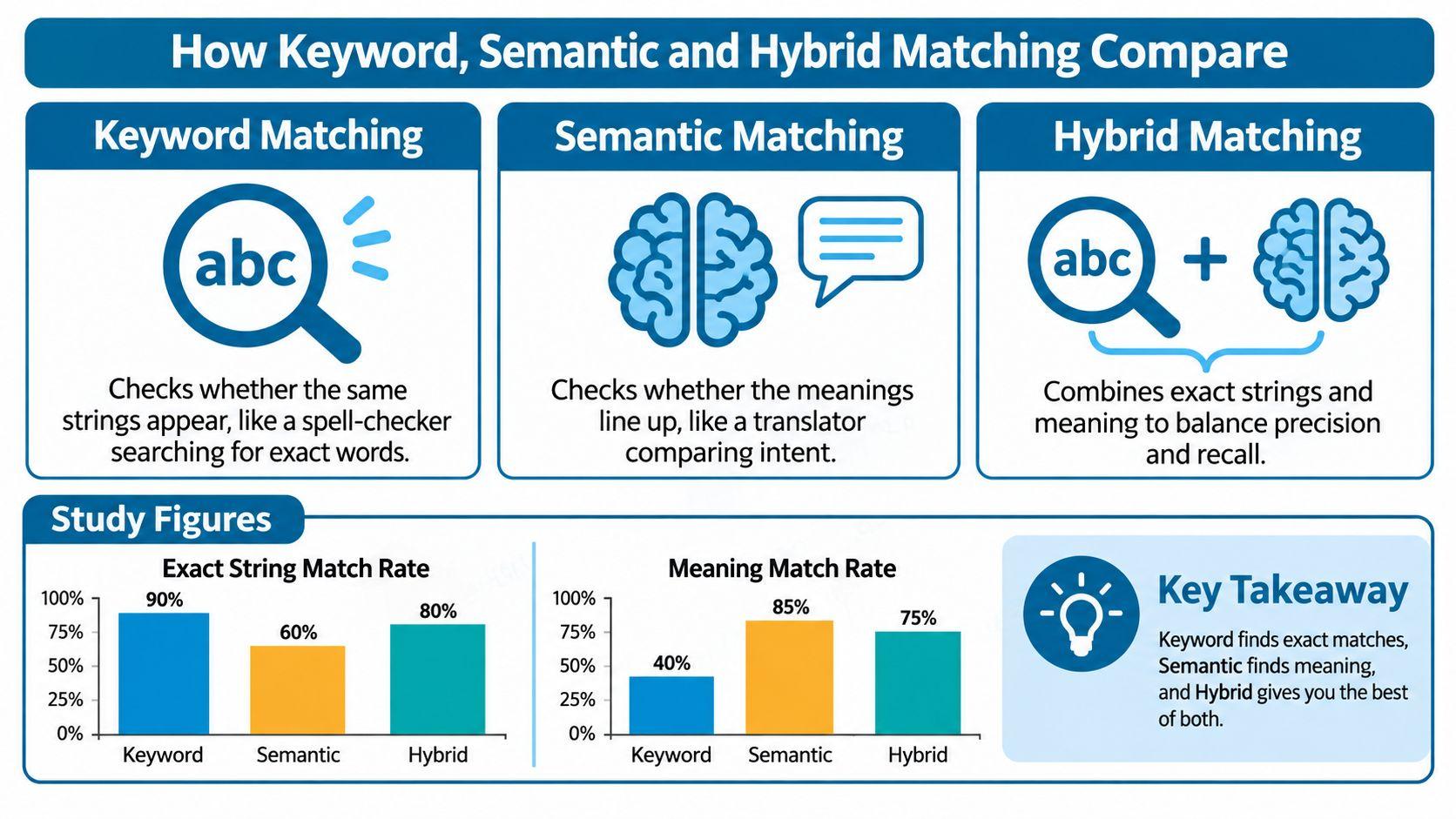
Keyword matching works like a spell-checker. It checks whether the same strings appear in both documents. Semantic matching works more like a translator. It checks whether the meanings line up, even when the words differ. Hybrid matching uses both, because each method fails in a different way.
What the performance numbers show
A 2025 ACM study of 50,000 resume-job pairs reported that its deep-learning matching system achieved an F1 score of 0.910, compared with 0.866 for BERT-base, 0.757 for Word2Vec, and 0.716 for TF-IDF. Higher is better, because F1 balances finding relevant matches against avoiding false ones. The same study reported processing capacity of 1,000 resume-job pairs per minute.
| Matching method | Reported F1 score | Gap to deep-learning system |
|---|---|---|
| TF-IDF keyword matching | 0.716 | 0.194 below |
| Word2Vec | 0.757 | 0.153 below |
| BERT-base semantic model | 0.866 | 0.044 below |
| Deep-learning matching system | 0.910 | Reference |
Treat those figures as an experimental result, not a universal benchmark for every tool. They still show a clear pattern. Methods that only count shared strings trail methods that can relate different expressions of the same capability.
Where exact wording still matters
Say a posting asks for distributed systems and your resume describes building microservices that handled traffic across regions. A keyword matcher can miss that connection because the headline term isn’t present. A semantic model is more likely to associate the two, since the surrounding context points to similar work.
That doesn’t make exact matching obsolete. Rare skills, version-specific tools, licenses, and certifications need precise identification. If a role requires a named version of a tool or a specific security certification, a close meaning isn’t enough. Hybrid systems keep lexical checks for those terms while using semantic scoring for broader experience.
Your practical move isn’t to copy the posting word for word. It’s to state your capabilities, seniority, and outcomes in language a matcher can connect to the employer’s requirements. If you’re applying in technology, the advice to tailor your resume for tech roles is useful here, especially the emphasis on concrete tools and measurable work rather than vague responsibility lists.
Practical rule: Use the employer’s exact term when it’s a tool, version, or credential you genuinely have. Use clear, outcome-based language for everything else.
How Matching Systems Combine Skills, Seniority and Eligibility
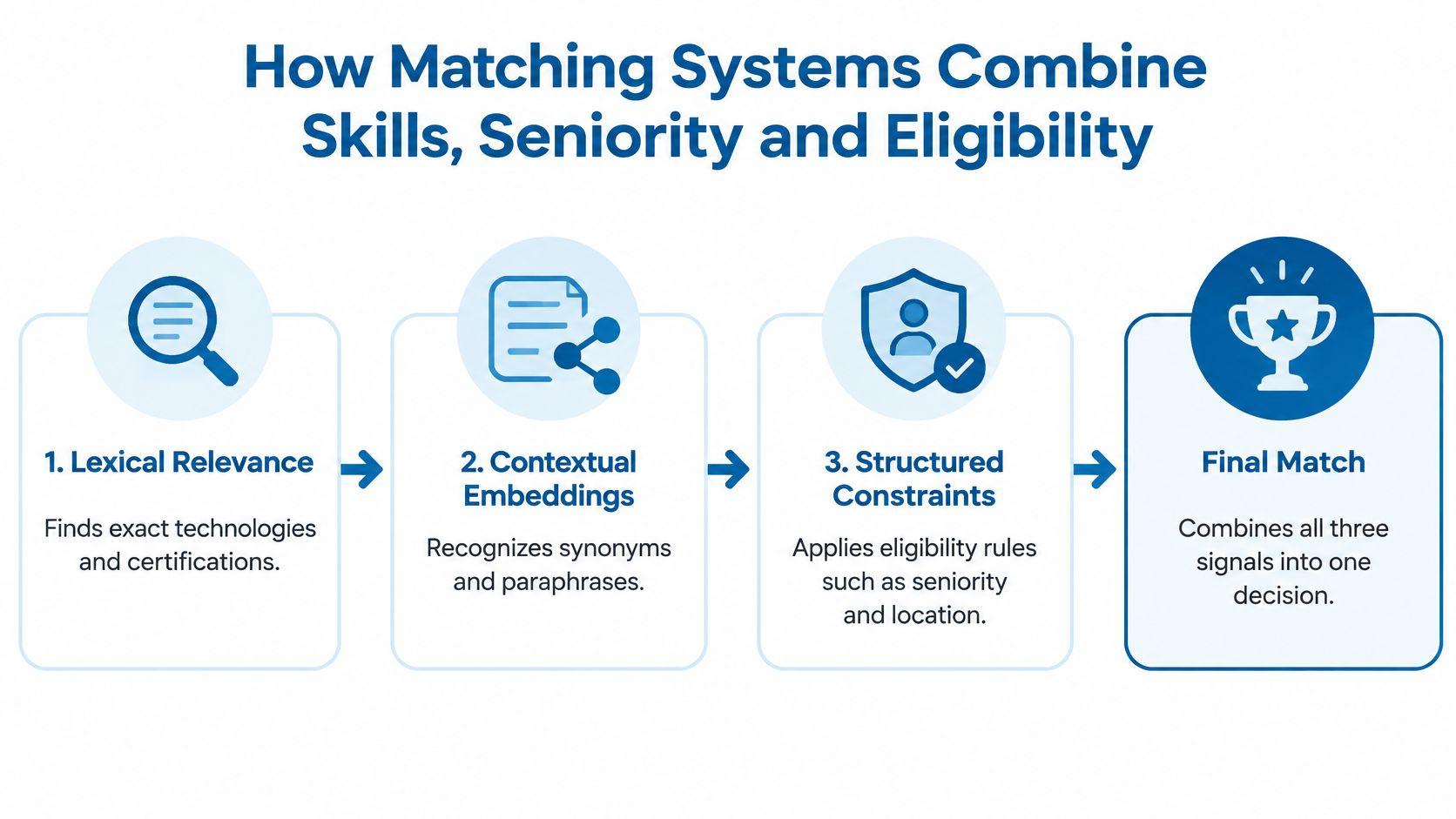
A single similarity number can hide an important failure. Your experience might align beautifully with a role while your location, degree, or years of experience don’t meet a mandatory requirement. A production matcher therefore needs separate signals, not one blended guess.
Three signals behind one score
The first signal is lexical relevance, which finds exact technologies and certifications. The second is contextual embeddings, which recognize synonyms and paraphrases. The third is structured constraint checks, which test location, work authorization, degree, and years of experience.
The 2023 Resume-Job Description Benchmark was designed to evaluate several connected tasks, matching resumes to job descriptions, extracting skills and experience, generating explanations, and editing resumes. That design reflects a simple point. Scoring, extraction, and explanation shouldn’t be treated as unrelated features.
Ranking quality also needs the right measures. Metrics such as nDCG@K, MRR, Precision@K, and Recall@K test whether the strongest candidates appear near the top. Raw accuracy alone doesn’t answer that ranking question, and ranking is what you experience when you open a results list.
The pipeline in plain steps
- Parse the resume. Extract skills, titles, dates, education, and outcomes into usable fields.
- Parse the posting. Extract required skills, seniority, domain, and eligibility conditions.
- Score lexical overlap. Check exact tools, versions, and credentials.
- Score semantic similarity. Compare meaning across differently worded experience.
- Apply eligibility constraints. Check location, authorization, and other hard requirements.
- Show the composite score. Display matched and missing requirements alongside the number.
In JobGlance, the resume you upload becomes the baseline that Smart Match scores are measured against. That baseline approach works best when eligibility is handled as its own layer, which is why starting from visa sponsorship openings is different from typing sponsorship into a general search bar and hoping the wording matches.
The explanation layer is the part you should read. Matched and missing requirements make the score auditable, and they stop a high semantic similarity result from masking a failed eligibility check.
When a High Score Is a Poor Application
Say two roles both score 88. One is listed as remote but only open to residents of one country you don’t live in. The other comes from an employer with a sponsorship record, but the location line is vague. Same professional fit, completely different application decisions.
That’s the central trap. Professional fit tells you whether your experience aligns with the work. Eligibility fit tells you whether the employer can legally and practically hire you. A match score built mainly from skills and experience can’t settle the second question by itself.
Remote does not mean work from anywhere
Remote’s 2025 workforce-trends report cites survey findings that more than half of HR and business leaders expected to increase international hiring during the following year. It also cites an international-hiring survey of technology companies with 100 to 5,000 employees, where 63% considered access to specialized skills unavailable locally the biggest advantage of hiring internationally, while 49% identified employment-contract preparation as the most time-intensive part of global compliance.
Those two findings explain the gap. Employers want global talent, but contracts, payroll, tax, and immigration still depend on country. A role can permit working outside an office while restricting you to a specific country or region. If you’re early in your career, compare that distinction directly in entry-level remote openings rather than assuming every remote label carries the same geographic freedom.
The posting itself may be unreliable
There’s another problem readers often miss. The score measures your fit to the posting’s wording, not necessarily to the hiring manager’s real priorities. Requirements can be inflated, copied from an older role, or written broadly and then narrowed during interviews. Public-sector hiring shows a similar need for structured checks, which is why CV matching for government ICT recruitment is a helpful example of matching used where eligibility and stated criteria have to be handled explicitly.
Check eligibility first: Confirm location, work authorization, and sponsorship signals before you tailor a single bullet.
Score fit and eligibility separately in your own notes. Mark each promising role as eligible, ineligible, or unclear. For unclear roles, look for explicit country language, sponsorship wording, and employer history before deciding. A high score with unclear eligibility isn’t a green light. It’s a prompt to verify.
Missing Keywords That Are Not Missing Skills
A missing phrase is not always a missing capability. Sometimes you’ve done the work under a different name, in a different industry, or with an equivalent tool. Sometimes you haven’t done it. Telling those cases apart is the skill this section builds, and it works without inventing evidence.
| Evidence type | Example | How to show it |
|---|---|---|
| Explicit | The exact term appears, such as Python | Keep it in the skills line and in one bullet with an outcome |
| Inferred | An equivalent tool or result, such as Airflow for workflow scheduling | Name the equivalent term once and state the measurable result |
| Unsupported | A phrase with no supporting work | Do not add it; build a project or complete an assessment first |
Why stuffing keywords backfires
The mechanics of matching explain why honesty pays. A recent preprint on resume matching notes that exact lexical methods struggle with synonyms, transferable skills, and contextual meaning, while contextual models improve relevance but are less interpretable. Two consequences follow. A genuine equivalent term is worth naming, because a purely lexical system may not connect it for you. And a copied term with nothing behind it creates a debt, because a recruiter or assessment will eventually ask you to demonstrate the skill. Authentic evidence travels through the whole hiring process. Borrowed vocabulary stops at the score.
Consider a marketing analyst moving toward data work. Her resume says she built forecasting models for campaign spend. A posting asks for predictive analytics. That is likely a wording gap, not a capability gap, if she can describe the model, its inputs, and the business result. Roles listed among data analyst openings often use the second phrase, so naming the equivalent once, plainly, helps both software and a human reader.
A five-step check for every missing term
- List each missing term. Work from the matched and missing view, where the role’s requirements are split into skills you already have and skills you are missing.
- Search your experience for equivalent work. Look for the same task, tool category, or outcome under another name.
- If the work exists, name it clearly. Use the equivalent term once and attach a real result.
- If it doesn’t exist, don’t claim it. Build a small project, produce a work sample, or complete an assessment first.
- Re-check the score last. Update the resume to reflect real evidence, then see whether the score moves.
A wording fix raises the score without changing anything else. Eligibility, seniority, and the reliability of the posting still need their own check, because a keyword you can defend is worth more than a number you cannot.
Match Score Bands and How to Decide
Use bands to decide where your time goes. These are a working framework, not an industry standard, because tools set cut-offs differently and weight signals differently. The action matters more than the exact boundary.
| Score range | What it usually means | What to do next |
|---|---|---|
| 80-100 | Strong fit with core requirements matched | Tailor promptly if eligibility is confirmed |
| 60-79 | Solid core fit with one or two visible gaps | Apply if eligibility is clear and each gap can be proven with real evidence |
| 40-59 | Partial fit with key requirements missing or unclear | Apply selectively after verifying whether the gap is real |
| Under 40 | Weak match on skills, seniority or domain | Skip unless the move is a deliberate career change |
Reading a score of 72
Say a backend role scores 72. Python, APIs, and PostgreSQL match clearly. Kubernetes appears as the one major missing requirement, and eligibility is confirmed. Don’t start by rewriting your whole resume. Read the result in this order.
- Check matched requirements first. Confirm the core of the role is covered.
- Read missing requirements next. Separate one major gap from minor nice-to-have terms.
- Classify each gap. Decide whether it’s a real skill gap or only a wording gap.
- Check eligibility before writing a cover letter. Confirm country, authorization, and sponsorship signals.
If your resume shows containerized deployments and managed orchestration work without naming Kubernetes, state that evidence precisely and apply. If you’ve never worked with container orchestration, don’t add the term. You can still apply if the rest of the fit is strong and the requirement isn’t clearly mandatory, but spend less time on this application than on a cleaner match.
A decision rule you can repeat
For scores of 80 and above with confirmed eligibility, tailor two or three bullets the same day and apply. For 60 to 79, apply only when eligibility is clear and each missing requirement can be proven or reframed with real evidence. For scores below 60, save the role for later or skip it, unless you’re deliberately changing direction and can explain the transferable case.
Filters change the meaning of the ranking, so apply sponsorship or work-from-anywhere filters before you trust the order. Users add their resume once, then type any title or skill and get matching jobs back ranked best fit first. Smart Match analyzes your resume to score and rank every job result by your fit, and it aggregates active roles from 100+ sites.
Don’t chase a number in an unfiltered pool. Shrink the pool to roles you can accept, then let fit ranking do its work.
Start with one action today. Run one search for your target title or strongest skill, apply the eligibility filter that matches your situation, and read only the top five results. For each one, check matched requirements, missing requirements, and eligibility in that order. Tailor the first role that passes all three checks, and skip the rest until you’ve sent that application.
Upload your resume once with JobGlance, search any title or skill, and get active roles scored from 0 to 100 against your actual experience, ranked best fit first. Apply the visa sponsorship or work-from-anywhere filter first, then read the matched and missing requirements on the roles that remain. It’s a faster way to spend your tailoring time on jobs you’re both qualified for and eligible to take.
Keep reading


