H1B Visa Job Search That Actually Gets Sponsorship


On this page
Treating an H1B job search like a company filter is a common mistake. They ask one question: does this employer sponsor? That question is too blunt for the market you’re in. For FY2025, USCIS reported 470,342 eligible H-1B registrations and 135,137 selected registrations, which works out to roughly 28.7% selected in the cap process, even before you get to petition filing quality and employer execution (USCIS H-1B electronic registration data).
That changes how a serious H1B visa job search should work. You’re not just looking for sponsoring companies. You’re looking for sponsorable roles. Those are jobs where the title, duties, wage level, seniority, and employer filing history line up well enough that a company can justify the petition and has a reason to spend one of its scarce chances on you.
If you keep applying as if all sponsorship-friendly employers are equally viable, you’ll waste time on roles that were never realistic. The faster route is to rank listings by role-level sponsorability first, then tailor hard for the shortlist.
Why Your H1B Visa Job Search Feels So Competitive
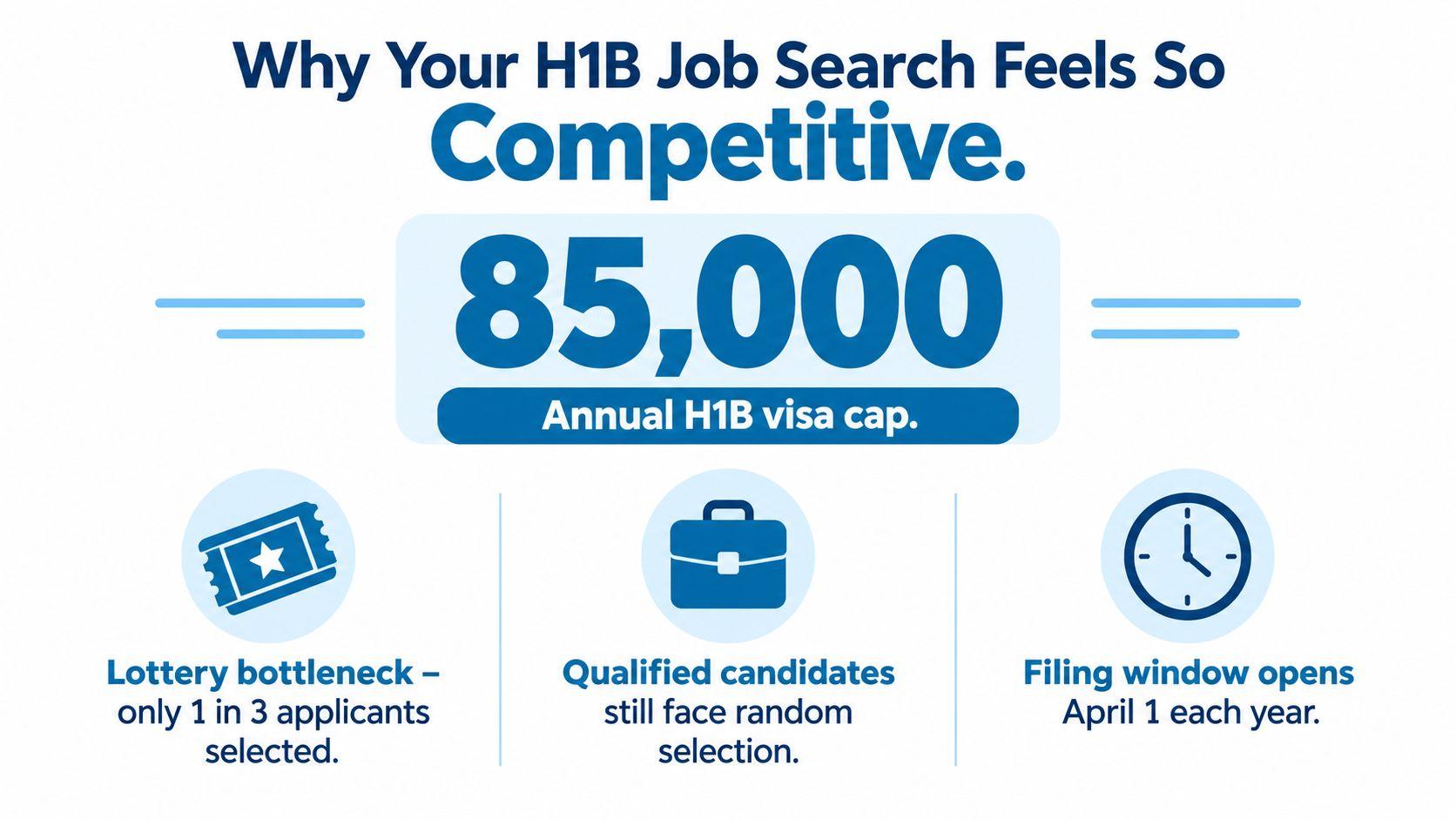
An annual cap of 85,000 new H-1B slots sits underneath a labor market that produces far more eligible candidates than that number can absorb. That cap structure has existed, with only temporary increases, since Congress set the modern framework in the Immigration Act of 1990 (NBER working paper on the H-1B cap history). The result is a search process where competition is shaped by policy design as much as by candidate quality.
Today, that cap is split into 65,000 regular-cap visas plus 20,000 for beneficiaries with a U.S. master’s degree or higher (Mintz summary of the H-1B cap structure). For a job seeker, that means every application sits inside a constrained intake system before the employer even decides how hard to push your candidacy internally.
The real bottleneck is role viability, not company branding
First-time cap-subject candidates often overestimate the value of finding an employer with a history of sponsorship. Sponsorship history helps, but it does not make every open job equally sponsorable.
A company may sponsor senior software engineers, data scientists, or niche infrastructure roles while declining to sponsor adjacent openings with lower wage bands, broader duties, or weaker specialty-occupation logic. The practical competition, then, is not candidate versus candidate. It is candidate plus role economics plus legal defensibility.
That is why the search feels harsher than a standard white-collar hiring market. You are not only trying to clear interviews. You are trying to match into a role the employer can justify filing, price at the required wage level, and prioritize for scarce legal budget and lottery exposure.
Continuing H-1B workers absorb much of the visible volume
Headline H-1B approval totals can give a false sense that the market is larger than it is for new entrants. USCIS approval volume includes a large share of continuing workers, extensions, transfers, and other cases from people already inside the system. An independent policy brief citing USCIS data noted that only a minority of FY2025 approvals were for initial employment, even though total approvals were much higher overall (USCIS registration page with FY2025 data references).
That distinction matters.
If you need first-time cap-subject sponsorship, you are competing for a narrower slice of employer attention than broad approval numbers imply. Employers already know this. Many will spend sponsorship effort where the filing path is cleaner, the business case is stronger, or the candidate can start through another work-authorized route first.
Wage level and seniority increasingly decide which roles get filed
The old filter was, “does this company sponsor?” The more accurate filter is, “does this specific role have sponsorship math that works?”
Coverage from January 2026 reported that the new H-1B selection rule favors higher wage levels, with lower-wage registrations receiving less favorable odds in the selection process (Kelly January 2026 H-1B briefing). A separate legal summary of the FY2027 change described the weighted system this way: Level I gets 1 entry, Level II gets 2, Level III gets 3, and Level IV gets 4 under the prevailing-wage framework (FordHarrison summary of the weighted selection change).
That change pushes employers toward roles with clearer seniority, stronger compensation bands, and less ambiguity about specialized duties. Entry-level postings can still be sponsorable, but they now require more scrutiny. If the job description is broad, the wage level is modest, and the employer has little history filing similar roles, the odds worsen before your resume is even reviewed.
The useful conclusion is blunt. Competitive pressure in an H1B visa job search does not come from applicant volume alone. It comes from applying to roles that were weak sponsorship bets from the start. Candidates who rank openings by wage level, seniority, and employer filing pattern usually waste less time than candidates who sort employers into a simple sponsor or non-sponsor bucket.
Where to Find Real H1B Sponsorship Jobs Faster
A useful search process starts by cutting the junk before you read a single job description. Most international candidates lose hours reopening the same role family across multiple boards, only to find that the posting never clearly states sponsorship.
The fix is a stacked filter workflow. Start broad, filter hard, then rank by fit. If you’re searching the U.S. market, use a dedicated U.S. visa sponsorship jobs page instead of typing “H1B sponsor” into a generic search bar. Category pages are faster because they narrow the market by eligibility first, not just keywords.
Filter for access before fit
A lot of search tools do this in the wrong order. They show you relevant-sounding jobs, then make you manually discover whether you can take them.
A better sequence looks like this:
- Start with visa eligibility: Filter for roles explicitly marked for sponsorship or flagged from employer sponsorship history.
- Add location reality: If you’re open to bridge options, layer remote or globally open roles into the same search logic rather than treating them as a separate search project.
- Only then rank by fit: Once the eligible pool is cleaner, use resume-to-job matching to decide which roles deserve tailoring.
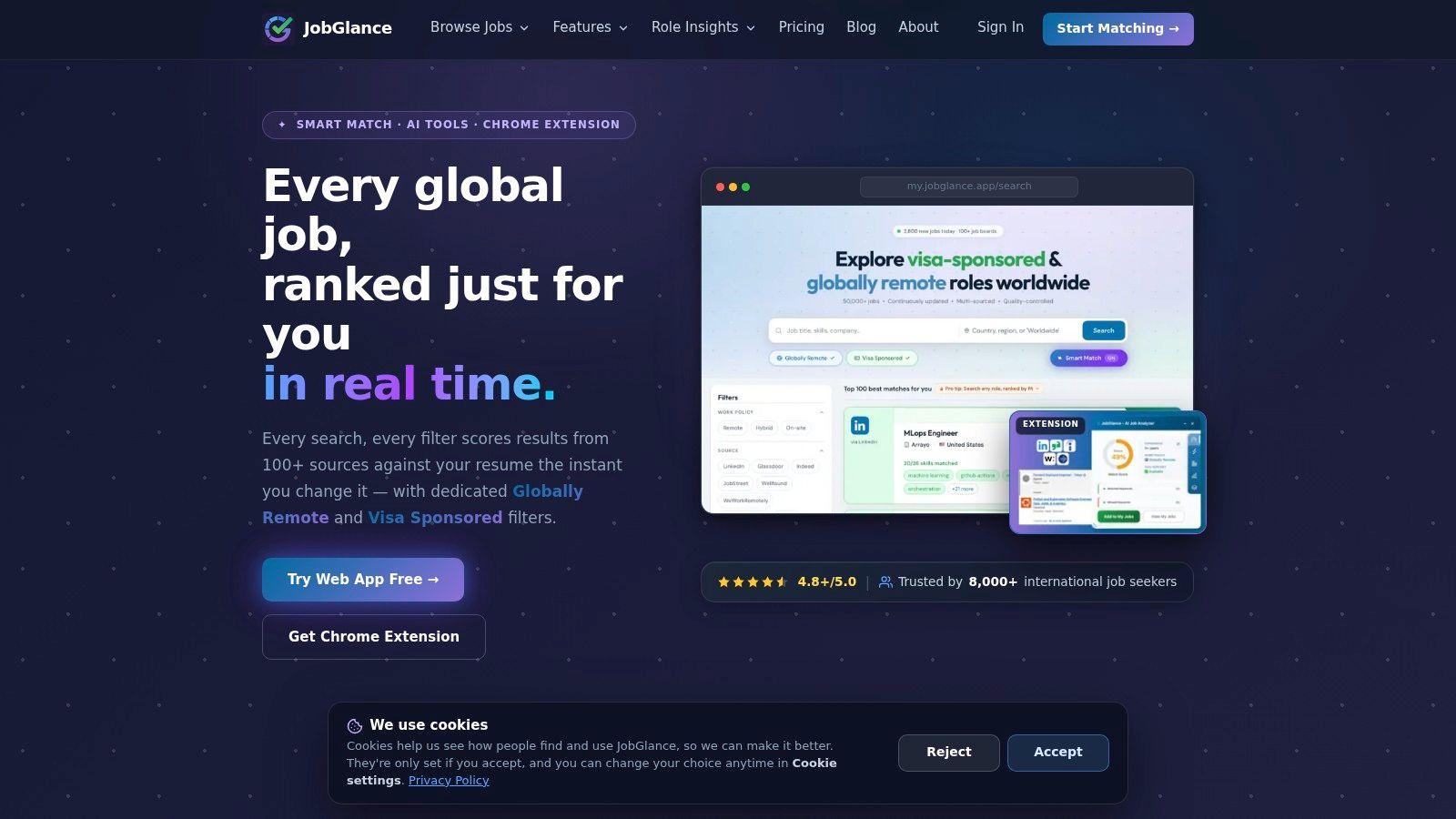
Tools that aggregate listings from many boards are useful. JobGlance, for example, combines 50,000+ active roles from 100+ job sites, lets users stack visa sponsorship and work-from-anywhere filters with any query, and re-ranks results 0 to 100 against the uploaded resume whenever the search or filters change. That matters because international candidates don’t just need more listings. They need fewer false positives.
Rank by sponsorability, not just relevance
A data analyst role at a known sponsor can still be a bad H-1B target if the posting reads like a generalist support job, sits at a junior wage band, or has muddy worksite terms. A less famous employer can be a better bet if the title is specialized, the duties map cleanly to a degree field, and the company has repeated filing history.
Use this triage order when you shortlist:
| Signal | What to look for | Why it matters |
|---|---|---|
| Employer history | Repeated sponsorship activity or known filing record | Lowers execution risk |
| Role specificity | Clear technical or specialized duties | Strengthens specialty-occupation fit |
| Seniority | Mid-level or above is often easier to justify | Aligns better with wage-weighted logic |
| Worksite clarity | One location, clear reporting line, direct employer control | Helps avoid petition friction |
Don’t ask only, “Would they sponsor me?” Ask, “Would this exact job be easy or hard for them to sponsor well?”
Build a shortlist, not a tab graveyard
You don’t need hundreds of open tabs. You need a ranked working list.
A practical workflow is:
- Run one broad search by role family.
- Apply sponsorship and location filters.
- Save only roles with a credible sponsorability profile.
- Rank that smaller set against your resume.
- Tailor for the top group, not the entire pool.
If you have no strong query yet, use a top-matches style view to surface roles that already align with your background. That’s especially useful when your skills fit several adjacent titles and you’re trying to identify which one has the cleanest sponsorship path.
How to Tailor Your Resume and Cover Letter for Sponsorship
Most H-1B advice treats the resume like a generic interview document. That’s too shallow. For sponsorship, your application also needs to support the employer’s future petition story.
USCIS-reported FY2024 data shows 33,393 Requests for Evidence, equal to 8% of 407,625 completed H-1B petitions (H1B Track summary of FY2024 RFE data). That doesn’t mean every resume should sound legalistic. It does mean your materials should help the employer show specialty-occupation fit, employer-employee control, and a clear worksite setup.
Match title, duties, and degree
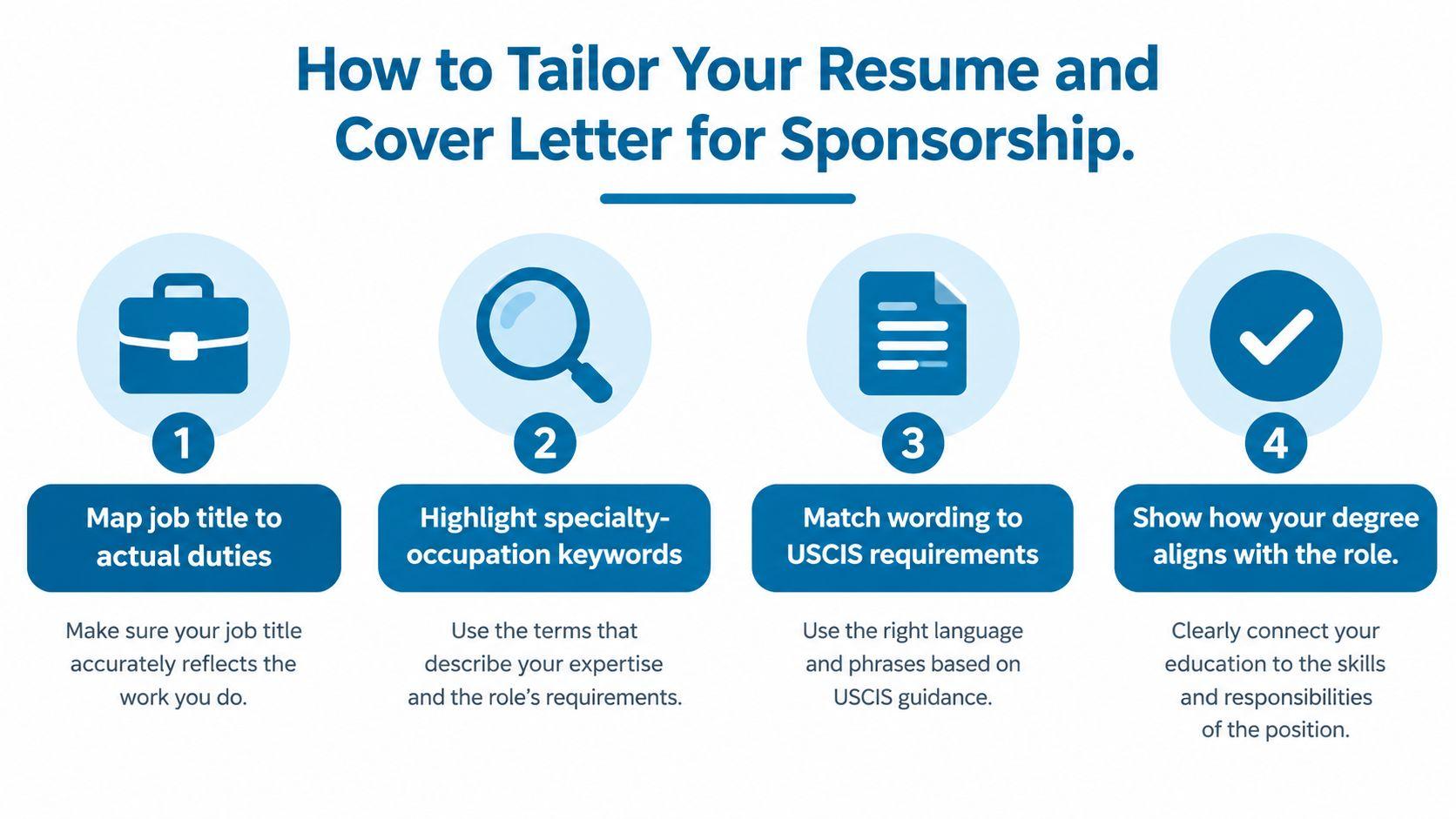
Your first job is to eliminate ambiguity. If the posting says “Backend Engineer” and your resume says “Software Generalist” with broad bullets, you’ve made the case weaker than it needed to be.
Use the posting’s specialized language where it’s accurate. If you’re targeting backend roles, study live role patterns on a backend jobs page and tighten your wording around architecture, APIs, distributed systems, data access, or platform ownership, depending on the role.
Here’s the difference in practice:
- Weak bullet: Worked on company software products across teams.
- Stronger bullet: Built and maintained backend APIs, data services, and production integrations supporting core product workflows.
The second version does more than sound better. It links your work to specialized duties that are easier to classify as a specialty occupation.
Tailor for petition clarity, not just ATS
ATS optimization matters, but sponsorship applications need another layer. The employer must eventually show what the role is, where the work happens, and who directs it.
That means your documents should avoid three common problems:
- Vague scope: Broad language makes the role look less specialized.
- Mismatched title and duties: Fancy job titles with generic bullets create friction.
- Missing work context: If your past work involved client sites, contracting, or matrix structures, describe your functional ownership clearly.
A clean application package usually has these traits:
- A single-column resume that parses reliably.
- Bullets that map to the posting’s actual responsibilities.
- Degree and technical background positioned near the top when they directly support the role.
- A cover letter that explains fit in plain language, not recycled enthusiasm.
“Your resume isn’t just selling you to a recruiter. It’s giving the employer raw material for a cleaner filing later.”
Use a tailoring loop, not one-off edits
The fastest candidates don’t rewrite from scratch every time. They run a repeatable loop.
Try this:
- Scan for missing terms: Compare your resume against the full job description, not just the title.
- Rebuild weak bullets: Replace generic verbs with technical ownership and outcomes.
- Check formatting: Export a text-preserving PDF so the application system can still read it.
- Write the cover letter last: Pull from the full posting and your updated resume so the language stays consistent.
If a role mentions direct ownership of systems, analytics pipelines, model deployment, compliance reporting, or another specialized function, your resume and cover letter should echo that exact functional territory where truthful. The aim isn’t keyword stuffing. It’s reducing the gap between how the company described the job and how your background appears on paper.
Outreach and Networking That Surfaces Hidden Sponsors
Some of the best sponsorship opportunities never say so in the posting. The employer may have a filing history, legal support, and budget, but the listing still looks silent or vague. That’s why a good H1B search includes targeted outreach, not just better applying.
A realistic example
Consider a mid-level data analyst choosing between two openings. One is at a startup with a compelling mission, no visible sponsorship language, and a broad role that mixes analytics, operations, and ad hoc support. The other is at a larger employer with repeated approval history, a cleaner analytics title, and a more formal team structure.
The startup may still interview international candidates. But the second role is more sponsorable. It’s easier for the employer to defend, easier to classify, and more likely to survive internal review.
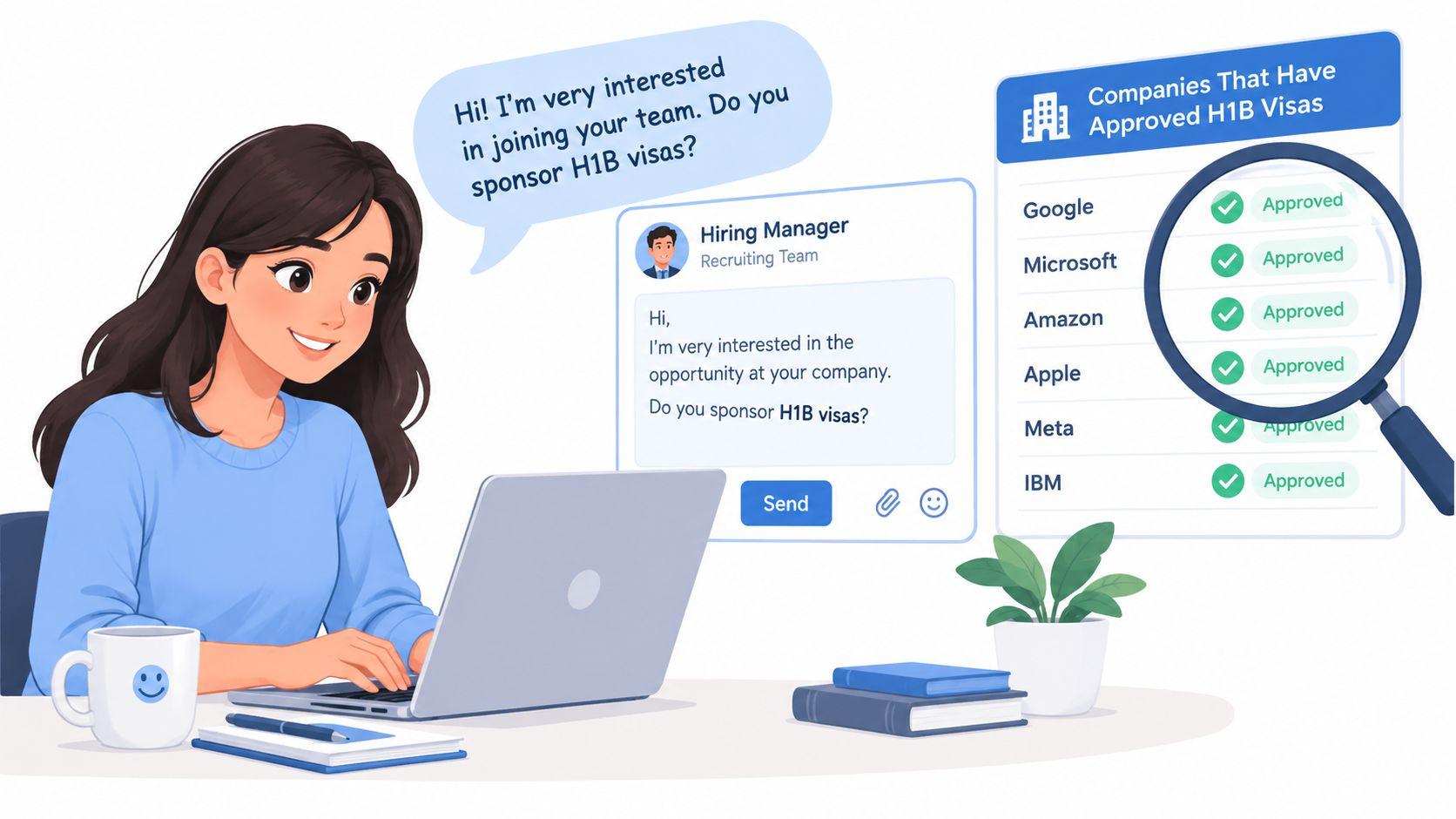
That’s where networking changes outcomes. Instead of asking both companies the blunt sponsorship question up front, the candidate reaches out to an alumnus and a hiring manager with a tighter note:
- They reference the exact role.
- They mention their fit in the role family.
- They ask how the team is structured and whether the company has previously hired internationally into similar positions.
That gives the employer room to answer with context instead of defaulting to a compliance-safe “no.”
How to ask without triggering a fast rejection
Good outreach is narrow and specific. Bad outreach asks strangers to solve your visa problem.
Use prompts like these:
- For alumni: Are international hires common on this team, especially in this role family?
- For hiring managers: I noticed this role sits between analytics and business operations. Is the team looking for someone with a more specialized analytics scope?
- For recruiters: Has the company hired candidates who needed employer-sponsored work authorization for similar positions?
If you need help framing a concise networking profile before those conversations, these networking resume examples are useful because they show how to present experience for relationship-building rather than formal application review.
Track hidden signals, not just replies
A useful networking pipeline captures more than outreach dates. It records what you’re learning about sponsorability.
Keep notes on:
- Role design: Is the work clearly specialized or mixed with general operations?
- Team maturity: Does the manager describe a defined function with stable reporting lines?
- Past precedent: Has anyone hinted that similar hires were sponsored before?
- Location and control: Is the worksite obvious, and is the company the direct manager of the role?
Those notes often tell you more than the job post itself. Over time, you’ll spot the pattern: hidden sponsors usually reveal themselves through role structure and prior hiring behavior, not through flashy language in the listing.
Planning Around the H1B Lottery Timeline and Alternate Pathways
Lottery odds matter less than candidates assume. In practice, the better predictor of search efficiency is whether you target roles that are sponsorable at your likely wage level and filing profile.
That distinction changes the calendar. A posting that looks attractive in January may still be a poor cap-season target if the role is too junior, too broad, or too weakly defined to support a clean filing. By contrast, a company that has sponsored before can still be the wrong bet if the specific opening sits at the low end of the wage band or reads like general operations.
USCIS has shifted cap selection toward wage-level weighting, as noted earlier in the article. The Department of Labor has also proposed higher prevailing-wage benchmarks, including raising Level I from the 17th percentile to the 34th percentile, Level II from the 34th to the 52nd, Level III from the 50th to the 70th, and Level IV from the 67th to the 88th percentile (Duane Morris summary of proposed prevailing-wage changes). The combined effect is straightforward. Marginally defined entry-level roles become harder to sponsor cleanly, while clearer and more senior roles become more attractive to file.
What that means for your search calendar
Treat the lottery timeline as a filtering tool, not just a deadline.
If your background points to Level I or a borderline Level II role, cap season should push you to be more selective, not more aggressive with volume. Focus on openings with tightly scoped duties, direct degree alignment, and employers that have filed for similar roles before. A broad pool of visa sponsorship job listings is useful at the top of the funnel, but the work is ranking listings by likely sponsorability before you spend applications on them.
If your profile maps to Level III or IV, the calendar works differently. You can justify a narrower list, faster outreach, and higher standards on employer history because your role is more likely to survive both internal approval and later scrutiny.
Choosing your H1B pathway by role profile and timing
| Likely Role Profile | Search Approach During Cap Season | Better Backup Option |
|---|---|---|
| Early-career, mixed duties, broad title | Apply only where the job description is specialized and the team has prior sponsorship precedent | Cap-exempt employers or a bridge role that builds clearer specialization |
| Solid Level II profile, but duties are still somewhat broad | Prioritize roles with stronger degree alignment and cleaner reporting structure | Delay cap dependence while you tighten scope through a more specialized job move |
| Clear specialist with several years of relevant experience | Target repeat filers and roles where seniority is visible in both title and duties | H-1B transfer path later if your first employer is not your long-term fit |
| Senior or unusually distinguished candidate | Keep applications selective and evidence-heavy | O-1 review if your record is well above normal market expectations |
Alternate paths when the cap route is weak
Some candidates should run parallel tracks from the start. That is usually true when the target role family is junior, generalist, or inconsistent in past sponsorship behavior.
Useful alternatives include:
- Cap-exempt employers: Universities, affiliated nonprofits, and research institutions can offer a faster route if your role family exists there.
- Remote or international bridge roles: These can help you build the exact specialization that raises later sponsorability.
- O-1 screening: This only fits a narrow group, but the upside is real if your profile is unusually strong.
- Longer-term immigration sequencing: Candidates in technical fields often benefit from reading visa choices as a sequence instead of a single lottery event. This Green Card for engineers lays out that logic well.
Day 1 CPT is often discussed as a fallback. It carries real legal and career risk, so treat it as an option for counsel review, not a default plan.
Your Next Moves to Land an H1B Sponsorship Offer
Response quality is the metric that should control your next step. After seven days, review the first batch of targeted applications and outreach, then decide whether to widen the search or tighten it further.
Use a simple rule. If replies are mostly rejections, silence, or requests for experience outside your actual profile, your problem is fit, not volume. Keep the role family narrow, revise your targeting criteria, and audit the first ten listings you chose for title clarity, required years of experience, location constraints, and whether the team appears to hire at your level.
If you are getting recruiter screens or relevant follow-ups, increase volume only inside that same cluster. Add adjacent employers, similar teams, and comparable titles. Do not jump from a sponsorable software role to generic analyst postings just to raise application count. More applications help only after the market has shown you what it accepts from your profile.
A practical seven-day loop looks like this:
- Day 1: Choose one primary role family and one adjacent backup.
- Day 2: Save 20 to 30 listings in that lane and rank them by fit to your actual experience.
- Day 3: Remove roles with unclear ownership, inflated requirements, or mixed job scopes.
- Day 4: Rewrite resume bullets for the top five roles, using the same technical language the postings use.
- Day 5: Send short outreach tied to specific openings, not generic sponsorship requests.
- Day 6: Review patterns in replies, rejections, and screening calls.
- Day 7: Expand only if the first signals are positive. If not, refine the target before sending more applications.
Keep a second track alive if your first track is slow. That track should include roles that build the exact experience your target U.S. jobs keep asking for, including global or remote positions with clearer advancement potential. The point is not backup for its own sake. It is to create better evidence for the next filing cycle.
JobGlance gives international candidates one place to search visa-sponsored and global remote roles, rank them against their resume, and spot likely sponsorship signals before they waste time applying. If you want a tighter H1B search loop with match scoring, resume tools, and cleaner role filtering, start with JobGlance.
Keep reading


