Job Search for Immigrants: A Practical Guide


On this page
Visa sponsorship appears in only 0.14% of U.S. job postings, even after rising from 0.04% in June 2021 to a peak of 0.16% in October 2024, according to Indeed Hiring Lab’s labor-market analysis. That single pattern explains why a generic job search for immigrants produces so much wasted effort. The challenge usually isn’t a shortage of vacancies. It’s identifying roles you can legally take, finding employers equipped to sponsor, and translating experience from another country into evidence a local hiring process can recognize.
A strong search therefore works backward from eligibility and market access, not forward from every attractive job title. You need a system for filtering sponsorship, separating domestic remote work from global work, proving the value of foreign credentials, and reaching employers through channels where candidates gain access.
Understanding the Real Challenge
The OECD employment data changes the starting assumption. Across OECD countries, the employment rate of immigrants increased from 67.9% in 2020 to 69.4% in 2021, while the unemployment rate declined from 10.3% to 9.1%. By 2022, the average migrant employment rate had reached 72.3%, nearly matching the 72.7% rate for people born in the country, according to the OECD International Migration Outlook 2022.
That doesn’t mean every immigrant faces an easy search. It means the broad problem is better described as access to the right labor market, rather than permanent exclusion from employment. The same OECD review found that 25 out of 30 OECD countries with comparable data had surpassed pre-crisis immigrant employment levels, while more than 80% of OECD countries had migrants who had returned to or exceeded their pre-crisis employment level. In more than half of those countries, migrant employment stood at its highest point in more than two decades. These figures describe labor-market integration at an aggregate level, not an individual guarantee, but they’re important because they challenge the belief that international experience has no market value.
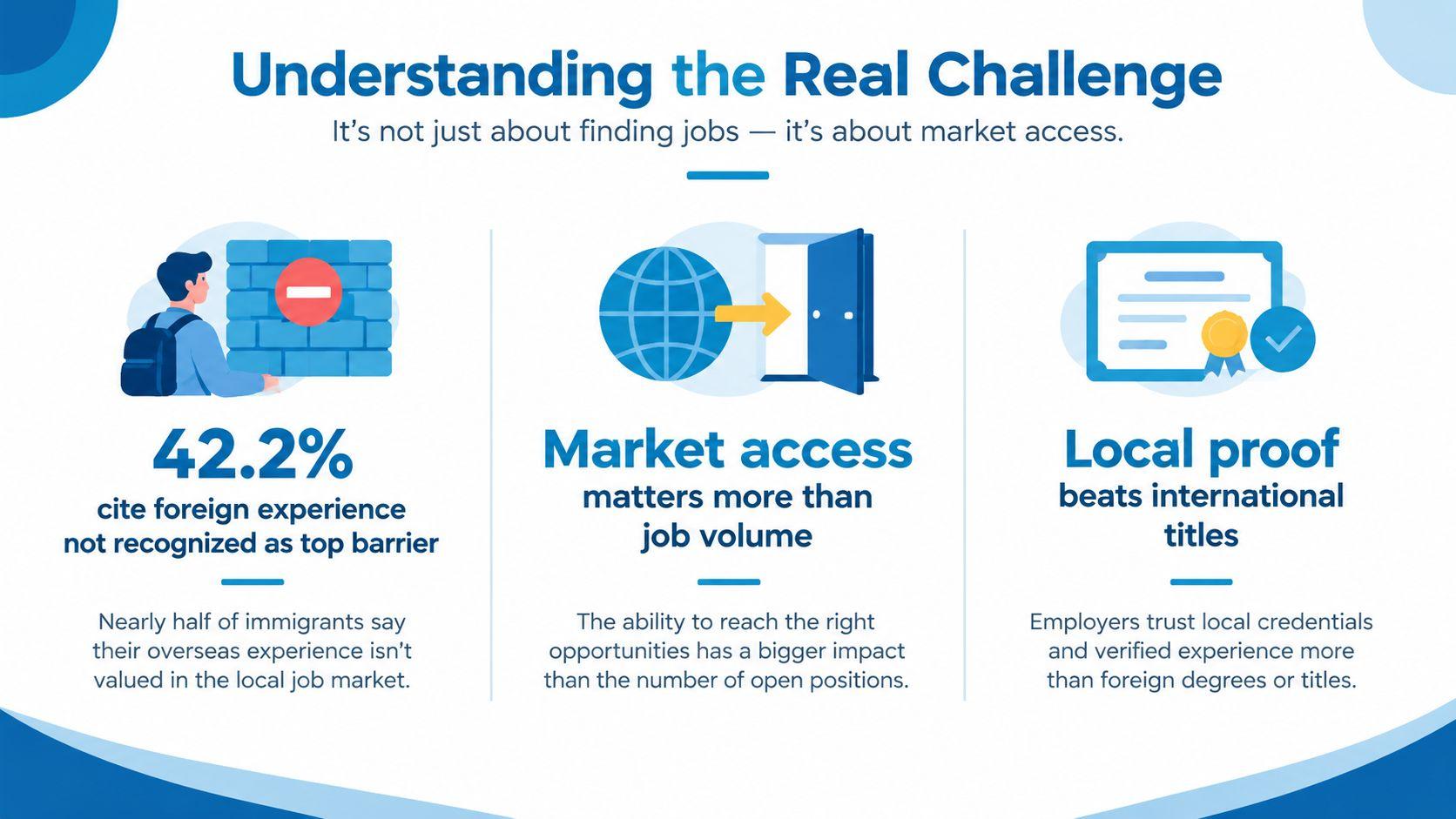
The bottleneck is translation
The OECD’s later review reported migrant labor-force participation of 78.2% in 2022, nearly two percentage points above the native-born population, and noted faster gains for immigrant women than men in employment and participation during that year. Yet the OECD International Migration Outlook 2023 also describes the barriers that keep participation from becoming suitable employment: language, unrecognized qualifications, limited local experience, weak information about job-search methods, legal restrictions, discrimination, family responsibilities, and housing or health constraints.
Your overseas title may be senior, but a recruiter may not know how it maps to the local occupation structure. A professional license may be legitimate, but unusable until a local authority recognizes it. A resume may describe excellent work, but fail to use the terminology employers and applicant tracking systems expect.
Practical rule: Treat every application as a translation task. Convert foreign titles, employers, tools, regulations, and achievements into signals the target market can verify quickly.
This is why mass applications underperform for many newcomers. They increase activity without fixing the underlying access problem. Strong candidates identify roles where their legal status fits, employers understand their credentials, and another person can validate their ability. Local proof beats international prestige when the hiring team can’t interpret the prestige.
Targeting Employers with Sponsorship Track Records
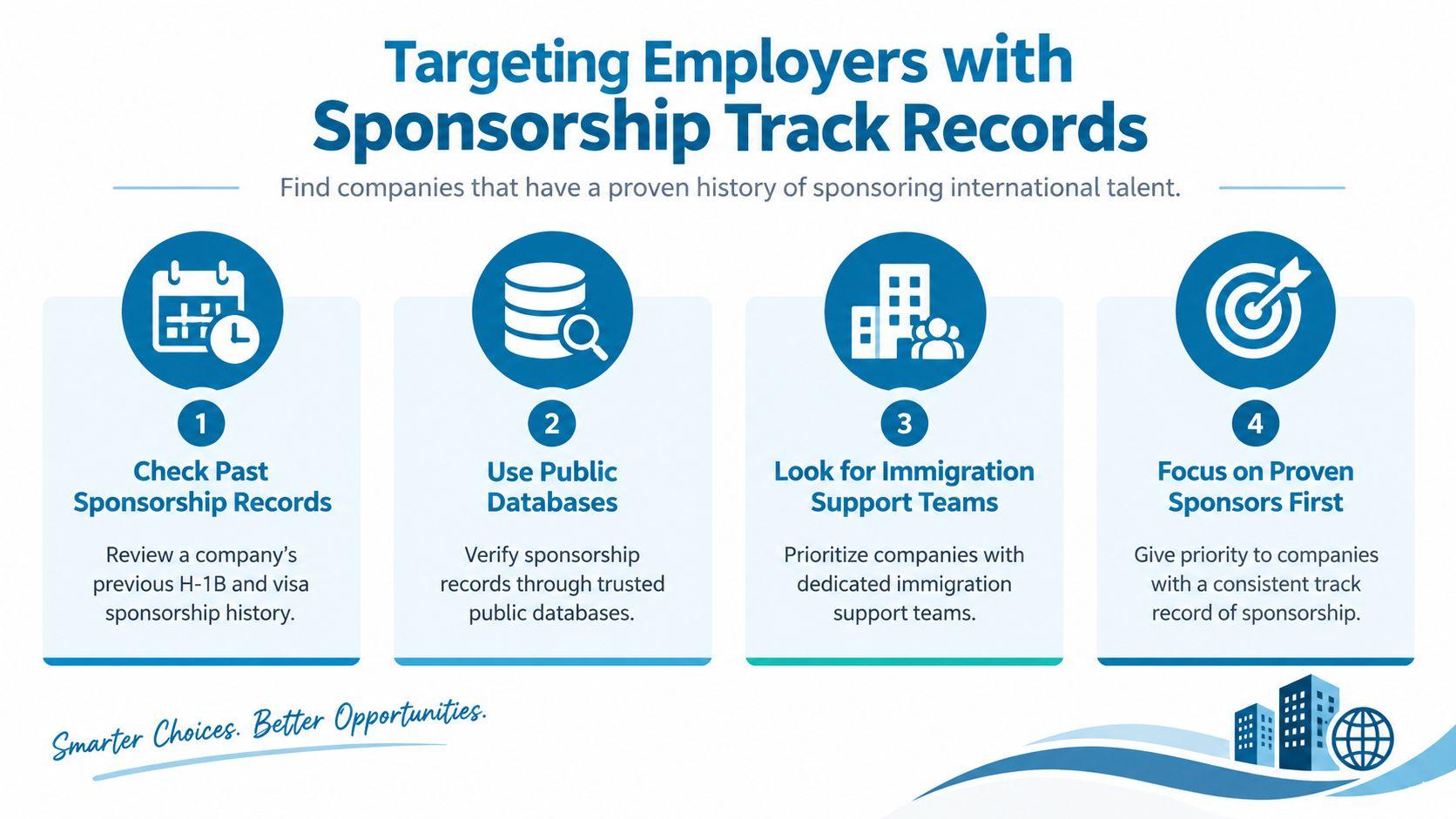
Sponsorship is concentrated among employers that already understand immigration administration. An employer that says it’s “open to international candidates” may still lack a current license, an immigration operations team, or a role that meets the relevant occupation and salary rules. A company with an established sponsorship record has already cleared more of those operational hurdles.
The UK illustrates the difference between a large potential market and an eligible vacancy. Workers on the Skilled Worker route must have an approved sponsoring employer and receive the higher of the general salary threshold or the occupation-specific going rate. The general threshold rose from around £26,000 to £38,700 in April 2024, then to £41,700 in July 2025, making the occupation code and compensation structure central to eligibility, as explained by the Migration Observatory’s overview of UK work visas.
The employer registry is useful, but it’s only the first screen. Reporting cited more than 137,000 registered UK visa sponsors in the year ending June 2025, while another source reported about 123,911 active licensed sponsors at the end of December 2025. Those figures come from reported UK sponsor-registry information, and they shouldn’t be read as proof that every listed employer is hiring for your occupation.
Use a verification sequence
-
Start with the official or recognized registry. Confirm that the employer holds the relevant sponsorship license in the destination country. A company website statement is weaker evidence than a current registry entry.
-
Check the job, not just the company. Sponsorship may be limited by occupation, location, salary, seniority, or business unit. A licensed employer can still advertise roles that aren’t suitable for sponsorship.
-
Look for operational evidence. Search for immigration counsel, global mobility staff, relocation support, or repeated hiring of international workers. These signals suggest the company can manage the process, though they don’t guarantee approval.
-
Verify before investing heavily. Ask a concise recruiting question: “Is this role open to candidates who require sponsorship, and does the company sponsor this occupation in this location?” Get clarity before spending hours tailoring an application.
For the United States, treat sponsorship language as a scarce signal. The share of postings mentioning visa or green-card support reached 0.16% in October 2024, then eased to 0.14% by May 2025, according to Indeed Hiring Lab data summarized by Lighthouse. Historical wording can remain in copied descriptions, and raw petition activity doesn’t necessarily prove that a specific current vacancy is sponsor-friendly.
Use a dedicated visa sponsorship job search as a discovery layer, then verify the employer and role through the applicable national registry. In the UK, EU countries, the US, Australia, and Singapore, the principle is the same: rank proven sponsors first, but verify the exact vacancy before applying.
Distinguishing Remote Work Eligibility
“Remote” describes where you work, not automatically where you’re allowed to work. A listing marked remote, US only may require US work authorization, payroll registration, tax compliance, and residence in a particular state. A listing open to candidates in any country has a different employment model, often involving an employer-of-record arrangement, contractor status, or a company entity in the candidate’s country.
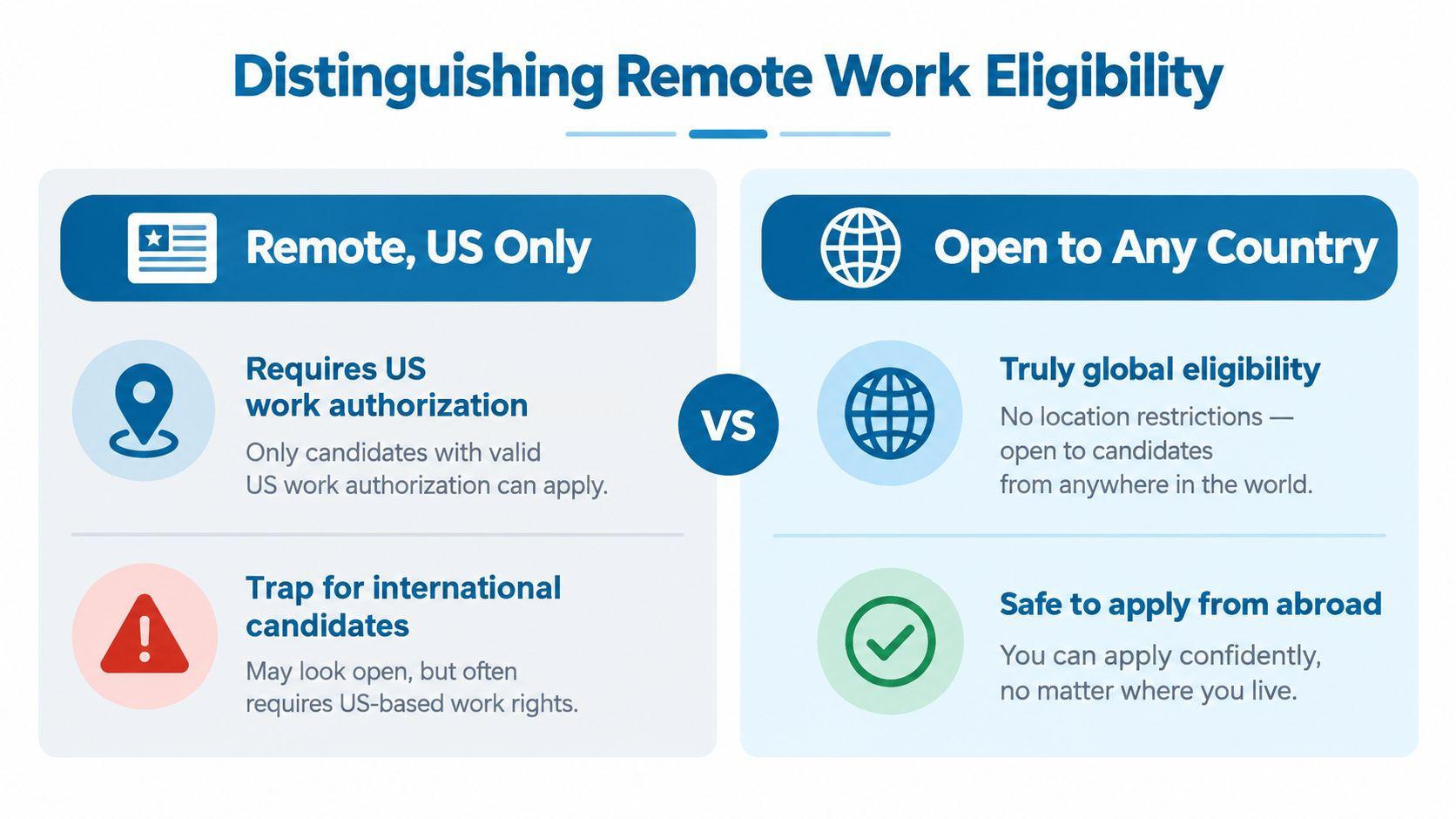
The distinction matters because unclear eligibility creates a false sense of opportunity. Recent research cited in the European Economic and Social Committee material reported that 60% of young immigrants feel their skills are undervalued, while 71% struggle to judge which paths or credential evaluations are worth pursuing. Those figures point to a decision problem, not a confidence problem. Candidates need better information before they commit effort.
Read the location language literally
Look for phrases such as:
- “Remote within the United States” or a list of eligible states. Assume domestic authorization is required unless the employer says otherwise.
- “Remote in [named country]”. This usually indicates local payroll or employment-law restrictions.
- “Work from anywhere”. Confirm whether “anywhere” means any country or only any location within the company’s operating region.
- “Global team”. This describes team composition, not necessarily hiring eligibility.
- “Contractor worldwide”. Ask about tax treatment, payment currency, intellectual property terms, and whether the arrangement can support your long-term immigration plans.
Ask the recruiter where the employer can legally hire you, what engagement model it uses, and whether the role requires authorization in a specific country. These questions belong early in the process, not after several interviews.
A work-from-anywhere job search is useful only when the filter reflects genuine global eligibility. Don’t treat remote work as a substitute for sponsorship without checking the legal structure. A globally remote contractor role may let you work from your current country, but it may not create a route to relocate later.
Converting Foreign Experience into Local Proof
Canadian data makes the translation problem concrete. Among recent working-age immigrants, 31.7% reported difficulty finding their first job. The leading obstacles included lack of Canadian experience or references at 42.2%, no connections in the job market at 38.3%, and foreign work experience not being accepted at 34.6%, according to Statistics Canada.
The answer isn’t to hide international experience. It’s to make the experience easier to evaluate. Replace an unfamiliar title with a functional title in parentheses, preserve the official title elsewhere when accuracy matters, and describe the business problem, tools, scope, and outcome in language used by the target market.
Make your resume locally legible
A useful transformation looks like this:
- Before: “Technical Manager, telecommunications operator, responsible for network modernization.”
- After: “Network Infrastructure Manager, led modernization across enterprise telecommunications environments using [relevant tools or standards], coordinating vendors, engineers, and delivery milestones.”
The second version doesn’t exaggerate. It supplies recognizable context. Add the country beside each employer, explain regulatory environments where relevant, and make the connection to the target role explicit.
Applicant tracking systems also need plain text signals. Use a single-column layout, standard section headings, conventional dates, and the exact skill terms appearing in the vacancy when they truthfully match your background. Avoid placing important information inside graphics, headers, or decorative text boxes.
Credential evaluation deserves a decision, not an automatic purchase. Pursue it when the role, regulator, licensing body, immigration pathway, or employer explicitly requires equivalency. Delay it when the job evaluates demonstrated skills, a portfolio, technical testing, or directly relevant work history. The right question is: will this evaluation open a gate that is currently blocking me?
For the networking barrier, create proof in smaller units. Ask former managers or clients for references that can be verified internationally, publish work samples with clear context, join local professional associations, and request short informational conversations from people in the target function. The role directory can help you compare how employers describe similar positions, so your resume reflects the vocabulary used across real vacancies rather than one translated title.
Prioritizing High-Yield Search Channels
Mass applications feel productive because the numbers are visible. For international candidates, they often place the weakest channel at the center of the search. A study of international graduates found that employment agents were the most-used first-job channel at 33%, followed closely by social networks at 32%. Company websites accounted for 20%, and university job ads for 10%, according to the Centre for Global Higher Education working paper.
The implication is practical: job boards should support your search, not define it. An open posting gives you a vacancy. A referral gives the employer context for your background and can answer the question that a resume can’t: why should this team spend time understanding an unfamiliar career history?
Build access deliberately
Start with people who have a reason to respond. Alumni, former colleagues, professional association members, recruiters specializing in your occupation, and vendors who worked with your previous employer are stronger starting points than random senior executives. Your message should ask for perspective, not a job.
A concise outreach note might explain your target function, destination market, work authorization situation, and one relevant area of experience. Then ask whether the person can point you toward employers that hire internationally or tell you which local credential matters in that function.
Use referrals in parallel with direct applications. After a conversation, apply to a role the person can identify, mention the discussion accurately, and ask whether they’re comfortable forwarding your profile. Don’t pressure contacts to endorse work they haven’t seen.
| Channel | Best use | Common mistake |
|---|---|---|
| Employment agents | Identify employers already handling international hiring | Sending one generic resume to every recruiter |
| Social networks | Gain context, referrals, and internal validation | Asking strangers for immediate sponsorship |
| Company websites | Apply when the employer and role are already qualified | Treating the careers page as your only source |
| University or alumni channels | Access local introductions and early-career guidance | Assuming alumni support replaces eligibility checks |
Your time allocation should follow your access strength. If you have former colleagues in the destination market, activate them first. If you’re new to the country, build a small network while applying selectively to verified sponsor-friendly roles. The objective isn’t to avoid applications. It’s to make each application arrive with better context.
Building an Integrated Search Workflow
A workable immigrant job search combines four decisions before you apply: Can I legally take this role? Does the employer support people in my position? Does my background match the actual requirements? Can I explain the match in locally recognizable language? Separating those decisions across disconnected job boards, spreadsheets, and writing tools creates avoidable duplication.
Begin with eligibility. Filter for visa sponsorship when relocation requires it, or for genuine work-from-anywhere roles when you’ll remain abroad. Keep the two paths separate because “remote, US only” and globally open work are different hiring conditions.
Next, rank by fit rather than recency. JobGlance aggregates 50,000+ active roles from 100+ job sites, refreshes its database every 24 hours, and scores each result from 0 to 100 against the user’s resume. Its dedicated sponsorship and work-from-anywhere filters narrow the eligible pool, while Smart Match ranks the remaining roles by profile fit.
A practical sequence
-
Search broadly by function and skill. Start with the work you can perform, not only the title used in your home country. Save recurring terms from relevant postings.
-
Apply hard eligibility filters. Remove roles that require authorization you don’t have, sponsorship they won’t provide, or residence in a country where they can’t employ you.
-
Inspect the match evidence. Review matched and missing keywords inside the job description. A lower score can still be worth pursuing if the missing term is learnable or your equivalent experience is poorly labeled.
-
Tailor the application. Use an ATS-friendly single-column resume, align truthful terminology with the posting, and write a cover letter that explains your cross-border experience in business terms.
-
Research the employer and verify the opening. Check sponsorship history, location restrictions, role legitimacy, and the recruiting contact. Historical sponsorship is a lead, not a guarantee.
-
Track outreach and applications together. Record the source, eligibility answer, referral, follow-up date, and outcome. This shows which channel is creating interviews rather than merely producing submissions.
The Chrome extension can carry match scoring, sponsorship detection, and application tools onto external job pages. Career Gap Analysis can surface skills that recur across saved roles, while the ATS Resume Builder can rebuild and tailor a resume for a specific vacancy. That workflow addresses the actual mechanics of immigrant hiring: eligibility first, interpretation second, application third.
Use JobGlance to search sponsorship and globally remote roles with dedicated eligibility filters, rank opportunities against your resume, and prepare applications without losing track of the evidence behind each decision. Start with a narrow target market, verify every role, and let the platform support a focused search built around access rather than application volume.
Keep reading


