
7 Best Remote Job Boards for Global Work in 2026


On this page
“Remote” doesn’t always mean you can work there. A listing may be remote within one country, limited to a time zone, structured as a contractor role, or unavailable without work authorization or sponsorship. The best remote job boards should therefore be judged by more than listing volume. This roundup compares seven platforms by role coverage, curation, salary and metadata quality, international eligibility, sponsorship visibility, and the efficiency of moving from discovery to application.
Treat every location label as a starting signal. Check the country, time-zone expectations, employee-versus-contractor structure, and work authorization language in the actual posting. JobGlance adds a comparison layer by aggregating roles, scoring resume fit from 0–100, supporting stackable Visa Sponsorship and Work-From-Anywhere filters, refreshing listings daily, and purging expired roles within 24 hours. You can explore relevant listings through JobGlance remote jobs.
The methodology is straightforward. Platform features are described as product capabilities, while eligibility, sponsorship, and legal work status remain employer-specific claims that candidates must verify directly.
1. JobGlance
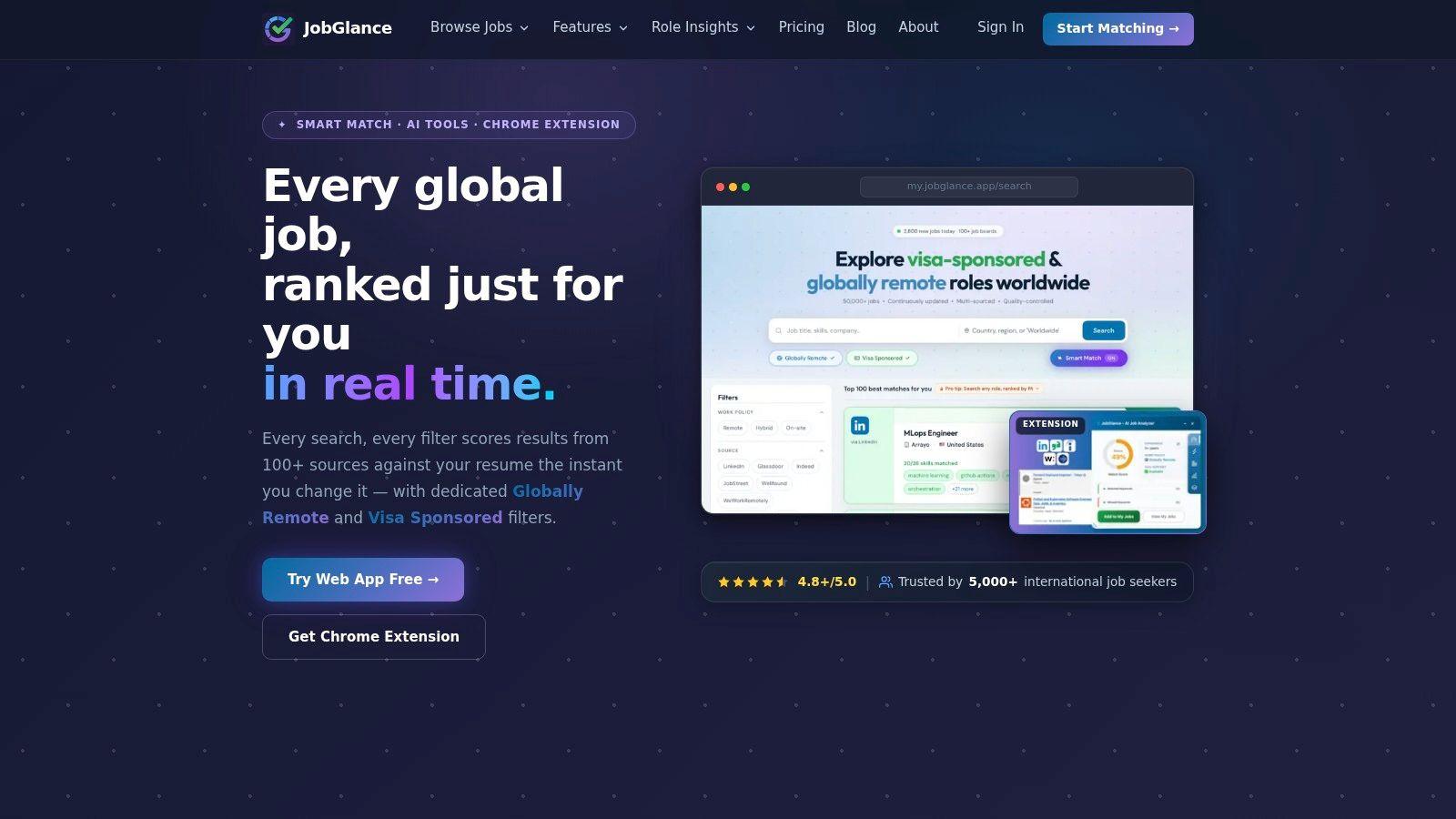
JobGlance addresses a practical problem in remote searches: deciding which listings deserve attention. Its web app aggregates 50,000+ active roles from 100+ sites and scores each result from 0–100 against an uploaded resume. Changing a query, filter, or resume re-ranks results in real time, so candidates can prioritize fit rather than rely only on recency.
For international candidates, the key distinction is eligibility filtering. Visa Sponsorship and Work-From-Anywhere are dedicated, stackable filters, allowing a search to be narrowed before resume-based ranking. Sponsorship signals are graded as Available or Likely, based on listing and employer data, so they indicate probability rather than establish legal authorization. The employer’s wording and application process remain decisive.
Why the search layer matters
JobGlance connects role discovery with application preparation. Its web app provides Smart Match search, Top Matches, an unlimited ATS Resume Builder, Resume Match Score views with matched and missing keywords, Career Gap Analysis, personalized cover letters, Deep Company Research with confidence and evidence, and similar-job discovery across sources. Product capabilities are described on the JobGlance features page.
Its Chrome extension adds match scores, sponsorship and remote detection, skill highlights, one-click saves, and the Magic Button to job pages. Integrations include LinkedIn, Glassdoor, Indeed, Wellfound, JobStreet, We Work Remotely, Working Nomads, and Jobspresso, with intelligent extraction on many other boards. This can reduce the time between finding a role and preparing an application, especially when one search spans several sources.
Practical rule: Use JobGlance to reduce the pool, then confirm location, employment structure, and sponsorship on the employer’s application page and in the full job description.
The extension is free and unlimited. The web app’s free tier includes an unlimited ATS Resume Builder, 10 global searches per month, 3 Search & Rank searches per month, and a read-only Top Matches preview. Pro removes those limits at $12.99 per month, or $10.39 per month billed quarterly. Resumes are used for matching, are not sold or used to train models, and the extension’s application pipeline stays in the browser.
Pros
- Graded sponsorship signals: Available and Likely labels from a curated employer list give international candidates a more specific screening signal than a generic remote tag.
- Fit-ranked aggregation: Resume scoring across roles from multiple sites reduces manual comparison between separate boards.
- Application preparation: Resume rebuilding, keyword gaps, cover letters, company research, and similar-job discovery sit alongside search.
- Freshness controls: Daily ingestion, self-healing signals, and 24-hour expired-role purging help limit stale results.
Cons
- Free-tier limits: Candidates using frequent global or Search & Rank searches may need Pro after the included allowances are exhausted.
- Signals require verification: A sponsorship or worldwide-remote label does not confirm the country, worker classification, or legal right to work.
- Aggregated workflows vary: Source listings may differ in detail, so candidates still need to open the employer posting before applying.
Best for: International candidates, visa seekers, digital nomads, early-career applicants, and professionals who want resume-ranked discovery across multiple sources.
2. We Work Remotely
A remote label does not establish global eligibility. We Work Remotely is useful because its regional tags make that distinction visible early, before a candidate invests time in an application. The board covers technical and non-technical functions, with category filters, company pages, and an active feed that support a focused employer search.
Start with the geography, not the job title. A listing marked “Anywhere in the World” may suit an international applicant, while another role can be limited to a country, region, time zone, or employment arrangement. The full posting still determines whether the employer can legally hire in your location and whether the role is employee or contractor work.
A practical workflow is to choose a function, check the regional tag, open the company page, and verify work authorization requirements in the complete description. Company pages add context: they can show whether an employer regularly hires remotely or has posted one location-limited opening. That makes the board more useful for comparing hiring patterns, not just collecting search results.
The trade-off is efficiency versus certainty. We Work Remotely’s remote-only focus reduces the noise created by general job sites, but every promising listing still needs an eligibility check. Paid options, including Basic, WWR Pro, and TopAccess, add alerts and other job-seeker features. Their value depends on whether faster notifications and added application functionality justify the cost for your search.
A worldwide label improves discovery, but it doesn’t answer whether the employer can hire you in your country.
Pros
- Broad remote reach: Technical and non-technical roles appear in one remote-focused marketplace.
- Clearer geography: Regional tags help distinguish worldwide listings from country-limited roles.
- Employer context: Company pages provide another way to examine the hiring organization.
- Lower search noise: Remote-only categories are more relevant than a general keyword filter.
Cons
- Eligibility still requires verification: Regional tags do not replace checking residence, authorization, time-zone, and contract requirements.
- Some convenience features are paid: Expanded alerts and application tools sit behind optional plans.
Candidates comparing country rules across boards can use JobGlance’s discussion of international jobs alongside the regional labels here. It helps frame discovery as the first screening stage, rather than proof that an employer can hire globally.
Best for: Candidates seeking a remote-only marketplace with broad role coverage and visible geographic tags.
Website: We Work Remotely
3. Remote OK
Remote OK works best as a fast, skill-based search tool for developers, engineers, data professionals, and other technical specialists. Searches built around React, Python, or another defined technology can turn a broad career goal into a practical query. That focus also limits its usefulness for candidates outside software and data work.
Its “Open Salaries” approach means many postings include salary fields, which can support early comparisons. Visibility depends on the employer, however, and a listed salary does not establish the quality of the full offer. Candidate premium features include instant alerts, an ad-free experience, and a verified or priority application badge.
The trade-off is volume. Frequent new postings can expose technical roles quickly, while creating more results to screen for seniority, country, contractor status, and required working-hour overlap. A role marked remote may still be restricted to a specific country or hiring region, so international candidates should verify legal work eligibility and sponsorship before applying.
A useful search should end with a decision, not another open tab. Search by a specific skill, inspect available salary information, read the location wording closely, and compare similar roles before submitting an application. JobGlance’s similar jobs across sites feature can help locate comparable postings elsewhere when one listing leaves eligibility or job details unclear.
Search discipline matters: High volume helps only when filters are specific enough to remove irrelevant roles.
Remote OK’s value is strongest for candidates who can define their target narrowly and move quickly. It is less efficient for someone who needs broad role coverage, verified worldwide eligibility, or a low-noise search process.
Pros
- Technical depth: Skill and stack tags support focused searches.
- Fast discovery: Frequent posting activity can reveal new technical roles quickly.
- Salary context: Many listings provide salary fields.
- Premium alerts: Paid features offer faster notifications and an ad-free experience.
Cons
- Narrower role mix: Non-technical opportunities are less prominent than software and data roles.
- Plan clarity: Candidate feature and pricing details are not presented in a simple plan grid.
- Eligibility still varies: Remote status does not confirm country access, sponsorship, or contractor terms.
Best for: Developers, engineers, data specialists, and technical candidates who value searchable skills and rapid listing discovery.
Website: Remote OK
4. FlexJobs
FlexJobs makes a deliberate trade-off: less open browsing volume in exchange for a quieter, screened database. Human-vetted listings are intended to remove scams, multi-level marketing opportunities, and commission-only roles. That filter can shorten the path from discovery to application, although candidates still pay for full database access.
Its category range is broader than technology-focused boards, covering education, healthcare, finance, administration, and other fields. Alerts, application tracking, and AI-assisted tools such as Expert Apply can reduce search administration. A 14-day money-back guarantee gives prospective members a defined way to test the service.
The key decision is whether curation matters more than unrestricted access.
A screened listing is not proof that an international candidate can legally accept the role. Employers may limit hiring to specific countries, require time-zone overlap, use contractor arrangements, or provide sponsorship only in selected jurisdictions. Salary information may also be absent because employers control what they disclose. Each posting still requires a direct eligibility check before application.
FlexJobs is most useful when “remote” is only one requirement. A candidate seeking part-time flexibility, a non-technical function, or work outside common startup and engineering categories may get more value from its broader organization than from a high-volume technical board.
Pros
- Lower noise: Human vetting addresses common scam, MLM, and commission-only concerns.
- Broad categories: Listings extend well beyond technical roles.
- Search tools: Alerts, tracking, and application support reduce manual administration.
- Risk control: The money-back guarantee provides a defined trial window.
Cons
- Paid access: Full database use requires a membership.
- Uneven salary detail: Compensation is not displayed upfront for every listing.
- No automatic legal clearance: Screening does not establish country access, sponsorship, or worker classification.
Best for: Non-technical professionals, flexible-work seekers, and candidates who value curation over unrestricted volume.
Website: FlexJobs
5. Remotive
Remotive is most useful when the target is a remote startup role in engineering, data, DevOps, product, marketing, or operations. Its categories and tags narrow discovery faster than a general employment marketplace, while email digests and a community newsletter support candidates who do not want to search manually every day.
The more important question comes after discovery: can the employer legally hire from the candidate’s location? A distributed team may still limit roles to specific countries, require contractor status, expect time-zone overlap, or sponsor work authorization only in selected jurisdictions. Startup language describes team culture, not automatic worldwide eligibility. Check the original posting and application details before investing time.
Remotive also offers public API and RSS feeds, and its listings can appear in Google Jobs. These channels let candidates monitor openings through their own workflow instead of relying on one browsing session. The trade-off is narrower coverage outside technology and startup functions, so high listing relevance does not equal broad occupational coverage.
A candidate focused on a defined role can use the newsletter as a screening layer. Passive discovery works best when the search criteria are already clear, such as a product role open to a particular country or time zone. Optional premium features can personalize digests by location or category, while the free community and newsletter still provide ongoing market monitoring.
Pros
- Startup signal: Strong coverage for remote-first startup functions.
- Passive discovery: Email and community channels surface roles without constant searching.
- Useful distribution: API and RSS access support alternative workflows.
- Focused categories: Technology and product candidates can narrow searches quickly.
Cons
- Tech concentration: Non-technical coverage is limited.
- Paid personalization: Some digest features require a premium tier.
- Eligibility varies: Startup-oriented postings may still restrict country, time zone, or work authorization.
Best for: Technical and product candidates who want startup discovery, newsletter monitoring, and community context.
Website: Remotive
6. Himalayas
The useful question on Himalayas is not how many remote listings it displays. It is whether a candidate can identify the roles they may legally and practically perform from their current location. Filters for country, time zone, skills, salary, and seniority bring those conditions into the search, while separate treatment of worldwide and location-restricted jobs reduces ambiguity.
That distinction matters for international applicants. A role labelled “remote” may still require residence in a specific country, overlap with a defined time zone, or employment through an eligible arrangement. Himalayas surfaces relevant signals, but the employer’s original posting remains the authority to verify work authorization, hiring location, and sponsorship.
Salary tools add a second screening layer. Automatic currency conversion makes cross-border comparisons easier, although undisclosed compensation limits the result. Applying salary as a strict filter can also remove relevant jobs whose listings omit pay details, reducing coverage in exchange for a cleaner shortlist.
Himalayas combines aggregated listings with direct employer postings and links applicants to the original source. Expiry handling and review processes reduce avoidable noise, but they do not replace checking whether the vacancy is current or whether its application route accepts candidates in your country.
A practical workflow is to filter by location and time zone first, then narrow by skills and seniority. Review salary information last unless compensation is the deciding constraint. This order preserves eligible opportunities while still making international comparison more efficient.
Pros
- Location structure: Country, time-zone, and worldwide filters foreground eligibility.
- Compensation comparison: Currency conversion supports international salary review.
- Technical filtering: Skills and stack tags narrow specialized searches.
- Employer handoff: Links return candidates to the original employer source.
Cons
- Uneven category depth: Some non-technical categories may offer less volume.
- Incomplete salary data: Employers do not always disclose compensation.
- Filtered coverage can shrink: Salary filters may hide otherwise relevant roles.
Best for: International candidates who prioritize location, time zone, salary metadata, and structured eligibility signals.
Website: Himalayas
7. Jobspresso
Jobspresso is useful when application quality matters more than listing volume. Its team hand-vets postings and checks signals such as the employer’s website and social presence. That process produces a smaller feed across technology, marketing, customer support, and operations, with less need to separate obvious low-quality posts from plausible opportunities.
The trade-off is coverage. A candidate searching for a narrow specialty may need a higher-volume board as a second source. Jobspresso’s international focus can surface roles beyond a U.S.-only search, but “international” does not establish worldwide eligibility. Location limits, work authorization, and sponsorship still require confirmation in each posting.
Use the board as a verification-first workflow: inspect the employer, read the location language, check whether sponsorship is addressed, and then follow the stated application route. Employer packages can include multi-job bundles and 90-day postings. For applicants, the practical value is a more focused path from discovery to a credible application, provided the role’s legal and geographic conditions match.
Pros
- Human review: Legitimacy checks can reduce avoidable noise.
- International scope: Listings are not framed only around the U.S. market.
- Category range: Technology, marketing, support, and operations appear in the feed.
- Application efficiency: Curation can shorten the path from discovery to employer review.
Cons
- Limited inventory: Narrow specialties may require a second board with higher volume.
- Uneven salary detail: Compensation visibility depends on what employers disclose.
- Eligibility still needs checking: Curation does not confirm sponsorship, worldwide access, or worker classification.
Jobspresso fits candidates who would rather review a manageable set of human-checked roles than process a noisy feed. It works particularly well as a second or third source beside a technical board with greater volume or a service with stronger worldwide filters.
Best for: Candidates who prioritize legitimacy and curation, especially in tech, marketing, support, and operations.
Website: Jobspresso
Top 7 Remote Job Boards Comparison
| Platform | Pricing and access ⚡ | Expected outcomes ⭐📊 | Ideal use cases 💡 | Key advantages |
|---|---|---|---|---|
| JobGlance | Free extension; Pro web tier removes limits | High, personalized resume scoring and real-time re-ranking reduces irrelevant results ⭐⭐⭐⭐ | International job-seekers, visa/relocation candidates, digital nomads, early-career tech/data pros | Resume-based match score; first-class Visa & Work-From-Anywhere filters; ATS resume builder; privacy-first extension |
| We Work Remotely | Free basic use; paid plans for alerts and extra features | Moderate, broad remote visibility and strong brand reach ⭐⭐⭐ | General remote job hunting across tech and non-tech functions | Large audience and brand recognition; category filters and company pages |
| Remote OK | Free; premium for alerts, verified badge, ad-free use | High for tech roles, fast posting cadence and often salary data ⭐⭐⭐ | Developers and technical candidates seeking high-volume listings | Massive tech volume; fine-grained tag filters; salary fields on many posts |
| FlexJobs | Paid membership required for full access; money-back guarantee | High-quality, low-noise leads with scam screening across many categories ⭐⭐⭐⭐ | Candidates prioritizing vetted, flexible, part-time, or non-tech roles | Human-vetted listings; reduced scam/MLM noise; broad non-tech coverage; application tools |
| Remotive | Free access; premium for personalized digests | Good, strong signal for startup roles and passive discovery via newsletter ⭐⭐⭐ | Startup-focused tech candidates and passive job hunters | Startup-centric listings; active community and email digests; API/RSS feeds |
| Himalayas | Free; newer platform with evolving volume | Good, helps confirm eligibility quickly and compare salaries across currencies ⭐⭐⭐ | International candidates needing timezone/country filters and salary conversion | Timezone and country filters; salary currency conversion; clear “worldwide” vs restricted roles |
| Jobspresso | Free browsing; smaller inventory than mega-boards | High legitimacy and lower noise; international reach ⭐⭐⭐ | Candidates seeking vetted remote roles across tech, marketing, support, operations | Hand-vetted listings and legitimacy checks; lower noise for international applicants |
Build a Board Stack, Then Verify Eligibility
No single platform wins every remote search because listing volume, eligibility, and application efficiency are different problems. Remote job boards have become core recruiting infrastructure. Virtual Vocations reported adding over 247,000 remote job postings in 2024, a 16% increase from 2023, with listings from 12,574 unique companies, also up 16% year over year. The same report recorded nearly 21,000 fully remote jobs per month on average. That scale explains why boards matter, but it doesn’t tell you whether any individual role is available in your country. Virtual Vocations’ 2024 remote jobs report provides the historical context.
Coverage is also fragmented. An analysis found that overlap between any two remote job boards was only 5% to 13%, meaning most listings in a board pair were unique to one source. The cross-board overlap analysis supports using a stack rather than trusting one feed. A separate index tracked 205,358 active remote positions across eight major boards, with 42,550 new jobs in the last seven days and 105,205 in the last 30 days, reinforcing the difference between marketplace breadth and individual eligibility. The remote-job index shows how concentrated and varied that ecosystem has become.
Choose the stack according to your bottleneck:
- JobGlance: Cross-source ranking, resume fit, sponsorship signals, and Work-From-Anywhere filtering.
- We Work Remotely: Broad remote-only reach and recognizable regional tags.
- Remote OK: High-volume technical searches and skill-based navigation.
- FlexJobs: Screened listings across technical and non-technical categories.
- Remotive: Startup discovery, tech categories, and newsletter-led browsing.
- Himalayas: Structured country, time-zone, salary, and worldwide filters.
- Jobspresso: Curated international listings with manual legitimacy checks.
Use a repeatable workflow. Search by role and skill, filter by country or worldwide eligibility, inspect the employer’s location and work authorization language, confirm sponsorship directly, tailor the resume and cover letter, and track the application. For a location-specific search, JobGlance’s Europe visa sponsorship jobs page and remote jobs by category provide relevant starting points, but the employer’s own terms still decide eligibility.
The practical takeaway is simple: a board’s remote label is a discovery signal, not proof of legal eligibility. The best remote job boards help you find opportunities, while disciplined verification determines whether you can accept them.
Use JobGlance to compare roles across sources, rank them against your resume, and filter for visa sponsorship or Work-From-Anywhere signals before you spend time applying. Start with the free extension or web-app tier, then verify every promising role directly with the employer.
Keep reading


