7 Software Engineer Cover Letter Examples


On this page
Only 21.2% of candidates who never submit a cover letter receive job offers, while 35.8% of those who always submit one get hired. That gap is why software engineer cover letter examples still matter in technical hiring, especially when employers are using them as a quick signal for fit, motivation, and communication. The best version isn’t a generic career summary, it’s a tight proof of role match, with the right stack, the right evidence, and the right constraints surfaced fast. JobGlance can help by showing matched and missing keywords through Resume Match Score, then letting you research the role before you tailor the letter.
1. The Skills-Focused Technical Cover Letter
A skills-first letter works when the posting is explicit and the hiring team wants to see immediate stack alignment. Lead with the languages, frameworks, or infrastructure tools the role asks for, then attach each one to a concrete result so the paragraph reads like proof, not a keyword dump.
Practical rule: mirror the job description’s wording exactly when the term is a hard requirement, because ATS and recruiters both scan for familiar language.
A backend candidate might open with Python, PostgreSQL, and AWS if those exact tools show up in the posting. A frontend engineer could lead with React, TypeScript, and testing frameworks, while a DevOps candidate might foreground Kubernetes, Docker, and CI/CD. The point is not to list everything you know, it’s to make the hiring manager think, “this person already speaks our stack.”
The strongest letters in this format pull 5 to 7 core requirements from the job description, then map each one to a project or outcome. That is where the backend role insights on JobGlance become useful, because the same keyword patterns that drive a search result also tell you what belongs in the first paragraph. If the posting mentions a library version, deployment pattern, or data store, use that exact wording only if you’ve used it.
A clean template looks like this:
- Start with stack fit: name the main tools the role asks for.
- Add one proof point: tie each skill to shipped work, not coursework.
- Match terminology carefully: don’t improvise synonyms for core technologies.
- Check missing keywords: JobGlance’s ATS Resume Builder can surface gaps before you apply.
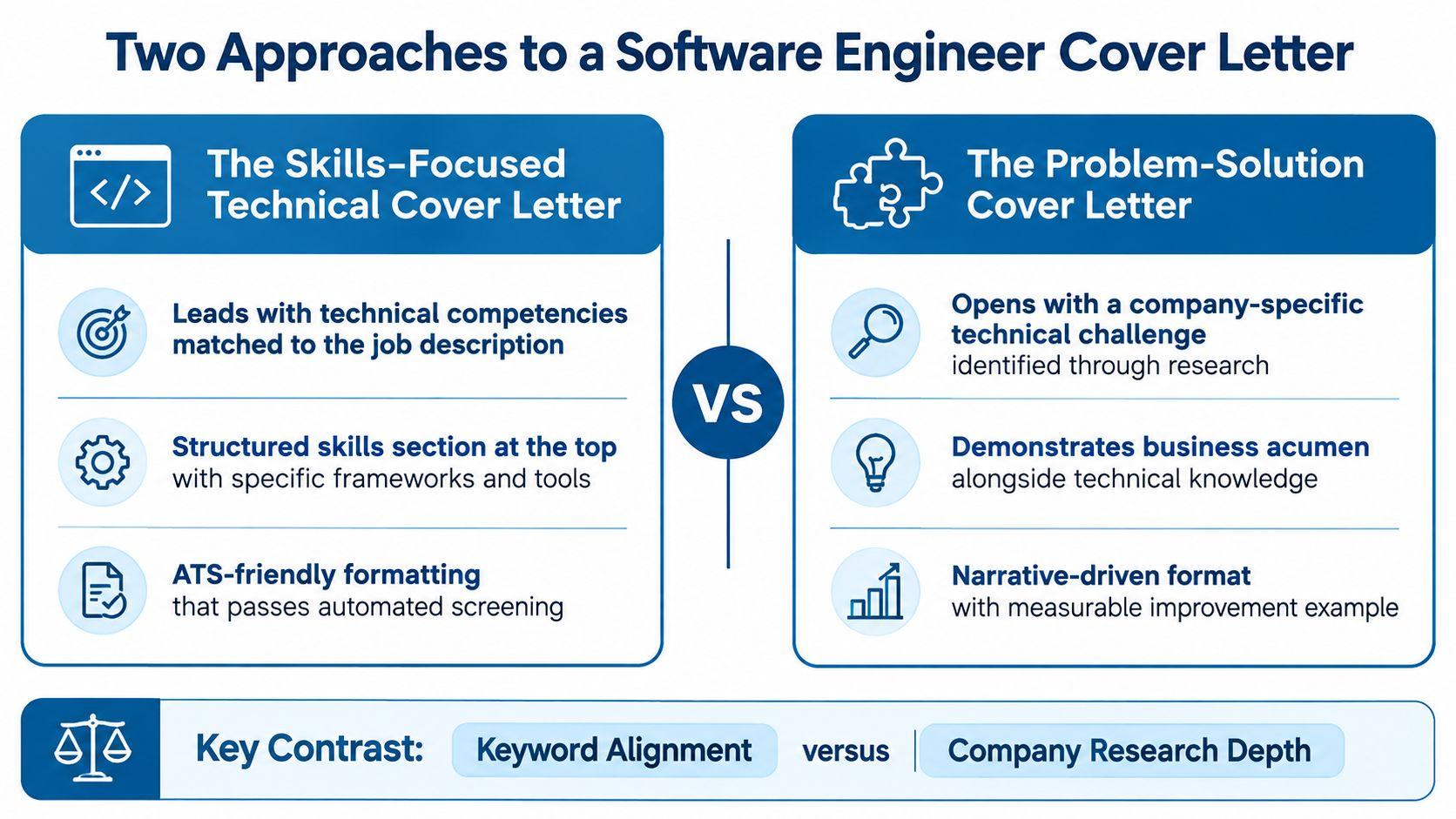
2. The Problem-Solution Cover Letter
This format works best when the company has a visible pain point and you have solved a similar one before. It beats a generic enthusiasm letter because it starts with the business problem, then shows why your technical background matters.
The opening should come from company research, not guesswork. Read the engineering blog, recent product launches, and the job description, then identify what the team seems to be struggling with, such as scale, reliability, or developer experience. JobGlance’s Deep Company Research can help you verify company context and separate it from eligibility filters in the same workflow, which matters when you are tailoring for fit and sponsorship at the same time.
What the reader should feel
The reader should see two things fast. First, that you understand the problem. Second, that you have evidence for the fix.
If the company has written publicly about API latency, a backend engineer can connect that to prior work on response-time optimization. If the posting hints at technical debt, a full-stack candidate can point to a legacy modernization project and explain the trade-off managed.
Keep the evidence tight and specific:
- State the problem clearly: name the issue the company appears to face.
- Show a past parallel: describe a similar technical challenge you handled.
- Explain the outcome: mention the result in practical terms, such as reliability, speed, or user experience.
- Avoid overclaiming: if you did not own the entire system, say exactly what you owned.
The trade-off is simple. This style demands research, and if you cannot identify a real company pain point, the letter starts to sound speculative. When the fit is real, the structure does more than signal interest, it signals judgment.
3. The Impact-Driven Cover Letter
The impact-driven letter is the right choice when your history already includes measurable engineering outcomes. A 2026 peer-reviewed study found that a one-point improvement in writing quality for resumes and cover letters was associated with 7% more interviews per application and a job obtained nearly 10 days earlier (Wiley study). For engineers, that supports a simple rule, the writing should make the metric density stronger, not softer.
Start with the result, then explain the technical path. That means leading with latency, uptime, scale, or cost, not with “I’m passionate about building.” A backend engineer can say they reduced latency, a frontend engineer can point to bundle size or load performance, and a DevOps engineer can show release speed or deployment reliability. What matters is that the numbers are tied to an action the candidate owned.
The strongest impact letters also keep the scale legible. A system serving one team and a system serving millions are different signals, so the reader needs both the number and the context. If you improved performance, mention the baseline. If you saved money, explain the change that created the savings. If you improved reliability, show what changed operationally.
Lines worth adapting
Lead with ownership, not activity: “I led,” “I architected,” and “I owned” are stronger than “I helped” when the metric is significant.
Connect technical work to business value: the hiring manager should be able to trace the code to a user or revenue outcome without guessing.
For candidates using JobGlance, the useful move is to compare your metrics with the job’s repeated keywords and use the Resume Match Score to decide which achievement belongs in the letter. That keeps the impact real and relevant, instead of impressive in the abstract.

4. The Visa Sponsorship-Aware Cover Letter
When work authorization affects eligibility, saying it early is not oversharing, it’s clarity. Sponsored roles can fail on paperwork long before technical fit becomes relevant, so this letter format helps remove ambiguity immediately. UK guidance for sponsored roles recommends naming the visa route up front, confirming readiness to start, and explicitly stating sponsorship needs so the employer can verify eligibility without confusion (HireKit visa sponsorship guidance).
Remote and global job searches become more practical than generic cover letters. JobGlance’s dedicated visa sponsorship filter helps you find roles where eligibility is already part of the search process, which means the letter can focus on fit instead of defensive explanation. That’s especially useful when applying across countries, because location, work authorization, and relocation support aren’t minor details, they’re gatekeeping facts.
The best sponsorship-aware letters are direct and calm. They state the current status, the target country, and the readiness to begin. They also frame sponsorship as a logistical and business decision, not a personal exception.
For example, the candidate can say they’re eligible to work in a specific region, or that they require sponsorship for a long-term role. What matters is that the employer can immediately understand whether the application is viable. If the role is open globally, mention the regions where you can legally work. If you need relocation support, say that plainly rather than burying it.
Use this format when:
- Eligibility is a real filter: the role depends on country-based work rights.
- The application asks directly: don’t make the recruiter hunt for your status.
- You’re targeting global teams: time-zone and location constraints matter as much as stack fit.
- The employer has a sponsorship track record: research that before you send the letter.
5. The Culture-Fit Cover Letter
Culture-fit letters work best when the company’s values differ in visible ways, such as remote-first operations, open-source priorities, or climate goals. The point isn’t to say “I like your mission.” It’s to show that your working style and values already align with how the team behaves.
A 2025 survey summary reports that 35.4% of job seekers consistently submit cover letters, 42.5% do so only for some applications, and only 21.2% of candidates who never submit one receive job offers, while 35.8% of those who always submit one get hired (Resume.io cover letter statistics). That doesn’t mean every culture-fit letter should be emotional. It means the letter still has enough signal value that a specific, genuine alignment can matter.
The best culture-fit examples avoid vague praise and instead connect personal behavior to a company practice. If a climate tech startup emphasizes carbon transparency, describe a past project where rigor and accountability mattered. If an open-source company publishes publicly and ships in the open, point to a contribution history that reflects that habit. If a remote-first team values async communication, mention cross-border collaboration or distributed work experience in concrete terms.
Signals worth verifying before you write
- Working style: does the company operate asynchronously, or is “remote” just a location label?
- Product values: are they mission-led, open-source-first, or operationally conservative?
- Team behavior: do employees talk about collaboration, shipping, or autonomy in public?
- Personal evidence: can you point to a real project or habit that matches the value?
JobGlance’s Deep Company Research can help you check culture signals alongside remote filters, which is useful because a culture-fit letter only works when the fit is grounded in evidence. If you can’t connect your own history to a company value, skip the style and use a different format.
6. The Portfolio-Backed Cover Letter
For many software engineers, the work itself is the strongest proof. A concise portfolio-backed letter works when your GitHub, deployed projects, or documentation are better evidence than a long narrative. That’s especially true in technical hiring, where managers often want to see shipping ability, code quality, and architecture decisions rather than polished prose.
Keep the letter short and point straight to the work. Mention one or two projects, then explain why they matter for the role. A backend engineer can direct the reader to a distributed system or a performance-sensitive service. A frontend engineer can point to a deployed app that shows component design, interaction quality, or state management. A DevOps candidate can link a production workflow, operator, or deployment pattern.
The main risk here is weak presentation. A portfolio that’s hard to use, missing README files, or full of broken links hurts the signal. If the company uses global or remote hiring, make sure your demos work from wherever the recruiter is reading them. JobGlance’s frontend role page is a good example of why the role context matters, because portfolio evidence only helps when it matches what the job is asking for.
What the reader needs to see
Practical rule: the portfolio should prove the same thing the cover letter claims, otherwise the letter feels like a teaser for work the recruiter can’t verify.
Use a clean handoff:
- Name the project: give the recruiter one clear place to look.
- State the relevance: connect the project to a need in the posting.
- Show documentation quality: README files and design notes matter.
- Avoid link rot: broken links can kill momentum fast.
This format works because it respects how engineers evaluate each other. They don’t need a long story if the code, demo, and documentation already tell the story well.
7. The Transition Narrative Cover Letter
Career changers need a different kind of proof. The letter has to explain the move, show progression, and make the previous background feel useful rather than irrelevant. That matters because the reader is trying to answer a practical question, not a philosophical one, can this person do the work and learn the rest quickly?
Start by naming the transition directly. Say you’re moving from QA to backend, pivoting from data analysis to engineering, or transitioning from bootcamp to first role. Then show the path in order, from prior domain work to technical learning to shipped projects. The structure matters because it turns a change in identity into a sequence of evidence.
A 2026 survey summary notes that 47.3% of job seekers have skipped applying to at least one job because it required a cover letter, while 73.4% tailor their letters in some way and only 10.6% send the same letter to every job (Zipdo cover letter statistics). For transition candidates, that customization gap matters even more, because the letter has to explain what the resume can’t.
The strongest transition letters use the past background as an asset. A QA candidate can explain how testing taught them to think about reliability and edge cases. A data analyst can point to systems thinking and pipeline work. A self-taught candidate can show a progression from structured study to deployed projects and honest self-assessment.
What to verify before sending
- Transition clarity: the new role should be named directly.
- Progression: coursework, bootcamp, projects, contributions, then the target job.
- Proof of capability: shipped work beats course completion on its own.
- Transferable background: previous domain knowledge should strengthen the case.
The best transition letter is not defensive. It shows strategic intent, practical learning, and a realistic sense of where you are now.
7-Style Comparison of Software Engineer Cover Letters
| Approach | 🔄 Complexity | 💡 Resources / Tips | 📊 Expected Outcomes | ⚡ Speed / Efficiency | ⭐ Key Advantages |
|---|---|---|---|---|---|
| The Skills-Focused Technical Cover Letter | 🔄 Low, templateable, structured skills-first | 💡 Extract 5–7 core technical keywords from posting; mirror terminology | 📊 High ATS pass rate; immediate technical relevance | ⚡ Fast to tailor per role | ⭐ Strong keyword alignment with hiring managers |
| The Problem-Solution Cover Letter | 🔄 High, deep company research and narrative craft | 💡 Read company blogs, docs, product notes; cite specific pain points | 📊 Higher callback likelihood (~+34%); memorable for mid/senior roles | ⚡ Moderate, research-intensive | ⭐ Differentiates candidate with business acumen |
| The Impact-Driven Cover Letter | 🔄 Medium, requires quantifying achievements and attribution | 💡 Compile 3–5 measurable results with baselines and your role | 📊 Very credible for experienced hires; emphasizes outcomes | ⚡ Moderate, needs metric gathering but concise to write | ⭐ Demonstrates measurable scale and business impact |
| The Visa Sponsorship-Aware Cover Letter | 🔄 Medium, legal clarity plus company sponsorship research | 💡 State work authorization clearly; research sponsor history and pathways | 📊 Reduces ambiguity; increases application completion for international candidates | ⚡ Moderate, brief text but needs verification | ⭐ Builds trust and filters incompatible roles early |
| The Culture-Fit Cover Letter | 🔄 Medium, authentic narrative and cultural signals required | 💡 Use Glassdoor, blogs, social posts; link personal values to specific initiatives | 📊 Improves cultural match assessment; can increase retention | ⚡ Moderate, personalization per company needed | ⭐ Emotionally resonant; strong for mission-driven/startup hires |
| The Portfolio-Backed Cover Letter | 🔄 Low, concise pointer but depends on portfolio quality | 💡 Ensure GitHub/portfolio has READMEs, demos, pinned projects and working links | 📊 Favored by engineering reviewers; work speaks louder than words | ⚡ Fast to write if portfolio is ready; depends on upkeep | ⭐ Direct proof-of-work; efficient for technical evaluation |
| The Transition Narrative Cover Letter | 🔄 Medium–High, map past experience to new role with evidence | 💡 Show progression (bootcamp, projects, certs); be explicit about transferable skills | 📊 Helps hiring managers understand pivots; higher performance if onboarded well | ⚡ Moderate, assembling proof and narrative takes time | ⭐ Addresses career-change concerns and highlights unique perspectives |
Turn the Example Into Your Next Draft
Pick the format that matches the hiring signal first. If the job ad is stack-heavy, use the skills-focused structure. If the company has a public technical pain point, use problem-solution. If your track record is already metric-rich, lead with impact. If eligibility matters, address sponsorship or location constraints early and directly. If your code is the strongest proof, make the portfolio the anchor. If you’re changing fields, use the transition narrative so the reader can follow the progression without guessing.
Then pull the repeated language from the posting and verify it against the role before you write a single sentence. JobGlance’s keyword highlights and Resume Match Score make that easier by showing which terms are matched and which ones are missing. The ATS Resume Builder is useful for checking whether your resume and cover letter are speaking the same language, and the company research tools help you avoid writing to the wrong problem.
A good final pass is simple. Read the letter once for role title and stack fit, once for proof points, and once for whether the company-specific reason sounds real. If you need sponsorship or work in a specific region, make sure that’s visible only where relevant and phrased plainly. Then confirm the letter is clean enough for both ATS parsing and human scanning, because cover letters still function as evidence, not decoration.
Before you send it, check this list in order, role title, core stack, one proof point, one company-specific reason, work authorization if needed, and a clear next step. If one of those pieces is missing, the letter is still a draft.
JobGlance pulls job search, matching, and application prep into one place, so you can see matched keywords, spot missing skills, and tailor a cover letter to the role you’re applying for. If you’re comparing software engineer cover letter examples against real job descriptions, visit JobGlance and use the match and research tools to turn one good draft into a stronger application.
Keep reading


