Skill Gap Analysis Tool Explained and How to Use It


On this page
You’ve crafted the CV, rewritten the cover letter, and still the inbox stays quiet. That silence usually isn’t about effort, it’s about a mismatch you can’t see yet, a missing skill, a weaker signal, or a role that asks for a different cluster of experience than the one you emphasized.
A skill gap analysis tool makes that invisible mismatch visible. For job seekers, that matters because the problem isn’t just “what skills do I lack,” it’s “which gaps are hurting my chances in the roles I keep applying to, and what should I fix first?”
Introduction Why Great Applications Still Get Ignored
A lot of job seekers know this pattern too well. They find a role that looks close, polish the resume, mirror the wording from the posting, hit submit, then wait for a reply that never comes. The frustrating part is that the application can still be strong and still miss the mark.
A skill gap analysis tool changes that search from guesswork into a ranking exercise. It compares your current profile with the requirements attached to a role, then shows which gaps are small, which are holding you back, and which are not worth chasing first. For a job seeker, that is more useful than a simple yes or no.
Skill gaps are not only a recruiter problem. The UK Employer Skills Survey 2024 shows how often they sit inside workforces, too. In the report, 12% of employers said at least one employee was not fully proficient in their role, down from 15% in 2022, and the number of affected employees fell to 1.26 million from 1.72 million in 2022. The same survey found that 4.0% of employees were judged to have a skills gap, down from 5.7% in 2022, and it frames the issue through incidence, density, and volume, which is a useful model for job seekers as well. UK Employer Skills Survey 2024
Practical rule: if your applications keep stalling, assume the problem is not effort first. Assume the problem is fit, then test that fit against the market.
The career-search version of this tool is more practical than a one-time HR audit. It helps you see whether your current experience matches the roles you want, which gaps repeat across those roles, and what to do next without rebuilding your whole career plan.
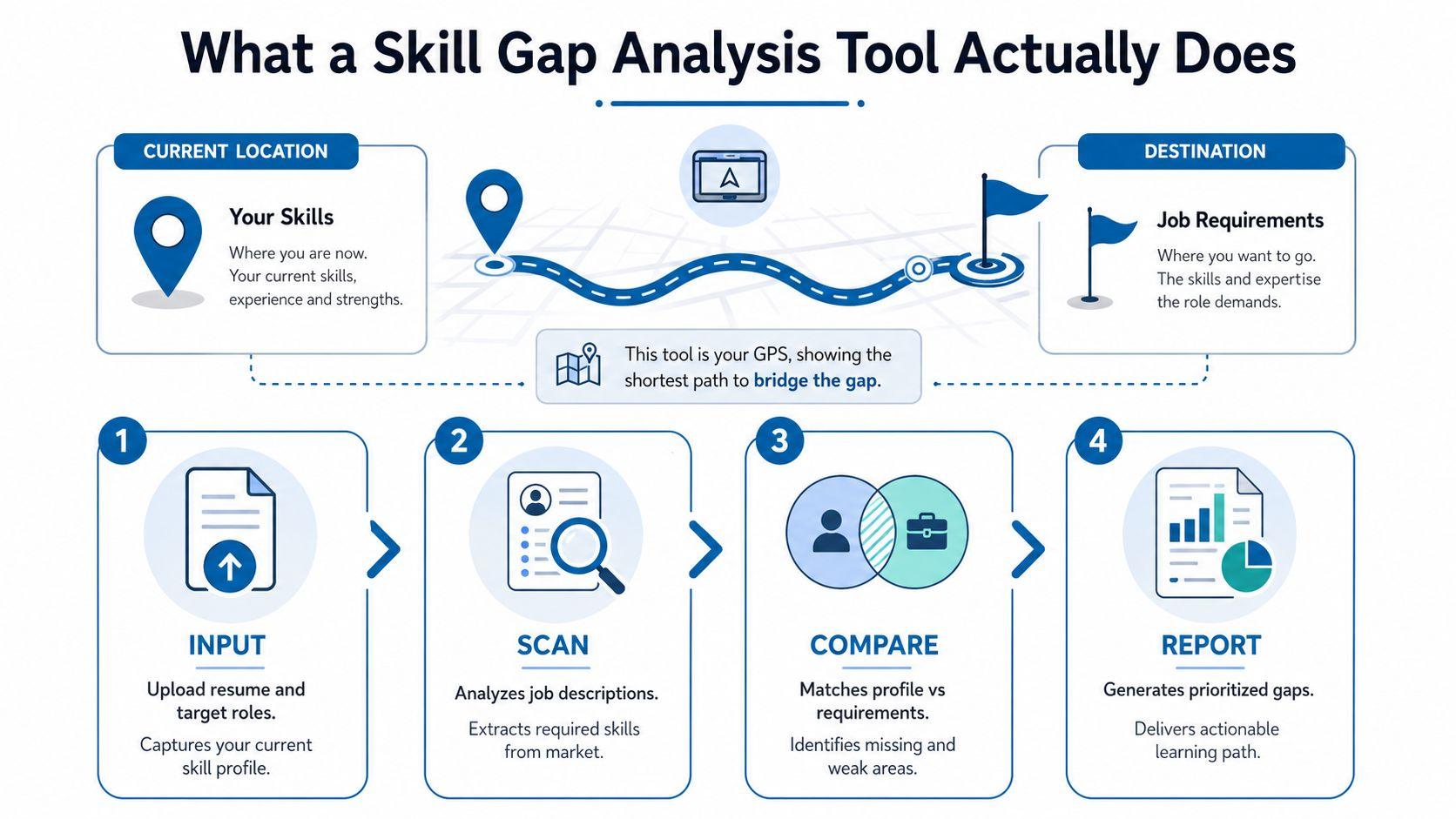
What a Skill Gap Analysis Tool Actually Does
A candidate opens a job post, sees familiar duties, and still gets no reply. The missing piece is often not effort, it is fit. A skill gap analysis tool shows where the fit breaks down by comparing your current profile with the requirements behind the role, then ranking the gaps by how much they matter for hiring.
The tool works like a filter rather than a scorecard. It starts with the competency model for a role or a group of similar roles, checks your current level against that model, then sorts the gaps by priority before linking them to next steps. For a job seeker, that means the tool is trying to answer a practical question: which missing skill is a minor note, and which one is a hiring blocker?
Core idea: the tool is not just a list of missing keywords. It turns a job description into a learning plan you can act on.
In practice, that can feel much simpler than it sounds. You save a few target roles, upload your resume, and the tool highlights the skills that keep showing up, along with the ones your profile does not show clearly enough yet. That helps with ordinary confusion, like whether “familiarity with dashboards” calls for a full analytics course or only a clearer way to describe work you already do.
Why the pipeline matters
The order matters because it stops you from fixing the wrong problem first. If you jump straight to courses, you can spend time on a weak gap while a stronger one keeps shutting doors in interviews. Research on digital transformation skill gap analysis treats prioritization as its own step for that reason, because high-severity gaps should be addressed before study time gets spread too thin. Digital transformation skill gap analysis
The OECD’s 2024 firm-level study gives the same lesson from another angle. Across firms in Hungary, Italy, the Netherlands, Portugal, and the Slovak Republic, 36% of firms experienced some extent of skill gaps on average, with the highest incidence in the Slovak Republic at 54%, followed by Italy at 37% and Portugal at 32%. The gaps were especially common in technical skills, teamworking, and problem solving. That is a reminder that useful tools should surface patterns, not just isolated missing items. OECD skill gaps in firms
How Skill Gaps Are Measured and Why Severity Matters
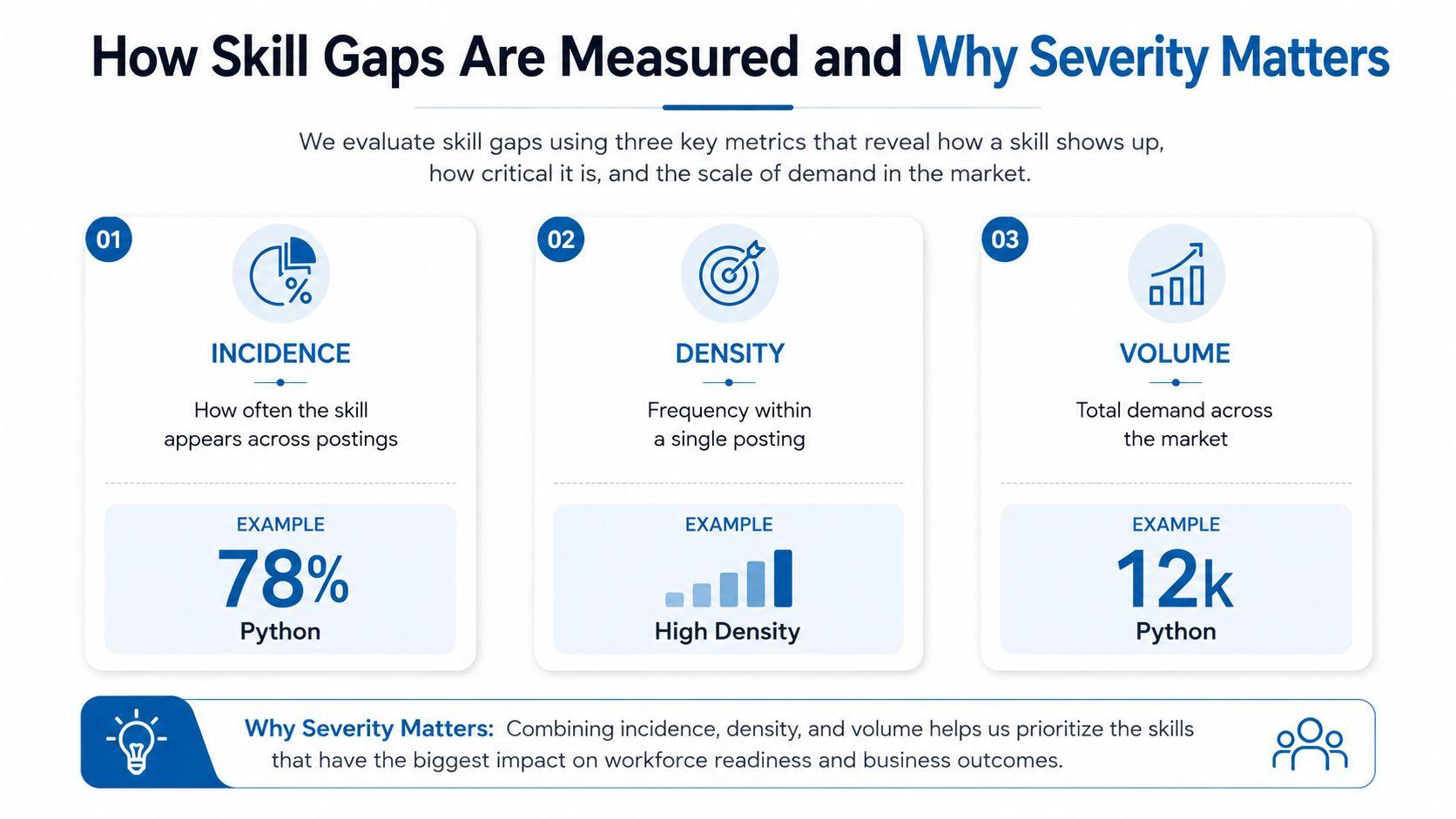
A missing skill sounds simple until you try to measure it. One role may mention a skill in passing, another may rely on it every day, and a third may expect mastery without naming it directly. Raw keyword matching can blur those differences and make a small issue look bigger than it is, or hide a major one.
A skill gap analysis tool needs a clearer yardstick. The UK survey language helps by separating incidence, density, and volume. Incidence shows how often a skill gap appears across the workforce. Density shows how concentrated that gap is inside a role or group of roles. Volume shows how many workers or roles are affected overall. UK Employer Skills Survey 2024
Reading the numbers like a candidate
For a job seeker, one weak spot is not always equally important. If a skill appears in many roles you want, shows up prominently in role descriptions, and keeps returning in your saved searches, it deserves more attention than a niche requirement you may never use again. Severity keeps your learning plan from turning into a random to-do list.
The same logic shows up in the OECD’s firm-level study. Technical skills, teamworking, and problem solving recur again and again, which suggests many gaps are patterns, not isolated misses. For a candidate, that means the tool should highlight repeated friction points, not just count missing keywords. OECD skill gaps in firms
Simple test: if a gap appears in one role, note it. If it appears across several target roles, rank it higher. If it appears and seems central to the work, it moves from “nice to improve” to “must address.”
Severity matters more than alphabetical order or personal embarrassment. A gap you feel most insecure about may not be the one blocking interviews. A smaller, repeated gap can do more damage because hiring managers read it as missing role readiness.
What a tool should help you separate
A strong tool should help you distinguish between a skill that is:
- Peripheral, useful but not decisive.
- Recurring, seen in many of your target roles.
- Critical, tied to the core work of the job.
Once you read gaps this way, the tool acts less like a scorecard and more like a map. It shows which fixes can change the odds of getting called back, especially inside an active job search where time and attention are limited.
How to Interpret Your Results Without Fooling Yourself
A skill gap analysis can be honest and still mislead you if you read it like a verdict instead of a map. The common mistake is treating every gap as proof that you are behind, when some gaps only mean your experience is not showing up clearly enough in the application.
Start by separating self-assessment noise from verified evidence. If you feel you “kind of know” a skill, but your resume, portfolio, and target job descriptions do not show it, treat that skill as unproven, not missing. That keeps anxiety from turning into overcorrection.
The UK AI labour market survey makes the drift problem easy to see. The report says 97% of respondents identified at least one skills gap, 57% of businesses reported a technical skills gap, and the most common gap was understanding AI concepts and algorithms, which rose from 55% to 60% over five years. Those figures show how quickly assumptions go stale in AI-heavy roles. UK AI labour market survey 2025 executive summary
What to trust first
Trust the job market before you trust your mood. If a gap keeps showing up in live postings, it deserves attention even if you have used a similar skill in another setting. The question is not whether you have touched it before, but whether employers can see enough proof to lower hiring friction.
A useful way to read the results is to rank gaps by friction, the same way a job seeker would rank interview blockers. A small gap that appears in many target roles can matter more than a larger gap that sits on the edge of the job. A tool is helpful here only if it acts like a compass inside an active application workflow, pointing you toward the skills that will change outcomes soonest.
A bias check you can use
- Evidence Check: compare the gap against real postings, not memory.
- Noise Filter: separate imposter-style doubt from actual missing proof.
- Priority Sort: rank by hiring friction, not by which skill feels most intimidating.
- Transfer Check: look for adjacent experience that already covers part of the gap.
- Action Choice: pick one skill to close next, not ten.
The next thing to question is whether the gap is validated or only inferred. A tool that matches titles to skills can tell you that a role wants “data storytelling,” but that is only part of the picture. The better test is whether your portfolio, assessments, or past work show that skill in a form recruiters can trust. That distinction helps you decide whether to keep applying with a light revision or pause and strengthen the profile first.
Practical Ways to Close Gaps That Employers Actually Notice
A gap closes faster when the fix matches the kind of proof employers want. A vague plan to “learn more” rarely helps because it leaves no visible result at the end. Hiring managers respond to evidence they can scan quickly.
Start by sorting each gap into one of three buckets, knowledge, execution, or signal. Knowledge gaps usually call for a focused course on the exact topic. Execution gaps need practice, projects, or work samples. Signal gaps need clearer resume language, a portfolio refresh, or a credential that puts the skill in plain sight.
| Gap Type | Best Intervention | How to Prove It |
|---|---|---|
| Knowledge gap | Short, focused course on the exact topic | A certificate, notes, or a small applied exercise |
| Execution gap | Hands-on project or portfolio case study | A public project, repo, dashboard, or work sample |
| Signal gap | Resume rewrite, portfolio refresh, or validated credential | Clear keywords in the application and visible evidence |
| Role-specific gap | Targeted practice on the exact tools used in the job | A job-matched project or demonstration in context |
The HR analytics research on skill gap analysis shows why targeted training works better than a one-time assessment, because it ties employee data, HR metrics, and outcome tracking together to forecast shortages and shape training plans. For a candidate, the same idea means checking whether each project, course, or resume update narrows the gap. HR analytics and skill gap analysis
Practical rule: don’t “study a skill.” Build proof that a hiring manager can verify in under a minute.
A data analyst role page can help you compare recurring requirements with your current proof points. If dashboard work keeps appearing, a small analysis project may help more than a broad analytics certificate. If SQL keeps showing up, a clean query sample may be a stronger signal than another resume line.
Sequencing matters. Fix the gap that appears most often in your target roles first, then use the next round of applications to see whether callbacks improve. That turns gap closure into something visible, not just something you hope is happening.
Using Gap Analysis Inside Your Job Search Workflow
A skill gap analysis tool works best inside the search flow, after you have already found roles worth considering. Search, filter, save, compare, then decide what to improve before the next application round. Used this way, it acts less like a one-time audit and more like a job-search compass, pointing you toward the gaps that create the most hiring friction.
The first filter is practical fit. If a role does not match your location, sponsorship need, or remote eligibility, that is not a skill gap, it is an access issue. Start by narrowing to roles you can pursue, then rank those results by fit, then inspect which missing skills keep appearing.
Saved roles make the pattern easier to see.
If one skill shows up across several openings, it deserves attention before a one-off requirement does. Open the strongest match and compare the job description with your current resume, portfolio, and notes from past applications. The missing keywords are a clue to what the employer may scan for in a resume or screening call.
That is why tools such as JobGlance combine ranking, match scoring, and career gap analysis in one workflow. They let you compare saved roles, spot recurring missing skills, and adjust an application before you send it. The same logic appears in its role pages, including a product manager role page, where the requirements can be read against your current profile instead of in isolation.
A useful workflow should answer a few plain questions:
- Which roles are worth applying to?
- Which gaps keep appearing across those roles?
- Which missing skills should you fix before the next application?
- Which applications need revision now, and which can wait?
The point is not to turn skill analysis into separate homework. It should change your next search, your next filter choice, and your next resume draft. That is how the compass works, by showing which roles are realistically closer and which ones need more proof before you apply.
Your Next Move From Insight to Interview
A skill gap is not a verdict. It is a signal about what your next application still needs to show, and it can be handled step by step instead of through a full reinvention.
Start with the gap that shows up most often in the roles you want. Then sort it into one of three buckets: knowledge, execution, or signal. After that, pick one thing you can prove, update your resume, portfolio, or application materials, and run the analysis again. A small visible change can shift how the rest of your search reads.
Use the tool like a job-search compass, not a one-time audit. If one missing skill keeps surfacing, that gap has more hiring friction than a one-off requirement, so it deserves attention first. For candidates starting out, you can also browse entry-level remote openings curated for new candidates and compare the same gap against live roles before you apply.
If you are applying now, keep it simple. Choose one role, one gap, and one proof point, then revisit the results after your next round of applications. JobGlance brings search, ranking, and gap analysis into the same workflow, so you can see which roles fit your profile and which skills keep blocking a reply.
Keep reading


