7 RPA Developer Jobs Sources and Application Tips


On this page
The sharpest signal in rpa developer jobs is scarcity, not volume. In the UK, just 17 permanent jobs cited robotic process automation in the six months to 5 July 2026, which was only 0.017% of all permanent jobs, while the same period showed a median annual salary of £78,999 for roles citing robotic process automation and £110,000 for UK roles excluding London, according to IT Jobs Watch. That mix of low posting volume and strong pay tells you the search is not about browsing endlessly, it’s about separating real openings from stale listings, then matching your evidence to the exact role, location, and eligibility rules.
JobGlance fits into that workflow as a comparison layer, not another isolated board. It helps candidates rank roles by fit, check visa sponsorship and work-from-anywhere eligibility up front, and compare listings across sources before they spend time tailoring a resume. The seven routes below follow the actual search-to-application sequence, from discovery to screening to submission.
1. LinkedIn Jobs with RPA Developer Filtering
LinkedIn is still the broadest professional search surface, which matters when the role itself is niche. The platform’s value for rpa developer jobs is not just scale, it’s how cleanly it lets you combine title, company, location, and experience filters so you’re not reading generic automation listings that happen to mention bots. For candidates targeting UiPath, Blue Prism, or Automation Anywhere ecosystems, that precision is the difference between a useful search and a noisy one.
The practical move is to search the platform like a recruiter would. Use Boolean strings such as “RPA Developer” AND (“UiPath” OR “Blue Prism” OR “Automation Anywhere”), then layer in “Remote” plus your target country if you want work-from-anywhere roles. If a posting says visa sponsorship or relocation assistance, keep it. If it doesn’t, don’t assume eligibility from the title alone.
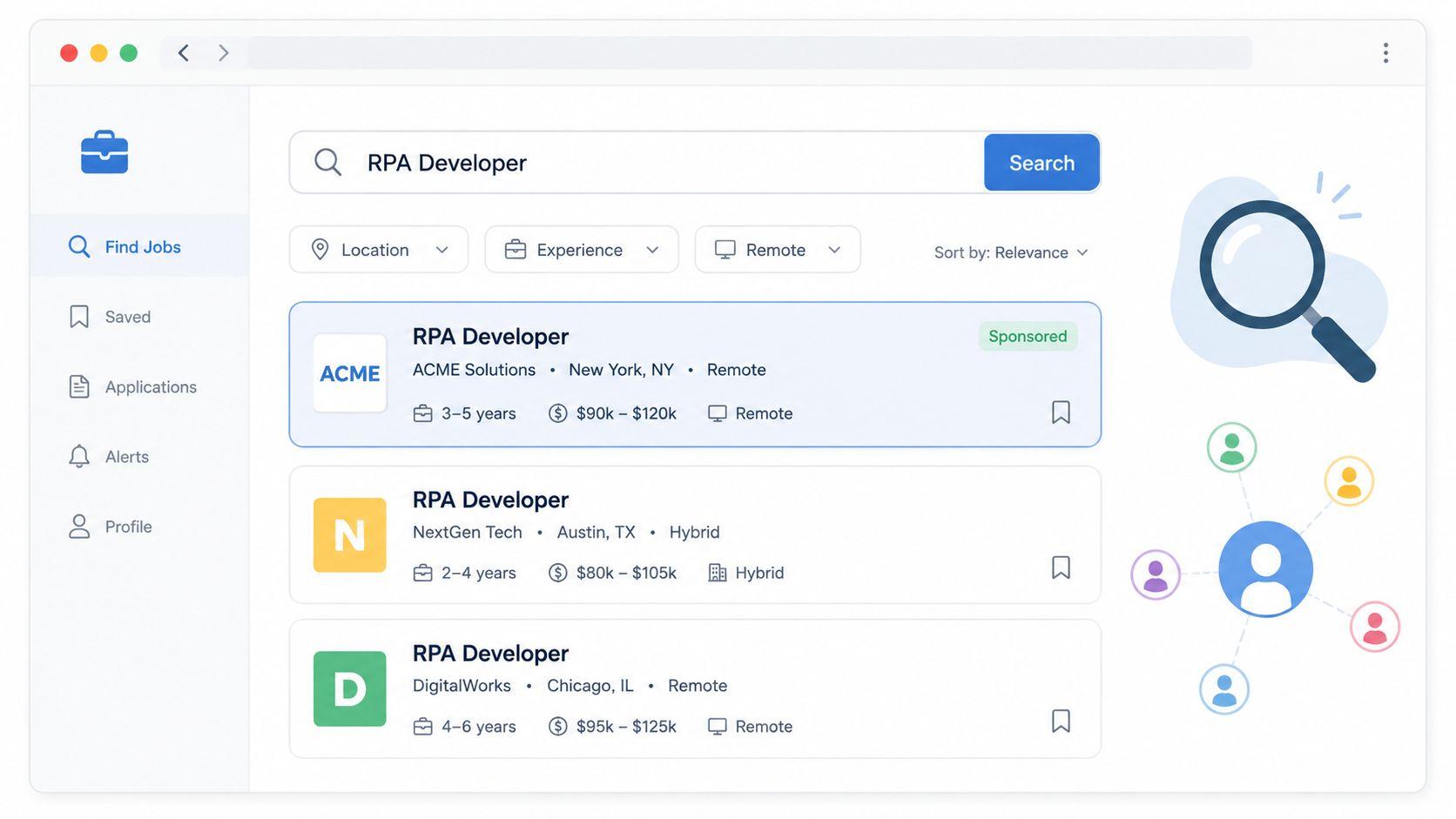
Practical rule: treat LinkedIn as a first-pass discovery tool, then re-rank the results against your resume and eligibility before you click apply.
A good real-world workflow is simple. Search for firms known for automation hiring, set alerts for them, and use JobGlance to compare what those LinkedIn results mean for your background in one pass rather than opening each job one by one. That’s especially useful when the same company posts multiple automation titles with slightly different seniority or location language.
2. Specialized Tech Job Boards GitHub and Stack Overflow
General job boards often blur software roles together. Specialized tech boards are better when you need to know whether a posting expects a process analyst, a bot builder, or a developer who can also handle APIs and scripting. That matters for rpa developer jobs because the job title alone rarely tells you how technical the day-to-day work will be.
GitHub and Stack Overflow also give stronger culture signals than most boards. If a company is recruiting through these channels, it usually wants engineering-minded applicants who can show working code, repository activity, or a public automation project. That makes them useful for candidates who already have a GitHub bot demo, a UiPath proof of concept, or a small script that handles exception paths cleanly.
What to check before applying
- Search signal, not just title: look for “Automation”, “RPA”, and “Remote” together so you don’t end up in generic software listings.
- Repository proof: include links to relevant GitHub work, such as automation scripts or bot logic, if the employer values hands-on engineering.
- Company footprint: review the employer’s GitHub organization or developer presence before you send an application.
- Role fit: use JobGlance to compare the board result against your resume so you can skip roles that are technically adjacent but not aligned.
A useful scenario is a remote-first company that posts on Stack Overflow and expects candidates to explain failure handling in a workflow. In that case, your portfolio matters as much as your job history. JobGlance helps by turning that broad board search into a narrower, fit-based shortlist instead of forcing you to interpret every listing manually.
3. Companies with Proven RPA Hiring and Visa Sponsorship Track Records
The most efficient search route is often the least glamorous one. If you need sponsorship, a direct company list is usually more useful than a broad keyword search because it lets you pre-filter for employers that already have a track record of supporting international hires. For candidates scanning rpa developer jobs, that means focusing on firms with established automation practices rather than hoping a random posting allows relocation.
JobGlance’s visa sponsorship filter is built for exactly that kind of search, and its visa sponsorship category page is the right place to start comparing openings by destination country. That matters because sponsorship is a gatekeeping condition, not a preference signal. Without it, you can’t legally accept the role if you don’t already have the right to work there, as JobGlance explains on its sponsorship page.
Practical rule: if sponsorship is non-negotiable, filter for it before you read the full description. Reading first and filtering later wastes time on roles you cannot take.
A real search pattern looks like this. Check the employer’s own careers page, then compare it against LinkedIn and JobGlance to see whether the same role is duplicated, stale, or narrower than it first appeared. If a company consistently hires across automation, it’s usually worth tracking directly rather than waiting for an aggregator to surface the opening.
One useful detail from the JobGlance sponsorship guidance is that employers often handle the paperwork and associated fees when they formally sponsor a foreign worker. That’s the kind of operational detail candidates should verify early, because a vague “international applicants welcome” line is not the same thing as actual work authorization support.
4. Remote-First RPA Job Listings
Remote listings are not automatically global listings. That distinction matters more in automation than in many other fields, because employers often separate US-only remote, country-specific remote, and work-from-anywhere roles. For rpa developer jobs, those labels can decide whether a search is worth your time at all.
Remote-first boards are useful because they concentrate employers that already operate across time zones and distributed teams. That usually makes them a better fit for candidates who want asynchronous work or who are applying from outside the employer’s home country. The practical search move is to ignore any role that says “remote” but still restricts applicants to one country unless that country is your target market.
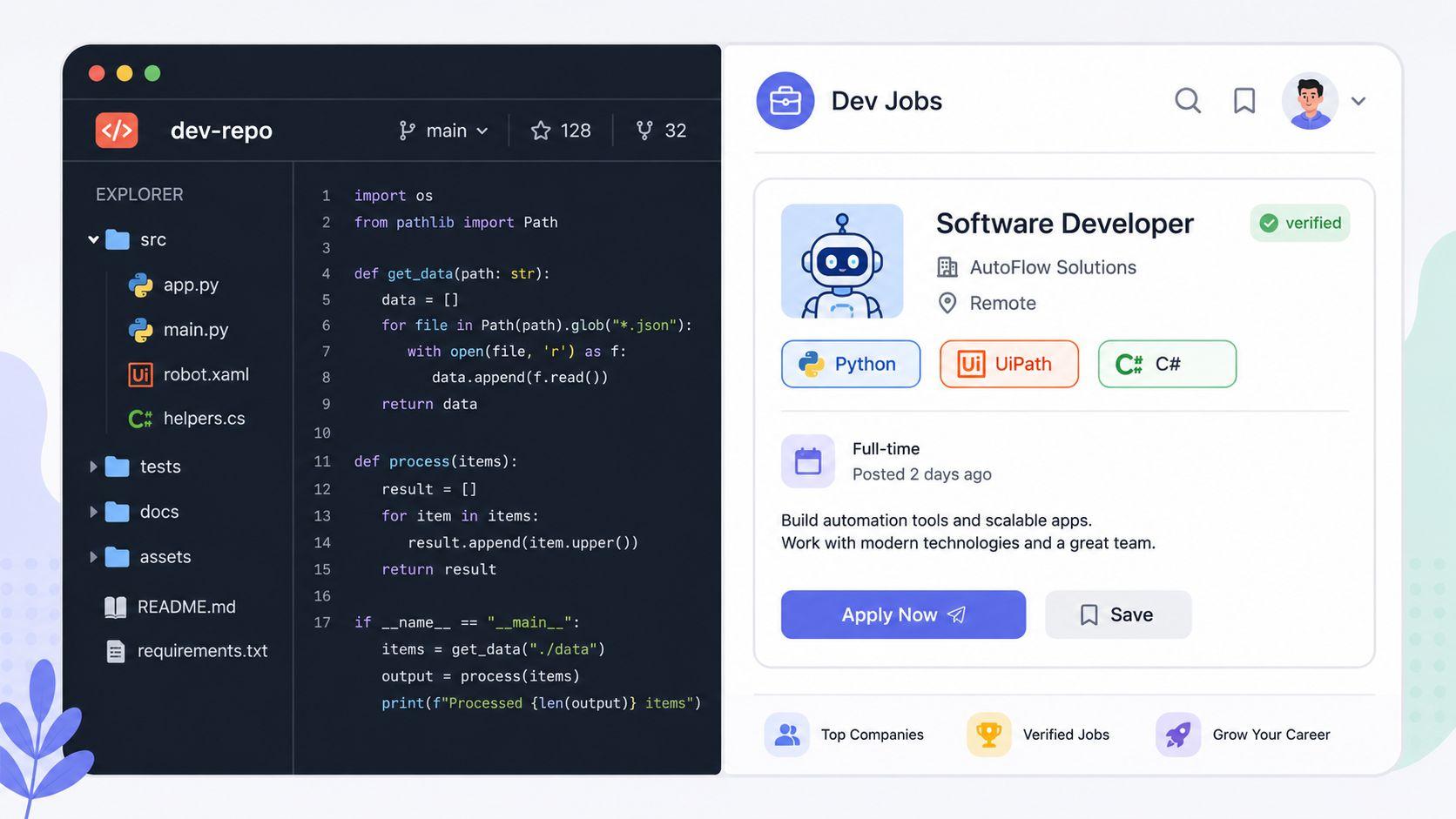
JobGlance’s remote jobs page is helpful here because it keeps work-from-anywhere distinct from domestic remote. That’s the right model for international applicants, since “remote” on its own can mean very different things depending on the board and the employer.
Read the remote policy, not just the posting
- Time zone overlap: check whether the company expects overlap or is async-first.
- Eligibility wording: look for “work from anywhere” rather than “remote, US only.”
- Policy details: review equipment, stipends, and co-working support on the company’s remote policy page.
- Sponsorship history: if the role is silent on visas, compare the employer against known sponsorship signals before you apply.
A concrete example helps. A remote RPA engineer role can be technically open while still excluding every candidate outside a single country. That’s why the comparison layer matters. You want to know whether the role is open to your location before you build an application around it.
5. RPA Developer Role Types and Career Paths
Seniority is not a cosmetic label in automation hiring. It changes the tool expectations, the interview depth, and the likelihood that a company will sponsor the move at all. For rpa developer jobs, the cleanest way to search is by role type first, then by platform and region.
JobGlance’s roles page is useful because it helps candidates map titles across related tracks instead of treating every “developer” posting as the same thing. An Analyst role can mean process discovery, light build work, or trainee-level automation support. An Architect role usually assumes broader platform design, workflow orchestration, and stakeholder coordination.
The career decision is operational. If sponsorship is the main goal, entry-level or analyst-track roles can be easier to access. If compensation and scope matter more, architect-level roles may be better, but they usually come with more complex screening and a longer hiring cycle.
Match the title to your evidence
- Process Analyst: strongest if you can show mapping, documentation, and business process review.
- Developer: best if you have live bot builds, tool knowledge, and debugging examples.
- Solution Architect: strongest when you can explain platform design and cross-team delivery.
- Platform Engineer: useful when the employer wants automation plus infrastructure or orchestration work.
If your resume only shows bot building, don’t apply to every architect role just because the title looks more senior. Hiring managers can see the mismatch quickly.
A practical example is a candidate with UiPath experience and Python scripting. That profile can sometimes move across analyst and developer roles more easily than into pure architecture. JobGlance’s career-gap logic is helpful there because it surfaces recurring missing skills across saved roles, which tells you whether to keep applying or step back and close the gap first.
6. Technical Recruitment Agencies Specializing in RPA
Recruiters matter more in niche markets than most candidates expect. In a segment as small as robotic process automation, agencies often know about openings before those roles appear broadly online, especially where employers want experienced automation talent or need to move quickly on a specialist hire. That makes them a real channel for rpa developer jobs, not just a backup plan.
The best use of a recruiter is not to send a generic CV and wait. It’s to give them a narrow placement brief, salary range, location preference, visa need, and the exact tool stack you can work in. That saves time on both sides and reduces the chance you get pushed into unrelated automation roles.
A direct question also helps. Ask which current openings offer sponsorship, which ones are hidden market roles, and whether the employer wants a contractor, a permanent hire, or a hybrid profile. Recruiters are much more useful when you force the conversation onto eligibility and scope.
Practical rule: never let a recruiter control the whole search. Compare every agency lead against the company’s own careers page or a live aggregated listing before you commit.
The strongest recruiter lead is one that already matches your geography and title level. If the role is for a senior automation architect but your resume only shows junior bot builds, the agency is not solving the mismatch. JobGlance can help you see that mismatch early by comparing saved jobs across sources so you don’t spend a week chasing a role that was never realistic.
7. Application and Interview Strategy for RPA Developer Roles
The interview process for automation work usually rewards preparation that looks close to the job. Employers want to see how you think through process flow, exception handling, and platform constraints, not just whether you can name a tool. That’s why a strong application for rpa developer jobs should show tool fluency, business logic, and a working portfolio, not just buzzwords.
JobGlance’s ATS Resume Builder and resume-match view are useful because they show you which keywords and skills are present in the posting. That lets you tailor the application around the exact stack, whether the role expects UiPath, Blue Prism, Automation Anywhere, or a mix of automation and AI workflow orchestration. It also helps you see missing keywords before you submit, which is more efficient than guessing.
Build the application around proof
- Resume alignment: mirror the job description’s tool names, versions, and process language where it’s truthful.
- Portfolio evidence: show one or two automation projects, even if they’re from training or a personal build.
- Interview stories: prepare examples for failure recovery, collaboration, deadline pressure, and process improvement.
- Company research: check the employer’s stability, culture, and hiring style before the interview.
- Salary stance: know your target range before the offer call so you don’t anchor too low.
A real-world scenario is an invoice-processing bot. If you can explain how you handled exceptions, retry logic, and handoff to a human reviewer, you’re already speaking the language most interviewers want. The same logic applies to HR onboarding or invoice-to-cash workflows.
Here’s the part candidates miss. A polished resume is only useful if it reflects the actual role level. If the listing is asking for orchestration, API work, or cross-team ownership, your application has to show more than bot configuration. Use JobGlance’s application tracking to keep that process organized instead of guessing which version of your resume went where.
RPA Developer Jobs: 8-Point Comparison
| Item | Implementation Complexity (🔄) | Resource / Cost (⚡) | Expected Outcomes (📊) | Ideal Use Cases (💡) | Key Advantages (⭐) |
|---|---|---|---|---|---|
| LinkedIn Jobs with RPA Developer Filtering | 🔄 Medium, advanced filters & Boolean search; algorithmic bias requires active optimization | ⚡ Low–Medium, free use; Premium/JobGlance improves signal | 📊 High volume enterprise roles; strong recruiter reach and visible sponsorship | 💡 Target enterprise RPA roles, recruiter outreach, visa-sponsored positions | ⭐ Largest network, direct recruiter access, proven placement rate |
| Specialized Tech Job Boards (GitHub Jobs, Stack Overflow) | 🔄 Low, straightforward tech filters and portfolio links | ⚡ Low, free; requires strong GitHub/portfolio samples | 📊 Higher signal-to-noise; clearer technical requirements but lower volume | 💡 Apply for engineering-focused RPA roles needing portfolio evidence | ⭐ High-quality postings, portfolio visibility, salary transparency |
| Companies with Proven RPA Hiring & Visa Sponsorship Track Records | 🔄 High, corporate hiring processes and long interview cycles | ⚡ Medium, direct applications, time investment; employer covers most legal costs | 📊 High likelihood of sponsorship, structured onboarding, stable roles | 💡 Candidates prioritizing guaranteed sponsorship and enterprise stability | ⭐ Published sponsorship policies, legal support, global mobility |
| Remote-First RPA Job Listings (WeWorkRemotely, RemoteOK, FlexJobs) | 🔄 Low, filter for work-from-anywhere; FlexJobs adds curation step | ⚡ Low–Medium, mostly free; FlexJobs subscription optional | 📊 Strong remote eligibility (higher % fully remote); smaller company mix | 💡 Work-from-anywhere seekers, candidates avoiding visa complexity | ⭐ High remote rates, vetted listings (FlexJobs), async-friendly roles |
| RPA Developer Role Types & Career Paths (Analyst → Architect) | 🔄 Variable, complexity increases with seniority and scope | ⚡ Medium, invest in certifications, hands-on projects, mentoring | 📊 Clear salary and sponsorship gradients by level; certifications speed hires | 💡 Career planning, targeting correct seniority for sponsorship/negotiation | ⭐ Clear progression ladder; certifications yield salary & hiring advantage |
| Technical Recruitment Agencies Specializing in RPA | 🔄 Low for candidate, recruiter manages sourcing & vetting | ⚡ Low for candidate, free; employer pays placement fee | 📊 Access to hidden senior roles; faster timelines for sponsored hires | 💡 Senior candidates seeking hidden-market roles and expedited sponsorship | ⭐ Hidden-market access, visa expertise, negotiation & coaching support |
| Application & Interview Strategy for RPA Developer Roles | 🔄 Medium–High, multi-stage technical + design + behavioral prep | ⚡ Medium, time, trial tool access, mock interviews (possible cost) | 📊 Improved success rates (40–60% uplift) and clearer offer outcomes | 💡 Candidates preparing to maximize interview-to-offer conversion & sponsorship | ⭐ Structured, practical assessments; behavioral emphasis helps stand out |
| Niche RPA Communities and Professional Networks | 🔄 Low, join and engage; sustained participation required | ⚡ Low, mainly time; occasional event costs | 📊 Lower direct volume but high referral quality and portfolio feedback | 💡 Networking, validating tool expectations, getting warm introductions | ⭐ Peer feedback, early role signals, targeted referrals and insights |
Turn Seven Sources Into One Focused Application System
The best way to search rpa developer jobs is to define the target role and geography first, then work outward from there. Search broad boards for volume, niche boards for signal, company career pages for direct hiring, remote boards for location flexibility, recruiters for hidden roles, and communities for context. Before you invest time, verify whether the role is truly remote or sponsorship-eligible, because those two filters decide whether you can actually take the job.
Then remove duplicates and stale listings, compare the remaining roles against your resume, and tailor your application to the tool stack and process context the employer wants. If the same missing skill keeps appearing across saved roles, record it and decide whether to learn it before the next round of applications. That is the difference between random browsing and a controlled search strategy.
JobGlance is useful as an optional workflow layer because it brings the fragmentation into one place. Its database aggregates 50,000+ active roles from 100+ sites, refreshes daily, scores matches from 0 to 100, and includes dedicated visa sponsorship and work-from-anywhere filters, plus the ATS Resume Builder, AI Toolbox, and application tracking. That combination matters when the market is small, duplicated, and highly location-sensitive, which is exactly the shape of robotic process automation hiring.
Keep this checklist tight, then apply once you’ve answered it. Is the role open to your location, does the tool stack match your experience, does the seniority fit your evidence, and have you the resume to the actual posting? If the answer is yes, submit. If not, keep filtering.
JobGlance gives you one place to compare live rpa developer jobs, check eligibility, score resume fit, and keep track of applications without juggling separate tabs. If you want a cleaner search path for sponsorship, remote eligibility, and role-level matching, visit JobGlance and use it to rank the openings that fit your background.
Keep reading


