
Reverse Chronological Order: How It Works in Resumes


On this page
A 2026 review reports that 96% of ATS software parses reverse chronological resumes successfully, making this format the default professional standard. Recruiters can also scan a career trajectory in about six seconds, so the order of your experience directly affects what they notice first.
That combination explains why reverse chronological order remains dominant. It gives software a predictable date sequence and gives hiring professionals an immediately recognizable path through your recent work. The format isn’t merely traditional. It reduces interpretation at the exact points where an application can be rejected, misunderstood, or overlooked.
Why Reverse Chronological Order Dominates Resume Writing
The strongest practical argument is compatibility. A 2026 industry review identifies reverse chronological resumes as the most widely used format and reports a 96% ATS parse rate (Extern’s resume format review). That result matters because applicant tracking systems need to extract job titles, employers, dates, and responsibilities from inconsistent documents. A format that presents those fields in a familiar sequence gives the parser fewer structural decisions to make.
The format also matches recruiter behavior. The same review states that recruiters can scan a career trajectory in about six seconds (Extern’s resume format review). A recent role appears first, its dates sit near the position, and the bullets immediately describe what the candidate did. The reviewer doesn’t need to reconstruct the timeline from a skills inventory or search through several sections to identify the candidate’s current level.
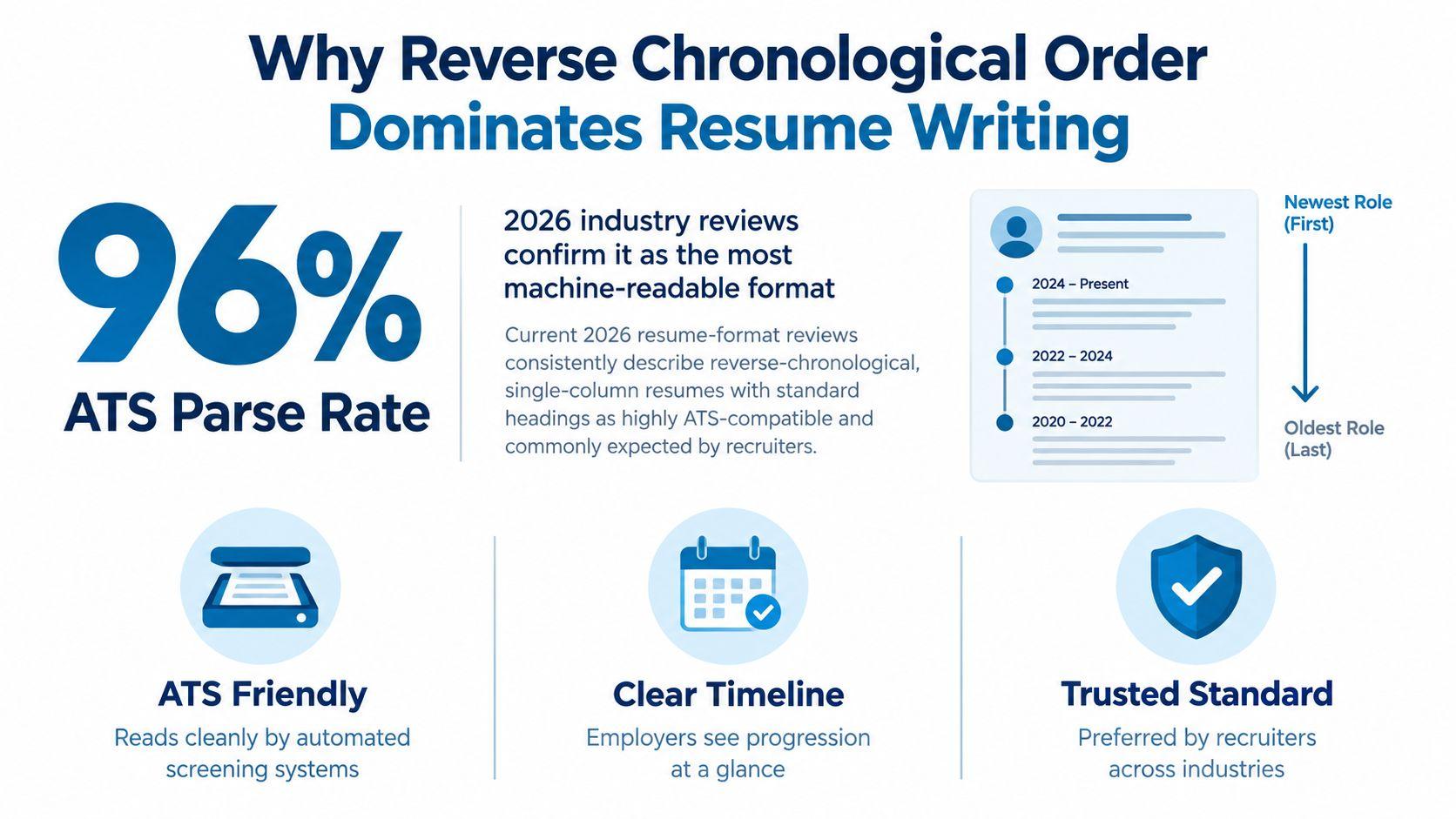
The machine-readable sequence
ATS software commonly extracts employment records as connected fields. A job title belongs with an employer, and both need a date range. Reverse chronological order presents the newest record first, then repeats the same pattern backward, creating a stable sequence for extraction.
Human reviewers benefit from the same design for a different reason. They usually want to know what you’re doing now before examining older experience. The format places your latest responsibilities, tools, and seniority at the top of the evidence.
Hiring operations rule: make the first employment entry answer the reviewer’s first question, “What level of work is this candidate doing now?”
The structure works best when the target role resembles your recent work. It exposes progression without requiring a narrative explanation, while the consistent layout keeps attention on evidence rather than document navigation.
The Core Structure of Reverse Chronological Format
Reverse chronological order means listing your most recent position first, followed by earlier roles in descending date order. You aren’t arranging work history by importance, skill category, or achievement. You’re creating a timeline that starts with the job most likely to represent your current capability.
A standard resume sequence usually looks like this:
- Header: Name, contact details, location, and relevant professional links.
- Summary: A concise positioning statement focused on the target role.
- Work experience: Current or latest position first, with earlier roles following.
- Education: Qualifications generally appear with the most recent credential first.
- Skills: Technical, functional, and language skills that support the target position.
- Optional sections: Certifications, projects, publications, awards, or volunteer work where relevant.
This order gives both the ATS and the recruiter a predictable reading path. Career-advice guidance describes reverse chronological order as the standard work-history layout and notes that it aligns with how ATS software scans date-ordered employment history (Jobseeker’s reverse chronological resume guide).
Why section order affects extraction
Keep dates in a consistent format, place them close to the corresponding employer and title, and avoid burying employment history inside paragraphs. Education should follow the same logic. If you’ve earned multiple qualifications, list the newest one first so the reader can identify your latest academic preparation without reconstructing the sequence.
For a useful companion on the placement of education on a resume, focus on how the section supports your experience rather than competing with it. A recent graduate may give education greater prominence, while an experienced professional generally lets work history carry the document.
Reverse Chronological vs Functional and Combination Formats
The three main resume formats make different promises to the reader.
A reverse chronological resume promises a transparent timeline. The newest role appears first, dates remain visible, and progression is easy to inspect. That clarity supports the reported 96% ATS parse rate for the format (Extern’s resume format review).
A functional resume promises immediate access to skills. It groups capabilities by theme and minimizes the prominence of employers and dates. That can help a candidate foreground transferable skills, but it asks ATS software and recruiters to connect evidence back to a work history that isn’t presented in the expected sequence.
A combination resume tries to do both. It highlights skills near the top, then includes a chronological employment section. The approach can work when a candidate needs to connect a career pivot with credible work history, but extra structure creates more opportunities for repetition and inconsistent dates.
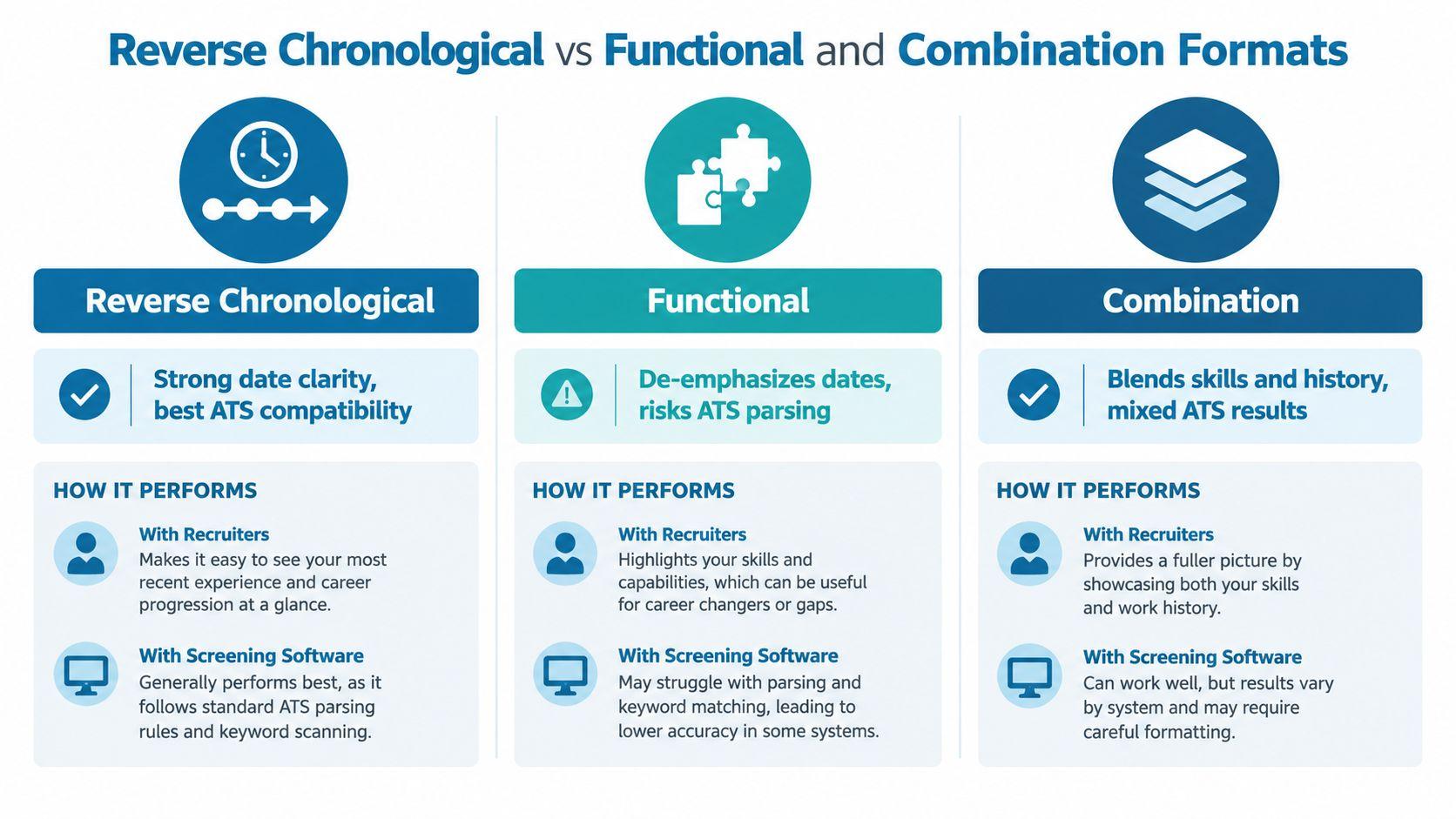
Compare friction, not aesthetics
The critical question isn’t which format looks more modern. It’s how much inference each format demands.
| Format | Primary signal | Main operational risk |
|---|---|---|
| Reverse chronological | Date-ordered progression | Gaps and short tenures remain visible |
| Functional | Skill clusters | Timeline and employer context become less prominent |
| Combination | Skills plus timeline | Repetition can weaken clarity |
Recruiters scanning quickly often prefer the format that answers “where is this person now?” immediately. A candidate applying through JobGlance’s role listings should therefore default to reverse chronology unless the career story requires a different emphasis.
A practical comparison of resume styles for ATS can help you evaluate the tradeoff before changing formats. Use a functional or combination structure strategically, not to hide information that a hiring team will eventually need.
Formatting Examples That Actually Work
A clean reverse chronological entry keeps the title, employer, location, and dates visually connected:
Senior Data Analyst, Northstar Systems, Remote
March 2023 to Present
- Built reporting workflows for operational teams.
- Translated product data into recommendations for stakeholders.
- Maintained documentation for recurring analysis.
The newest role comes first, and each bullet begins with a clear action. The format doesn’t require decorative design. It requires stable relationships between fields.
A less effective version separates dates from roles or places achievements in a skills section with no employer context:
Analytics, dashboards, stakeholder reporting
Northstar Systems
Earlier role, dates listed elsewhere
That arrangement may look flexible, but it makes the reader match disconnected pieces. It also gives an ATS more work when extracting employment records.
| Section | Position | Date Convention |
|---|---|---|
| Current role | First in work history | Month and year to Present |
| Previous role | Immediately below current role | Month and year to month and year |
| Contract assignment | Place by actual end date | Month and year to month and year |
| Education | Newest qualification first | Month and year or year, consistently |
For overlapping employment, keep both roles in their actual date positions and label one as part-time, contract, or consulting work when applicable. Don’t force simultaneous roles into a single timeline if doing so would obscure the employers or responsibilities.
Career transitions need the same discipline. A recent role outside your target field should remain visible, while the summary and bullets explain the transferable value. Hiding it creates a gap the reader may interpret less favorably than an honest transition.
Benefits That Explain the Format’s Dominance
Reverse chronological order reduces cognitive load because the reader doesn’t have to decide how the evidence should be arranged. The latest role establishes a reference point, and every earlier position becomes a comparison against it. That is especially useful during fast screening, where the recruiter has limited time to decide whether the application deserves closer review.
The structure also protects important information from being buried. Recent experience typically contains the candidate’s latest tools, responsibilities, and level of ownership. Placing it first makes the strongest current evidence available before the reader reaches older history.
One structure serves two reviewers
The ATS and the recruiter don’t read in the same way, but they both benefit from consistency.
- Field recognition: Titles, employers, and dates appear in a repeated pattern.
- Progression visibility: Promotions and expanding responsibilities are easier to identify.
- Target alignment: Recent bullets can mirror the language of the vacancy.
- Review speed: The recruiter can verify current level without reconstructing the timeline.
The reported about six-second recruiter scan gives this design choice practical weight (Extern’s resume format review). A format that makes the latest relevant evidence easy to find supports rapid qualification. A format that makes the reviewer hunt for dates spends that scarce attention on navigation.
A resume should not make the reviewer solve a formatting problem before evaluating your experience.
The format also creates a useful editing discipline. Because older positions move lower, you can allocate detail according to current relevance rather than giving every job equal space. That keeps the document focused without deleting the career evidence needed to establish credibility.
When Reverse Chronological Order Fails Your Situation
Transparency becomes a weakness when the visible timeline distracts from the value you need to demonstrate. A long gap, repeated short engagements, or a major career pivot may dominate the first impression before the reviewer reaches your transferable skills.
The format can also undersell experienced candidates whose most relevant work sits well behind their latest title. An older technical role may provide stronger evidence for a specialist position than a recent management role, yet reverse chronology naturally gives the newer role more visual priority.
Situations that deserve a deliberate alternative
- Career gaps: A functional emphasis can foreground current capabilities before the reader studies dates.
- Frequent changes: A combination format can group related achievements while preserving employer history.
- Major pivots: A skills summary can connect previous experience to a new target field.
- Overqualified recent roles: Selected earlier work may need more explanation than the latest position.
These alternatives shouldn’t disguise facts. They should change the order in which the reader encounters them. A functional resume still needs enough employment detail to establish credibility, and a combination resume still needs a clear timeline for ATS extraction.

The decision depends on whether chronology supports your candidacy. If it does, use it plainly. If it doesn’t, change the emphasis while retaining accurate dates, employers, and responsibilities.
How to Choose the Right Format for Your Career Stage
Start with the evidence a recruiter must understand first. If your latest roles show steady progression toward the target position, reverse chronological order is the logical choice. It makes current level, employer context, and increasing responsibility visible in one pass.
A different format deserves consideration when your strongest argument is not your latest title. Use this decision framework:
- Steady career path: Choose reverse chronology when recent work is closely related to the vacancy.
- Early career: Use reverse chronology for internships, projects, education, and first roles, provided the sequence remains easy to scan.
- Career change: Consider a combination structure if a skills summary can connect your previous field to the new one without duplicating every bullet.
- Extended gaps: Use a functional emphasis only when it helps surface current, relevant capabilities accurately.
- Mixed experience: Combine a concise skills profile with a complete date-ordered history when both elements matter.
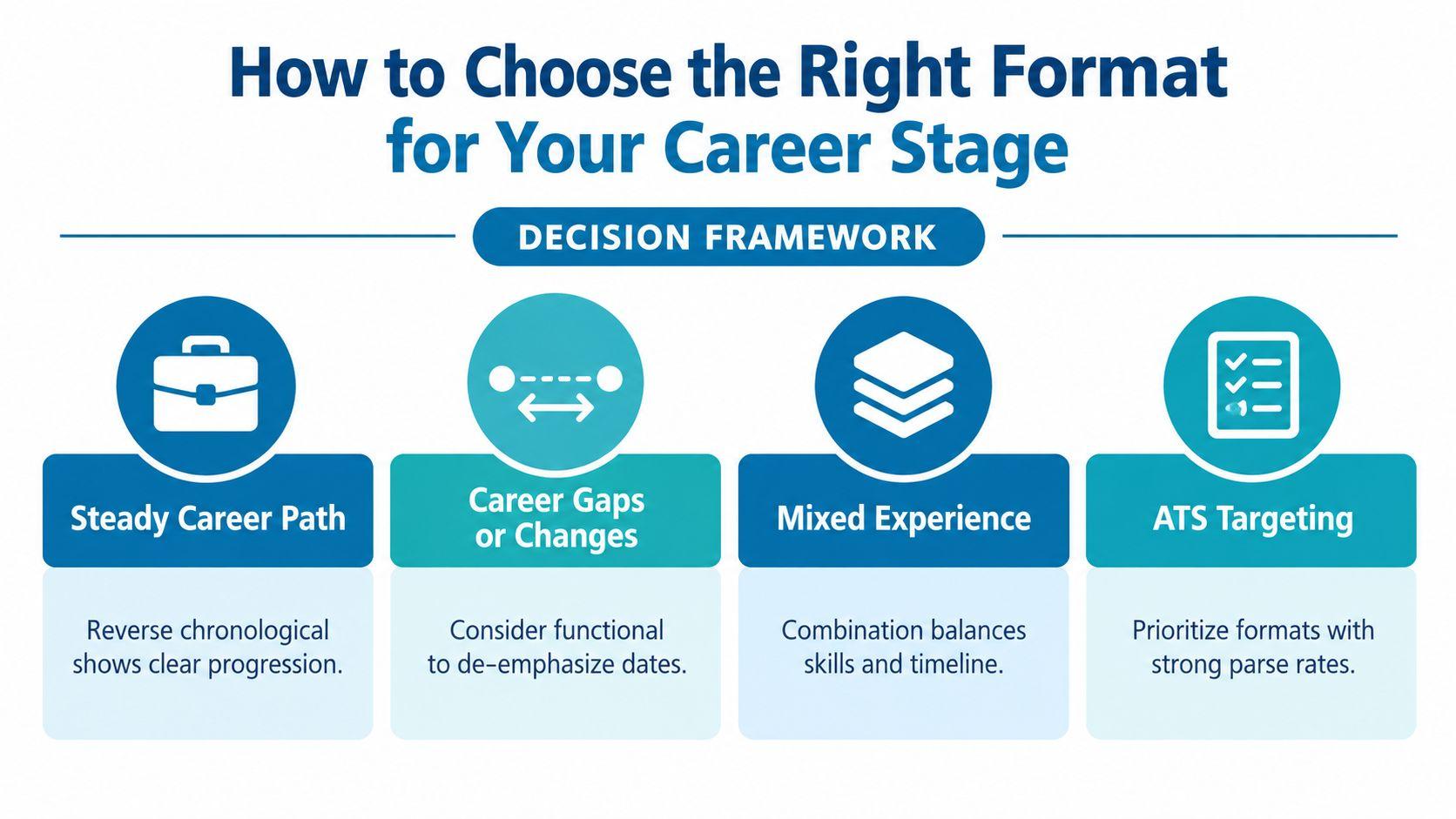
Match the format to the screening environment
The target industry and application channel also matter. If an employer relies heavily on ATS screening, a clear employment timeline should remain central even when you add a skills section. If a human referral will read the resume directly, a combination structure may provide more room to frame a pivot.
For candidates pursuing remote entry-level work, remote entry-level roles can vary widely in required experience and eligibility. Your format should make the evidence matching the role visible first, whether that evidence comes from employment, education, projects, or volunteer work.
The safest principle is simple: use reverse chronology by default, then depart from it only when the alternative clarifies a legitimate career story better.
Optimizing Your Reverse Chronological Resume for 2026
Correct ordering is only the foundation. Your latest role should contain the terminology that matches the target vacancy, but the wording must remain accurate. ATS software can identify terms, while recruiters judge whether those terms are supported by credible responsibilities and outcomes.
Use a focused editing process:
- Align the summary: Name the target function and the strongest current capabilities.
- Refine recent bullets: Put relevant tools, methods, and responsibilities near the top of the latest role.
- Keep dates consistent: Use one month-and-year convention throughout the document.
- Preserve context: Attach achievements to the employer and position where you delivered them.
- Remove weak repetition: Older roles need enough detail to establish progression, not identical bullets copied from the latest job.
For international and remote applications, eligibility can be as important as skill fit. A resume may match the role while the candidate remains ineligible because of location, sponsorship, or work authorization. Search platforms should therefore help candidates evaluate both the job’s requirements and the application’s practical viability. You can review remote opportunities while keeping the resume structure focused on evidence the employer can verify.
JobGlance is one option for this workflow. Its web app scores roles against an uploaded resume, highlights matched and missing keywords, supports visa sponsorship and work-from-anywhere filters, and includes an ATS Resume Builder that checks and rebuilds resumes in single-column templates.
The deeper lesson is that reverse chronological order works because it creates a shared data model for two audiences. The ATS receives recognizable fields in a stable sequence, while the recruiter sees current capability before older context. Keep that sequence intact, then tailor the content inside it.
JobGlance can help you find roles ranked against your resume, identify missing keywords, and filter for visa sponsorship or work-from-anywhere eligibility before you apply. Visit JobGlance to connect structured resume preparation with a more focused job search.
Keep reading


