
Objective Statement on Resumes: How to Write One That Works


On this page
“Resume objective statements are dead” is popular advice. It’s also incomplete. Career guidance across the 2010s and 2020s increasingly called objectives outdated, yet recent guidance still treats them as a live block at the top of a resume for candidates who need to clarify direction. The section didn’t disappear. Its job changed.
A modern objective statement on resumes isn’t a personal wish list. It’s a targeting signal. It tells a recruiter, and an applicant tracking system, which role you want, what qualifies you for it, and what the employer gets by continuing to read. Used in the wrong situation, it wastes valuable space. Used well, it explains a career pivot or limited experience before the work history has a chance to do that.
Why the Objective Statement Refuses to Die
The old version sounded like this: “Seeking a challenging position with opportunities for growth.” It described what the applicant wanted, applied to almost any job, and gave the employer no reason to care. That format deserved to fade.
The modern version survives because some resumes have a direction problem, not an achievement problem. A recent graduate may have relevant coursework and an internship but little full-time history. A career changer may have strong skills that don’t look relevant when arranged under an old job title. Someone returning after an employment gap may need to explain the intended destination before a recruiter starts making assumptions.
Career guidance reflects that narrower use case. A recent overview of resume objectives describes objective statements as once-standard resume features that became less favored as summaries focused more directly on employer value. The same guidance notes that current advice tends to reserve objectives for entry-level applicants, career changers, and candidates with gaps rather than experienced professionals with an obvious track record.
The top of the resume has a specific job
Recruiters don’t begin by studying every bullet. One 2025 source reports an initial resume scan of about 7.4 seconds, while another reports roughly 7 seconds. The figures differ slightly, but the practical conclusion is the same: the opening lines need to establish relevance immediately. Research on resume objectives and screening also reports that 97.8% of Fortune 500 companies use applicant tracking system software, which makes clear role language and relevant keywords useful before a human review.
That doesn’t mean stuffing every phrase from the job description into the opening. It means using the limited space to remove ambiguity. “Marketing professional” is broad. “Entry-level lifecycle marketing coordinator with email campaign and customer research experience” gives the reader a destination, a level, and a reason to keep reading.
Practical rule: An objective earns its place when it explains something your experience section cannot explain quickly.
The objective is therefore not dead, and it isn’t mandatory. It’s a small tool for a specific problem. By the time you finish this guide, you’ll know when it beats a summary, how to build it from a job description, and how to adapt it for remote, international, and visa-related applications.
When an Objective Beats a Summary
Choose a summary when your past results already prove your fit. Choose an objective when the recruiter needs a clear explanation of your target role and why your existing evidence still applies.
A professional summary compresses proof: accomplishments, scope, tools, and outcomes. It works best when you have enough relevant material to show what you have delivered. An objective serves a different purpose. It foregrounds role fit when your experience section does not yet present a clear story for the position you want.
The decision depends less on seniority alone than on reader uncertainty. If the recruiter can quickly connect your previous work to the vacancy, a summary usually has more value. If the connection requires interpretation, an objective can establish the direction before the reader makes the wrong assumption.
That distinction matters for international applications. If you are applying only for roles you can legally pursue, state the intended position and relevant eligibility context clearly. You can filter opportunities through categories such as visa sponsorship jobs and remote jobs, then tailor the opening to the exact role and work arrangement.
The decision in one glance
| Your situation | Use an objective or a summary | Why it works |
|---|---|---|
| Entry-level candidate with limited experience | Objective | It connects education, projects, or transferable skills to a defined target role. |
| Career changer | Objective | It explains the bridge from the previous field before the recruiter misclassifies the background. |
| Returning after an employment gap | Objective | It names the current target and frames relevant prior experience or refreshed skills. |
| Experienced candidate with relevant results | Summary | Evidence from past work usually supports your case better than a statement about future goals. |
| Experienced candidate applying to a sharply different function | Objective or hybrid profile | Use an objective when the change needs explanation. Otherwise, use a summary with a clear target headline. |
Online advice sometimes claims that summaries produce dramatically more callbacks than objectives. An Indeed guide to general resume objectives repeats a claim that summaries can receive 340% more interview callbacks, while noting that the figure comes from a secondary, unverified benchmark. Treat it as a warning against broad hiring claims, not as a rule. The figure does not account for experience level, role, industry, resume quality, or the reason for choosing an objective.
Experienced professionals will often gain more from a focused summary. Advice on crafting a results-driven executive summary reinforces the distinction: use the opening to prove scope and outcomes rather than describe a generic aspiration.
Use this test: if you can say, “I have already done this work and can show what happened,” write a summary. If the recruiter may ask, “Why is this person applying for this role?”, write an objective that answers that question immediately.
The Structure of an Objective That Lands
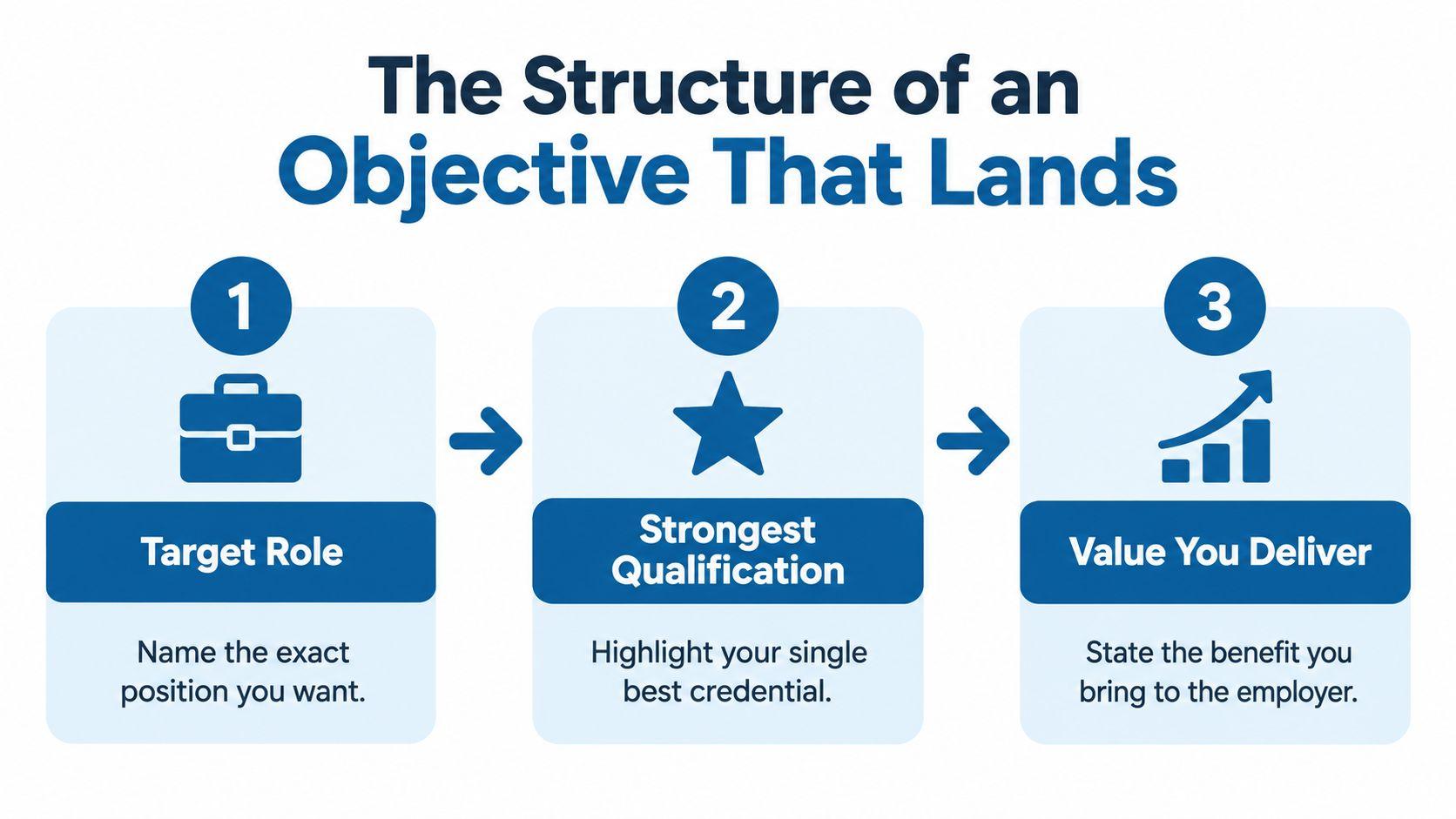
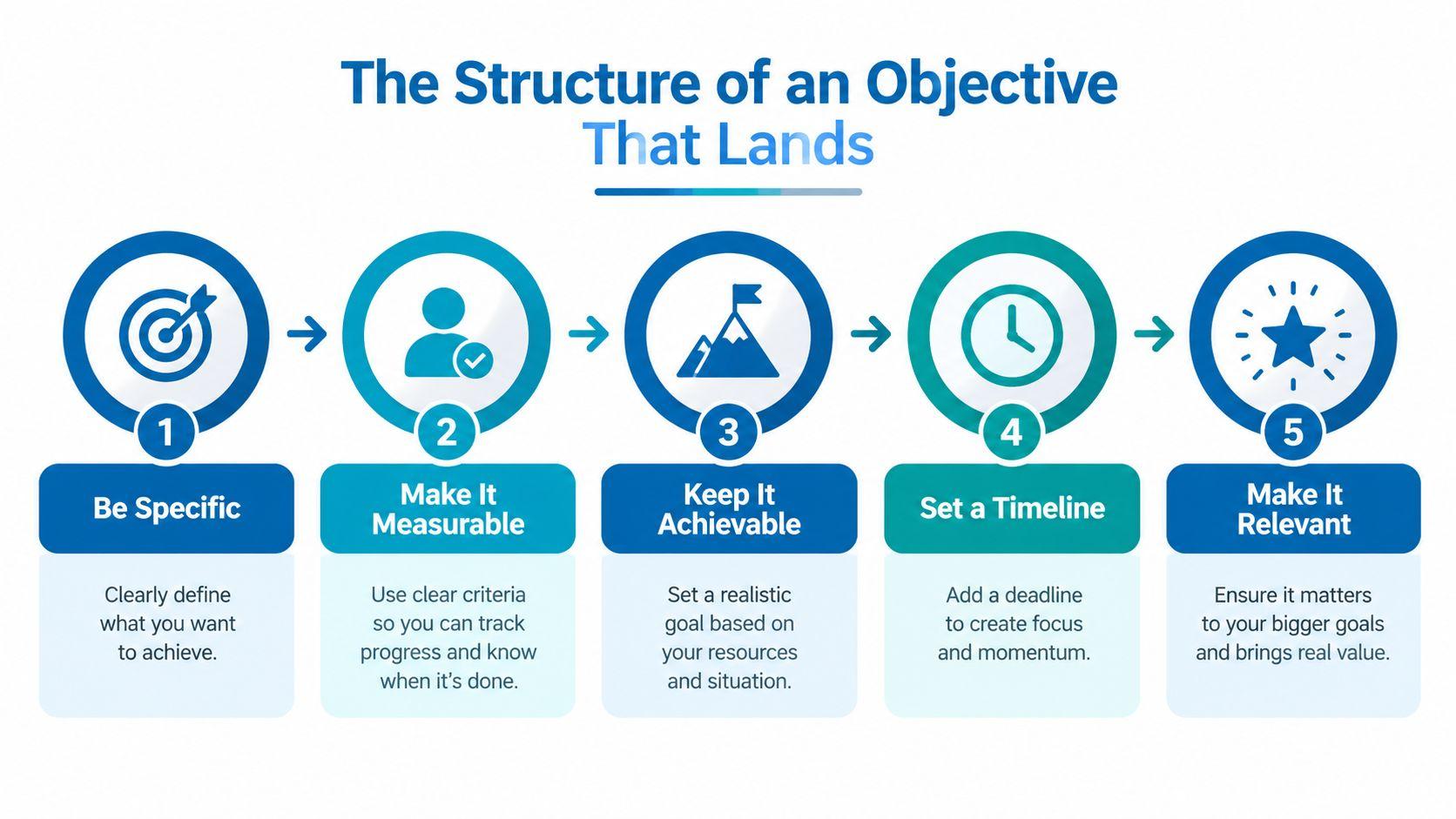
A useful objective has three working parts. Each part should come from the posting and your own evidence, not from a template filled with interchangeable adjectives.
Start with the target role
Use the exact job title from the listing whenever it accurately describes the position. “Operations coordinator” is stronger than “an opportunity in business.” Exact wording helps the recruiter classify your application quickly and gives the opening a clear destination.
If the employer uses a specific title such as “Customer Success Associate,” don’t replace it with “client-facing professional” just to sound more impressive. The job title is usually the clearest relevance signal available.
Add one strongest qualification
Choose the credential, project, skill, or adjacent result that most directly supports the role. Don’t list every strength you’ve ever developed. An objective is too short to carry a full skills inventory.
A recent graduate might use a degree, internship, or relevant project. A career changer might use stakeholder communication, process improvement, data analysis, or another transferable capability backed by evidence. A returning professional might pair earlier experience with a current course, certification, or recent project.
State the value you bring
Finish by connecting that qualification to an employer priority. The value can be practical and modest. “Support accurate reporting,” “improve customer onboarding,” and “coordinate reliable project delivery” are clearer than “make a meaningful contribution.”
Purdue’s resume workshop guidance supports the basic mechanics of keeping the objective brief, targeted, and focused on what the applicant offers. Use one to three sentences, roughly 30 to 50 words, and place the block directly below your contact information. Rewrite it for every employer.
A strong objective answers three questions: What role do you want? What is your strongest relevant qualification? What will the employer gain?
Pull the raw material from the job description in this order:
- Role: Copy the exact title.
- Priority: Identify the main outcome or responsibility.
- Proof: Select one credential, project, or achievement that supports that priority.
- Wording: Replace broad synonyms with the posting’s actual terms where they’re accurate.
- Cutting: Remove anything that describes your desire for growth, challenge, or opportunity without explaining your usefulness.
Compare these two versions:
Seeking a challenging position where I can grow professionally and use my communication skills.
Career changer targeting a Customer Success Associate role, bringing client onboarding and issue-resolution experience from SaaS support. Ready to improve adoption through clear customer communication and structured follow-up.
The second version names a role, establishes a bridge, and describes an employer-facing contribution. It doesn’t need to promise more than the evidence supports.
Writing Your Objective by Experience Level
The same structure sounds different depending on what the candidate can prove. The wording should reflect the evidence available, not imitate the tone of a more experienced applicant.
The recent graduate
A graduate with an internship may not have a long employment record, but that doesn’t mean the objective should apologize for limited experience. Lead with the target role, then use education, internship work, or a project as the qualification.
Suppose the candidate studied information systems, completed a help-desk internship, and handled ticket documentation and basic troubleshooting. The objective should not call them a “hard-working team player.” Those words don’t distinguish the candidate. The useful evidence is technical support exposure, documentation, and familiarity with user issues.
Adaptable example:
Recent information systems graduate targeting an IT Support Specialist role, bringing hands-on troubleshooting and user documentation experience from a help-desk internship. Ready to support responsive issue resolution and maintain clear technical records for internal teams.
The statement establishes level without announcing inexperience. It also gives the recruiter terms to look for in the internship bullets.
Candidates at this stage can find role-specific opportunities through remote entry-level openings, but the resume still needs to match each posting. A remote role may prioritize written communication, ticketing tools, asynchronous collaboration, or independent problem-solving. Use only the qualifications you can support elsewhere on the resume.
The mid-career professional moving up
A professional aiming for the next level usually has enough evidence for a summary. An objective makes sense only when the target role requires a deliberate repositioning, such as moving from specialist to team lead or from implementation into product operations.
The key is not to write “seeking a leadership opportunity.” That states ambition without demonstrating readiness. Identify the result that signals the next level, then connect it to the target responsibility.
Adaptable example:
Product operations specialist targeting a Product Operations Manager role, bringing experience coordinating launches, improving cross-functional workflows, and turning customer feedback into roadmap input. Ready to strengthen operating rhythms and decision support across product and go-to-market teams.
This version avoids invented achievements because the candidate can replace each broad area with a documented result in the experience section. If the professional has strong, directly relevant outcomes, a summary will probably carry more weight. The objective is useful only if it makes the promotion or functional move easier to understand.
The career changer
Career changers need the objective to perform the framing work that a conventional chronology can’t. Name the transition plainly. Then borrow credibility from adjacent skills and connect them to the new field.
A teacher moving into customer success, for example, shouldn’t pretend that classroom experience is identical to SaaS account management. It isn’t. But the candidate can credibly highlight stakeholder communication, coaching, structured follow-up, and problem resolution, then show how those capabilities support the target role.
Adaptable example:
Transitioning from secondary education into Customer Success, bringing stakeholder communication, coaching, and structured problem-solving developed through student and family support. Ready to apply those strengths to customer onboarding, adoption, and long-term account relationships in a SaaS environment.
The phrase “transitioning from” does important work. It tells the reader why the previous job titles look different and points toward the transferable evidence that follows. The objective shouldn’t hide the gap between fields. It should make the gap understandable and show a credible bridge across it.

Adapting Objectives for Remote and International Roles
Remote and international applications add a screening question: Can this person work under the role’s location, authorization, and scheduling conditions? If the objective leaves that unclear, the recruiter may stop before reviewing the rest of the resume.
Use the objective to answer only the eligibility questions raised by the posting. Name a target location, work authorization, relocation status, or timezone availability when it affects hiring. Leave out personal details the employer has not made relevant. Do not claim global flexibility for a role restricted to one country or region.
Mirror the role, not every keyword
Applicant tracking systems read objectives and summaries as text. Guidance on ATS-friendly resume objectives supports using job-description keywords, especially the exact job title, because literal matches can help systems and recruiters identify relevance.
Keyword matching has limits. An objective crowded with tools, skills, and locations becomes harder to scan and weakens the strongest qualification. Put the exact title first. Add only the few capabilities or credentials you can demonstrate, then place the remaining keywords in the skills and experience sections.
For a globally remote role:
Technical Writer targeting a globally remote position, bringing API documentation and developer education experience. Available for distributed collaboration across European and North American working hours, with a focus on clear documentation that reduces support friction.
For an international role involving sponsorship:
Data Analyst targeting a visa-sponsored role in the Netherlands, bringing SQL, dashboard development, and business reporting experience. Eligible to discuss work authorization and ready to support reliable operational decisions through clear analysis.
The second objective does not promise sponsorship. It names the target and signals that authorization belongs in the hiring conversation. Change the wording when the posting requires existing authorization, relocation, or residence in a specific jurisdiction.
Separate work-from-anywhere from domestic remote
“Remote” may describe a job limited to one country, region, or group of payroll jurisdictions. Work-from-anywhere roles permit a different arrangement. Verify the listing before writing the objective. Applicants outside the employer’s hiring area should not use “globally remote” unless the posting supports that arrangement.
For a focused international search, visa sponsorship opportunities can help identify listings where eligibility forms part of the application context. The objective then has a narrower job: connect the target title and relevant qualifications to the route by which the candidate can accept the role. That decision rule matters more than adding another generic template.
Before and After Examples That Show the Difference
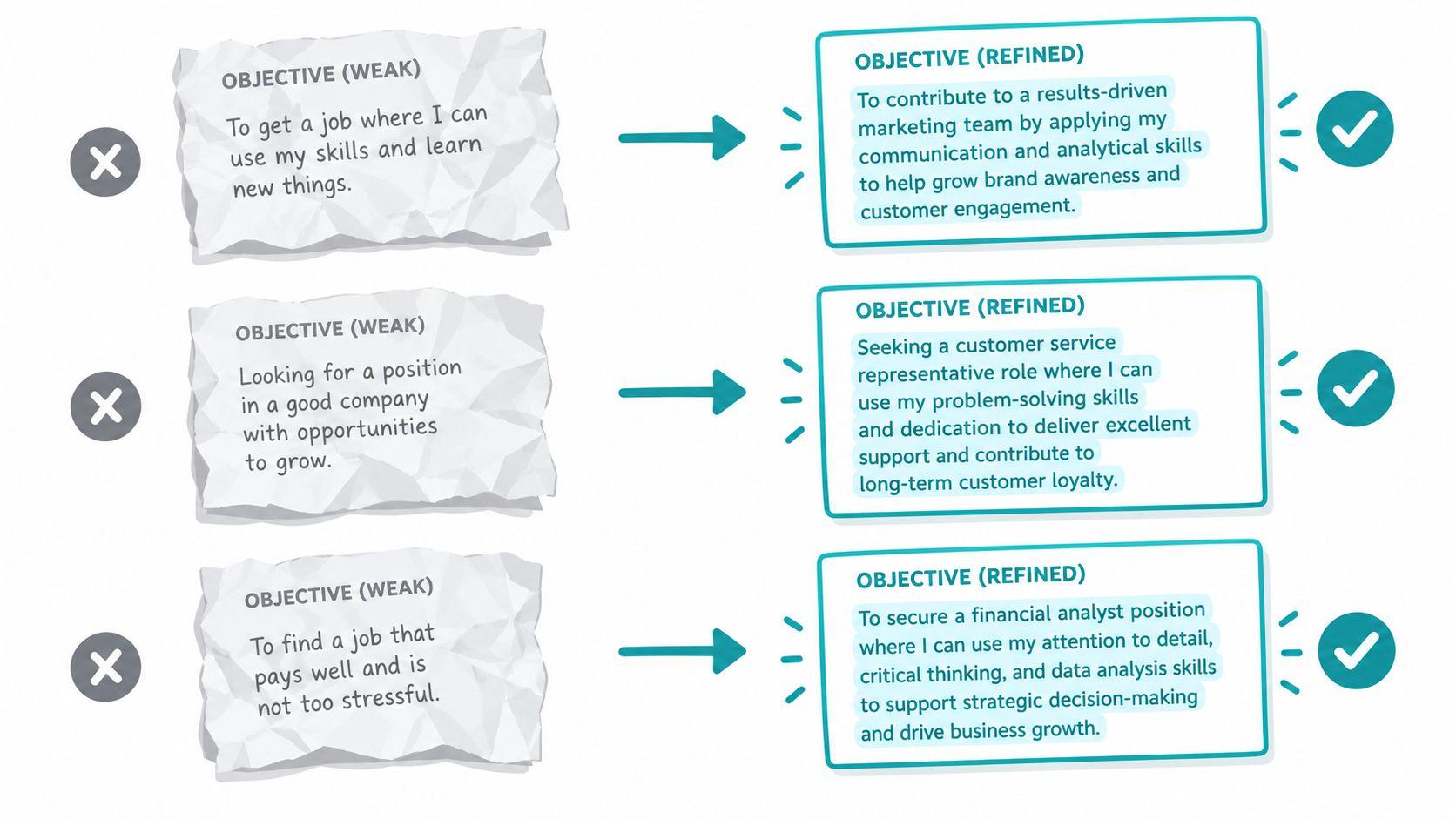
Weak objectives usually fail because they could belong to anyone. The quickest diagnosis is to circle every phrase that would remain true if the job title, employer, and candidate changed. Remove those phrases and replace them with role, evidence, and value.
The vague aspiration
Weak:
Seeking a challenging position with growth opportunities where I can use my skills and contribute to company success.
Stronger:
Junior Content Writer targeting a B2B SaaS role, bringing SEO research, editorial planning, and clear technical writing from agency projects. Ready to produce search-focused content that supports qualified organic discovery.
The rewrite removes “challenging,” “growth opportunities,” and “company success,” none of which identifies a fit. It adds the target role, relevant capabilities, and a concrete contribution.
The self-focused wish list
Weak:
Looking for a role that develops my skills, offers professional growth, and allows me to work with a collaborative team.
Stronger:
Project Coordinator transitioning from event operations, bringing vendor communication, schedule management, and issue resolution across complex live projects. Ready to support dependable delivery and clear coordination for cross-functional teams.
The candidate’s preferences no longer occupy the opening. Collaboration appears as a work requirement the candidate can support, not as a benefit they’re asking the employer to provide.
The one-word title
Weak:
Product Manager
Stronger:
Associate Product Manager candidate bringing customer research, backlog coordination, and cross-functional project experience from a software implementation team. Ready to translate user needs into clear requirements and support disciplined product delivery.
A title alone isn’t an objective. It doesn’t explain the transition, establish qualifications, or give the reader a reason to inspect the rest of the resume. Candidates targeting this path can compare their language with live Product Manager roles and borrow only the requirements they genuinely meet.
The test is simple: replace every phrase that could describe any applicant with a detail only you can defend. Your objective will usually become shorter, sharper, and more credible at the same time.
Mistakes to Avoid and a Final 30-Second Check
The worst objective statements don’t fail because the candidate lacks potential. They fail because the opening asks the recruiter to do unnecessary interpretation.
Fix the common failure modes
- One- or two-word objective: A title is a label, not an argument. Add the qualification and contribution that make the target credible.
- Passive voice: “Seeking to be given an opportunity” makes the candidate sound detached. Use active language such as “bringing,” “applying,” “supporting,” or “improving.”
- Unsupported claims: Don’t call yourself an expert, strategic leader, or high performer unless the resume supplies evidence. Replace the adjective with a project, credential, responsibility, or result.
- Generic wording: If the same statement survives unchanged across every application, it isn’t targeted. Rewrite the title, qualification, and employer priority for the posting.
- Self-focused language: “I want to grow” may be true, but it isn’t a hiring argument. State what you can contribute while pursuing the role.
- Keyword stuffing: More keywords don’t automatically create more relevance. Keep the exact title and a few proven skills, then let the rest of the resume carry supporting terms.
Run the final check before sending
Read the objective once and answer these questions:
- Does it name the exact role from the posting?
- Does it state one proven qualification?
- Does it explain what the employer gets?
- Does it stay within three sentences?
- Did you rewrite it for this specific application?
- If the role is remote or international, does it accurately frame location or eligibility without making a promise the posting doesn’t support?
If any answer is no, edit before you submit. A resume objective isn’t a miniature autobiography, and it isn’t a declaration of ambition. It’s a compact explanation of fit for candidates whose direction needs context. The objective isn’t dead. It’s just smaller and sharper than it used to be.
Use JobGlance to find remote and visa-relevant roles, compare your resume against specific postings, and identify missing keywords before you apply. Start with a role that clearly matches your target, then use the objective to make that fit obvious in the first few lines.
Keep reading


