Job Relocation Package: What It Covers and How to Compare


On this page
Employers have spent serious money moving people for decades. The Employee Relocation Council put the average US corporate relocation for a homeowner at $45,330 in 1992, excluding the cost of buying the employee’s house, up from $26,432 in 1981, a rise of roughly 71.5% in eleven years, as reporting on corporate moves at the time recorded.
That history explains why the headline figure in an offer letter tells you so little. A job relocation package isn’t one benefit but a schedule of cost categories, each with its own cap, its own payment timing and its own tax treatment. The same advertised allowance can be worth very different amounts once those terms are counted. Read the offer the way the employer’s finance team reads it: line by line, then in cash.
What a Relocation Package Covers
A job relocation package is the set of costs an employer agrees to fund when you move for a role. It isn’t a standard product with a standard price. Think of a restaurant bill with separate lines: the employer may cover some in full, cap others at a fixed figure, and leave the rest to you. Two candidates with the same salary and the same destination can sign packages worth wildly different amounts because the lines differ.
Three mechanisms deliver the money, and each behaves differently in your bank account.
- Receipt-based reimbursement. You pay the supplier first, submit documents, and get repaid later.
- Direct vendor payment. The employer books and pays the moving company, the serviced apartment or the immigration lawyer.
- A lump sum. Cash lands with you, and every cost decision and every overrun is yours.
Federal relocation rules show how granular the categories get. They list household-goods transportation, travel to the new location, temporary housing, real-estate transaction costs and tax assistance as separate components, and for federal employees they split tax support into a withholding tax allowance for federal withholding and a relocation income tax allowance that reimburses eligible federal, state and local taxes the move creates (41 CFR Part 302-17). Private packages rarely reach that level of paperwork, but they use the same building blocks.
Relocation package cost categories and the question to ask
| Cost category | What it covers | Question to ask |
|---|---|---|
| Household goods shipment | Packing, transport and storage of belongings | Is there a volume or weight cap? |
| Travel to the new city | Flights, mileage and lodging for the move | Does lodging cover a house-hunting trip? |
| Temporary housing | Hotel or furnished rental while you search | How many nights or months are covered? |
| Home sale or lease break | Commissions, closing costs or early lease exit | Is there a cap on these costs? |
| Immigration and visa costs | Visa, permit and legal fees | Who pays for dependents? |
| Tax assistance | Tax advice or a gross-up for relocation tax | Is a gross-up included? |
| Lump-sum allowance | Fixed cash amount the employee manages | What are the amount, payment timing and repayment terms? |
| Repatriation | Return move at the end of the contract | Is it conditional on staying a set period? |
A package described only as “relocation assistance” hides which of those lines are included, which are capped, and which are missing entirely. Silence on a category isn’t the same as coverage, and it rarely means the cost goes away.
Practical rule: put the eight categories on one page, mark each as covered, capped, paid later or missing, and send that page to the recruiter as your question list.
When you’d rather compare many employers than argue with one recruiter, work from the visa sponsorship job listings and read the relocation language in each posting before you invest in an application.
How Employers Pay Relocation Benefits
Money arrives in four shapes, and the shape matters more than the amount. In 2025, 47% of employee relocations were fully reimbursed, 23% were partially reimbursed, 19% were paid as lump sums, and 12% were not reimbursed, according to Atlas Van Lines’ 2026 Corporate Relocation Survey.
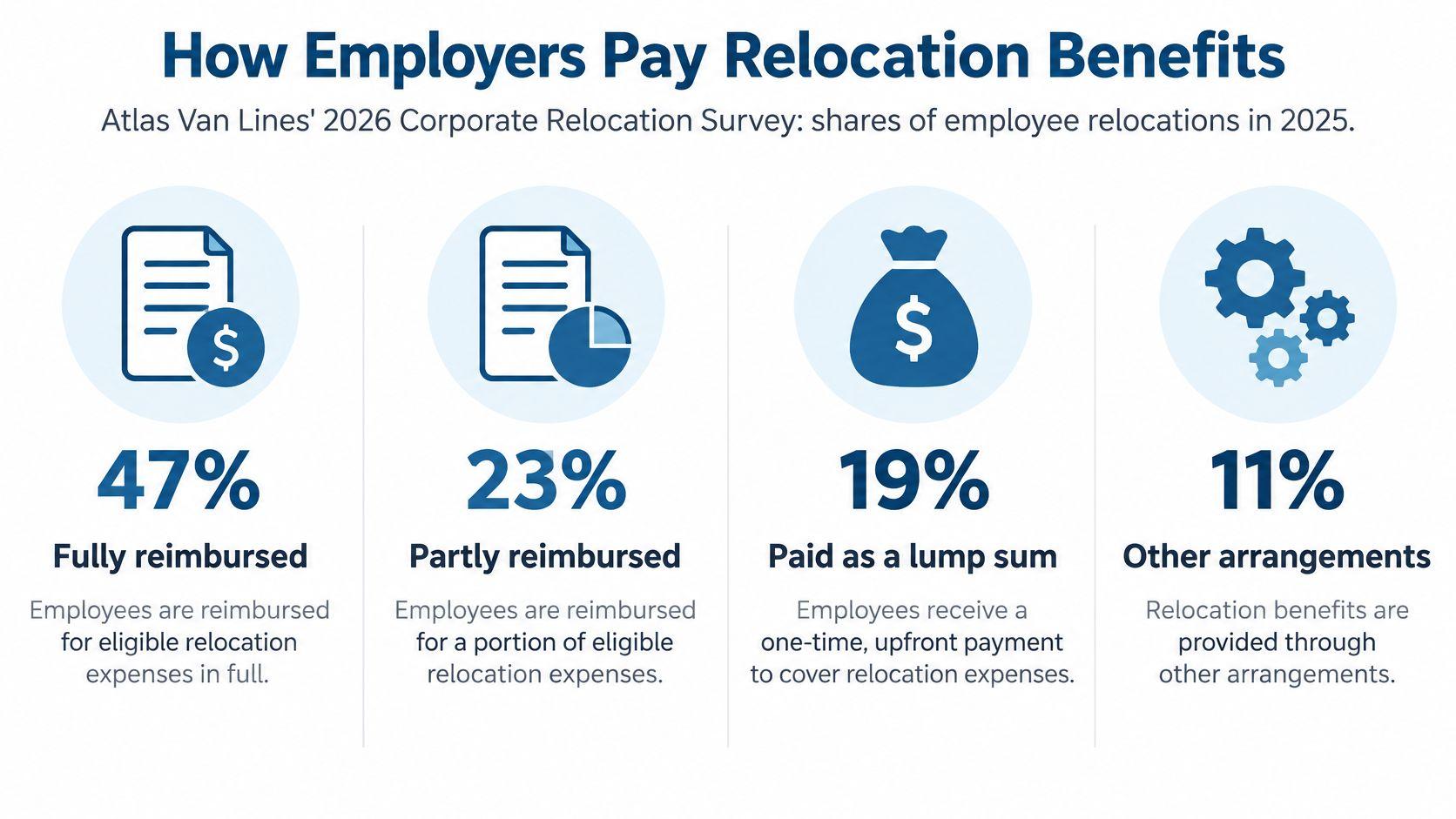
Each route puts a different person in charge of the cash flow. Full reimbursement sounds like the best outcome, and it often is, but you fund the move first: flights, deposits, shipping and legal fees leave your account before anyone approves a receipt. Partial reimbursement leaves a defined gap that you carry. A lump sum moves every cost decision and every overrun onto you. The 12% with no reimbursement fund the entire move themselves.
2025 employee relocation payout types
| Payout type | Share of 2025 relocations | What the employee funds |
|---|---|---|
| Fully reimbursed | 47% | Costs first, repaid after receipts |
| Partially reimbursed | 23% | The gap between costs and reimbursement |
| Lump sum | 19% | All costs, with cost decisions and risk on the employee |
| Not reimbursed | 12% | The entire move |
Worker-level survey data tells the same story from the other side. A 2022 survey of relocating workers found 64.14% received some form of employer compensation while 35.86% paid relocation costs themselves. Among those who got support, direct coverage of moving expenses was the most common benefit at 33.07%, followed by employer-sponsored trips to search for housing at 18.08%, lump-sum payments at 16.58%, temporary living-cost support at 16.48% and miscellaneous expense allowances at 15.78% (Allied relocation survey infographic).
Two conclusions follow. More than a third of movers get nothing, so employer support can’t be assumed at any level. And the most common form of help is narrow: it covers the transport of your belongings, not the move.
If a vehicle is part of the move, compare corporate vehicle relocation options before assuming the shipping line in your package covers it, because car transport is usually quoted and settled separately.
The payout-type check: name the route before you compare amounts, then ask how many weeks you’ll be out of pocket before repayment arrives.
How Relocation Pay Is Taxed
An allowance quoted in an offer letter is usually a pre-tax number. For US civilian employees, moving-expense reimbursements are no longer excluded from gross income for tax years after 2017, and the surviving exception is limited to active-duty Armed Forces members who move under qualifying permanent-change-of-station orders (IRS guidance on moving expenses to and from the United States). In practice, the reimbursement is wages: reported, withheld and taxed like salary.
US tax treatment of relocation pay by move type
| Move type | Tax treatment | Question to ask |
|---|---|---|
| Civilian domestic move in the US | Taxable wages for tax years after 2017 | Is the payment grossed up or stated net? |
| Active-duty military permanent change of station | Excluded from gross income | Do the orders qualify? |
| Move from the United States to another country | Pay for future services at the new location | Which country’s tax and payroll rules apply? |
| Move into the United States | Generally US-source income | Is withholding handled on arrival? |
Cross-border moves add a sourcing question on top of the rate. The same IRS guidance explains that reimbursement for a move from the United States to another country is generally treated as pay for future services at the new location, while reimbursement for a move into the United States is generally US-source income. That difference decides which payroll system withholds and at what rate.
Three questions sort most of this out before you sign: does the employer gross up the payment to offset the tax, will the amount appear on a Form W-2, and is it paid upfront or only after documented expenses.
The written offer should also state whether the figure is a gross reimbursement, a tax-assisted payment or a grossed-up benefit, because those three produce different take-home amounts from the same headline. IRS Publication 15-B draws a further distinction between reimbursements tied to future services, past services, and a contractual repatriation commitment, which is the line that governs return-move obligations on international assignments.
One boundary to keep in view: these are US rules. Other countries treat arrival and departure differently, and the year you land and the year you leave are usually the two that need local advice before you accept.
How to Value a Package Step by Step
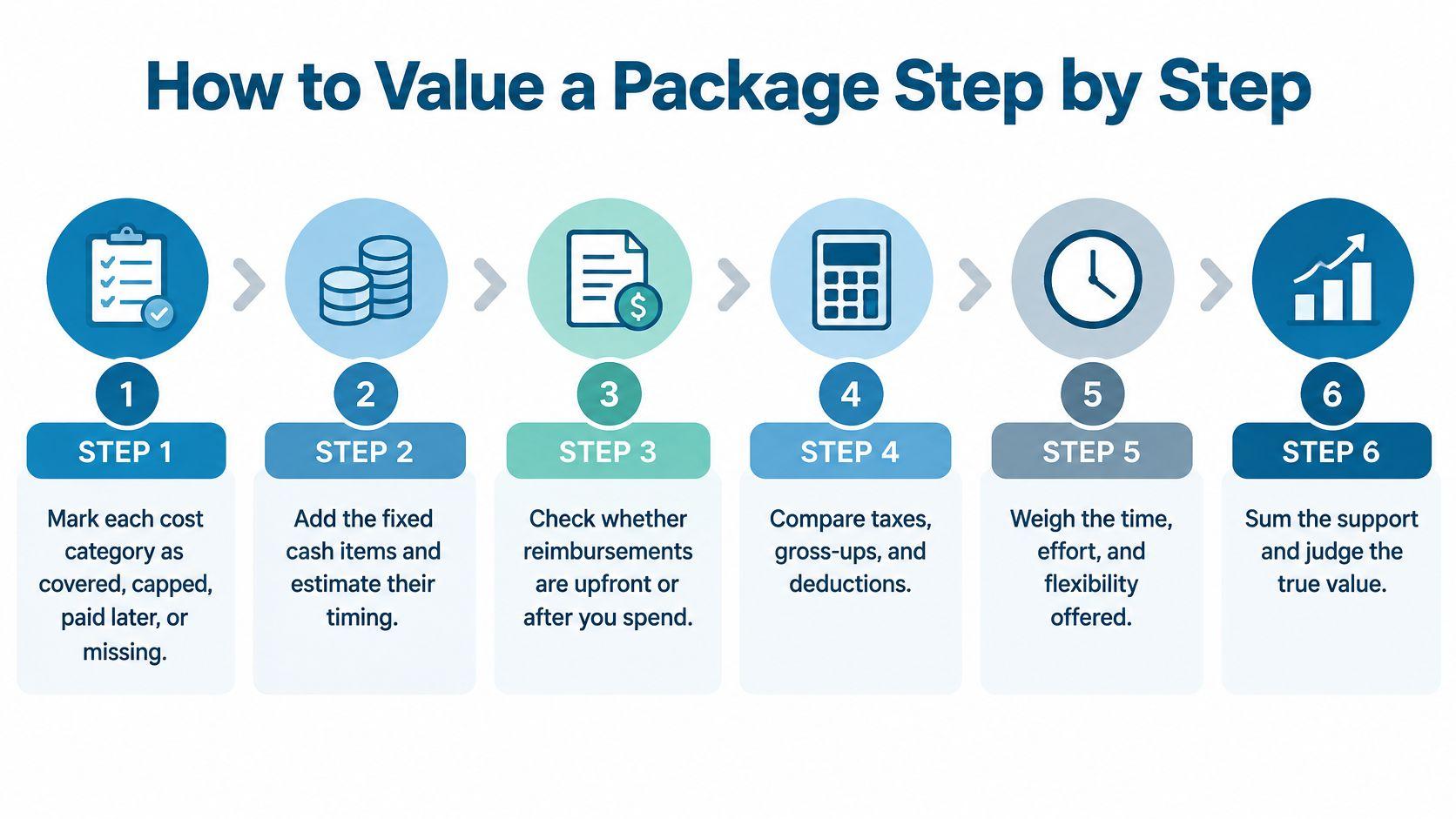
Value a package the way an analyst values a contract: by line, by timing, by risk. Six steps get you there.
- Mark the categories. Take the eight items from the cost table and label each covered, capped, paid later or missing. This fixes the scope before any money is counted, and it stops a large lump sum from masking a missing immigration budget.
- Attach terms to every covered item. Each one needs a cap, a documentation standard, a payment date and a clawback trigger. IRS rules treat household-goods transport, storage and travel, including lodging but generally not meals, as separate components for the groups still eligible for special treatment, and a reimbursement above actual cost can create extra taxable income (IRS Form 3903 instructions). Separate terms keep those items from collapsing into one disputed number later.
- Split guaranteed cash from reimbursable spend. Only the first is certain, so count it on its own line rather than adding it to money you can merely claim back.
- Apply tax. Subtract withholding and income tax from every taxable amount, or use the grossed-up figure when the employer offers one.
- Model three scenarios. A single move, a family move, and an early exit or failed visa that triggers repayment. The third is the one offers omit and the one that decides how much risk you’re carrying.
- Check the cash-flow gap. List everything you pay before reimbursement and count the weeks until the money returns. Between two similar packages, the shorter gap is usually worth more than the larger allowance.
A Worked Example With Two Offers
Say one offer carries a $10,000 lump sum with no tax gross-up and a 12-month repayment clause, and the second carries a smaller headline figure paid as a company-managed move with immigration and housing funded from separate budgets.
The first is worth less than its label, because withholding and income tax take a cut before you spend anything, and the lump sum still has to cover flights, shipment and deposits out of the net amount. It also exposes you to repayment if the role ends inside the year. The second removes the upfront outlay, keeps the repayment exposure off the immigration line, and buys the shipment at the employer’s negotiated rate rather than yours. On a like-for-like comparison, the smaller headline can win comfortably.
Price the physical move itself as one line of that model, using Endless Storage’s moving cost guide to work through volume, packing and storage, because shipment caps are usually written in weight or cubic feet rather than dollars.
Housing and Cash-Flow Gaps Packages Often Miss
Housing is where a lump sum fails most often. 67% of workers view temporary housing as a key relocation motivator, 76% want employer help securing it, nearly one quarter name housing costs as a major deterrent, and 30% have declined a relocation because housing was unaffordable, according to the 2025 Global Mobility Survey takeaways.
So the question to put to an employer isn’t how big the allowance is. It’s what happens on the morning the employer-paid hotel period ends and no affordable lease has come through.
A package that funds only hotel nights hasn’t solved housing. It has bought you time, and the amount of time is negotiable.
Check where the money stops:
- Deposits and guarantors. A rental deposit and a local guarantor requirement can block a lease faster than rent does.
- Broker and agency fees. Common in many markets, frequently excluded from “temporary accommodation” lines.
- Utilities and connection costs. Rarely reimbursed, always paid in the first month.
- Storage between leases. The gap between your shipment arriving and your apartment being available.
- Delays you don’t control. Immigration processing and landlord referencing push the hotel bill past the funded nights.
Family costs compound the same gap. Who pays visa fees for dependents, does tax advice cover both the arrival year and the departure year, and are spouse job-search support, childcare, school placement, medical coverage gaps and return travel inside the package (Deloitte wish list survey results)? Ask for managed help rather than a self-serve portal: in that 2025 survey of mobility professionals, traditional third-party-managed benefits were preferred over self-serve tools by a 56% to 44% margin.
Liquidity is the last gap and the most common. A package can look generous and still require you to pay deposits, flights and legal fees months before the first reimbursement lands. If you own a home, price the exit too, using a comparison of home selling expenses to see whether the home-sale line covers commission and closing costs or only part of the transaction. Then compare the whole package against local rent and the realistic time to a signed lease, not against another package.
Negotiating a Written Relocation Package
A reference point helps before you ask for anything. In a recruiting-budget analysis prepared for 2027 planning, the most frequently selected lump-sum band was $10,000 to $12,499, chosen by 26% of respondents, and 28% of companies used lump-sum relocation payments in 2025, down from 35% the previous year (HeroHunt’s 2027 recruiting-budget analysis). Treat it as a comparison point rather than a rate card: destination, seniority, family size, distance and whether immigration support sits inside the number all move the figure.
What you want in writing is narrower and more useful than a bigger number.
- The exact amount and the payment date. “Around ten thousand” and “with your first payroll” are different offers from a figure and a date.
- Repayment and clawback terms. How long the clause runs, what triggers it, and whether it’s pro-rated if you leave in month eight.
- Who counts as a dependent. Named people, not a category, because the visa line usually turns on this definition.
- What sits inside the cap. Confirm whether visa fees, temporary housing, shipment, flights and tax gross-up draw from one allowance or from separate budgets.
Before you sign: ask for a written schedule of covered costs, caps and repayment conditions. A verbal assurance about the visa fee isn’t a package.
If the employer won’t move on the lump sum, trade instead of arguing. Separate immigration and housing budgets usually protect more value than a slightly larger taxable payment, because they remove costs and repayment exposure rather than adding gross income you then have to spend on the same things.
Filter for Relocation Support Before You Apply
Screen for support before you read individual postings, because the two attributes that decide whether a package is in play at all are easy to filter and impossible to negotiate around later: whether the employer sponsors a visa, and whether the role is open to candidates in your country.
JobGlance’s Global Mobility Filters cover visa sponsorship, globally remote, location, work policy and skills, and results stay personally ranked by Smart Match rather than by posting date. Roles that come with a relocation package are included in the visa sponsorship results, so that filter does the first pass. JobGlance also tracks companies that hire globally by default, so their roles appear even when a posting never uses the word relocation.

Don’t assume packages are reserved for senior hires. Nearly 60% of employers surveyed in 2024 and 2025 said they offered relocation assistance to interns, according to the National Association of Colleges and Employers, so the filter is worth running at entry level too.
Then work the sequence:
- Shortlist what passes the filters. If the move is yours to arrange rather than the employer’s, start from the work from anywhere job listings, where the location question is settled before the package question begins.
- Read each posting for relocation language. Compare what it names against the eight cost categories and note what’s absent, because absence is the part you’ll negotiate.
- Request the written schedule before you accept. Amounts, caps, payment timing, dependents, clawback and tax treatment, on one page.
Filters narrow the pool. They don’t confirm the offer, so the shortlist is the start of the work rather than the end of it.
JobGlance is built for this exact stage of the search: 80,000+ active roles from 100+ job sites, each scored against your resume, with visa sponsorship and work-from-anywhere as dedicated filters instead of keywords. Run a search with the sponsorship filter on, then read every shortlisted posting against the cost categories above before you discuss a number. Start at JobGlance.
Keep reading


