
Job Fit Score Explained: How to Rank and Win


On this page
The most popular advice about a job fit score is also the least useful: copy every keyword from the job description into your resume and watch the percentage rise. That approach misunderstands what hiring software reads. A score can fall because the parser missed your experience, because your location makes the role unattainable, or because your resume lists a skill without showing how you used it.
A useful score is not a hiring verdict. It’s a ranking signal built from document structure, skills, seniority, eligibility, and the wording of a specific vacancy. If you understand those inputs, you can improve both the score and the quality of the applications behind it.
Understanding the Job Fit Score Concept
A job fit score measures the relationship between your profile and one specific role. It doesn’t measure your general employability, guarantee an interview, or predict whether a hiring manager will like your communication style. The number answers a narrower question: how strongly does the available evidence in your resume align with the requirements and constraints represented in this posting?
That distinction matters because modern job matching is a ranking problem. A system must decide which roles deserve attention first, often across a large and changing inventory. It may compare skills, titles, experience, education, location, work authorization, and other signals, then order the results by estimated relevance rather than returning every listing containing a familiar word. You can explore that kind of role-based search through JobGlance’s role listings.
Why keyword counting breaks down
Exact keyword matching still has a place. Recruiters use filters, and applicant tracking systems need recognizable text. But a keyword counter can’t reliably distinguish between:
- A skill used in a recent role and a skill mentioned once in a skills block.
- A senior specialist who owned delivery and a junior candidate who observed the same process.
- A required certification and an unrelated course with similar wording.
- A role that matches your background but can’t legally employ you.
- A resume that contains the right words but can’t be parsed correctly.
The distinction between historical matching and open-market matching is particularly important. A 2016 study using 143,000 job announcements and 65,000 CVs found that strong matching could improve recommendation performance in settings with known recruiter or applicant history, while performance dropped sharply in cold-start situations where the system had only the job advertisement available (INRIA research paper). That is the environment many job seekers face. The platform may know the posting, but it doesn’t know how a recruiter will react to an unfamiliar candidate.
Practical rule: Treat a fit score as evidence about the match between your documented profile and a vacancy, not as a prediction of your hiring outcome.
A strong score therefore requires more than vocabulary overlap. The system needs enough structured and contextual evidence to connect your experience to the role. It also needs to separate a desirable match from an attainable one. A data analyst with the right tools, seniority, and industry background may still be a poor result for a role restricted to applicants with local work authorization.
The score is most useful when it tells you why a role ranks highly and where the gaps sit. Matched requirements should be visible. Missing requirements should be distinguishable from missing document data. Without that explanation, a percentage can create false confidence or cause qualified career changers to reject themselves too early.
How Algorithms Calculate Your Match Percentage
A practical mental model is to treat the score as a calibrated relevance estimate assembled from several signals. The system first extracts information from your resume and the job description. It then compares corresponding fields, applies constraints, and ranks the result against other roles or candidates.
The exact formula varies by platform, but recruiter behavior shows why a multi-factor model is more useful than raw text similarity. A recruiter survey reports that 99.7% of recruiters use keyword filters in their ATS, while 43.4% use location filtering (ATS filtering data from Jobscan). Other common filters include skills, education, job title, certifications or licenses, and years of experience.
The reported usage rates are summarized below:
| Filter Category | Usage Rate |
|---|---|
| Keyword filters | 99.7% |
| Resume skills | 76.4% |
| Education | 59.7% |
| Job title | 55.3% |
| Certifications or licenses | 50.6% |
| Years of experience | 44.3% |
| Location | 43.4% |
What the model is trying to distinguish
A useful model doesn’t give every signal equal weight. A mandatory license may operate as a gate, while an industry keyword may influence ranking without determining eligibility. Seniority can also be inferred from job titles, scope of responsibility, duration, and the verbs used in achievement statements.
The model may consider:
- Skills alignment, including required tools, methods, and domain knowledge.
- Experience level, using titles, responsibility, and evidence of ownership.
- Education and credentials, especially where the posting treats them as requirements.
- Role terminology, including equivalent titles and recognizable occupational labels.
- Geographic eligibility, such as country, region, or remote-work restrictions.
- Context, meaning whether your resume shows the skill in a credible work setting.
The output is normally a continuous ranking rather than a binary decision. A score on a 0 to 100 scale can express that one role is more relevant than another without claiming that a candidate is either qualified or unqualified. That calibration is difficult. A 2025 benchmark using 736 real-world resumes across four job titles found that fit assessment can be measured at scale but remains noisy enough to require agreement checks such as Fleiss’ kappa (NAACL benchmark paper).
Specialized scoring models can also outperform general-purpose language models on this narrow task. An evaluation of roughly 10,000 real-world candidate-job pairs reported ROC AUC 0.85 for a specialized match-score model, compared with 0.77 for general-purpose LLMs, using the same source above. The lesson isn’t that one model will always be correct. It’s that job-fit scoring deserves task-specific evaluation, calibrated outputs, and agreement checks rather than an AI label placed over a keyword search.
A higher score should mean stronger evidence across relevant dimensions. It shouldn’t merely mean that your resume repeats the vacancy’s language more often.
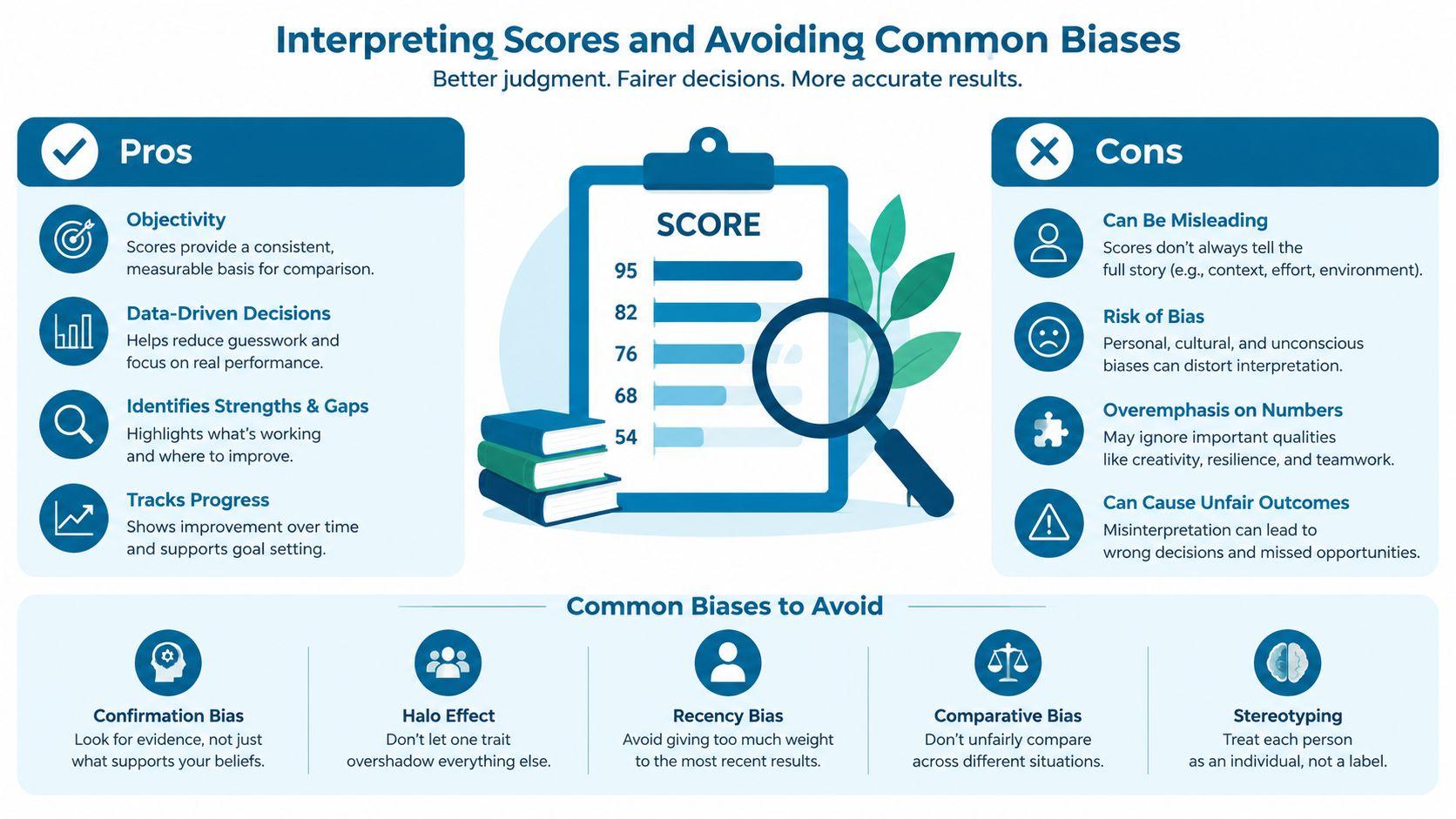
Interpreting Scores and Avoiding Common Biases
A weak job fit score can reflect document failure before it reflects your experience. Before semantic matching starts, the parser must identify headings, dates, employers, roles, skills, and descriptions. If the file structure hides those elements, the scoring system evaluates an incomplete version of your career.
Document format is therefore a mechanical constraint, not a design preference. One 2026 ATS analysis reported a 4% parsing failure rate for DOCX files compared with 18% for PDF files, along with 93% parsing accuracy for single-column resumes compared with 86% for two-column layouts (ATS parsing analysis). A clean, single-column document with selectable text, conventional headings, and predictable chronology is usually the safer choice.
A low score may be a document problem
Inspect the extracted content before deciding that your experience is missing. Check whether the system can recognize:
- Your job titles and employment dates.
- Important tools, certifications, and technical terms.
- Text placed in headers, footers, tables, icons, or sidebars.
- The difference between a current skill and an older responsibility.
- The context around each skill, including projects and achievements.
Keyword stuffing creates another scoring problem. The same ATS analysis reports that resumes with matched keywords are about three times more likely to reach a recruiter’s desk than unoptimized resumes, while stuffing can reduce ATS scores by about 30% (ATS parsing analysis). Use each term where it accurately describes work performed. Mention “Python” in a project, responsibility, or result that shows how you used it instead of repeating it across every section.
A score also inherits weaknesses from its inputs. Job descriptions may be vague, inflated, outdated, or internally inconsistent. Similarity models can favor familiar wording while undervaluing unusual combinations of skills, business context, and seniority. Career changers may have strong transferable evidence that the model cannot map cleanly.
Responsible hiring requires explainability and human review. Guidance on building fair hiring processes supports treating the score as one input, not an automatic rejection mechanism. Candidates should be able to identify whether a low result reflects missing evidence, unreadable formatting, or a genuine gap in role requirements.
The Hidden Constraints Behind Every Match
Skills don’t make a job attainable on their own. A candidate can be an excellent professional match and still be unable to accept the role because the employer can’t sponsor a visa, the job is remote only within a specific country, or the required working hours don’t overlap with the candidate’s time zone.
This creates two separate questions:
- Desirability: How closely does the candidate’s experience fit the work?
- Eligibility: Can the candidate legally and practically perform the work from their location?
A credible job fit score should keep those questions distinct. If a role requires local work authorization, that requirement shouldn’t disappear inside a general semantic score. It should act as a visible constraint or eligibility filter. Otherwise, the system can rank a role highly because of excellent skill overlap while still sending the candidate toward an application they can’t complete.
Remote doesn’t always mean global
Remote work is now a significant labor-market category. In the United States, 22% of the workforce, or about 32.6 million Americans, worked remotely in 2025, and more than a third of job openings globally included hybrid or fully remote options (remote-work market commentary). Those figures make remote status worth treating as a primary search dimension, not a decorative keyword.
But “remote” can describe very different arrangements:
- Remote within one country.
- Remote within a legal hiring region.
- Remote with required travel to an office.
- Remote with fixed hours tied to a headquarters.
- Work from anywhere, subject to tax and employment rules.
An international candidate should filter for the last category separately from domestic remote roles. Time-zone overlap, payroll availability, employer-of-record coverage, and work authorization can all change the practical result. The same principle applies to sponsorship. A strong skills match is relevant only after the candidate confirms that the employer can hire them in the target country. For example, a focused search for US visa sponsorship jobs is more useful than adding “visa” to a broad keyword query and hoping the wording is accurate.
Eligibility comes before desirability. A high skills score can’t repair a failed legal, geographic, or operational constraint.
The best ranking systems apply those constraints early, then compare fit among the roles that remain. That prevents a misleading “95% match” from hiding a practical eligibility score of zero.
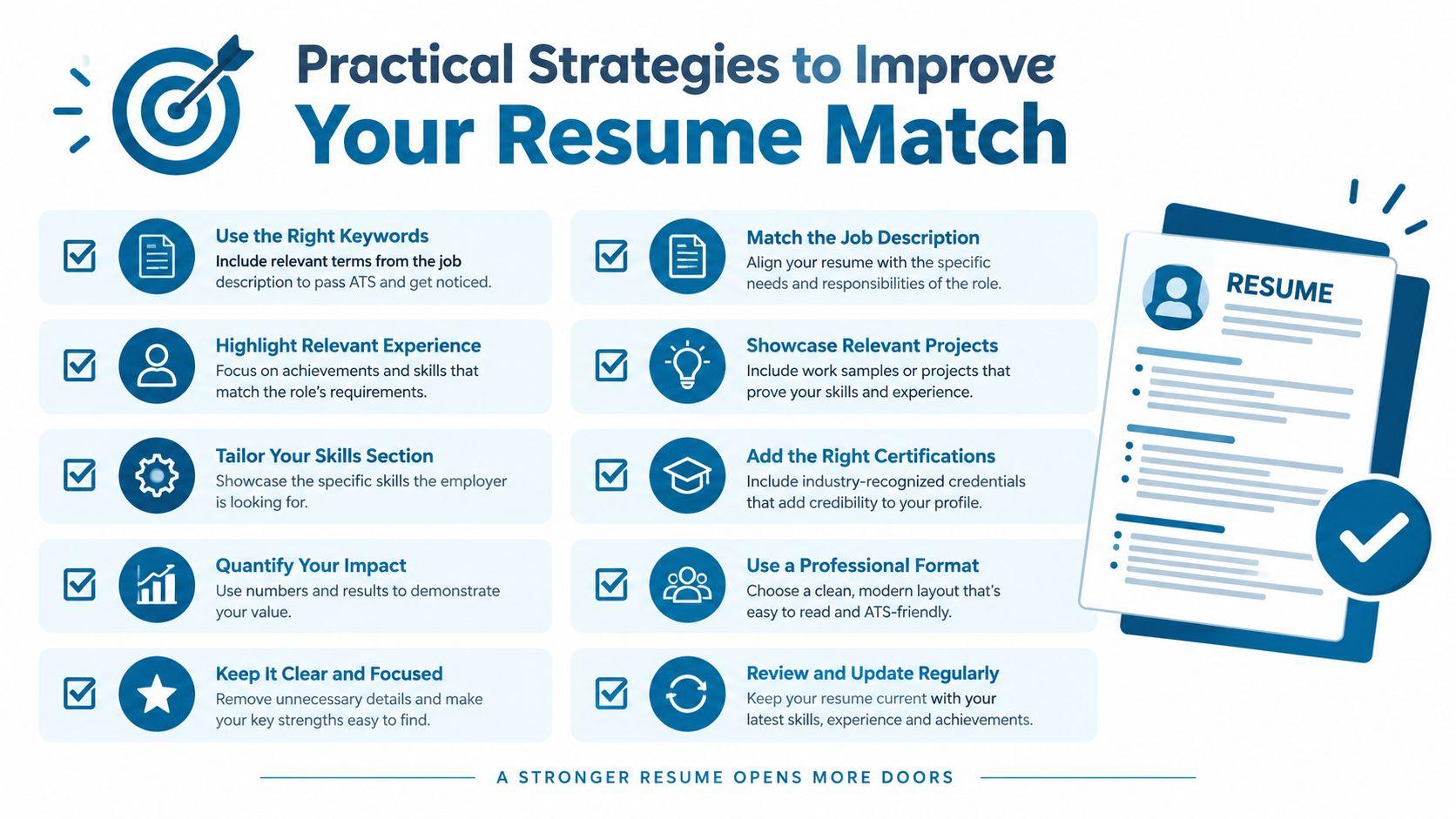
Practical Strategies to Improve Your Resume Match
Improving a score starts with a specific vacancy, not a permanent master resume. Your document should preserve a stable career narrative while changing the evidence that matters for the role in front of you.
Start with the posting
Extract the requirements into three groups:
- Hard gates: Work authorization, location, required licenses, language requirements, and seniority that cannot be compromised.
- Core capabilities: Skills, tools, methods, and responsibilities that appear repeatedly or receive prominent placement.
- Supporting signals: Industry exposure, education, preferred tools, and related experience.
Then compare each group with your resume. Mark every requirement as matched, partially supported, missing, or unclear because the parser may not read it. That distinction prevents you from treating a formatting problem as a career gap.
A good bullet contains a skill, context, and outcome. “Built dashboards in SQL and Power BI for finance stakeholders” gives a system more useful evidence than a detached list containing “SQL, Power BI, dashboards.” Keep claims accurate. Never add a tool you haven’t used because it appears in the posting.
Rebuild for reliable extraction
Use conventional section headings such as Summary, Experience, Education, Skills, and Certifications. Keep the layout single-column, avoid text embedded in images, and test whether the exported file allows you to select and copy the content in the intended reading order.
Tailor with restraint
Use the employer’s terminology where it accurately describes your experience. If the posting says “forecasting,” don’t rely only on “planning” when your work genuinely included forecasting. Add the specific term to the relevant achievement, then explain the surrounding work so the recruiter can judge depth.
A repeatable audit looks like this:
- Read the job description for constraints first. Remove roles you can’t legally or practically accept.
- Map requirements to evidence. Link each important requirement to a resume bullet, project, credential, or portfolio item.
- Repair missing context. Add tools, scope, stakeholders, and outcomes where they are true and relevant.
- Check the file mechanically. Confirm that dates, headings, skills, and contact details parse correctly.
- Review missing keywords. Decide whether each omission reflects a real gap, a synonym issue, or poor document structure.
- Save recurring gaps. If the same capability appears across several target roles, treat it as an upskilling priority rather than a one-off tailoring task.
For a concrete target, compare your evidence against current data analyst roles. Career gap analysis becomes valuable when it aggregates repeated requirements across saved vacancies. It shows whether your next improvement should be a credential, a portfolio project, deeper tool experience, or clearer wording.
Real-World Examples of Job Fit Scoring Interfaces
The difference between a vague percentage and a useful interface is explanation. A practical job search screen should show the score beside the role, then let the candidate inspect the evidence behind it without opening several separate tools.
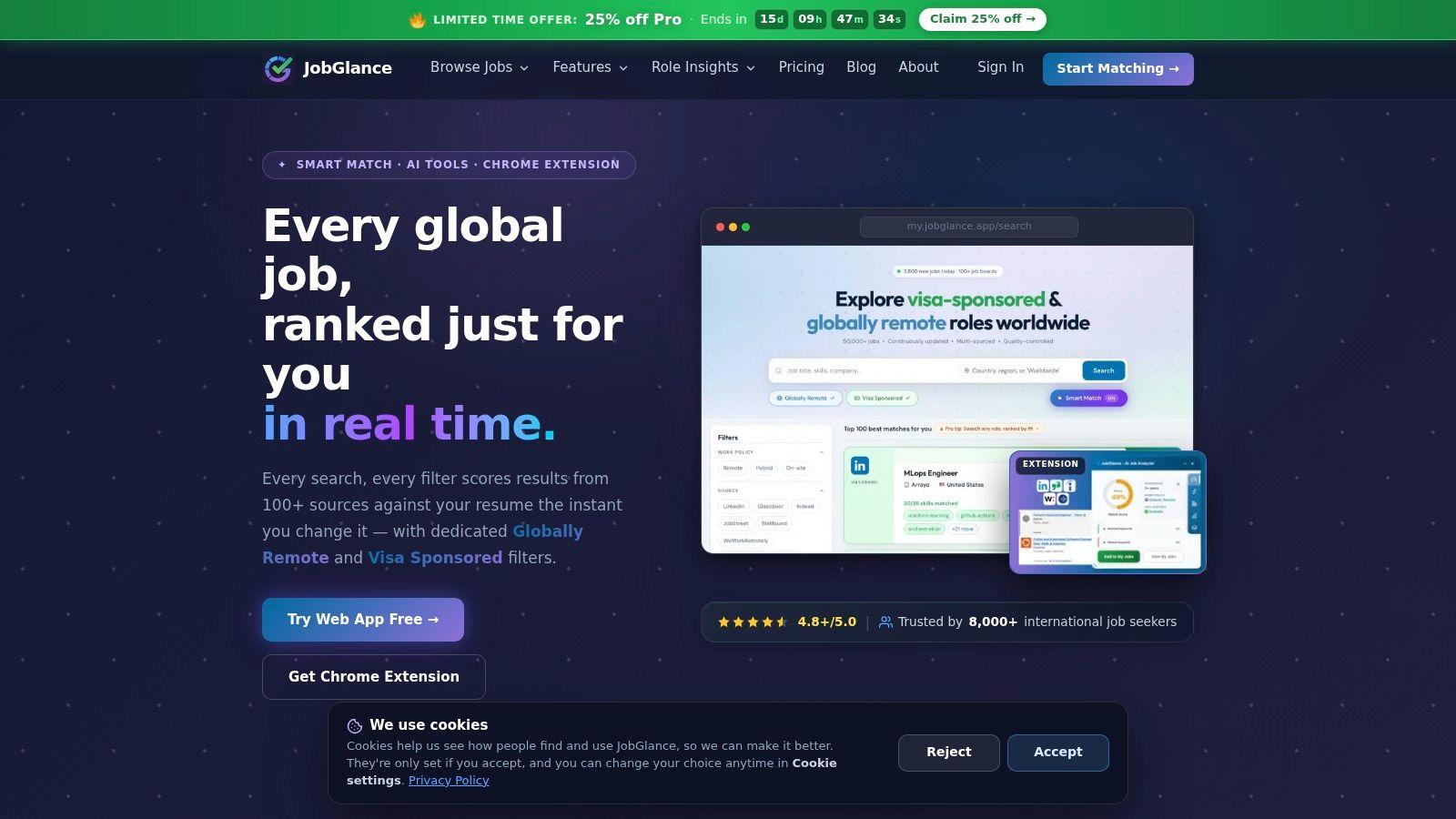
Consider a candidate searching for analytics roles. After uploading a resume, the platform ranks the result set by the candidate’s fit instead of leaving postings in a purely chronological order. The candidate can then change the title, region, remote preference, or sponsorship filter and see the ranking adjust to the new search conditions.
The per-job view should answer three immediate questions:
- Which requirements did the resume support?
- Which terms or capabilities are missing?
- Did the role fail on skills, seniority, or eligibility?
Highlighting matched and missing keywords directly inside the job description is more useful than displaying a score with no diagnostic layer. A missing keyword might signal a genuine capability gap, but it might also mean the resume uses a different professional term. The candidate can then make a deliberate edit instead of stuffing the document with repeated phrases.
How filters should stack
A sponsorship filter should narrow the eligible pool before the fit ranking decides which remaining roles deserve attention. A work-from-anywhere filter should also remain separate from a domestic remote filter. Combining those signals with semantic matching prevents the interface from presenting attractive but unusable jobs at the top.
The browser experience matters too. Candidates often discover a vacancy on a large job board, not inside a dedicated matching database. A companion extension can carry the same resume-based score onto external job pages, detect sponsorship or remote eligibility, and expose matched and missing skills while the candidate is reading the original listing.
The interface shouldn’t imply that a score replaces judgment. It should reduce triage, expose trade-offs, and help the candidate decide whether the opportunity deserves a personalized application.
Building a Better Job Search Strategy with Fit Data
A job fit score becomes more valuable when you stop treating it as an application scorecard and start using it as market feedback. A single low result may reflect wording, parsing, or an unusual posting. A repeated gap across the roles you want is stronger evidence that your profile needs attention.
Track patterns across saved roles:
- Repeated tools: Identify technologies or methods that recur in your target vacancies.
- Seniority language: Compare “support,” “own,” “lead,” and “architect” requirements with the scope shown in your experience.
- Domain expectations: Separate transferable skills from industry-specific knowledge.
- Eligibility restrictions: Record which locations, countries, time zones, and sponsorship conditions repeatedly remove roles.
- Evidence quality: Check whether your resume proves the skill through projects and outcomes, rather than merely naming it.
This turns job search into a feedback loop. If the market repeatedly asks for a capability you already have, improve how your resume expresses it. If it asks for something you lack, choose a project or learning plan that creates credible evidence. If most attractive roles fail on location or authorization, change the search geography or target employers with a demonstrated willingness to hire internationally.
Company research should support that filtering. Look for evidence of sponsorship history, global hiring practices, and the actual employment arrangement behind a “remote” label. A broader guide to planning a modern search is available in this resource on job search strategy for 2026, but the operating principle is simple: use fit data to choose where to spend effort, not to outsource your career decisions.
JobGlance provides resume-based scoring for roles, highlights matched and missing skills, re-ranks results after search or filter changes, and includes dedicated visa sponsorship and work-from-anywhere filters. Visit JobGlance to compare viable roles by fit, diagnose recurring skill gaps, and carry the same matching logic onto job pages across the web.
Keep reading


