Job Search Plan: A Weekly System That Gets Interviews


On this page
1.948 million unemployed Americans had been out of work for 27 weeks or more in December 2025, and they made up 26.0% of everyone looking for work that month, according to the Bureau of Labor Statistics duration of unemployment data. A search can feel active while the same roles, same filters and same resume keep producing no interviews.
Treat a job search plan as a weekly operating system: set targets you can repeat, check eligibility before tailoring, log each application where it can be audited, and judge channels by interviews per 20 applications rather than raw volume. The working tools are the weekly target table and the conversion benchmarks, not a bigger pile of submissions.
No plan guarantees an interview. The point is faster feedback: which listings you were eligible for, which resume version earned replies, and which channel deserves next week’s effort.
Weekly Targets to Plan Your Job Search Around
The timeline is the first thing to plan against. In 2025 the median unemployed American had been searching for 9.9 weeks while the mean ran 23.0 weeks, and 38.4% of the unemployed population had been out of work for at least 15 weeks, according to the Bureau of Labor Statistics. The mean sits far above the median because long spells drag it there. Half of searchers move in about ten weeks; a large minority keeps going for months.
A plan built around one strong week of applications can’t survive that spread. You need targets you can hit in a normal week, with a normal life, held steady long enough to produce a trend.
| Weekly activity | Target | What it tells you |
|---|---|---|
| High-fit applications | 10 to 20 roles | Whether your target list matches the market |
| Tailored versions sent | One for every application | Whether document quality is working |
| Role-specific outreach | 2 to 3 contacts per target employer | Whether introductions reach interviews |
| Eligibility checks | Before every tailoring session | Whether the role is open to you at all |
| Pipeline audit | 30 to 45 minutes once a week | Whether sources and follow-ups are current |
The target list is what stops unsuitable roles from eating the week. If you can’t find ten roles that clear your own filters, the problem is the title, the location or the seniority band, not your effort level. Widen the search across roles by function and experience level before you widen your standards.
Outreach exists so the plan doesn’t depend on one channel. Two or three named contacts per target employer gives you a second route into companies where an application alone rarely surfaces. The audit is the row people skip: thirty to 45 minutes to update stages, chase anything overdue and delete dead listings keeps follow-ups from slipping past the point where a hiring manager has forgotten you.
Run the table as a four-week trial. Hold the targets fixed even when a week goes badly, then calculate interviews per 20 applications, which is interviews divided by applications, multiplied by 20. The comparison only means anything if the inputs stayed constant, which is why you don’t change targets mid-trial.
The rule that decides everything else: volume is a means, not the goal. If interviews per 20 applications hasn’t moved after four weeks, change the list or the document before you send a single extra application.
How to Build Your Target List and Check Eligibility
Tailoring is the expensive step, so eligibility comes first. A role that fails a visa, location or seniority check on first read never deserved an hour of rewriting, and that cost multiplies across a week of applications.
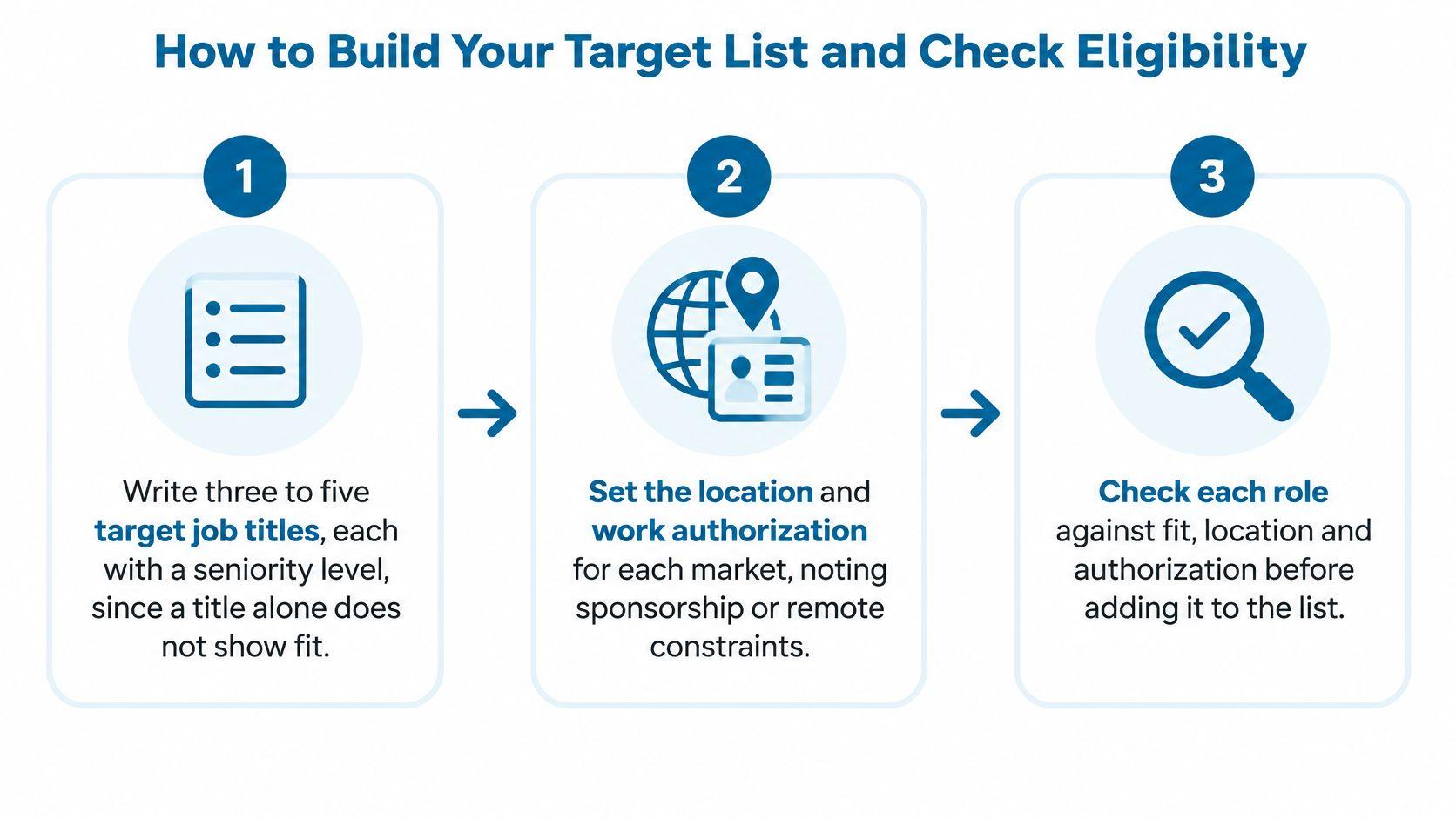
- Write three to five target job titles, each with a seniority level. A title alone doesn’t show fit. “Product manager” covers a first job and a director role, and applications sent to the wrong band return data about a market you’re not in.
- Set the location and work authorization for each market. Note whether you already hold the right to work there or would need sponsorship. That one field decides whether an entire country belongs in this week’s list.
- List five to eight skills the target roles keep asking for. Mark the ones you can prove with evidence from past work. The unproven column is a study list, not resume material.
- Check sponsorship before you tailor anything. The UK Skilled Worker route, for example, requires a confirmed offer from a Home Office approved employer, a valid electronic Certificate of Sponsorship, an eligible occupation and the required salary, with a general threshold of £41,700 a year and 70 points needed overall (GOV.UK’s Skilled Worker guidance). The certificate must be used to apply within three months, so timing counts as eligibility.
- Verify the remote scope. Remote can mean worldwide or one country, and that difference decides whether you can take the job at all. Employers generally need a sponsor licence to employ someone from outside the UK, and the sponsored role must meet minimum-wage and working-time rules as well as the visa criteria (GOV.UK’s guidance for sponsoring employers). Confirm the permitted work location and the payroll arrangement before counting the role.
- Keep only the roles that pass every check. Build a list of 10 to 20 for the week and stop browsing.
That fifth step is worth the minutes it costs. 27% of international remote job seekers said in 2024 they were frustrated by the difficulty of working out whether they could apply for a job from outside the United States (Virtual Vocations’ Remote Work Demographics Survey).
Three of these checks carry most of the weight, and they run in order.
| Check | Requirement | Note |
|---|---|---|
| General salary threshold | £41,700 a year | Applicable going rate and permitted discounts can change the calculation |
| Points needed | 70 overall | Includes 20 for sponsorship and 20 for skill level |
| Certificate of Sponsorship | Valid electronic certificate from an approved employer | Must be used to apply within three months |
What a list that passes looks like
Most roles on a well-built list should pass. If two out of twenty survive, the filters are too tight or the market you picked doesn’t hire that title at your level. You should also be able to say why each role passed, in one sentence, without reopening the posting.
Credential gates sit alongside visa gates and are easy to miss in fields where a licence, ticket or induction is the main barrier. Traffic control work in Sydney is the standard example, where getting rostered on Sydney civil sites depends on holding the right tickets and site induction before any employer reads a resume. The eligibility question comes before the application, not after it.
When sponsorship is the constraint, start from the visa sponsorship job category pages rather than searching by title and hoping the posting mentions it. Most postings don’t say either way.
Track Applications in a Pipeline You Can Audit
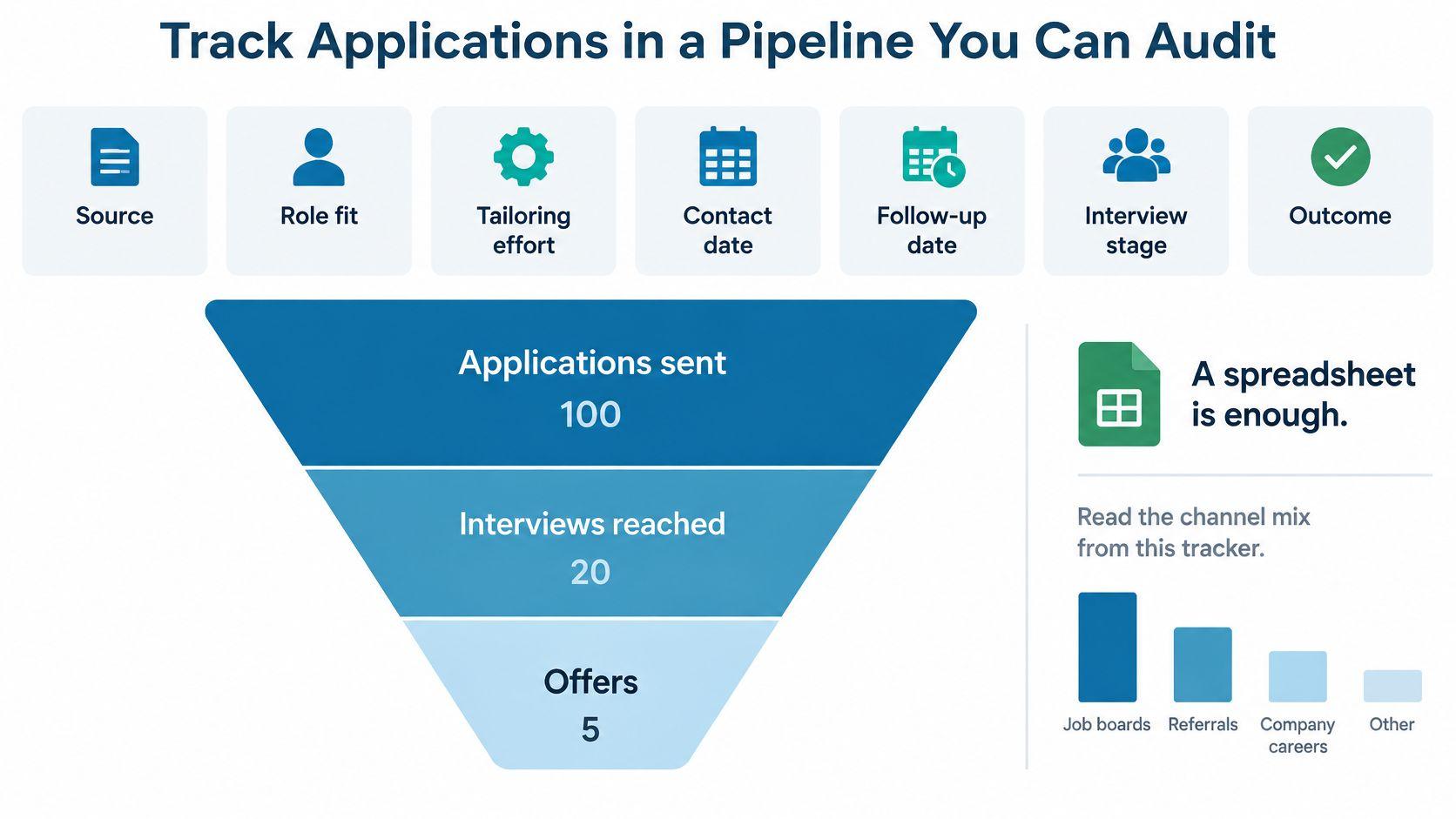
Job boards carry most of the applications and a minority of the offers. New York Federal Reserve research found that online job boards generated 60% of applications but only 24% of offers, while employee referrals and campus recruiting generated 8% of applications and 38% of offers (New York Fed research on how people find jobs).
That split is the argument for spreading the week across two channels instead of pouring everything into boards, and it tells you what to record. Log seven fields per application: source, role fit, tailoring effort, contact date, follow-up date, interview stage and outcome. A spreadsheet is enough. Source and role fit show which channel deserves next week’s hours. Contact and follow-up dates stop warm threads going cold. Stage and outcome turn a vague feeling of progress into a ratio you can check.
The funnel those fields describe narrows predictably, and the narrowing is the information.
Four numbers that tell you where the plan is failing
Track qualified-application-to-screen rate, referral-to-interview rate, interview-to-offer rate and median days between follow-ups. Each points at a different repair. A weak screen rate means targeting or materials. A weak referral-to-interview rate means your outreach is vague. A weak interview-to-offer rate is preparation, and no amount of rewriting fixes it.
Interviews per 20 applications is the number the plan turns on: interviews divided by applications, multiplied by 20. Forty applications with no screens points at targeting or document problems. Screens that never become interviews point at the materials or the conversation itself. Same zero on the dashboard, opposite fixes.
Outreach has a shape worth copying. Each message names a specific team, product or skill match and asks for information rather than an immediate referral. A stranger asked a question will usually answer; a stranger asked a favour usually won’t. Log every reply against the source field so referral outreach can be compared against board applications on the same scale.
The last habit is fifteen minutes a week to update the tracker. A stale pipeline hides the exact pattern it exists to show.
Tailor Each Application Without Padding Your Resume
Tailoring is a mapping exercise, not a writing exercise. The aim is to show that your evidence answers the posting, in the posting’s own vocabulary, without adding anything you’d have to defend in a technical interview.
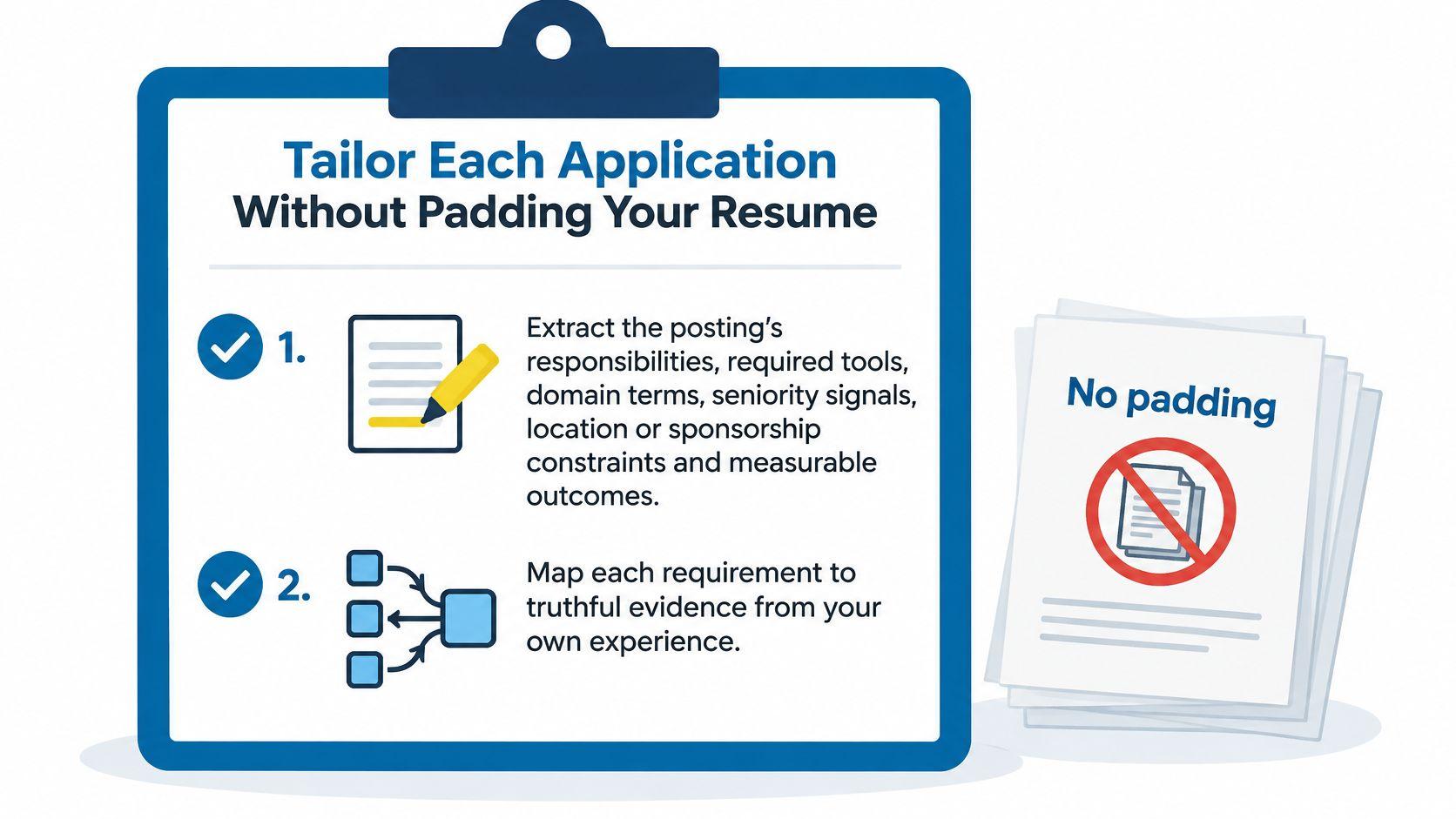
- Extract what the posting asks for. Responsibilities, required tools, domain terms, seniority signals, location or sponsorship constraints, measurable outcomes. You’re building a checklist, not reading for tone.
- Map each requirement to truthful evidence. If nothing in your history answers it, leave it out. A gap you can discuss is survivable; a claim you can’t defend ends the process.
- Reorder bullets so the strongest match sits first. Recruiters skim the top third of a resume, and the evidence that proves fit should be the first thing their eye lands on.
- Check consistency across the resume and the application form. Dates, titles, contact details, work authorization. Contradictions between the two documents cost interviews for reasons candidates never hear about.
- Send a cover letter only when it adds evidence. A letter that restates the resume is a tax on the reader.
Two steps do most of the work, and they’re the two people skip.
What the numbers do and don’t promise
Customized cover letters have been shown in field experiments to raise callback rates, though the absolute rate stays low either way. You’re moving from one small probability to a slightly better one, which is still worth the hour when the posting calls for it.
Keyword filters are the mechanical half of the same problem. A Jobscan recruiter survey found 99.7% of recruiters used keyword filters inside an applicant-tracking system, most often on resume skills (76.4%), education (59.7%), job title (55.3%) and certifications (50.6%) (Jobscan’s applicant tracking system research). Match the employer’s terminology where the filter reads it, then make the document readable for the human who follows.
Keyword stuffing fails in one specific way: it gets you past the filter and into a technical screen you can’t pass. The interview is the audit.
A resume is adjusted to a job by matching it against the skills the role asks for, both the ones you already have and the ones you’re missing. The second list is what you work on between applications, not inside them.
Conventions change across borders as well. English CV tips for Moroccan jobseekers covers the spelling, format and phrasing differences that make a document read as local rather than translated, and those differences decide whether a recruiter trusts the rest of the page.
Close the week with an audit that removes roles outside your constraints, confirms every highlighted keyword has evidence behind it, and compares callback rates by role family and document version. Keep separate versions for materially different job families and stop there. Five near-identical resumes is admin, not tailoring.
Which Channels and Resume Versions Convert
Volume and conversion call for different strategies, and one dataset makes the gap concrete. In Huntr’s Q3 2025 job search report, an analysis of 375,000 applications, the typical job seeker sent 16 applications a week while the most aggressive 10% sent 83, and customized resumes converted to an interview or offer at 6.5% against 4.3% for generic versions, roughly a 50% improvement. The same report put employer career portals at an 11.21% interview rate while LinkedIn and Indeed both sat below 4%.
| Channel or version | Reported rate | Source note |
|---|---|---|
| Tailored resume | 6.5% interview-or-offer conversion | Huntr Q3 2025, 375,000 applications |
| Generic resume | 4.3% interview-or-offer conversion | Huntr Q3 2025, 375,000 applications |
| Google career portal | 11.21% interview rate | Huntr Q3 2025 channel analysis |
| LinkedIn and Indeed | Below 4% interview rate | Huntr Q3 2025 channel analysis |
| All job seekers, 2018 | 13.67 applications, 1.93 interviews on average | BLS 2018 survey |
| Unemployed 27 weeks or longer, 2018 | Below-average interview yield | BLS 2018 survey |
Read the table as a set of local benchmarks rather than a league table. Tailoring pays for itself before channel even enters the calculation. The employer’s own portal beat the two biggest aggregators on interview rate, which is why an application submitted through a company’s own site is time well spent. Reach and effectiveness come apart at exactly that point.
The federal survey points the same way. Job seekers averaged 13.67 applications and 1.93 interviews in 2018, and the interview yield was weakest among people unemployed 27 weeks or longer (Bureau of Labor Statistics analysis of how job seekers search). Long searches and low conversion travel together, though which causes which is harder to say.
Friction belongs in the channel decision too. 71% of job seekers expected an application to take under 30 minutes and 35% would abandon one that took too long (Jobvite’s 2025 Job Seeker Nation report). That argues for reserving intensive tailoring for roles with strong fit and a short process.
Decision rule: when interviews per 20 applications stop rising, add quality, sharpen targeting or change channel. Pouring volume into a flat conversion rate only buys more of the same silence.
Channel rates shift by industry too. A sector that hires in bulk, where candidates can find entry-level trucking jobs by the hundred, produces very different numbers from a niche professional field where twenty applications is a busy month. Use your own baseline.
Remote roles need the same caution. One listing can be open to a single country and the next to anyone anywhere. If remote is the target, work from the globally remote job category pages so you’re comparing roles that share the same eligibility rules, then hold each one to the eligibility check before you tailor.
Start Your Plan This Week
One setup session gets the system running. Pick the 10 to 20 roles that cleared your eligibility checks, build the tracker with its seven fields, and write a weekly target for every row of the first table. That’s an afternoon’s work, not a week’s.
The habit that holds it together is a fixed review slot, same day each week, 45 minutes.
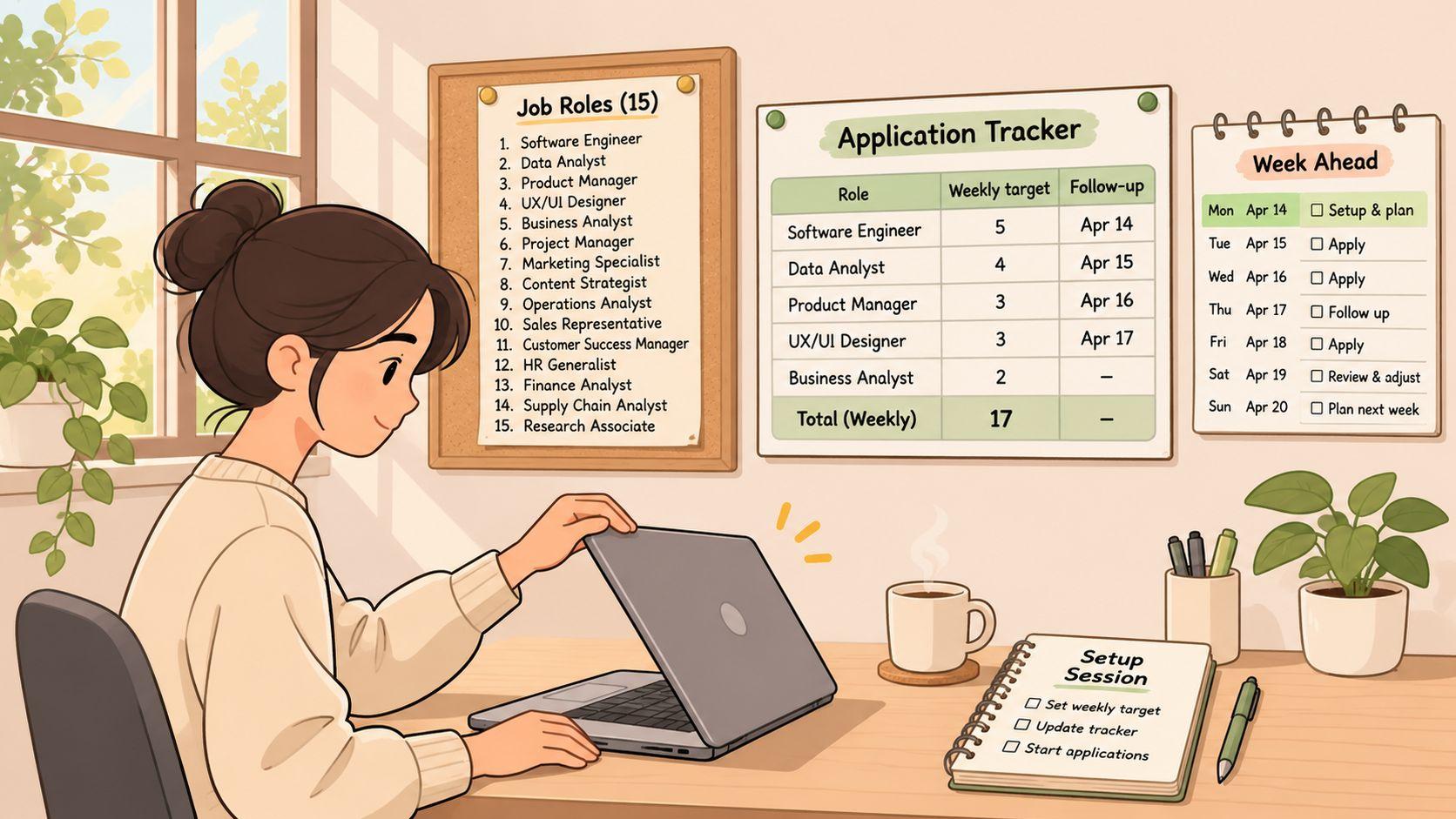
In that slot, count applications, screens and interviews, calculate interviews per 20 applications, compare it with your four-week baseline, and change one variable before the next week. One variable, so you can tell what moved. A monthly review handles the larger questions: whether the target list draws responses at all, whether one channel deserves a bigger share of the week, and whether the same skill gap keeps appearing in roles you want.
Set up an alert so new matches arrive without daily searching. In JobGlance, run a search in the web app and use the “Get these jobs in your inbox” row under the results to open an alert pre-filled with that search. The alert saves the keyword, location and filters and sends new matches as one digest, which replaces the morning job-board scroll with a single review.
Cap search time at a fixed number of hours per week. Checking boards daily creates the feeling of progress while consuming the hours that tailoring and outreach need. When the target list runs dry, pause and rebuild the list rather than filling the week with unsuitable roles. If globally remote work is the goal, browse by region to keep the eligibility rules consistent, and still run the check on every listing.
No tool guarantees interviews or offers. The plan works because it changes what you do each week and shows you the result, so judge it after four weeks of data rather than after four days of nerves.
JobGlance scores every role 0 to 100 against your resume and treats visa sponsorship and work-from-anywhere as filters you stack on any search, so the eligibility step in this plan takes seconds instead of a paragraph of guesswork. Type a target title, apply the sponsorship or remote filter, and the pool from more than 100 job sites comes back ranked by fit rather than by posting date. Build this week’s list at JobGlance from roles you already know you can take.
Keep reading


