
International Resume Format Guide for Global Jobs


On this page
You can send the same polished resume to jobs in the U.S., the U.K., Germany, and Singapore and still get four different reactions. One recruiter skims it and likes the experience. Another stops at the missing photo. A third never sees your strongest bullet points because the layout confuses the system that parsed it first.
That’s why international resume format is less like a single template and more like a travel kit. You keep one strong core, then adapt the parts that trigger local expectations or machine-reading problems. The resume that works for a domestic application can look incomplete, overexposed, or unreadable once it crosses a border.
The safest way to think about it is simple. Build for clarity, structure, and flexibility, then localize for country rules, recruiter habits, and ATS parsing. That gives you one document family instead of one brittle file that tries to fit everywhere at once.
What International Resume Format Really Means
An international resume format is an adaptable structure, not a fixed design. The content has to survive changes in paper size, terminology, and disclosure norms without falling apart. A globally usable version usually keeps a reverse-chronological, single-column layout with minimal personal details, because that structure travels well across major markets and reduces ATS friction.
The page size baseline matters more than most job seekers expect. A4 is standard in many countries, while the United States, Canada, Mexico, most of Mesoamerica, Chile, and the Philippines commonly use Letter size. A resume that is designed only for one page width can feel cramped or awkward when exported into a different market’s document norms, even before anyone reads a line.
The wording matters too. In the U.S., Canada, and France, people often say résumé. In the U.K. and Italy, CV is more common, and in Australia and New Zealand the terms can be used interchangeably. Those labels are not just vocabulary, they often signal different expectations around length, section order, and how much personal information belongs on the page. A candidate who treats the terms as perfect synonyms often misses the local logic behind them.
A power adapter works on the same principle. The device stays the same, but the plug changes depending on the country. Your work history is the device, the format is the adapter, and the local market decides which plug shape fits without forcing the employer to improvise.
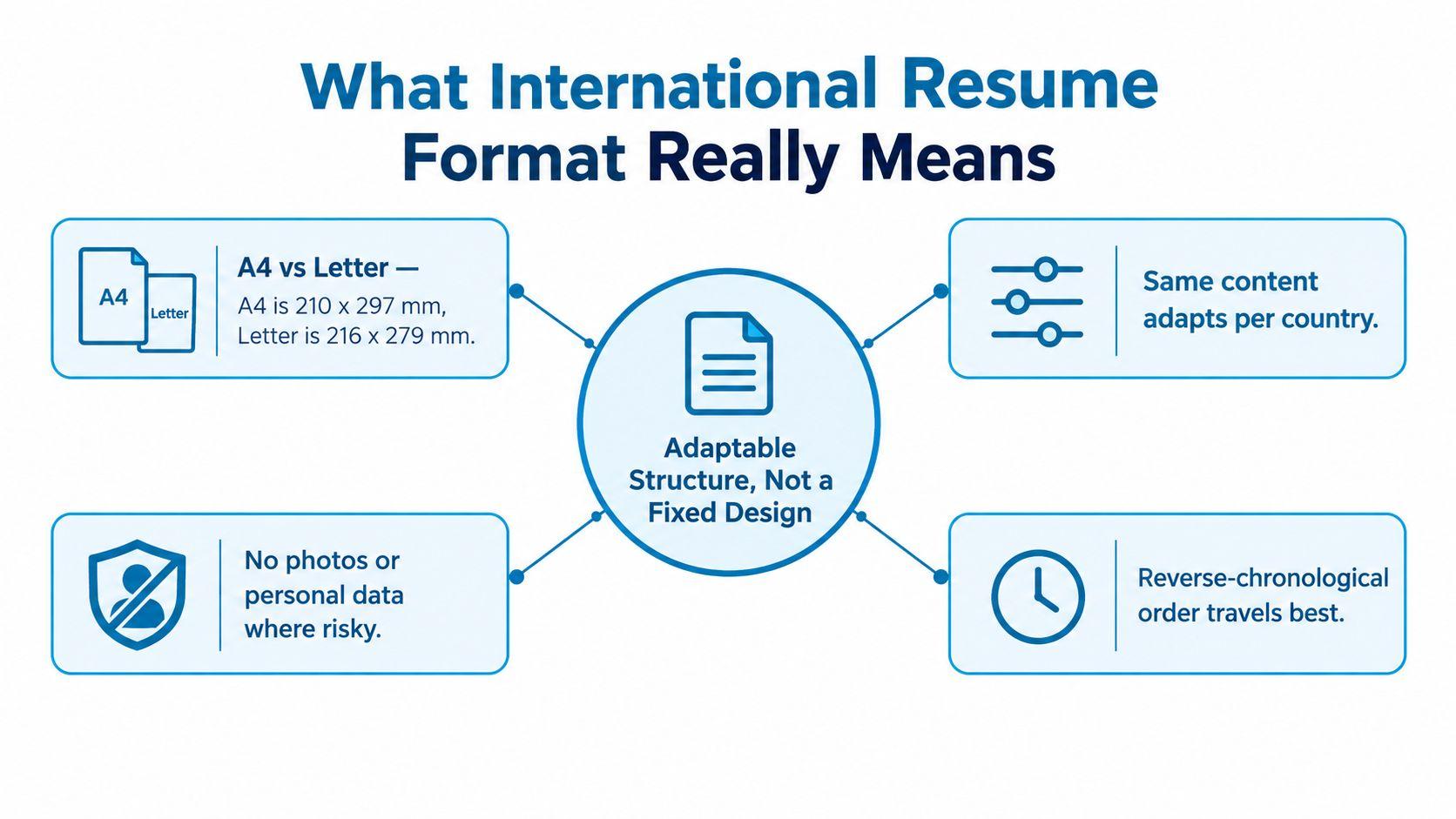
Practical rule: keep the core content stable, then export local versions for the market you’re targeting.
The core structure that travels best
A strong global foundation usually includes these pieces in the same order, unless local convention says otherwise:
- Contact block first. Keep it clean and functional, with only the details the destination market expects.
- Summary next. Make it short, direct, and tied to the role.
- Work history in reverse chronology. Recruiters scan recent experience first.
- Skills and education after that. These sections stay readable when they use plain text and standard headings.
That structure is the difference between a resume that adapts and a resume that gets rebuilt from scratch every time you apply. If you want a deeper look at live openings where this kind of flexibility matters, the visa sponsorship jobs in Europe category is a useful way to see how destination market expectations show up in real postings.
Country and Region Conventions You Must Localize
A resume can feel perfectly normal in one market and awkward in another. The safest way to handle that is to separate three decisions before you edit anything: what the law allows, what recruiters expect, and what ATS software can read without trouble.
What to include, and what to leave out
Start with the personal data block. In the United States and Canada, resumes are usually concise, and details such as photos, date of birth, marital status, and nationality are generally left out. In parts of continental Europe and some Gulf markets, more personal information can be expected, and in Germany, France, and parts of Asia a professional photo is often normal. The same document can therefore read as properly local in one country and overexposed in another. For a broader view of how local language and layout expectations shape those choices, Goodhand’s localization translation page is a useful reference point.
A practical rule helps here. Build the resume first, then localize the personal details last, after you know whether the target market wants them at all. That keeps you from sending a U.S.-style application with unnecessary private information or a European-style application that feels too bare.
| Market | Photo | DOB / Age | Nationality / Visa Status | Notes |
|---|---|---|---|---|
| U.S. | No | No | Only if relevant | Keep personal details minimal. |
| Canada | No | No | Only if relevant | Similar to U.S. norms. |
| U.K. | No | No | Usually unnecessary | Guidance commonly avoids age and marital status. |
| Germany | Often acceptable | Sometimes expected | May appear | Formal presentation is more common. |
| France | Often acceptable | Sometimes expected | May appear | Local conventions can be more detailed. |
| Gulf markets | Sometimes expected | Sometimes expected | May appear | Check employer and country norms carefully. |
| Parts of Asia | Often expected in some contexts | Varies by market | Varies | Local hiring practice matters as much as role level. |
This is why a universal template breaks down. A field that reassures one recruiter can create privacy concerns for another. A photo that feels standard in one market can feel misplaced in another.
Practical rule: if a field might create risk, include it only when the destination market clearly expects it or the employer asks for it.
Length changes by region too, but the rule is not rigid. In North America, resumes are usually shorter and more job-focused. In much of Europe, the same document may be called a CV and can include more detail. A modular resume works better than a single fixed file because it lets you switch personal fields in or out without rebuilding everything. For live examples of cross-border roles where these choices matter, the visa sponsorship jobs in Europe category gives you a practical way to compare how destination-market expectations show up in real postings.
A second layer matters as well. Personal data decisions are not only about style, they are also about market risk. Visa status can help in one posting, feel irrelevant in another, and create confusion if it is presented without context. That is why the strongest international resume format uses a core version that stays stable, then a market-specific version for visa-sponsored roles and another for work-from-anywhere applications. The core stays the same. The personal block changes with the destination.
ATS and File Format Rules That Decide If You Are Read
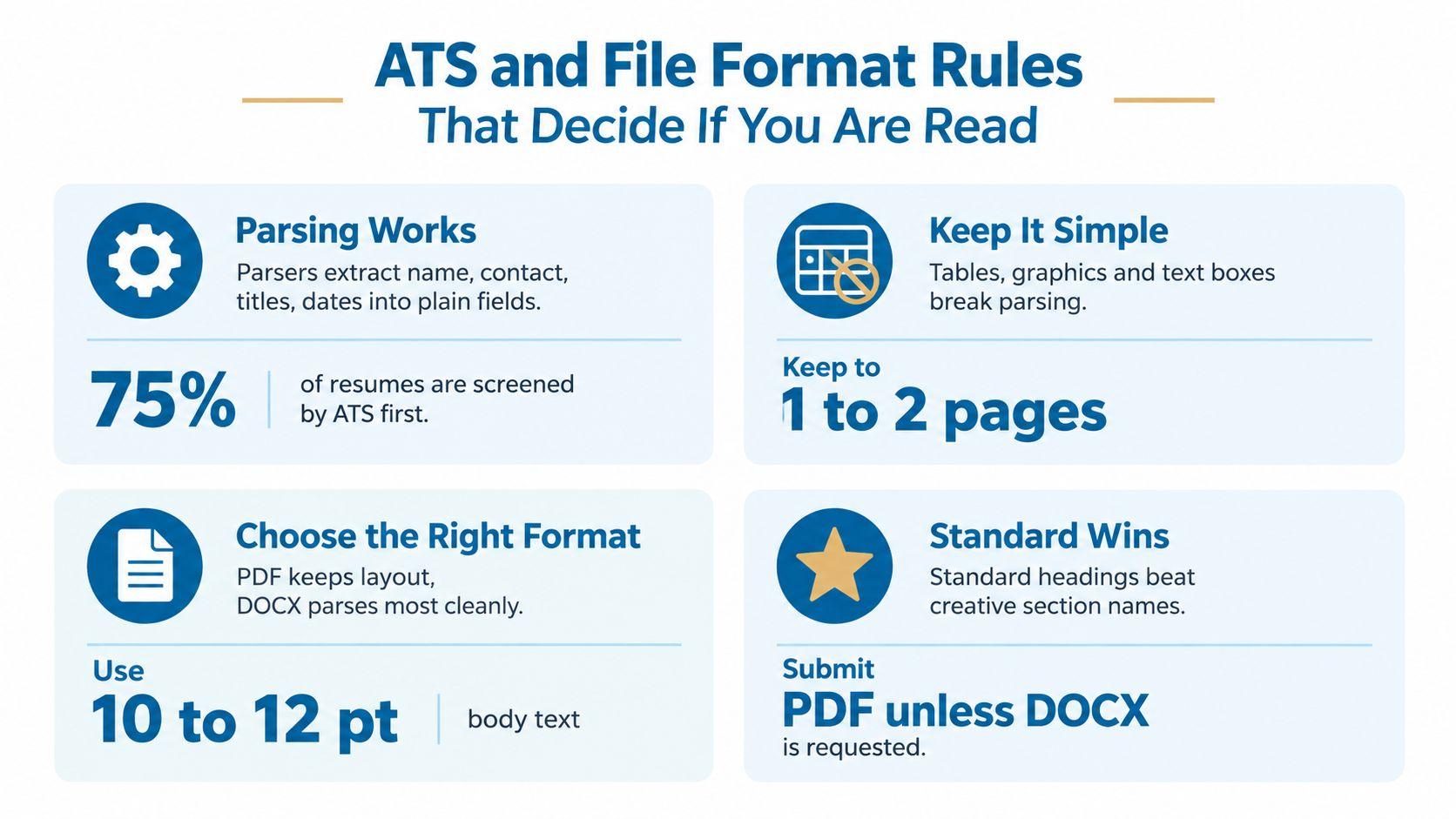
A recruiter cannot review what the software fails to parse. For international applications, that matters as much as the wording itself. A resume that looks polished to the eye can still drop key details if the file structure confuses an ATS. Contemporary ATS-focused research says resumes with tables, graphics, or images can lose 50% or more of their content when parsed, while a simple single-column format reaches a 94% parse success rate across major ATS platforms. The same source reports PDF acceptance at 96% of ATS systems and DOCX acceptance at 100%, with non-standard fonts causing parsing failures in 23% of cases and headers and footers ignored by 67% of ATS systems (ATS statistics).
That makes the safe choice fairly clear. Use plain structure first, visual decoration second. Standard section titles such as Work Experience, Education, and Skills give the parser obvious anchors, while inventive labels can hide information from software even when they still make sense to a person. A resume built in a design tool can look impressive and still fail at the first screen if the wrong fields disappear.
Use one column, left-aligned text, standard headings, and a clean font. If an employer asks for a specific format, follow that instruction. If the posting gives you no format rule, choose the version that keeps the content readable instead of the one that looks most stylized on screen.
How ATS reads your document
ATS software usually extracts your name, contact details, job titles, dates, and skills into plain text fields. It handles that job well when the structure is simple. It struggles when information sits inside text boxes, sidebars, headers, footers, or multiple columns. That is why layout decisions are not cosmetic. They decide which parts of your profile survive the scan.
- Name and title fields: keep them at the top in plain text.
- Work history: list roles in a clean chronological order.
- Skills: mirror the job description’s wording where it fits naturally.
- File choice: use PDF when the employer has not requested anything else, or DOCX when the posting specifies it.
File size can create a separate problem. If your resume is heavy after you localize it for different markets, a resume PDF size optimizer can help keep the file lighter without breaking readability.
Keyword alignment matters too. If a posting asks for a specific tool or core skill, use the same wording in your resume where it is truthful and relevant. That does not mean copying the ad line for line. It means matching the language the parser and recruiter are already scanning for.
The remote jobs board is a useful test case for this. Remote postings often use very specific wording around collaboration, communication, and work style, so both the ATS layer and the recruiter’s first read become easy to test. If your file is clean, readable, and aligned to the posting, it has a better chance of getting through the first screen.
Tailoring for Visa Sponsored and Remote Roles
Visa-sponsored roles and remote roles both reward precision, but for different reasons. In one case, the employer wants to know whether you’re eligible to work. In the other, they want to know whether you can do the job across distance and time zones. The same resume core can handle both if you place the right signals in the right places.
How to signal eligibility without oversharing
For visa-sponsored applications, keep the work authorization signal short and factual. Put it near the contact block or in the summary if the employer is screening for eligibility early. Use the language from the posting when it mentions sponsorship, relocation, or authorization, but avoid adding sensitive personal data unless the market expects it. The goal is to answer the eligibility question without turning the resume into a private dossier.
For remote roles, the signal changes. Employers care about location fit, remote experience, and whether you can work with distributed teams. If the role is work-from-anywhere, say that you’re open to distributed work and make your time-zone readiness clear. If it’s remote in one country only, don’t blur the distinction. Those are different jobs, and a recruiter will spot the mismatch quickly.
A resume should answer the employer’s first question before they ask it. For sponsored roles, that question is eligibility. For remote roles, it’s operational fit.
Where the wording belongs
A good modular resume usually places these details in predictable spots:
- Contact area: city, country, and, when relevant, work authorization status.
- Summary: one sentence about the kind of role you’re seeking, with sponsorship or remote language if it matters.
- Experience bullets: use phrases from the posting where they match your background.
- Skills section: include tools and collaboration terms that fit the role, especially for distributed teams.
That lets you reuse the same core document and shift the emphasis by market. You don’t need a different career history for each application. You need a different emphasis.
For roles where sponsorship is part of the search, the visa sponsorship jobs page can help you see how employers frame that requirement. If you’re applying to distributed teams, a separate remote-focused version of the same core resume should foreground asynchronous communication, time-zone awareness, and the platforms you’ve used.
JobGlance is one tool that can support that process, because it scores a resume against job postings and rebuilds it in a single-column ATS-friendly format. Used well, that kind of workflow helps you keep one master version and then localize exports for sponsored or remote roles without starting over each time.
Examples and Templates That Show the Adaptation
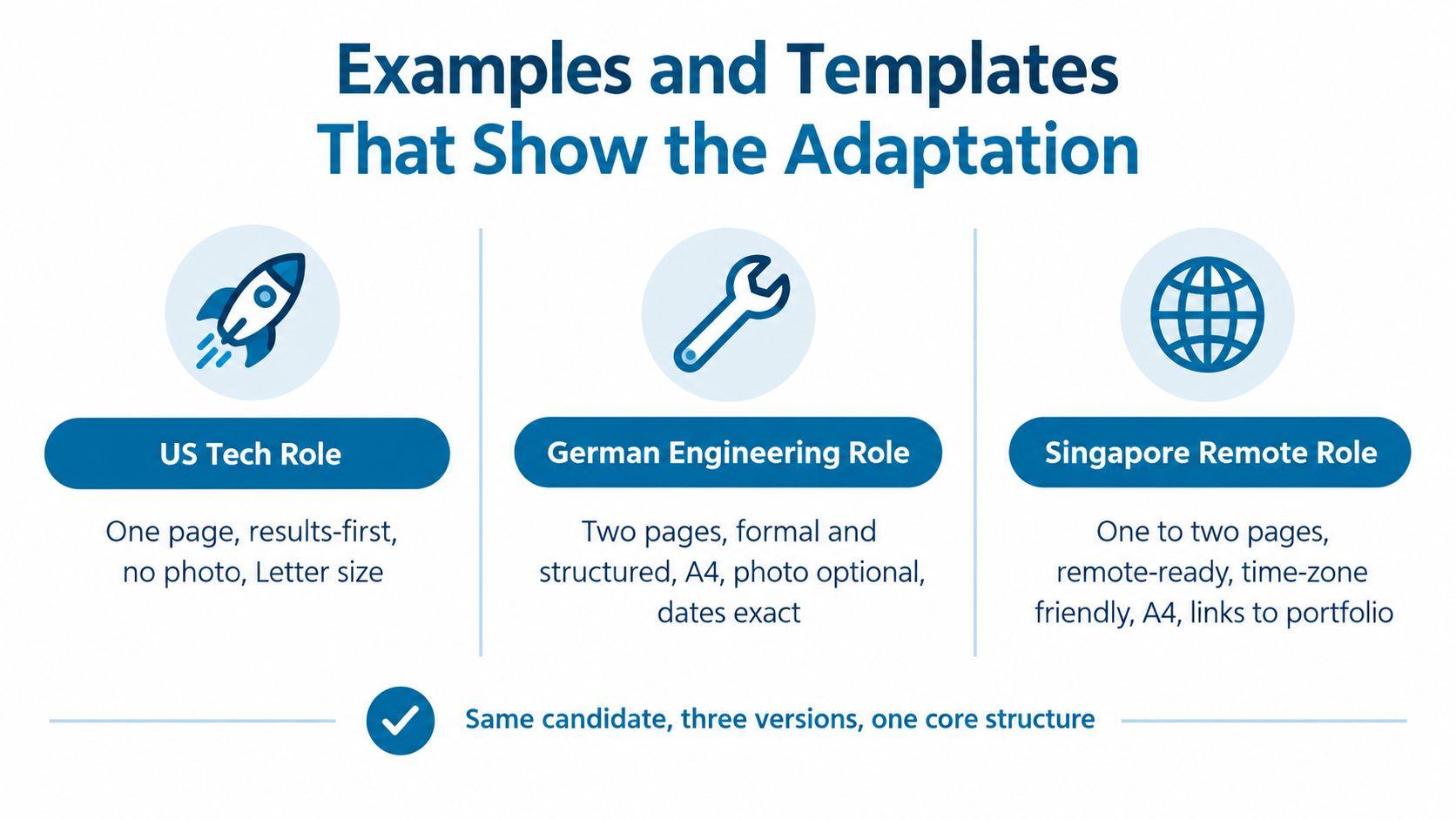
The easiest way to understand adaptation is to compare the same candidate in three markets. The experience stays the same. The frame changes. That’s the whole point of a modular resume.
A U.S. tech version
A U.S. version usually aims for one page, keeps the language results-first, and leaves out photos. The contact area stays minimal, and the summary gets straight to recent wins, tools, and job fit. If the candidate is a software engineer, the resume would emphasize shipped products, languages, frameworks, and measurable outcomes in plain text.
“Same person, different frame. The work history doesn’t change, but the U.S. version trims anything that doesn’t help a recruiter make a quick decision.”
A German engineering version
A German version often feels more formal and structured. It may use A4 paper, a two-page layout, and a more complete personal data block if that matches the employer’s norm. The document still needs clean chronology and clear headings, but the tone can be more detailed and methodical.
“The German version doesn’t just translate words, it changes the level of formality and the amount of personal information the employer expects.”
A Singapore remote version
A Singapore remote version sits between the two in some cases. It may still be concise, but it should highlight collaboration across locations, remote readiness, and time-zone coordination if the role depends on it. If the posting is remote-first, portfolio links, GitHub, or work samples can sit near the top so the recruiter sees proof of work quickly.
“The strongest remote version doesn’t shout ‘remote.’ It shows that distance won’t slow the work down.”
The structural pattern stays the same across all three. The candidate keeps the same core experience, then adjusts length, personal details, and emphasis. That’s much safer than trying to invent a new document for every country.
If you want to speed up the building process, an ATS resume builder can help you start from a single-column template and then export versions that match local norms. Templates are useful too, as long as they’re treated as a starting point, not a final answer. The resume should still reflect the market, the role, and your real background.
Final Checklist to Adapt Your Resume for Global Applications
Before you send an international application, check the basics in the order that matters. Start with paper size, then confirm length, then decide whether the market expects a résumé or CV style document. After that, review personal data fields, standardize your headings, and make sure the layout is single-column, left-aligned, and easy for ATS software to read.
A solid master file makes this easier. Build one core resume, then create localized exports for each market instead of maintaining unrelated documents. That way, your work history stays consistent while the details that create risk or confusion change by destination.
Use this quick filter before you hit submit:
- Paper format: A4 or Letter, depending on the market.
- Length: short and tight where expected, fuller where the norm allows it.
- Personal details: include only what the destination market expects or the posting asks for.
- Headings: use standard labels that software and recruiters recognize.
- Font and layout: keep them simple, clean, and readable.
- File type: follow employer instructions, or default to the format that preserves parsing.
- Keywords: mirror the job description where it’s truthful and relevant.
A good international resume isn’t the one with the most decoration. It’s the one that survives translation, scanning, and local expectations without losing your best qualifications. If you can localize the same core document for visa-sponsored roles, remote roles, and country-specific applications, you’re already ahead of most candidates.
If you want a faster way to find roles that fit your location, visa, and remote preferences, JobGlance brings those filters into one search flow and scores matches against your resume. Its built for international and remote job seekers who need clearer targeting before they apply. Visit JobGlance to compare live roles and shape your resume to the market you’re entering.
Keep reading


