How to Prepare for Technical Interview: A Time-Boxed Plan


On this page
Grinding more LeetCode isn’t a strategy, it’s procrastination with a scoreboard. Candidates do need coding reps, but the people who convert interviews care less about raw volume and more about whether you can explain trade-offs, recover when you get nudged off course, and stay sharp while someone watches you work. The strongest signal in the data is simple, preparation quality beats passive repetition, and the gap most guides miss is performing under observation, not solving in isolation.
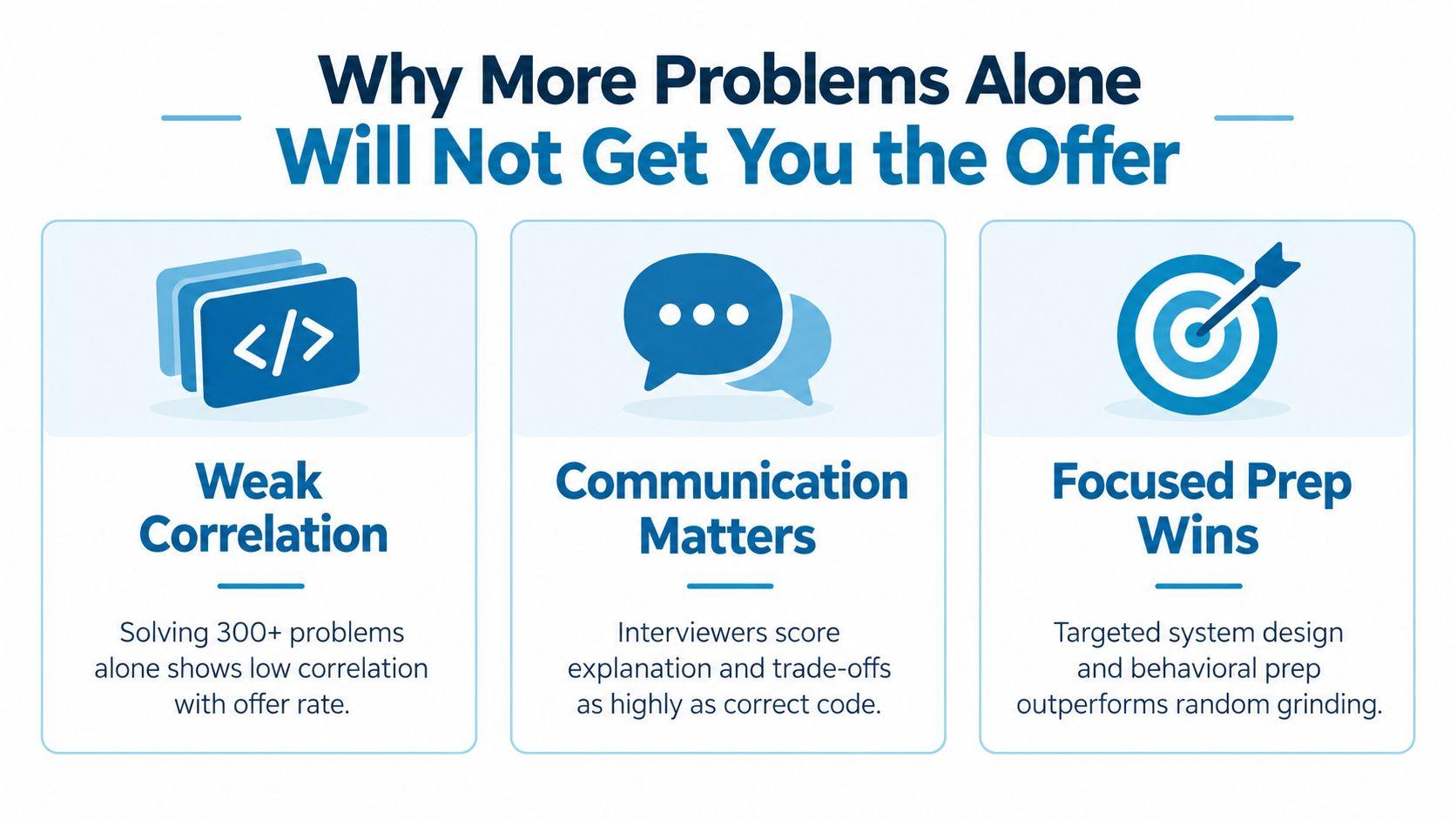
Why More Problems Alone Will Not Get You the Offer
The usual advice says to solve more problems until the offer appears. That sounds disciplined, but it misses what interviewers evaluate. In one analysis, problem count correlated only 0.27 with performance, which explained about 7% of outcome variance. The stronger signal was coverage of core interview patterns, so the study’s takeaway was to prioritize pattern coverage over raw count (A data-driven analysis of 100,000 technical interviews).
What actually moves the needle
Structured repetition works better than blind volume. A Hackerrank interview-prep analysis found that junior candidates who solved 20 coding challenges improved their onsite interview chances by at least 15%, while developers with 2+ years of experience who solved the same number saw a 50% increase in onsite chances. The same dataset said 5 mock interviews doubled the average chance of passing real interviews, which is a clearer signal that feedback and live performance matter as much as practice volume (Hackerrank interview practice study).
Practical rule: if your prep plan does not include timed mocks, you are training the wrong muscle.
The gap is usually not knowledge. Candidates can know the right approach and still lose the room if they cannot explain trade-offs, recover after a hint, and keep the solution coherent while someone watches them work. An arXiv study on software engineering candidates found that many people practiced coding in authentic settings but rarely prepared in front of an audience with observers, which matches what interviewers see every week (arXiv study).
The right target
A strong prep plan combines pattern coverage, mock interviews, and live narration. That is the difference between solving in private and earning trust under observation. If you can only perform when nobody is watching, you are not ready.
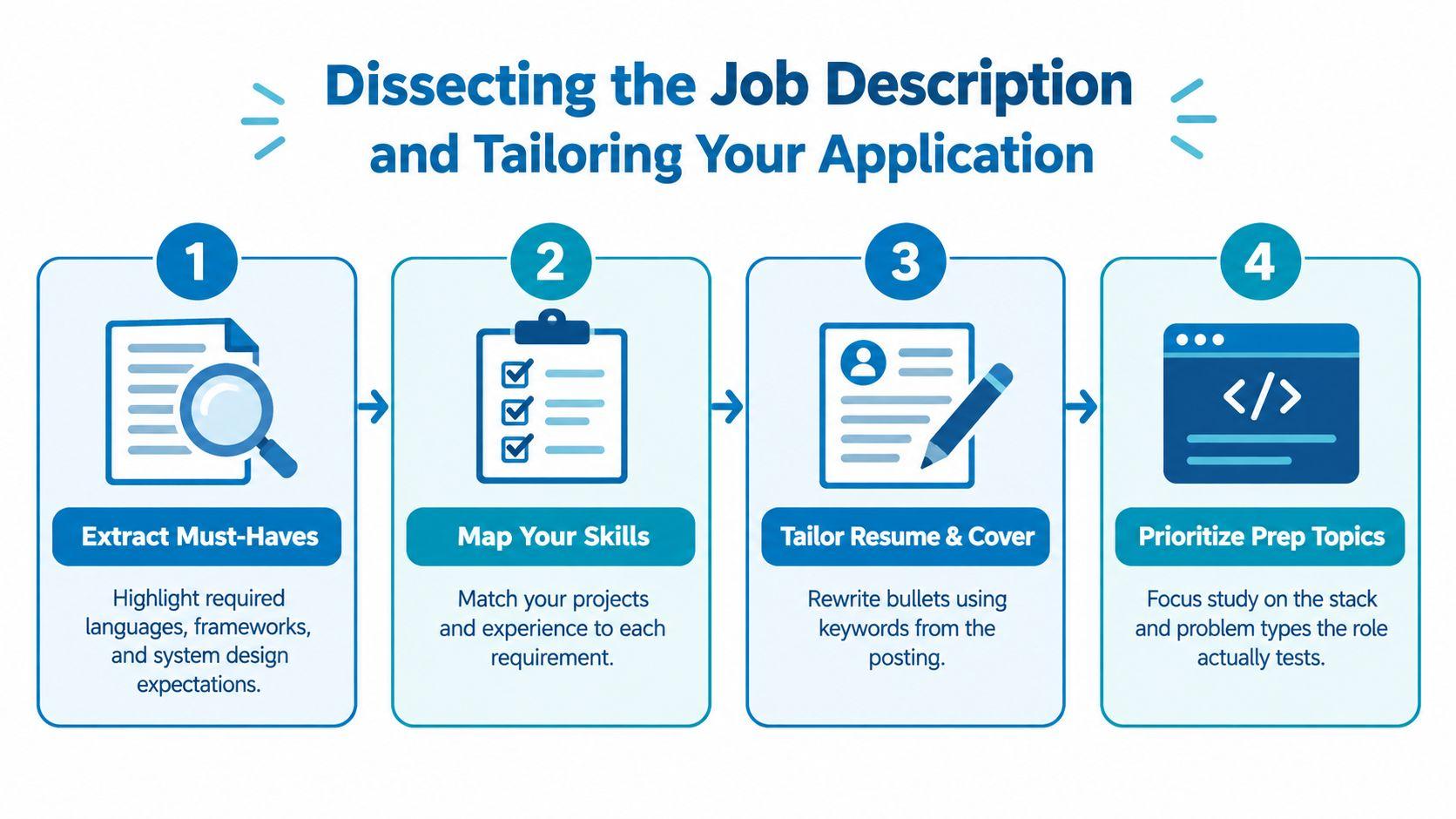
Dissecting the Job Description and Tailoring Your Application
Before you study, read the posting like an engineer, not like an applicant desperate to click apply. The job description tells you which languages, frameworks, systems, and collaboration habits matter most, and those signals should shape both your resume and your study plan. A role that emphasizes APIs, distributed systems, and ownership demands a very different interview prep mix than one that mostly values frontend performance or data pipelines.
Filter the role before you filter your time
Use a simple workflow. First, extract the must-haves, then map your own experience to each one, then rewrite your resume bullets so the language matches the posting. Finally, turn the same list into a prep map, because you shouldn’t spend a week on graph puzzles if the role is really testing service design, debugging, and production trade-offs.
For international candidates, the eligibility filter matters just as much as the skill filter. Remote can still mean country-limited remote, while work-from-anywhere means the employer is explicitly open to hiring globally. The same separation applies to sponsorship, where the employer has to act as your sponsor so you can legally work as a foreign national, and without that sponsorship they can only hire people who already have the right to work there. That distinction saves time, especially when the wrong filter sends you into a pipeline you can’t legally complete (JobGlance remote definition and category structure, visa sponsorship definition).
Build a shortlist before you build a study calendar
A focused search usually beats a broad one. JobGlance’s live role pages make that practical because they separate backend roles from other families, and they also keep remote and sponsorship filters distinct. For backend-focused candidates, the relevant role page is Backend roles.
The goal isn’t to collect dozens of tabs. It’s to narrow the field to 5 to 10 roles that are worth preparing for, then reverse-engineer the interview surface area from those postings. If a role repeats system design language, ownership, API design, and incident response, your prep should echo that pattern. If it keeps surfacing collaboration and production debugging, your resume and stories should reflect that too.
A clean shortlist also cuts down on wasted effort. JobGlance’s category pages show that remote searches can be segmented by geography and level, so you can align your prep with what you’re eligible for instead of treating every remote listing as interchangeable.
Building a Prioritized Study Plan for Coding and System Design
The best study plan is time-boxed, not aspirational. You’re not trying to “learn everything,” you’re trying to become interview-ready in a narrow window, usually by balancing coding patterns, system design, and the practical judgment companies now expect around APIs and AI-assisted workflows. Recent HackerRank reporting says companies are emphasizing real-world programming skills, REST APIs, and GenAI literacy, which means prep has to cover more than textbook algorithm drills (HackerRank on real-world programming skills and GenAI literacy).
Junior and senior candidates should train differently
Experience changes what you need to emphasize. Juniors usually need broader pattern recognition, while senior candidates need stronger system judgment, clearer trade-off language, and more practice explaining architecture choices out loud. The table below is a practical way to split a 4 to 6 week plan.
| Focus Area | Junior (0-2 years) | Senior (3+ years) |
|---|---|---|
| Coding patterns | High priority, heavy repetition | Moderate priority, targeted refresh |
| System design | Core fundamentals only | High priority, deeper trade-offs |
| Behavioral stories | Basic ownership and learning stories | Broader stories with scope, influence, and conflict |
| AI-tool judgment | Basic use and explanation | Strong focus on tool choice, review, and debugging |
| Mock interviews | Frequent, short, structured | Frequent, scenario-specific, higher pressure |
The point of the split is simple. Junior candidates usually lose offers because they can’t recognize enough patterns quickly. Senior candidates more often lose them because they can’t communicate architecture, leadership, and trade-offs with enough precision.
Time-box the week, then measure coverage
Use daily blocks instead of open-ended sessions. A good rhythm is one block for coding patterns, one for system design or practical system thinking, and one for review. When you finish a problem, record the pattern it belongs to. When you finish a system design prompt, record the decision points you handled well and the ones you missed.
Don’t count problems first. Count patterns, decision points, and clean explanations.
For many candidates, the turning point is moving from “I solved it” to “I can explain it cleanly in 10 minutes.” That’s the interview skill. A weak solution with a clear explanation often beats a correct solution delivered as silence and panic.
Use the role to shape the stack
If the job leans infrastructure-heavy, pair coding work with more time on system behavior, APIs, and reliability. For that kind of search, a role family like DevOps and SRE is a better prep signal than a generic software-engineering list. The interview loop itself is often broader than people expect, so your calendar should reflect the full range of what gets tested, not just the easiest part to practice alone.
Running Mock Interviews That Actually Improve Performance
Solo practice hits a ceiling fast. You can solve problems alone and still fail the interview because you do not narrate clearly, react well to interruptions, or recover when your first idea is wrong. The fix is to run mocks under the same pressure, with someone scoring the parts that decide the outcome.
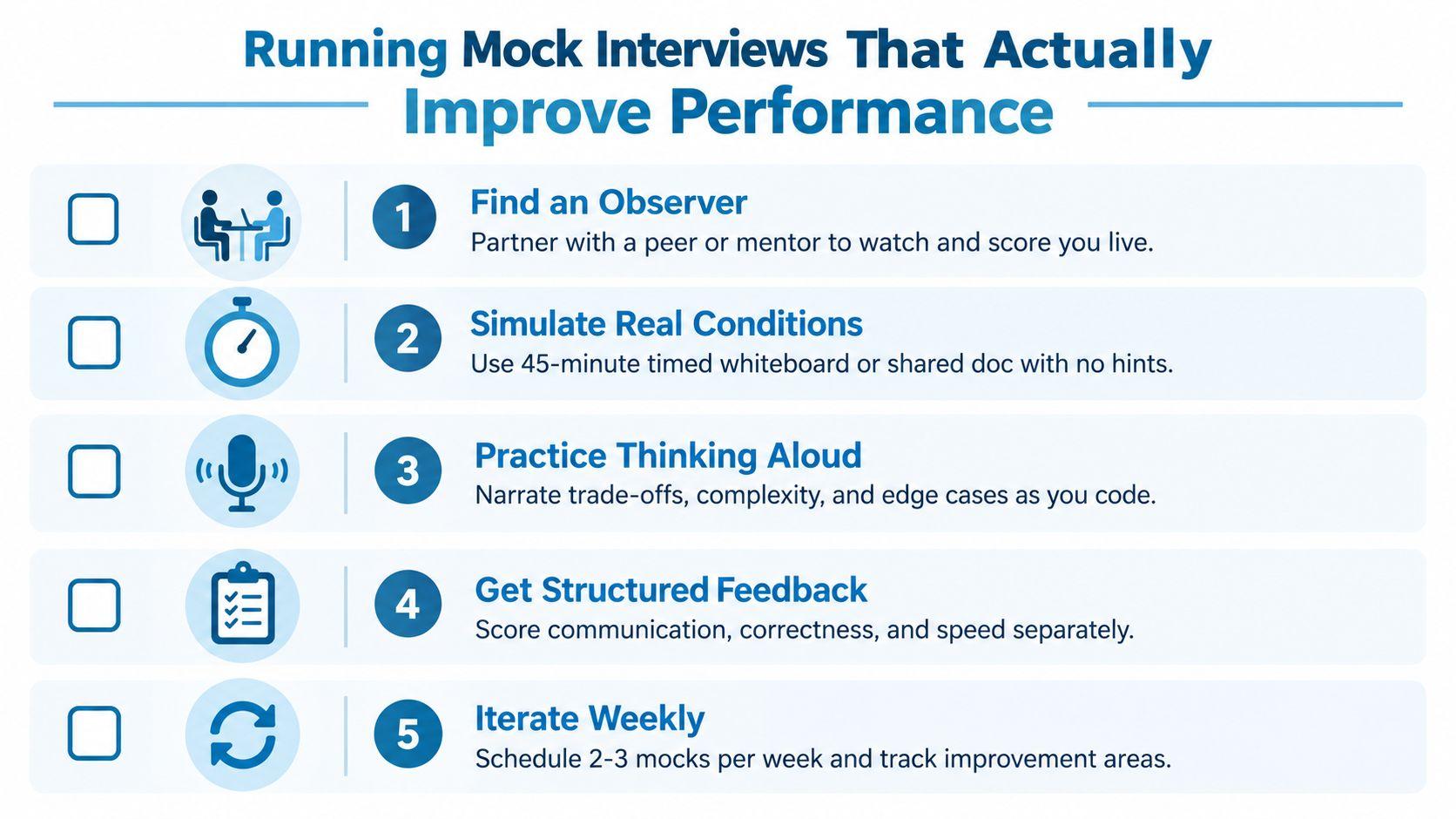
A useful mock protocol
Run 5 to 10 timed mocks. Keep each session close to the format you expect, whether that is a shared doc, a whiteboard, or a video call. Ask the observer to score communication, correctness, and speed separately. Those failures look different, and they improve in different ways.
A clean session has four parts:
- Set the conditions. No hints, no pausing to search notes, and no rescuing yourself with a full restart.
- Think aloud from the start. State assumptions, clarify constraints, and walk through the brute-force approach before you optimize.
- Accept interruptions. Let the observer ask questions mid-solution, then answer without losing the thread.
- Review the recording. Mark every point where you rambled, skipped edge cases, or buried the decision.
The fastest gains come from fixing communication gaps. Many candidates think they need more algorithms, but the issue is that they do not sound trustworthy under pressure. A recent arXiv study makes the same broad point, practice alone and practice under observation expose different weaknesses.
Drill the live parts separately
A few drills close that gap. Solve one problem while speaking every thought out loud. On the next pass, ask someone to interrupt you with a new constraint halfway through. On another pass, force yourself to present two approaches and compare them before you code. These are small exercises, but they train the exact muscles that private practice skips.
The other benefit is calibration. A mock tells you when a good answer is too slow, too messy, or too shallow for the role. That feedback is hard to get from self-study, and it is why structured mocks matter far more than passive review.
Preparing Behavioral Stories That Serve Multiple Rounds
Behavioral rounds are not a side quest. Hiring teams use them to test whether you can explain decisions, handle pressure, and stay consistent when the discussion moves from code to judgment. The same story often shows up in multiple rounds, including follow-ups from technical interviewers who want to hear how you worked through a trade-off or recovery.
Build one story bank, not three separate ones
Prepare 5 to 7 stories that can flex across behavioral, system design, and follow-up questions. One production bug can cover conflict, leadership, technical depth, and failure recovery if you structure it well. Separate stories for “teamwork,” “failure,” and “ownership” usually create more memorization work than value, and they fall apart when the interviewer shifts the prompt.
Use STAR, but keep it technical. The Situation should be short. The Task should name the system or constraint. The Action should say what you changed, and the Result should cover impact, trade-offs, or what you would do differently next time. If the story involved metrics, include them. If it involved a trade-off, spell that out. If it involved disagreement, describe the constraints on both sides instead of assigning blame.
Tailor the same story to different prompts
A strong story changes shape with the question. For “tell me about a conflict,” emphasize the disagreement and resolution. For “tell me about a failure,” focus on what broke and what changed afterward. For “how do you lead,” emphasize how you coordinated people or clarified a plan.
A senior interviewer rarely wants your autobiography. They want proof that you can make technical decisions, communicate them, and own the result.
Company research still matters. If the organization values reliability, talk about incident handling and prevention. If it values product velocity, talk about prioritization and shipping under uncertainty. The same event can answer several prompts if you control the emphasis instead of trying to invent new material every time.
Interview-Day Checklist and Progress Metrics
The last day before the interview should be quiet. Skip the cram session, stop chasing new topics, and resist the urge to become a different candidate overnight. Use the time to set up your environment, rest, and sharpen what already works.
24-hour checklist
- Test setup. Check your camera, mic, IDE, and internet connection before the interview window.
- Mental reset. Review lightly, sleep early, and plan short breaks so you do not show up exhausted.
- Review priorities. Revisit your core patterns and your strongest STAR stories, not every note you have ever taken.
- Arrive early. Log in 15 minutes early with water and notes ready, then stop fiddling.
Preparation should also match the role. If you are targeting work-from-anywhere roles, the interview may include different expectations around communication, timezone overlap, and self-management than a local remote job.
Readiness is easier to judge with numbers than with mood. Track how often you pass mock interviews, how many question patterns you can handle without drifting, and whether you can finish timed answers cleanly. For live coding, the test is not just solving. It is solving while narrating clearly, staying calm under observation, and handling the pressure of being judged in real time, including by tools or interviewers who are watching how you think.
A good sign is not “I felt great.” A better sign is that you can recover after a small interruption, restate the problem, and keep your structure intact. Easy practice can create false confidence. Timed mocks expose whether your process holds up when someone else is in the room.
The interview cycle can drag on, so do not overreact to one miss. As noted earlier, hiring can take a long time in some cases, which is enough reason to keep applying while you keep score on your own prep. A rejection is data about that interview, not a verdict on your ability.
Keep reading


