
7 Full Stack Java Jobs Sources to Watch in 2026


On this page
About 147,521 active Java developer openings are reported in the United States, with Java employment projected to grow 13% from 2018 to 2028 and roughly 20,900 new Java jobs expected during that period, according to recent Java hiring-market data. That volume sounds encouraging, but a large result count doesn’t tell you whether a role is current, genuinely full stack, open to your location, willing to sponsor a visa, or worth the application effort.
This roundup evaluates seven full stack Java jobs sources through the order candidates need to make decisions. It starts with demand evidence, moves through broad discovery and specialist channels, then covers startup hiring, compensation benchmarking, and eligibility checks. The practical filters are Java and Spring relevance, remote scope, visa sponsorship, salary context, listing freshness, and application quality.
JobGlance adds a workflow layer by aggregating 50,000+ active roles from 100+ job sites, refreshing its database every 24 hours, scoring results against your resume, and separating work-from-anywhere roles from domestic-remote jobs through dedicated filters. The JobGlance web app combines those signals with Smart Match, resume tailoring, company research, and application tracking.
Comparison criteria: Coverage finds opportunities. Signal quality identifies credible matches. Access confirms whether you can accept the role. Tailoring potential determines whether a promising listing becomes a strong application.
1. Backend Developer Skills, What Job Posts Actually Ask For in 2026
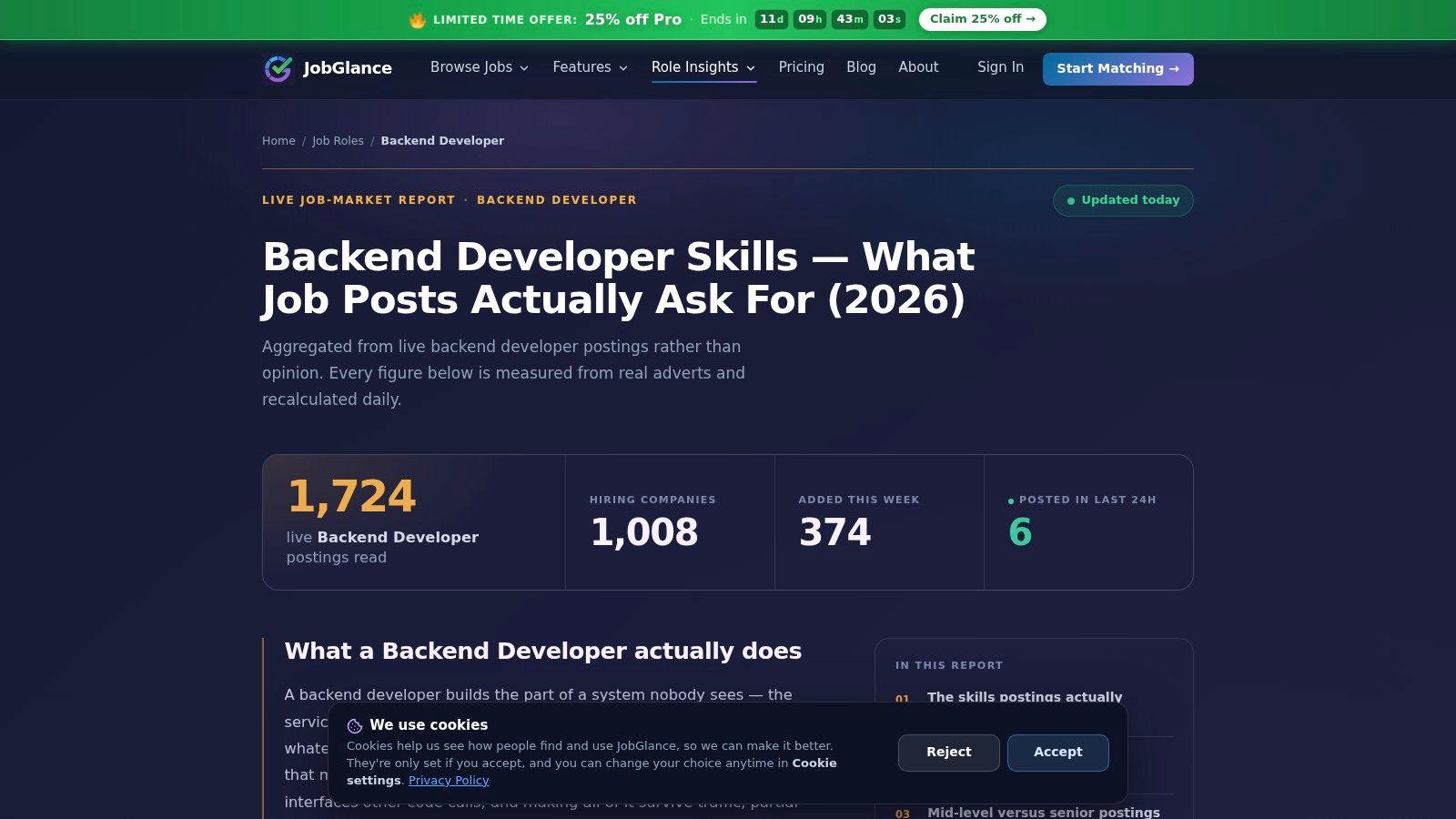
The best starting point isn’t a job board. It’s evidence about what employers are asking for right now. Backend Developer Skills, What Job Posts Actually Ask For turns live backend listings into a practical view of recurring technologies, experience expectations, salary bands, and hiring signals.
That matters because full stack Java jobs rarely stop at Java. Employers commonly combine Java with Spring or Spring Boot, databases, APIs, frontend frameworks, testing, cloud delivery, and production operations. A candidate who searches only for “Java developer” may miss full stack roles, while someone who presents every possible technology without showing Java depth can look unfocused.
The page is particularly useful for deciding whether your profile should lead with Java backend specialization plus frontend literacy or present as a broader full stack profile. That distinction is important in a market where employers are layering cloud-native delivery, CI/CD, observability, security, and AI integration onto established enterprise stacks. Recent hiring coverage describes this shift toward engineers who can work across product teams while still delivering modern infrastructure and AI-enabled workflows.
Why this source comes first
The report is refreshed from JobGlance’s aggregated listings, so it functions as a market snapshot rather than a static learning guide. It can help you identify whether Spring, databases, REST APIs, React, Angular, cloud, or DevOps appear repeatedly in the roles you want. It also exposes employer signals around sponsorship and global hiring, which keeps skill research connected to actual eligibility.
Its main limitation is weighting. Because the dataset has a strong Java and Spring presence, it may be less representative if you’re comparing Java with Go, Rust, or Node.js opportunities. Salary bands are also aggregated across locations and employers, so use them to spot direction and positioning, not as a personal offer prediction.
Practical rule: Use role evidence to choose what to emphasize, then use individual job descriptions to decide what belongs in the final resume.
The page connects directly with Smart Match, Career Gap Analysis, the ATS Resume Builder, and the AI Toolbox. That makes it more actionable than a general skills article. You can identify recurring gaps, compare them with your resume, and tailor your application to a specific role. For broader context on Java-oriented responsibilities, compare the software development Java role with the full stack postings you find.
Best for: Candidates deciding what to learn, experienced developers benchmarking their profile, and international applicants checking whether their Java skills align with roles that may support global hiring.
2. LinkedIn Jobs
LinkedIn Jobs is strongest when discovery needs to connect with professional context. It covers employers across company sizes, exposes recruiter activity, and lets candidates use their network alongside applications. For full stack Java jobs, that can be valuable because many enterprise openings are handled through recruiters, staffing partners, or hiring teams that respond better when a candidate has a credible profile and relevant connections.
Search supports titles, skills, locations, alerts, remote preferences, and experience levels. Many listings provide an Easy Apply route, while others send you to the employer’s applicant-tracking system. Premium features can add applicant insights, match signals, company growth information, and AI-generated job summaries, but those features don’t remove the need to read the actual requirements.
The weakness is competition and noise. Popular Java, Spring Boot, React, and Angular listings can attract attention quickly, and a prominent result isn’t necessarily the right result. A recruiter may describe a role as remote while restricting it to one country, state, or payroll jurisdiction.
Where LinkedIn fits the workflow
Use LinkedIn for employer discovery, recruiter outreach, and validation. Look for evidence that the company has a genuine engineering organization, then compare the role’s technical requirements with your resume. Don’t treat the profile-based recommendation feed as a complete market view because it reflects LinkedIn’s own recommendation logic rather than every relevant listing across the web.
For candidates seeking global eligibility, JobGlance’s worldwide remote jobs category creates a useful contrast. It separates roles that accept candidates from anywhere from domestic-remote roles that merely allow home working inside a specified country.
That distinction can save time. A Java full stack engineer outside the employer’s hiring country may be technically qualified but still unable to work there without sponsorship or a global employment arrangement. LinkedIn can surface the role, but you still need to verify access before investing in outreach or an application.
Best for: Network-led discovery, recruiter conversations, enterprise employers, and candidates who can use a strong professional profile to add context beyond a submitted resume.
3. Indeed
Indeed is the broadest discovery tool in this comparison. It brings together enterprise, mid-market, staffing, and employer-posted opportunities, which makes it useful when you don’t yet know where your next full stack Java job will come from. Its search filters cover remote status, salary, experience, company, and job type, while resume hosting and one-click application flows reduce friction.
That breadth comes with a triage cost. Duplicate listings can appear across employers and staffing firms, and older postings may remain visible after the hiring situation has changed. Staffing-heavy results can also blur the difference between a direct employer role, a contract assignment, and a recruiter-managed pipeline.
Use volume without lowering your standards
Indeed works best as a discovery net, not as your final ranking system. Search combinations such as Java, Spring Boot, REST, React, Angular, SQL, and microservices, then inspect the employer, location policy, application destination, and date information. If a listing asks for a long stack but gives no clear product, team, or employment context, it deserves less attention than a narrower role with transparent responsibilities.
The same distinction applies to international candidates. A posting that includes “remote” may still require work authorization in the United States or another specific market. JobGlance’s visa sponsorship software engineer listings put eligibility into the search process rather than leaving it buried in a keyword field.
Indeed is also useful for entry-level candidates because its breadth can reveal adjacent titles such as Java software engineer, application developer, backend engineer, or junior full stack developer. Yet market coverage doesn’t mean equal hiring probability. Recent full stack market analysis describes demand as concentrated toward senior and AI-capable engineers, with softer conditions for entry-level candidates and more startup experimentation with TypeScript, Go, or Python.
Best for: Wide discovery, mobile searching, staffing-led opportunities, and candidates who can tolerate more manual filtering to find credible matches.
4. Dice
Dice is more focused than general job search engines because its marketplace is built around technology and IT hiring. That focus makes it a productive source for Java roles involving enterprise systems, contract delivery, architecture, infrastructure, and specialized recruiter pipelines.
A Dice search is more likely to expose the language employers use when they need someone who can work inside an established technology environment. That may include Java or J2EE, Spring, persistence frameworks, messaging, web services, relational databases, SQL, test-driven development, microservices, and frontend frameworks. The resulting roles aren’t always branded “full stack Java developer,” so searching adjacent technical titles matters.
The trade-off is recruiter dependence
Dice can be valuable for mid-level and senior candidates, especially those open to contract work. Recruiters often use the platform to source candidates for clients, which can produce opportunities that don’t receive the same visibility on consumer-oriented boards. The downside is that the initial interaction may feel transactional, and sponsored or featured postings can receive more prominence than less-promoted roles.
Staffing duplication is another issue. Compare the client, project, location, contract terms, and application destination before treating similar listings as separate opportunities. A role repeated by several recruiters isn’t necessarily several openings.
Java’s enterprise durability explains why specialist coverage remains important. A 2025 ecosystem survey reported that 99% of surveyed organizations actively use Java, while nearly 70% said more than half of their applications are built with Java or run on a JVM, according to OpenLogic’s Java ecosystem analysis. That evidence supports using specialist boards for enterprise Java discovery, even when newer startups choose other stacks for greenfield products.
Best for: Mid-senior engineers, contract candidates, enterprise Java specialists, and applicants comfortable working with technology recruiters.
5. Wellfound
Wellfound changes the hiring conversation by concentrating on startups from seed stage through growth companies. Full stack Java jobs there may describe the product, stack, team size, salary, equity, and expected ownership more directly than a large enterprise listing. Candidates can often communicate with founders or hiring managers instead of moving immediately into a standard ATS process.
That directness is the main advantage. A Java engineer who can explain how Spring Boot supports a product, how APIs connect to a modern frontend, or how cloud deployment affects reliability may stand out more in a small team than through a keyword-heavy application queue. Startup listings also tend to make the relationship between technical work and business outcomes clearer.
Startup fit requires a different risk assessment
Wellfound isn’t the place to assume that every listing has the stability, process, or role boundaries of a large employer. Early-stage teams may expect one engineer to handle backend development, frontend delivery, deployment, debugging, and product decisions. That can be a strong opportunity for a broad builder, but it can frustrate someone seeking a narrowly defined Java role.
The platform is also less useful if your priority is maximum enterprise coverage. Banks, insurers, government-adjacent teams, and large technology organizations may be easier to find through LinkedIn, Indeed, or Dice. Startup listings may also change quickly, so verify whether the company is still hiring before spending time on a highly specific application.
The market context matters here. Dice’s full stack Java jobs overview highlights Java’s continued presence across enterprise sectors and reports roughly 9.2 million Java developers worldwide, while also noting that 94% of Fortune 500 companies use Java. That doesn’t make every startup a poor choice, but it shows why Wellfound should be a complementary channel rather than your only source.
Best for: Product-minded engineers, candidates who want direct conversations, and Java developers comfortable with broader ownership in smaller teams.
6. Built In
Built In combines job listings with company profiles and technology-focused editorial content. That combination helps candidates assess more than the technical stack. You can investigate a company’s product, culture, location strategy, and compensation context before deciding whether a full stack Java role deserves a personalized application.
The platform is particularly useful for candidates targeting product-focused technology companies and roles in established tech hubs. Listings often provide richer employer context than a generic aggregator, and remote and location pages make it easier to narrow the search by geography.
Treat company context as an application-quality signal
A Java role is more attractive when the company explains what its engineers build, how teams collaborate, and what the position owns. That information can improve both your decision and your application. Instead of repeating “Java and Spring Boot” in a cover letter, you can connect your experience to the company’s product, customers, delivery model, or engineering challenges.
Built In’s limitation is coverage. It leans toward U.S. technology markets, funded startups, and tech-forward employers, so it may not show the same breadth of banking, public-sector, or international listings as LinkedIn and Indeed. Its remote inventory is also smaller in sheer breadth than the largest generalist platforms.
Use it when quality of employer context matters more than raw volume. For candidates who need sponsorship, company research is especially important, but a detailed profile still doesn’t prove that a specific position supports international hiring. Check the posting’s work authorization language and use a dedicated eligibility filter before applying.
Best for: Candidates researching product companies, evaluating culture and engineering context, and preparing for interviews after finding a promising role.
7. Levels.fyi Jobs
Levels.fyi Jobs is the compensation and leveling source in this list. Its job board lets candidates filter around compensation, level, company, and remote preferences, while its salary reports and community data provide context for negotiation.
For Java full stack candidates, that context is useful because job titles vary widely. One employer may call the role full stack Java developer, another software engineer, and another senior backend engineer with frontend responsibilities. Comparing level and total compensation can reveal whether a role is aligned with your experience, even when titles aren’t consistent.
A 2026 salary dataset reports average U.S. annual pay of $120,804 for Java full stack roles, with most salaries between $105,000 and $135,500 and the 90th percentile at $148,500, according to ZipRecruiter’s Java full stack salary data. The same source reports an average hourly rate of $58.08 for a full stack Java developer listing, with most workers earning between $50.48 and $65.14 per hour.
Compensation is a filter, not a verdict
Levels.fyi is strongest when you already understand your target role and need a realistic negotiation range. It can help you identify companies and levels worth pursuing, but incomplete compensation data limits comparisons. Total compensation may include base pay, bonus, equity, or other components that aren’t directly interchangeable.
The platform also skews toward larger technology employers and highly visible companies. That makes it less representative of small businesses, regional employers, and some traditional enterprise Java teams. Use it to benchmark a shortlist, then verify the actual range, location adjustment, employment type, and benefits in the posting.
Best for: Experienced candidates setting compensation targets, applicants comparing levels, and engineers preparing for negotiation rather than just maximizing application volume.
Full-Stack Java Jobs: 7-Source Requirements Comparison
| Item | Implementation complexity (🔄) | Resource requirements (⚡) | Expected outcomes (⭐ 📊) | Ideal use cases (💡) | Key advantages |
|---|---|---|---|---|---|
| Backend Developer Skills, What Job Posts Actually Ask For (2026) | 🔄 Low, consume & act quickly | ⚡ Low, web access; JobGlance account recommended | ⭐ High-quality market signals; 📊 Current skill & salary trends | 💡 Upskilling, resume tailoring, visa/eligibility checks | Daily-refreshed data; employer hiring signals; actionable integrations |
| LinkedIn Jobs | 🔄 Medium, profile optimization + networking | ⚡ Moderate, time investment; optional Premium cost | ⭐ Broad exposure; 📊 Recruiter outreach & match signals | 💡 Networked discovery, outreach, mid–senior searches | Largest employer coverage; direct recruiter contact; premium insights |
| Indeed | 🔄 Low, minimal setup; quick apply | ⚡ Low, resume hosting; frequent mobile use | ⭐ High-volume leads; 📊 Wide coverage but mixed quality | 💡 Cast a wide net, frequent searching, entry to mid roles | Unmatched listing volume; one-click apply; strong mobile experience |
| Dice | 🔄 Medium, tech-focused profile & sourcing | ⚡ Moderate, profile maintenance; recruiter engagement | ⭐ Targeted tech matches; 📊 Good signal for mid–senior Java roles | 💡 Tech-specialist hiring, contractor and perm roles | Tech-only marketplace; recruiter sourcing tools; credible listings |
| Wellfound (ex–AngelList Talent) | 🔄 Low–Medium, profile + direct messaging | ⚡ Low, profile setup; active chat with founders | ⭐ Fast direct conversations; 📊 Startup role and comp visibility | 💡 Early-stage startups, roles with equity, founder outreach | Direct apply/chat; salary/equity shown; faster non‑ATS lead |
| Built In | 🔄 Medium, research-driven applications | ⚡ Moderate, company vetting and targeted outreach | ⭐ Higher signal for product-fit roles; 📊 Rich company context | 💡 US tech hubs, product-focused teams, interview prep | In-depth company profiles; salary guides; culture insight |
| Levels.fyi Jobs | 🔄 Medium, filter by level/compensation | ⚡ Moderate, time to benchmark & filter | ⭐ Strong for compensation-targeted matches; 📊 Benchmarks for negotiation | 💡 Targeting high-pay roles; negotiation prep and leveling | Compensation transparency; leveling data and pay reports |
Turn Seven Sources Into One Shortlist
Start with Backend Developer Skills, What Job Posts Actually Ask For. Use it to identify which Java and Spring skills appear across current roles, where frontend expectations enter the profile, and which gaps recur often enough to affect your next applications. This gives you a demand-led starting point instead of choosing technologies because a single job description happened to mention them.
Next, use LinkedIn, Indeed, Dice, Wellfound, and Built In for different types of discovery. LinkedIn is useful for recruiters and employer context. Indeed expands coverage. Dice improves access to specialist and contract pipelines. Wellfound exposes startup opportunities and direct conversations. Built In adds company and product context that can improve application quality.
Don’t merge every result into one undifferentiated list. Apply a decision sequence:
- Confirm technical fit: Look for Java, Spring or Spring Boot, APIs, databases, frontend requirements, testing, cloud, CI/CD, security, and observability.
- Confirm practical access: Check whether the role is onsite, hybrid, domestic-remote, or fully open to candidates in other countries.
- Confirm freshness: Review the posting date, employer site, application destination, and signs that the vacancy is still active.
- Confirm compensation context: Compare the stated range with level, location, employment type, and total compensation expectations.
- Confirm application value: Prefer roles where your experience maps clearly to the responsibilities and your resume can demonstrate relevant outcomes.
JobGlance can reduce the repetition created by searching several sources separately. Use Search & Rank to query titles or skills and let Smart Match rank the results against your resume. The platform re-ranks the result set when the query or a filter changes, so you can test Java, Spring Boot, frontend, sponsorship, and remote combinations without manually rebuilding the search on every board.
Eligibility should come before deep application work. Stack the dedicated visa sponsorship or work-from-anywhere filters before reviewing roles, rather than treating “remote” as proof that you can work from another country. The distinction matters because the market contains both domestic-remote roles and global opportunities, and the two categories aren’t interchangeable.
Then inspect the 0–100 resume match score and the highlighted matched and missing keywords. A low score doesn’t automatically mean you should reject a role, but it does tell you where the application may fail an ATS screen or appear weak to a recruiter. Use Career Gap Analysis to identify recurring missing skills across saved roles, not just one-off keywords from a single advertisement.
For strong matches, tailor the ATS resume and cover letter to the actual posting. Lead with the Java and Spring experience the employer needs, show frontend capability where the role requires it, and add cloud, CI/CD, security, or AI integration only when you can support those claims with real work. JobGlance’s ATS Resume Builder can rebuild and tailor the resume, while the AI Toolbox can create a cover letter from the job description and your resume.
Before applying, use Deep Company Research to examine listing legitimacy, company stability, culture, and interview difficulty with cited evidence and confidence levels. Use Similar Jobs Across Sites to find equivalent openings, which can reveal a better location policy, clearer salary range, or more direct application route. That comparison is especially useful when a listing appears on several boards with different descriptions.
Finally, track every serious application account-wide. Record the source, role, company, eligibility signal, custom resume version, recruiter contact, and next action. A broad search becomes useful only when you can distinguish a discovered listing from a qualified opportunity and a qualified opportunity from a well-prepared application.
The best full stack Java jobs shortlist balances technical fit, eligibility, freshness, compensation, and tailoring. No single board delivers all five. The practical advantage comes from using each source for its strongest signal, then applying one consistent workflow to decide what deserves your time.
JobGlance brings live job aggregation, resume-based match scoring, visa sponsorship and work-from-anywhere filters, AI-assisted tailoring, company research, similar-role discovery, and application tracking into one workflow. For full stack Java jobs, use it to move from scattered listings to a shortlist built around skills, access, freshness, and application quality, then visit JobGlance to start searching.
Keep reading


