
10 Data Engineer Interview Questions to Know


On this page
A 2026 analysis of 14,096 data-engineer interview questions across 566 live sessions found that data pipelines and architecture led the field with 1,057 questions, followed by SQL with 845 and Apache Spark with 686 (Final Round AI analysis). The pattern is clear: interviewers aren’t testing whether you can recite definitions. They’re testing whether you can make sound decisions when data is late, duplicated, expensive to process, difficult to govern, or needed by several teams at once.
Strong data engineer interview questions therefore demand more than tool familiarity. A good answer clarifies requirements, states trade-offs, describes an implementation, connects the decision to a measurable outcome where you have evidence, and explains how the system remains reliable after launch. This list moves from SQL and pipeline foundations through warehouse modeling, Spark, streaming, scalable platform design, security, and behavioral evidence.
Use Prompt Builder data analyst packs to turn weak areas into practice prompts, then compare target listings in JobGlance. Its Career Gap Analysis can surface repeated skills across saved roles, while resume matching helps align your language with the jobs you’re pursuing. The aim isn’t to memorize ten polished speeches. It’s to build ten adaptable stories that prove you can operate data systems under real constraints.
1. Explain the Difference Between ETL and ELT Pipelines
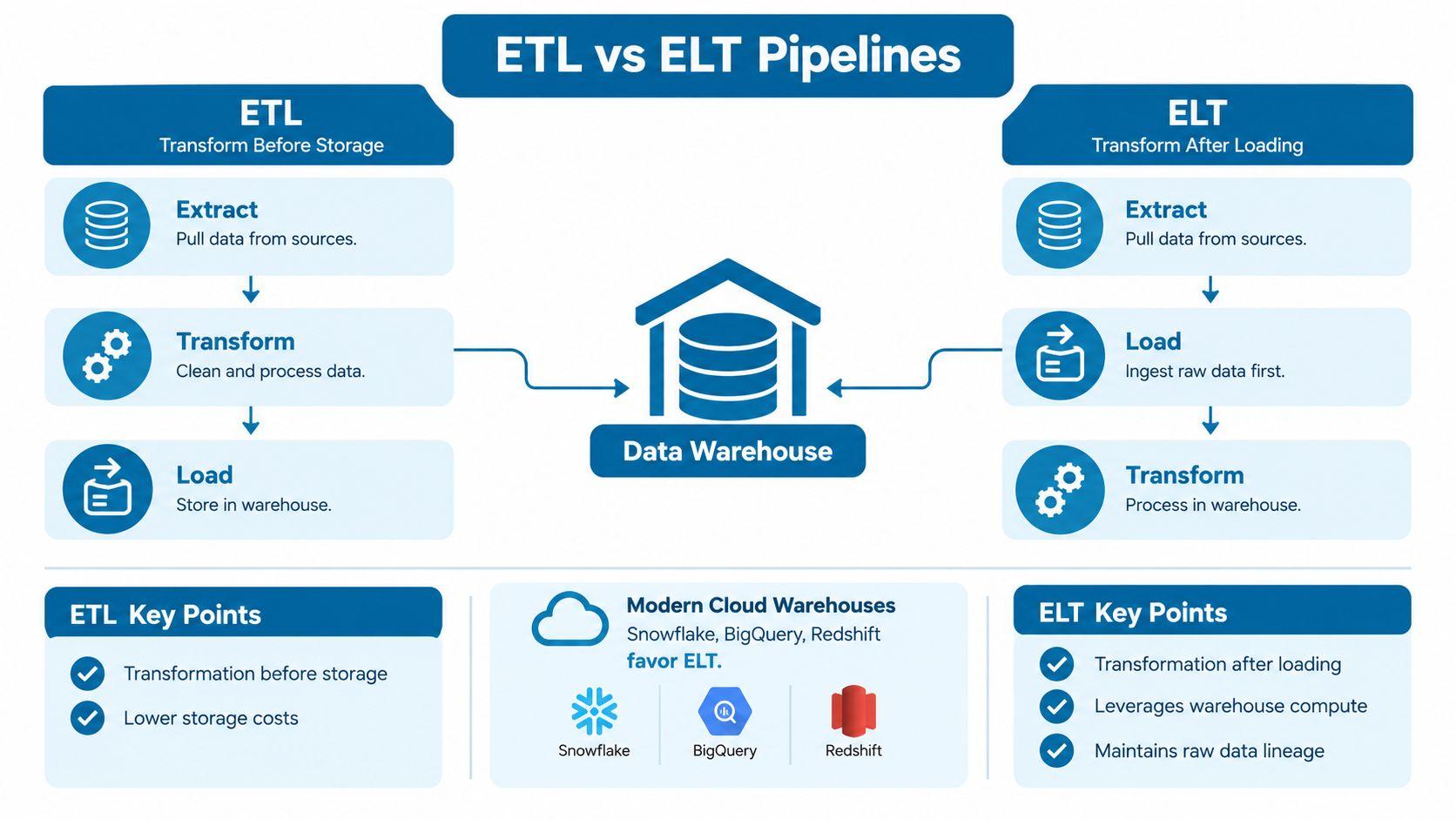
ETL transforms data before loading it into the destination. ELT extracts and loads raw data first, then performs transformations inside the warehouse or lakehouse. The distinction matters because it changes where compute happens, how much raw history you retain, and how easily you can reprocess a transformation when business logic changes.
A strong answer should avoid calling one pattern universally better. ETL can suit sensitive data that must be filtered before storage, systems with limited warehouse compute, or workflows requiring transformation close to the source. ELT often suits cloud warehouses because raw data remains available for lineage, auditability, and later modeling. You should discuss latency, cost, governance, schema control, and recovery, not just expand the acronyms.
What a convincing answer should include
Name the tools that fit the architecture. Apache Airflow can orchestrate extraction and transformation dependencies, dbt can manage warehouse-based SQL transformations, and platforms such as Snowflake separate storage from compute, which affects scaling decisions. You might describe a pipeline that lands immutable source data, validates its schema, applies dbt models, and publishes tested marts for analysts.
Avoid unsupported performance claims or borrowed company examples. Instead, use your own project and explain what changed. Did raw retention make a backfill safer? Did early transformation reduce exposure to sensitive fields? Did an incremental model lower processing demand? If you can’t quantify the result, describe the operational evidence, such as fewer manual reruns or clearer lineage.
Practical rule: Don’t defend ETL or ELT as a slogan. Defend it against the source system, data sensitivity, freshness requirement, warehouse capability, and failure-recovery plan.
Your resume should make the choice visible. “Built Airflow pipeline” is weak. “Designed an Airflow-orchestrated ELT workflow with dbt models, source validation, and documented lineage” gives an interviewer several useful follow-up paths.
2. Design a Data Pipeline for Handling Real-Time Streaming Data at Scale
Start with requirements, not Kafka. Ask about event volume, latency targets, delivery guarantees, ordering, retention, replay needs, acceptable duplication, and the consequences of late data. A design that works for live dashboards may be inappropriate for financial reconciliation or fraud detection.
Then describe a layered architecture: producers publish events to Kafka topics or a managed equivalent, consumer groups process partitions, a streaming engine such as Apache Flink or Spark Structured Streaming applies transformations, and results land in durable storage and serving systems. Explain how state is stored, how windows are chosen, and how downstream consumers recover after failure.
The assessment is in the failure paths
Interviewers will listen for operational detail. Discuss consumer lag, broker or worker failure, backpressure, malformed events, out-of-order arrivals, and replay. A dead-letter topic can isolate records that repeatedly fail validation. Checkpointing and durable offsets can support recovery, but you should explain how the sink avoids duplicate effects when a message is retried.
Monitoring should include consumer lag, processing latency, throughput, error rates, checkpoint health, and data freshness. A dashboard without an escalation path isn’t observability. Explain who receives the alert, what runbook they follow, and how you distinguish a slow producer from a blocked consumer.
A production-oriented role may also overlap with DevOps and SRE openings, where reliability, incident response, and service ownership are evaluated directly. That overlap is useful resume evidence: show the deployment model, infrastructure ownership, alerting, and recovery work, not only the transformation code.
3. How Would You Optimize a Slow-Running SQL Query in a Data Warehouse?
Don’t begin by rewriting SQL from memory. Begin with the execution plan, query history, warehouse workload, and the size and shape of the data. A slow query can result from a full scan, an inefficient join, skewed distribution, excessive sorting, stale statistics, poor partition pruning, or competition for compute.
Your answer should follow a diagnostic sequence. Confirm whether the regression is new, identify the expensive operator, inspect filters and join cardinality, check whether the query selects unnecessary columns, and compare the actual plan with the expected access path. Then propose the least risky intervention. Depending on the platform, that might involve partitioning, clustering, distribution keys, a materialized view, a pre-aggregated model, or a query rewrite.
Show warehouse judgment
The same fix doesn’t apply everywhere. Snowflake clustering, Redshift distribution choices, and BigQuery partitioning and clustering address related problems through different mechanisms. Mention query queue time, slot or warehouse utilization, concurrent users, and cost visibility. A technically faster query can still be a poor solution if it creates an expensive refresh process or harms other workloads.
A good example includes a baseline, the evidence you inspected, the change, and the validation method. If you don’t have a measured improvement, don’t invent one. Say that you compared execution plans, scanned bytes, runtime, concurrency impact, or warehouse consumption before and after the change.
Query optimization is an investigation. The strongest answer explains why the engine was slow before it explains what code was changed.
Resume signals should name the platform and method: “optimized BigQuery models through partition pruning and query-plan analysis” is more credible than “improved SQL performance.” Include monitoring or cost controls if you owned them.
4. Describe Your Experience Building Data Quality Frameworks and Data Validation Pipelines
Data quality work becomes persuasive when you connect a rule to a business risk. A null check may protect a revenue report, a uniqueness test may prevent double-counting, and a referential-integrity check may stop an incomplete customer dimension from reaching a machine-learning feature set.
Describe quality as a set of controls across the pipeline. Validate schemas and required fields near ingestion, test transformations in staging, apply business rules before publication, and monitor distributions and freshness after deployment. Tools might include dbt tests, Great Expectations, Soda, or a custom validation framework, but the tool is less important than the ownership model and failure behavior.
Explain what happens when a test fails
A strong response distinguishes blocking failures from warnings. A broken primary key may quarantine a batch, while a modest distribution change may create an alert for investigation. Explain where bad records go, whether valid records can continue, how alerts are routed, and how a data owner confirms resolution.
Your incident story should cover the symptom, detection point, root cause, containment, stakeholder communication, and prevention. Don’t claim a percentage reduction or saved cost unless your records support it. Evidence can also be operational, such as a new contract, a quarantine table, a runbook, or a dashboard that made ownership explicit.
For roles that blend engineering and analysis, compare your preparation with data analyst openings. The overlap can reveal whether your resume presents quality as engineering ownership or merely as a reporting task. You can also compare data quality platforms when evaluating terminology for your target employers.
5. Walk Through How You Would Design a Data Warehouse Schema for an E-Commerce Platform
Begin with business questions. An e-commerce warehouse might need to explain revenue by product and region, order conversion, returns, inventory movement, customer activity, and fulfillment performance. Those questions determine the grain of each fact table and prevent a schema that looks tidy but cannot answer operational questions accurately.
State the grain before naming tables. An order fact can represent one order, while an order-line fact represents one product line within an order. Mixing those grains creates incorrect totals, especially when analysts join orders to line items, shipments, discounts, or returns. A strong answer names separate facts where necessary and makes additive and non-additive measures explicit.
Model history deliberately
Likely dimensions include customer, product, date, geography, and fulfillment. Explain how product category, price, address, or customer status changes over time. A slowly changing dimension strategy should preserve historical truth when the business asks what was known at the time of the sale, while a simpler overwrite may be acceptable when only the current state matters.
Choose a star or more normalized design based on query patterns, governance, and scale. Denormalized dimensions can simplify analysis, while normalized structures can reduce duplication and clarify ownership. Discuss surrogate keys, late-arriving dimensions, refunds, cancellations, and unknown members. These details distinguish a schema designed from a diagram copied from a textbook.
Your resume should show the business outcome of modeling work without fabricating numbers. Mention the fact grain, warehouse platform, dbt or SQL implementation, testing, and the stakeholders who used the models. “Built revenue mart” is vague. “Modeled order-line, shipment, and return facts with historical product dimensions for finance and operations reporting” demonstrates actual design judgment.
6. How Do You Approach Debugging a Data Pipeline That’s Producing Incorrect Results?
Incorrect output requires a data investigation, even when the pipeline reports success. Common causes include duplicate joins, changed source semantics, late records, faulty filters, and incorrect history handling. A strong answer begins by defining the affected data, users, time period, and business risk before proposing a fix.
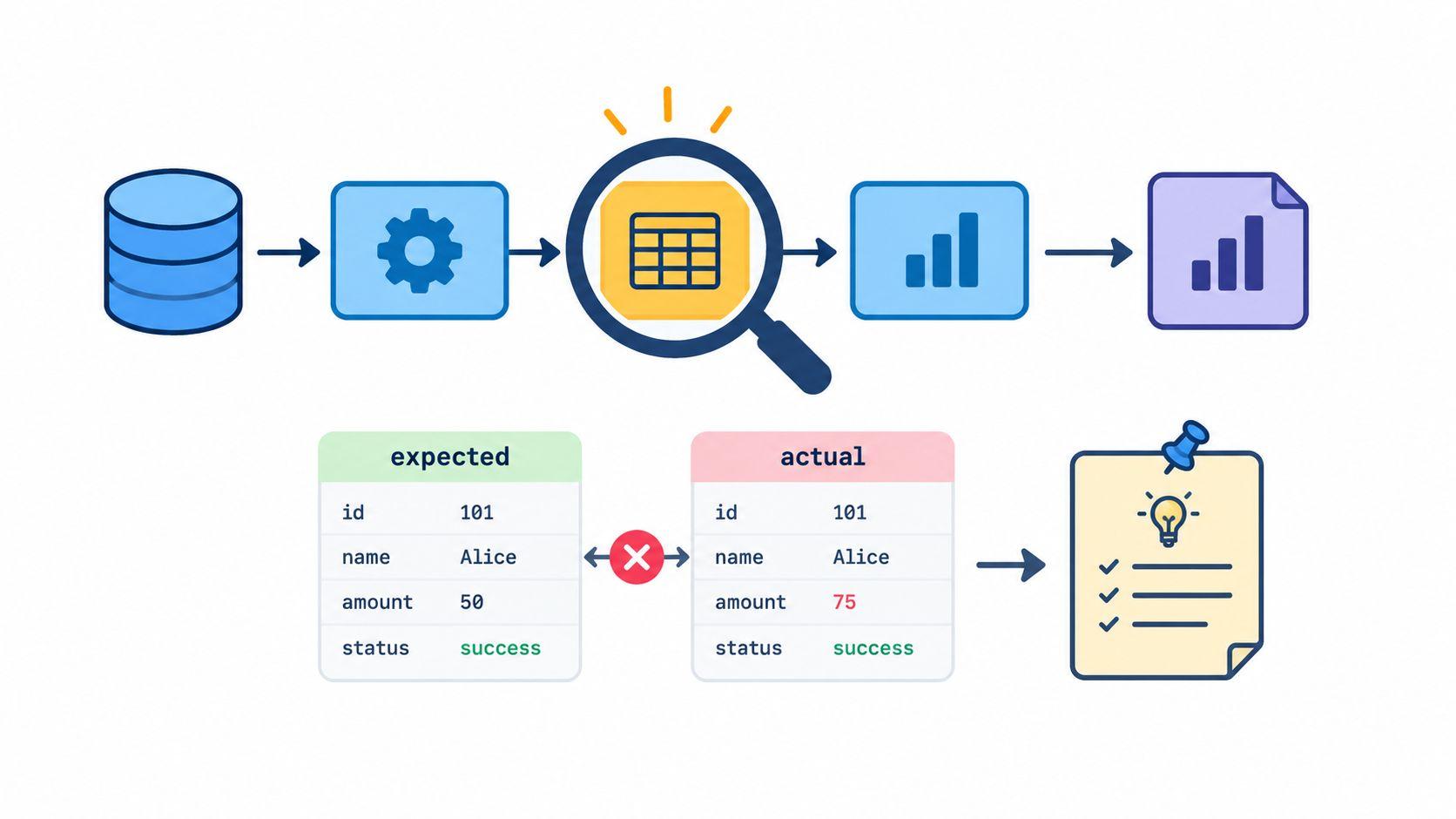
Compare the result with a trusted reference or prior period, then inspect row counts, distinct keys, null rates, aggregates, and sample records at each stage. Trace the first divergence between expected and observed values. Review source changes, transformation commits, orchestration parameters, and deployment timing so the diagnosis is tied to evidence rather than guesswork.
Pair diagnosis with communication
Describe how you would contain the incident. You might pause publication, mark affected partitions, notify analysts and business owners, and retain the incorrect output for comparison. The response should reflect impact and freshness requirements. Continuing to distribute disputed data creates a separate communication failure.
A credible incident account covers four decisions:
- Detection: Identify the check, alert, reconciliation, or user report that exposed the issue.
- Isolation: Explain how you narrowed the fault from the published table to a stage, filter, source, or join.
- Correction: State the safe code change, backfill method, and validation against known-good data.
- Prevention: Add the missing test, lineage detail, alert, data contract, or runbook.
Avoid unsupported claims about business loss or recovery time. Describe the evidence you verified and how the fix reduced recurrence risk. Resume bullets should show incident ownership, root-cause analysis, monitoring, and stakeholder communication. Behavioral questions are a standard part of data engineering interviews, so these signals help connect technical delivery with operational judgment.
7. Explain How You Would Implement Incremental Data Loading vs. Full Refreshes
Incremental loading reduces the amount of data processed, but it introduces correctness problems that a full refresh can avoid. The decision depends on source volume, update and deletion behavior, freshness requirements, backfill needs, warehouse capabilities, and the confidence you have in the change signal.
For an incremental design, identify the marker. It might be an updated_at timestamp, a database log, a CDC stream, or a watermark. Then explain how you handle updates, deletes, late arrivals, clock differences, retries, and records that change several times before extraction. A simple timestamp filter isn’t enough if a source can modify old rows without reliably updating the timestamp.
Idempotency is the dividing line
Use merge or upsert logic, deterministic keys, partition replacement, or a staging-and-swap pattern so a retry doesn’t double-count data. Validate watermark progression and compare source and destination counts or control totals. For historical corrections, explain whether you replay a bounded interval, rebuild affected partitions, or run a full refresh for a small dimension.
Full refreshes remain sensible for compact, low-change tables or models where simplicity outweighs processing overhead. Incremental models fit large event or transaction tables when the change capture is trustworthy. Fivetran can support CDC-based ingestion, while dbt provides incremental model patterns, but neither removes the need to define deletion and replay behavior.
Your resume should specify the mechanism and safety controls. “Implemented incremental pipeline” becomes meaningful when paired with CDC, watermark validation, merge semantics, late-arriving data handling, and backfill procedures. If the role emphasizes operations, include checkpoint monitoring and recovery documentation.
8. Describe Your Experience with Apache Spark, Distributed Computing, and Handling Large Data Processing Jobs
A strong Spark answer connects distributed architecture to measured engineering decisions. Explain how the driver, executors, tasks, partitions, and cluster manager interact, then describe a real job: its input, bottleneck, Spark UI evidence, intervention, and validation method. This shows operational understanding rather than familiarity with DataFrame syntax alone.
Focus on partitioning, shuffles, data skew, joins, serialization, memory pressure, and file layout. A broadcast join can reduce network movement for a small dimension, while broadcasting a large relation can exhaust executor memory. Repartitioning may balance uneven work, but too many partitions increase scheduling and output-file overhead. The right choice depends on data size, key distribution, and workload shape.
Read the Spark UI before tuning
Use stage duration, task variance, shuffle read and write, spill, garbage collection, and executor failures to locate the constraint. Then state the change precisely, such as selecting fewer columns before a join, filtering earlier, changing partition strategy, adjusting executor memory, or rewriting an aggregation. A dominant key may require salting or a different aggregation design. Distinguish a code issue from a data-shape issue, because they require different remedies.
One sentence can separate a credible answer from a generic one: name the metric that changed and how you checked correctness after tuning. Native Spark metrics, Datadog, or CloudWatch can support that evidence when you have used them. Do not borrow performance gains from another company.
For current data engineer openings, compare requirements for Spark, streaming, cloud infrastructure, quality, and monitoring. Use that comparison to select resume examples and rehearse the trade-offs each role is likely to test.
9. How Would You Approach Building Scalable Data Infrastructure That Multiple Teams Can Depend On?
Treat shared data infrastructure as a product. Identify the users first, including analysts, machine-learning engineers, application teams, and business stakeholders. Each group needs different interfaces, guarantees, documentation, and support paths, so “make it scalable” isn’t a complete design requirement.
Your answer should cover standard interfaces, ownership, onboarding, observability, and change management. Reusable ingestion patterns, documented contracts, infrastructure as code, environment separation, and tested deployment workflows can reduce variation across teams. A self-service path matters too, but it should include guardrails for access, cost, schema quality, and production support.
Make service levels concrete
Define what the platform promises: freshness, availability, incident response, retention, lineage, or query performance. Explain how teams request exceptions and how you prioritize competing needs. Cost visibility belongs in the design because unconstrained self-service can move operational burden into the cloud bill rather than remove it.
A senior answer also addresses organizational failure. Who owns a broken source? Who approves a schema change? How do consumers discover a deprecated dataset? How do you measure adoption and satisfaction without confusing usage with value? These questions reveal whether you can operate a platform after launch.
Your resume should show influence without unsupported adoption claims. Name the templates, APIs, catalog, deployment workflow, or governance controls you created. Describe how another team onboarded, how incidents were handled, and what became standardized. Those details are stronger than generic claims about building “highly scalable infrastructure.”
10. Explain Your Approach to Data Security, Privacy, and Compliance in Data Pipelines
Security should begin with data classification and purpose, not with a list of encryption tools. Identify sensitive fields, define who needs them, minimize collection, and separate raw restricted data from approved analytical products. Then explain how access is granted, reviewed, logged, and revoked.
A complete answer covers encryption in transit and at rest, secrets management, role-based access control, masking or tokenization, network isolation, audit logging, retention, and secure deletion. Tools such as Vault, cloud key-management services, and warehouse masking policies can support these controls, but your design must explain who configures them and how failures are detected.
Connect compliance to engineering behavior
For GDPR, CCPA, or HIPAA-related work, don’t just name the regulation. Explain the operational requirement relevant to your system, such as deletion requests, retention limits, access records, or restricted health data. A deletion pipeline needs more than a delete statement. It should identify replicas, derived tables, caches, backups, and evidence that the request was completed.
Security often adds friction to analytics. Discuss controlled access layers, pseudonymized identifiers, approved aggregates, break-glass procedures, and monitoring for unusual queries. A strong candidate can protect sensitive data without making every legitimate investigation impossible.
Resume evidence should specify the control and the data type without exposing confidential details. “Implemented PII masking and role-based access for an analytics warehouse, with audit logging and retention workflows” is useful. Avoid claiming compliance certification unless you directly owned the documented control and can explain how it was tested.
10-Question Comparison: Data Engineer Interviews
| Topic | 🔄 Implementation Complexity | ⚡ Resource Requirements | 📊 Expected Outcomes | 💡 Ideal Use Cases | ⭐ Key Advantages |
|---|---|---|---|---|---|
| Explain the Difference Between ETL and ELT Pipelines | Moderate, conceptual clarity, production nuance | Varies, ETL needs pre-processing compute; ELT needs warehouse compute & storage | Clear tradeoffs: cost, latency, lineage; architecture decision | 💡 Legacy on-prem → ETL; cloud warehouses (Snowflake/BigQuery) → ELT | ⭐ Shows architectural maturity; informs cost/governance choices |
| Design a Data Pipeline for Handling Real-Time Streaming Data at Scale | High, distributed systems, fault tolerance, state | High, Kafka/Kinesis, Flink/Spark, state stores, ops expertise | Low-latency processing, real-time analytics, robust fault recovery | 💡 Fraud detection, personalization, monitoring, real-time metrics | ⭐ Enables time-sensitive insights; highly scalable when done right |
| How Would You Optimize a Slow-Running SQL Query in a Data Warehouse? | Moderate, diagnostic + warehouse-specific tuning | Low–Medium, EXPLAIN tools, test compute, possible materialized views | Faster queries, lower costs, improved user experience | 💡 High-cost queries, frequent reports, slow dashboard backends | ⭐ Immediate operational impact; applicable across warehouses |
| Describe Your Experience Building Data Quality Frameworks and Data Validation Pipelines | Moderate, design checks, integrate with pipelines | Medium, tools (Great Expectations, dbt), monitoring & alerting | Fewer downstream incidents, higher trust in data, SLA adherence | 💡 Regulated domains, analytics-critical pipelines, onboarding data | ⭐ Reduces business risk; improves reliability and observability |
| Walk Through How You Would Design a Data Warehouse Schema for an E‑Commerce Platform | Moderate, dimensional modeling, SCDs, grain decisions | Medium, modeling effort, storage for denormalized schemas | Accurate reporting, performant analytics, consistent business metrics | 💡 Revenue, LTV, inventory reporting; OLAP dashboards | ⭐ Aligns schema with business questions; optimizes query patterns |
| How Do You Approach Debugging a Data Pipeline That’s Producing Incorrect Results? | Moderate, systematic isolation & RCA under pressure | Low–Medium, logs, historical snapshots, staging environments | Restored correctness, documented root cause, preventive fixes | 💡 Production incidents, data drift, regression after deploys | ⭐ Minimizes business impact; improves future detection & runbooks |
| Explain How You Would Implement Incremental Data Loading vs. Full Refreshes | Moderate, CDC/watermarks add complexity; full refresh simpler | Varies, incremental lowers recurring compute; full refresh spikes compute | Cost savings and fresher data vs. simpler, fully consistent loads | 💡 Large fact tables → incremental; small static dims → full refresh | ⭐ Cost-effective at scale when implemented with idempotency |
| Describe Your Experience with Apache Spark, Distributed Computing, and Handling Large Data Processing Jobs | High, deep tuning (partitioning, shuffle, memory) | High, clusters, memory, monitoring, ops expertise | Scalable processing of very large datasets; faster batch jobs | 💡 ETL/feature engineering on 100GB+ datasets, heavy joins/aggregations | ⭐ Handles petabyte-scale workloads; flexible APIs for many use cases |
| How Do You Approach Building Scalable Data Infrastructure That Multiple Teams Can Depend On? | High, technical design + organizational coordination | High, platform tooling, governance, SLAs, documentation | Self-service, consistent APIs, reduced onboarding time, reliable SLAs | 💡 Multi-team orgs needing governed self-service and shared data products | ⭐ Enables organizational scalability and faster time-to-insight |
| Explain Your Approach to Data Security, Privacy, and Compliance in Data Pipelines | Moderate, mix of legal & technical controls | Medium, encryption, IAM, masking tools, audit logging | Reduced legal/financial risk, auditable access, protected PII | 💡 Healthcare/finance/consumer PII; any regulated data workflows | ⭐ Essential risk mitigation; balances protection with analytics needs |
Turn Interview Topics Into Resume Evidence
Preparation works best when each target role becomes a small evidence map. Start by selecting the jobs you want, then mark repeated requirements across SQL, Python, orchestration, Spark, streaming, cloud infrastructure, security, quality, and platform ownership. A 2026 role report found Python in 72.6% of listed data-engineer roles, SQL in 62.6%, pipeline skills in 61%, infrastructure in 50.3%, data quality in 40.4%, monitoring in 34.6%, and Spark in 34.4% (JobGlance role analysis). Those signals support a practical conclusion: prepare for the tools, but build stories around the production responsibilities behind them.
Map each repeated requirement to one of the ten questions. SQL optimization can hold a query-plan story. Pipeline design can hold an architecture story. Data quality can hold an incident story. Security can hold a privacy-by-design example. Platform design can hold a cross-team delivery story. This prevents your preparation from becoming a collection of disconnected definitions.
Write each example in a concise STAR structure, but keep the technical substance. State the situation and constraint, describe the decision, explain the implementation, and finish with the result or operational evidence. If you have a verified metric, use it and be ready to explain how it was measured. If you don’t, don’t manufacture one. A changed alert, safer retry process, clearer ownership model, or successful backfill can still demonstrate impact.
Rehearse trade-offs rather than memorized conclusions. Interview-prep resources describe a typical process of four to five rounds, often combining recruiter screening, SQL or coding screens, pipeline or system design, and behavioral evaluation (DataInterview preparation guide). The same guide notes that some companies may extend the process to as many as nine stages, so your examples need to work at different levels of depth. Give a concise answer first, then expand into architecture, failure handling, cost, governance, or stakeholder communication when prompted.
Review every tool and metric on your resume before the interview. You should be able to explain the exact role of Airflow, dbt, Spark, Kafka, Snowflake, BigQuery, AWS, Azure, or any monitoring platform you list. If you only followed an existing runbook, describe that accurately. Credibility improves when your ownership boundaries are clear.
JobGlance can help rank roles against your resume, inspect matched and missing keywords, and narrow searches with dedicated visa sponsorship job listings or work-from-anywhere roles when location matters. Its Career Gap Analysis aggregates recurring skills across saved roles, which turns scattered job descriptions into a preparation priority list. The platform also offers an ATS Resume Builder and per-job keyword matching, useful when you need to align the resume without adding tools you haven’t used.
One underserved preparation area deserves special attention: data systems that support AI agents. Recent 2026 coverage points to semantic layers, MCP tool design, AI evaluation, and governance for autonomous systems as emerging interview subjects, while mainstream lists still concentrate heavily on SQL, Python, and classic pipelines (DataWorkers interview coverage). You don’t need to force AI into every answer. You should, however, be ready to discuss context freshness, lineage, evaluation data, observability, access controls, and cost or rate-limit trade-offs when the target role serves LLMs or agents.
A strong data engineer interview answer should be specific enough to show what you built, why you chose it, how you operated it, and what changed. That standard applies whether the question involves a warehouse query, a streaming consumer, a Spark job, or a sensitive customer dataset. Prepare evidence, not slogans, and let the architecture follow the requirements.
JobGlance aggregates active roles from more than 100 job sites, scores results against your resume, and highlights matched and missing keywords for each listing. Use JobGlance to compare data engineering roles, identify recurring skill gaps, and focus your interview preparation on the requirements employers keep repeating.
Keep reading


