10 Technical Interview Tips for Better Job Offers


On this page
Technical interviews are selective enough that preparation can’t begin with a coding platform. Companies interviewed nearly 21 candidates for one software engineering hire on average, according to hiring data cited by Karat’s technical hiring analysis. That makes the interview a pipeline, not a single exam: first target roles you can legally and practically accept, then prepare against the requirements, practice visible reasoning, and close the loop after every conversation.
The most useful technical interview tips therefore cover the full candidate journey. JobGlance can help rank roles against your resume, separate visa sponsorship from work-from-anywhere eligibility, surface recurring skill gaps, and tailor application materials before you spend time preparing. Its public category pages also let international candidates inspect live options, including visa-sponsored jobs worldwide.
The ten tactics below cover research and preparation, problem-solving and coding, system design, behavioral answers, remote interviews, and post-interview follow-up. The sequence matters. Practicing algorithms for a role you can’t take, or rehearsing answers without understanding the company’s format, wastes the same scarce preparation time you’re trying to protect.
1. Master the STAR Method for Behavioral Questions
Technical ability doesn’t fully explain how you work through conflict, incidents, failed decisions, or competing priorities. The STAR method, Situation, Task, Action, Result, gives each answer a clear shape and keeps you from turning a behavioral response into an unfocused project history.
Take a production outage. The Situation establishes which service was affected and what users experienced. The Task states your responsibility, such as identifying the fault and restoring service. The Action focuses on what you did, including the debugging path, communication, mitigation, and prevention work. The Result closes with the outcome, using verified evidence from your own experience rather than vague claims.
Build an evidence bank around the competencies the role is likely to test. Structured interview guidance recommends grouping the vacancy into roughly four to six competencies, then preparing a primary example and, where possible, a backup example for each competency, as outlined in this structured-interview preparation workflow.
Build stories that prove judgment
Prepare examples covering technical challenges, conflict, failure, leadership, collaboration, and successful delivery. For each story, write four short lines:
- Situation: What system, team, customer, or deadline created the context?
- Task: What outcome were you accountable for?
- Action: Which decisions did you personally make, and why?
- Result: What changed, and how did you verify it?
Use metrics only when you can defend them. Time saved, performance improvement, cost reduction, incident duration, or adoption can make a result concrete, but unsupported numbers weaken credibility. Practice each answer aloud until you can deliver it concisely, then adapt the emphasis to the company’s values and the role’s responsibilities.
Practical rule: Keep the spotlight on your decisions, not the team’s entire biography.
2. Practice Coding on Whiteboards and Without IDE Features
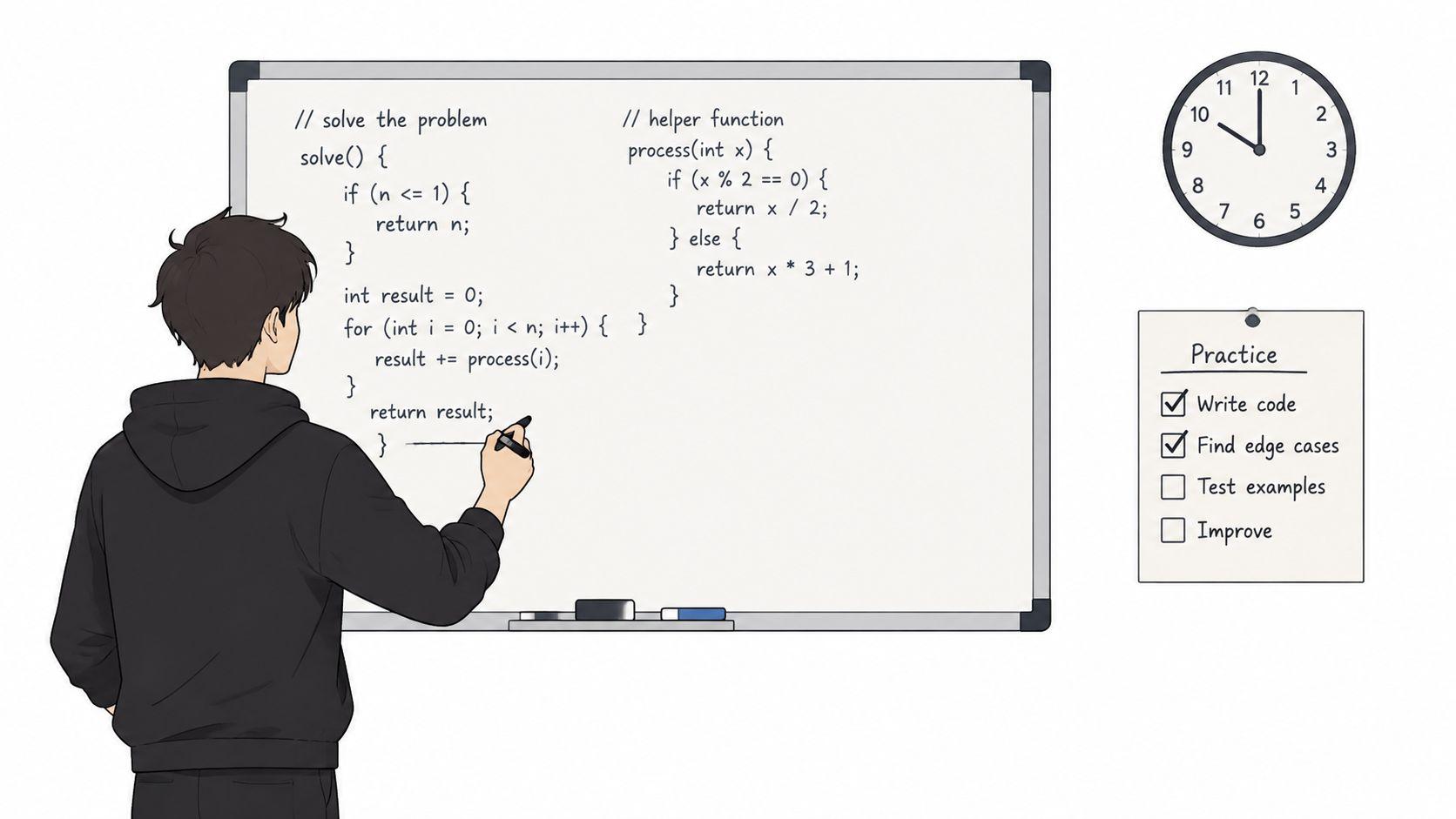
An IDE hides many errors that an interview environment may expose. Autocomplete, syntax highlighting, generated imports, and immediate error checking can make familiar code feel easier than it is under live conditions. Practice without those supports so you can concentrate on the reasoning process the interviewer will observe.
Start with a problem you can solve comfortably. Write the input assumptions and pseudocode first, then convert the outline into code while narrating the transformation. Afterward, compile or run the solution in a normal environment and record mistakes such as incorrect boundary conditions, forgotten initialization, invalid syntax, or an overlooked null case.
CoderPad’s interview format is relevant because live coding and technical discussion are both common. A 2025 state-of-tech-hiring survey reported that 49.82% of companies used live coding interviews, while 75.27% included technical discussion. The format rewards candidates who can write workable code and explain the decisions behind it.
Recreate the constraint, not just the question
Use a whiteboard mode, a plain text editor, or paper followed by a compiler check. Ask a peer to watch without interrupting, or record yourself solving while explaining each step. Your practice should include:
- Pseudocode first: State the algorithm before syntax enters the discussion.
- Manual tracing: Run a small example line by line before execution.
- Mistake tracking: Keep a personal list of recurring errors and review it before each session.
- Format matching: Rehearse in the platform or style the employer is likely to use.
The point isn’t to avoid all mistakes. It’s to make your reasoning observable and your recovery deliberate.
3. Clarify Requirements and Ask Strategic Questions Before Coding
Starting to code immediately can be a sign that you’ve solved a different problem from the one the interviewer intended. Clarifying questions reduce ambiguity, expose constraints, and give you information that should determine the algorithm or architecture.
For a coding problem, ask whether the input is sorted, whether duplicates are possible, how large the input can become, and what output format is required. For a rate limiter, ask about request volume, acceptable latency, consistency, geographic distribution, failure behavior, and whether the system must enforce limits globally or per region.
The questions matter because constraints change solutions. A small input might support a simple readable approach. A large or highly skewed input may require a different data structure, caching strategy, partitioning model, or failure policy. You’re demonstrating engineering judgment before writing a line of code.
Convert uncertainty into a working contract
Don’t ask a long list of disconnected questions. Group them by the decision they affect:
- Scale: How many requests, records, users, or concurrent operations are expected?
- Correctness: Are empty inputs, negatives, duplicates, missing values, or retries valid?
- Performance: Is the priority response time, memory use, throughput, or implementation simplicity?
- Scope: Should you optimize for one process, multiple machines, one region, or global operation?
- Success: What behavior should the interviewer consider correct?
Write the answers down and restate the refined problem. “I’ll assume the input can be unsorted, duplicates are valid, and linear extra space is acceptable. Is that the intended scope?” This creates a shared contract and gives you a reference point when you explain later trade-offs.
4. Communicate Your Thought Process Out Loud Throughout
A technically correct answer can still be difficult to evaluate if the interviewer can’t follow how you reached it. Live coding interviews combine implementation with discussion, and a separate survey rated live coding interviews 3.83 out of 5 and practical coding tests 3.59 out of 5, as reported in CoderPad and CodinGame’s 2024 survey summary. The practical implication is clear: communication isn’t decoration around the solution. It’s part of the performance.
Begin with the high-level approach. Explain the data structure, the main loop or recursion, and the expected complexity before you start typing. As you work, state why you’re choosing one path over another. “A hash map gives constant-time average lookup, and I’m accepting extra memory because the input size makes the time reduction more valuable” is far more useful than writing a map and explaining it only after the fact.
Narrate productively when the code breaks
Good narration isn’t a stream of every fleeting thought. It’s a sequence of decisions, assumptions, checks, and corrections. When you’re stuck, describe the obstacle and the next experiment. When a test fails, identify the input, trace the relevant variables, and name the missing case.
Use short checkpoints:
- Approach: “I’ll first build a frequency map, then scan for the required relationship.”
- Trade-off: “Sorting would reduce auxiliary space in one version, but it would change the time complexity.”
- Validation: “I’m testing the empty input before the general case.”
- Alignment: “Does this interpretation match the expected behavior?”
Practice this during mocks, not only during real interviews. Silence can look like confusion even when you’re thinking carefully. A brief explanation keeps the interviewer oriented and gives them an opportunity to correct a mistaken assumption early.
5. Test Your Code With Edge Cases and Trace Through Examples
Most candidates test the happy path first because it’s easy to demonstrate. Interviewers learn more from the boundaries. Empty input, a single element, duplicate values, missing targets, null references, and maximum-size behavior reveal whether your algorithm matches the problem’s actual contract.
For string reversal, test an empty string, one character, spaces, special characters, and a longer value. For binary search, test an empty array, arrays with one or two elements, an absent target, and duplicates. For tree traversal, test a null tree, a single node, and an unbalanced structure.
Use a repeatable test order
Write cases before execution so testing doesn’t become an afterthought. A compact sequence works well:
- Boundary first: Test zero, one, minimum, and maximum relevant values.
- Shape changes: Try empty, duplicate, sorted, reverse-sorted, missing, and highly uneven inputs.
- Normal example: Confirm the intended common path.
- Manual trace: Follow each variable through the code and compare it with the expected output.
- Verbal summary: State what you tested and what remains unverified.
If a test fails, don’t erase the failure from the conversation. Explain the diagnosis, modify the code, and rerun the affected case. That shows controlled debugging rather than a performance built around never being wrong.
“Test the case most likely to invalidate your assumption before polishing the general path.”
Tie the test back to the requirement you clarified earlier. If you established that duplicates are valid, show the duplicate case. If memory was constrained, explain whether your test approach introduced unnecessary storage.
6. Explain Trade-offs and Choose Appropriate Data Structures
Interviewers aren’t only checking whether your code returns the right output. They’re checking whether you can choose an approach that fits the constraints. A hash map may be preferable to sorting when fast lookups matter and additional memory is acceptable. An iterative solution may be safer than recursion when the call stack could grow unboundedly. A min-heap can support merging sorted streams while keeping the active working set focused on the next candidates.
State the trade-off immediately after choosing the structure. Don’t present a data structure as a memorized answer. Connect it to the input size, required operations, runtime environment, and the questions you asked at the start.
Compare one credible alternative
After implementing the first solution, pause and compare it with another approach:
- Time versus space: Would using a map reduce repeated work at the cost of memory?
- Readability versus optimization: Is the faster version harder to maintain without a demonstrated need?
- Runtime behavior: Could recursion, allocation, or synchronization create operational risk?
- Scale: Does the choice remain reasonable as data volume or concurrency grows?
- Further optimization: What would you measure or change if the constraint became stricter?
Then summarize complexity clearly. Say what drives the time cost, what drives auxiliary space, and which assumptions make the analysis valid. If the interviewer changes a requirement, revise the choice rather than defending it mechanically.
This habit also improves system-design answers. The strongest candidates don’t list fashionable components. They explain why each component exists and what downside it introduces.
7. Research the Company and Role Deeply Before the Interview
Preparation should follow the role, not a generic software-engineering syllabus. Read the job description as an interview specification. Extract the technologies, responsibilities, ownership level, domain language, and collaboration expectations, then investigate the company’s product, technical direction, team structure, and recent changes.
Use the company website, engineering blog, press releases, public employee profiles, and interview reports as inputs. If the role mentions Kubernetes, understand whether the company is migrating workloads, operating a platform, or listing a preferred skill. If it discusses event-driven systems, prepare questions about the reliability, observability, or data-consistency problems that such a system creates.
Prepare questions that reveal the real job
Avoid questions that the company’s homepage answers. Prepare two or three that connect directly to the work:
- Technical direction: “Which part of the platform is receiving the most architectural attention?”
- Operational ownership: “How does the team handle incidents and follow improvements into the roadmap?”
- Role expectations: “What would distinguish a successful first project from an average one?”
- International logistics: “How does the company handle sponsorship or location eligibility for this role?”
JobGlance’s Deep Company Research can organize listing legitimacy, company stability, culture, and interview difficulty with confidence levels and cited evidence. Its resume and job views also highlight matched and missing keywords, which gives you a concrete way to tailor both your stories and your questions.
Don’t research only the company. Research the format. A role may use a practical build task, debugging session, algorithm screen, system design discussion, or AI-assisted assessment. Recent coverage describes technical assessments as fragmenting across these formats, so “I’ll just practice algorithm questions” is no longer a sufficient plan.
8. Master System Design Patterns and Common Architectures
System design interviews test whether you can move from requirements to a defensible architecture. Start simple, then add components only when a stated constraint requires them. A load balancer, cache, message queue, CDN, replica, or shard should answer a specific problem, not serve as evidence that you’ve memorized architecture diagrams.
Practice reusable patterns through concrete systems. For a real-time notification service, discuss asynchronous delivery, retry behavior, ordering, user preferences, and failure isolation. For a URL shortener, define the data model and lookup path, then consider hot links, expiration, storage growth, and partitioning. For each design, explain the API, storage choice, high-level flow, bottleneck, and operational risk.
Build a compact design portfolio
Choose several representative systems, such as a URL shortener, social feed, chat service, video platform, and logging or metrics system. For each one, document:
- Data model: What entities exist, and which relationships matter?
- APIs: What operations do clients need?
- Traffic shape: Is demand steady, bursty, read-heavy, or write-heavy?
- Scaling path: Where would caching, queues, replication, partitioning, or a CDN help?
- Failure behavior: What happens when a dependency is slow, unavailable, or inconsistent?
- Trade-off: What does your design optimize, and what does it sacrifice?
Keep the first explanation short enough that each component’s purpose is clear. Then invite a changed requirement and adapt. Candidates targeting platform reliability work can also review DevOps and SRE roles on JobGlance to compare live role requirements with the patterns they’re practicing.
AI changes the discussion without removing fundamentals. Recruiter guidance points toward transparent AI policies, multimodal assessments, and evaluation of how candidates collaborate with AI tools, so be prepared to explain verification, decomposition, judgment, and the boundaries of assistance rather than treating AI as either forbidden or magical.
9. Handle Mistakes and “I Don’t Know” Gracefully
Interviewers don’t need you to recognize every API or produce flawless code without feedback. They need to see how you respond when an assumption fails. A calm correction can reveal more engineering maturity than a lucky first attempt.
Suppose you discover that your counter was never initialized. Name the symptom, trace the failing path, identify the cause, apply the fix, and rerun the relevant test. Don’t bury the mistake under repeated apologies. “The failure points to the empty-input path. I used the general loop without initializing the result, so I’ll fix that and retest the boundary case” shows ownership and method.
Turn uncertainty into a plan
When you don’t know a technology, separate the unknown API detail from the underlying concept. Explain what you understand, state the assumption you’d make, and ask the interviewer to confirm it. If you’re exploring an uncertain route, request a hint directly and show how you’ll use it.
A useful recovery pattern is:
- Acknowledge: “I haven’t used this library directly.”
- Connect: “I’d expect it to expose a queue or buffer with controlled consumption.”
- Validate: “Can I confirm whether delivery is at-least-once?”
- Proceed: “Given that behavior, I’d make the consumer operation idempotent.”
- Review: “I’d verify the assumption against the documentation and a small test.”
If time runs out, summarize the current solution, the unresolved issue, and the next step you’d take. The interviewer can evaluate your direction even if the implementation is incomplete.
10. Prepare Targeted Practice Based on Your Target Role and Difficulty
Broad practice creates a false sense of coverage. A backend engineer, data engineer, frontend engineer, and DevOps specialist may all receive a coding exercise, but the recurring skill gaps and evaluation criteria differ. Choose the role, company stage, seniority, and likely format before allocating study time.
For data engineering, prioritize SQL optimization, data modeling, large-scale processing, and distributed systems. For frontend roles, practice component architecture, state management, browser behavior, accessibility, and performance reasoning. For DevOps roles, prepare infrastructure as code, container orchestration, monitoring, incident response, and reliability trade-offs. For backend roles, combine coding fundamentals with APIs, data stores, concurrency, observability, and system design. JobGlance’s backend role listings provide a direct way to inspect the language used across relevant postings.
Let recurring requirements set the agenda
Annotate several target vacancies and mark each requirement as essential, repeated, unfamiliar, or already evidenced. Then create a role-specific practice plan:
- Format: Identify whether the employer uses HackerRank, CoderPad, a take-home task, debugging, or design discussion.
- Frequency: Spend more time on skills that recur across your target postings.
- Difficulty: Match practice to the level and ownership expected, not an abstract problem ranking.
- Evidence: Attach one project, incident, or work example to each major competency.
- Review: After a mock interview, record the exact failure mode and adjust the next session.
JobGlance’s Role Insights summarizes what live listings ask for, while Career Gap Analysis aggregates recurring missing skills across saved roles. That turns preparation into a response to your chosen market rather than an endless list of disconnected exercises.
11. Use Remote Interview Controls and Follow Up Precisely
A remote technical interview tests more than code. Audio failure, an untested screen share, a missing job description, or a confused recovery after a dropped connection can consume attention that should remain on the problem. Treat the virtual setup as part of the interview environment.
Join early enough to verify the platform, microphone, camera, framing, screen sharing, code editor, and network. Keep the meeting link, recruiter contact, resume, notes, and job description organized before the call. If you have a backup device or connection, know how you’ll switch and how you’ll tell the interviewer what happened.
Make the follow-up specific
Write down unresolved questions and commitments during the conversation. Afterward, send a short message that thanks the interviewer, references one substantive discussion point, and confirms the next step if one was stated. For example, mention the rate-limiting trade-off you discussed and clarify the assumption you used. Don’t attach unsupported claims or generic material that the interviewer didn’t request.
Candidates seeking location-flexible roles should distinguish domestic remote from work-from-anywhere eligibility. JobGlance keeps those signals separate, and its remote entry-level jobs page is useful for candidates who need to filter opportunity before investing in interview preparation.
Use JobGlance application tracking to record the role, interview stage, interviewer, unresolved questions, and follow-up status. The record becomes valuable when several processes overlap. It also helps you compare what each company tested with what the posting promised.
11-Point Technical Interview Tips Comparison
| Technique | 🔄 Complexity | ⚡ Resource requirements | ⭐ Effectiveness | 📊 Expected outcomes | 💡 Ideal use cases |
|---|---|---|---|---|---|
| Master the STAR Method for Behavioral Questions | Low–Medium, structured practice to craft stories | Low (2–4h prep; gather 5–7 examples) | ⭐⭐⭐ | 📊 Clearer behavioral answers; ~2.3x interview progression | Behavioral rounds, leadership/principled-fit questions |
| Practice Coding on Whiteboards and Without IDE Features | Medium–High, adapt to no-IDE constraints | Moderate (paper/peer mocks, platforms like CoderPad/Pramp) | ⭐⭐⭐ | 📊 Better syntax confidence; ~1.4x technical scores | Live coding, onsite/remote whiteboard-style interviews |
| Clarify Requirements and Ask Strategic Questions Before Coding | Low, simple habit, needs structure | Low (practice 3–5 targeted questions) | ⭐⭐⭐ | 📊 ~30% less wasted coding; 81% positive interviewer signal | Ambiguous problems, system design, early-stage prompts |
| Communicate Your Thought Process Out Loud Throughout | Medium, multitask speaking and coding | Low–Moderate (mock interviews to practice) | ⭐⭐⭐ | 📊 Interviewers follow reasoning; ~1.8x higher scores | Pair-programming style interviews, communication-evaluated rounds |
| Test Your Code With Edge Cases and Trace Through Examples | Medium, methodical but time-consuming | Low (5–10 min per problem; mental checklist) | ⭐⭐⭐ | 📊 Fewer runtime bugs; ~1.6x code quality scores; prevents 42% failure cases | Final verification, correctness-focused coding rounds |
| Explain Trade-offs and Choose Appropriate Data Structures | Medium–High, analytical reasoning required | Moderate (study DS & complexity, practice alternatives) | ⭐⭐⭐⭐ | 📊 Stronger design/optimization signals; ~2.1x system-design scores | Senior roles, optimization problems, system-design discussions |
| Research the Company and Role Deeply Before the Interview | Medium, focused information gathering | Moderate (2–4h; blogs, LinkedIn, Glassdoor) | ⭐⭐⭐ | 📊 Tailored answers; avoids 58% prep failures; noticed by 84% of hiring managers | Company-specific interviews, negotiation, culture-fit discussions |
| Master System Design Patterns and Common Architectures | High, extensive study and practice (20–30h) | High (books, courses, case studies, mock designs) | ⭐⭐⭐⭐ | 📊 Strong system-design performance; appears in ~65% senior backend rounds | Senior backend/SRE/architect interviews, large-scale design tasks |
| Handle Mistakes and “I Don’t Know” Gracefully | Low–Medium, mindset and recovery practice | Low (behavioral practice, phrasing) | ⭐⭐⭐ | 📊 Better resilience signal; 72% of interviewers prioritize recovery | High-pressure questions, unknown-technology prompts, incident simulations |
| Prepare Targeted Practice Based on Your Target Role and Difficulty | Medium, requires honest gap analysis | Moderate (role-specific mock problems, JobGlance/Glassdoor) | ⭐⭐⭐ | 📊 Higher role-fit scores; ~1.9x vs. generic prep | Role-specific interviews (Backend, Frontend, DevOps, Data) |
| Use Remote Interview Controls and Follow Up Precisely | Low–Medium, setup + concise follow-up | Low (device checks, backup plan, tailored follow-up) | ⭐⭐⭐ | 📊 Fewer technical disruptions; clearer next steps and better impression | Remote interviews, distributed teams, formal follow-up processes |
Turn Every Interview Into a Better Next Attempt
The best technical interview preparation compounds because each interview produces usable evidence. A rejection without notes becomes a vague judgment about your ability. A rejection connected to missing SQL depth, weak requirement clarification, poor narration, or an unsuitable location filter becomes a specific change to your next process.
Start with viable roles. Use JobGlance match scores to rank postings against your resume, then apply the dedicated visa-sponsorship or work-from-anywhere filters before spending hours on company research. These filters answer different eligibility questions. Sponsorship concerns an employer supporting legal work authorization, while work-from-anywhere concerns whether the employer accepts candidates across locations. A role can satisfy one without satisfying the other.
The scale of the available search pool makes filtering practical rather than cosmetic. JobGlance’s public pages list 28,551 visa-sponsored roles globally, while its US sponsorship page lists 11,899 sponsored roles and 425 hiring companies. Its US remote page reports 9,751 remote jobs, giving candidates separate starting points for relocation-supported and location-flexible searches. Treat those pages as discovery surfaces, then verify the exact terms in each posting.
Tailor the application before beginning deep preparation. Use the resume match view to identify missing keywords inside the job description, then adjust the resume only where your experience supports the requirement. The ATS Resume Builder can rebuild the document in a single-column format and tailor it to a selected job. A cover letter should add role-specific evidence, not repeat the resume.
Next, use Role Insights and Career Gap Analysis to prioritize study. If your saved backend roles repeatedly ask for a capability you can’t explain, schedule practice around that gap. If the roles vary between algorithm screens and practical debugging, rehearse both. If the company permits AI, prepare to explain what you use it for, how you verify its output, and which reasoning you retain personally. If AI isn’t allowed, practice without it and treat the restriction as part of the format.
Run timed coding sessions and system-design rehearsals under realistic constraints. Start each problem by clarifying requirements, state the approach, narrate trade-offs, test edge cases, and summarize complexity. Rehearse STAR stories from a small evidence bank, then test your remote setup and prepare a precise recovery plan for connection problems. The 2025 hiring survey data shows why this combined approach matters: candidates may face both hands-on coding and technical discussion, not one isolated skill test.
After every interview, log what happened while the details are fresh. Record the format, topic, difficulty, unanswered questions, communication issues, and any feedback. Compare the questions with your target-role checklist, then review missing keywords and repeated skill gaps across applications. Mock interviews deserve the same review. One 2026 industry analysis reported that completing five mock interviews doubled the chance of passing a real technical interview, while also reporting that 71% of engineering leaders said AI makes technical skills harder to assess, as detailed in the technical interview behavior analysis. The useful lesson isn’t to chase a magical practice count. It’s to repeat realistic simulations and improve the failure modes they expose.
Finally, follow up promptly and specifically. Thank each interviewer, reference a real technical discussion, answer an unresolved point only if you can be accurate, and record the status. Then return to the next viable role instead of restarting from a blank page. Your preparation should become a living system, with the job search supplying the requirements and each interview supplying the next revision.
JobGlance ranks roles against your resume, separates visa sponsorship from work-from-anywhere eligibility, supports resume tailoring, surfaces recurring career gaps, and tracks applications across the interview process. Visit JobGlance to filter viable roles first, then turn the requirements of those roles into targeted technical interview practice.
Keep reading


