Resume ATS Score: How It Works and How to Improve It


On this page
A resume ATS score is less a grade than a sorting signal, and that distinction matters because in a 2026 analysis of 10,000 resume scans, the median score was 62 out of 100 and 71.4% of resumes scored below 75, which the source treated as a common passing threshold. In other words, most applicants are not losing to a mysterious blacklist, they’re landing in the broad middle or bottom of the pile before a recruiter ever opens the file. That’s why the right question isn’t “How do I get a perfect ATS score?” It’s “How do I make my resume the clearest match for this one job, while still reading like a credible human document?”
What a Resume ATS Score Actually Measures
A resume ATS score measures how closely your resume matches the requirements of a specific job posting, not how good you are as a candidate in the abstract. The same 2026 scan dataset showed that only 11.2% of resumes scored 85 or higher, while 17.4% scored 75 to 84, 39.9% scored 60 to 74, and 31.5% scored below 60. That distribution makes the point clearly, most resumes live in borderline territory, so small changes in phrasing, section structure, and keyword alignment can move a candidate from overlooked to review-worthy. Resume Adapter’s 2026 ATS rejection report
The score is a ranking signal, not a universal grade
The best way to think about it is as a prioritization score for one role. ATS software compares the text in your resume to the job description, then ranks you against other applicants using signals like skill matches, title relevance, dates, and education. A high score can still lose if the role is highly competitive or your resume doesn’t present enough proof, while a modest score can still win if the candidate pool is weak or the resume is exceptionally credible.
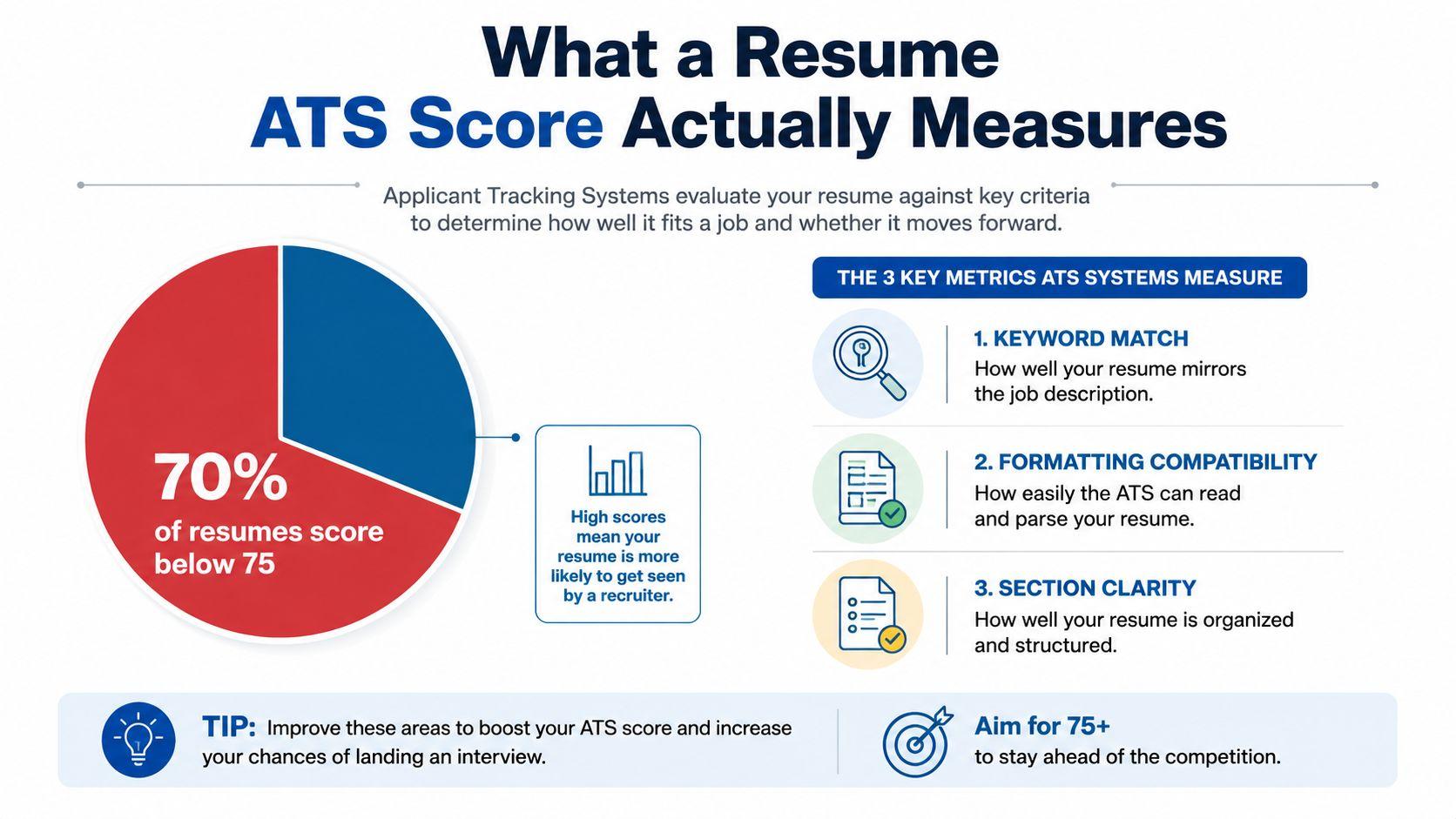
The practical meaning is simple. If your resume lacks the exact terms the employer expects, or if the parser can’t read the layout, you may never reach the recruiter’s screen. That’s why keyword match, formatting compatibility, and section clarity matter so much. A resume ATS score is useful only when you treat it as a job-specific fit indicator, not a promise of interview access.
Practical rule: A low score is a visibility problem first, a qualification problem second.
How ATS Systems Calculate Your Score
ATS tools don’t usually “read” a resume the way a person does. They parse the file into structured fields first, then compare those fields against the job description with weighted criteria. In one expert breakdown, keyword matching accounts for roughly 40 to 50% of the score, experience relevance for 20 to 25%, education for 10 to 15%, and formatting parseability for the remainder. Missing a required skill or certification can reduce the score materially, because the system is looking for hard requirements before it cares about stylistic polish. ATS scoring factors explained
What gets counted first
The biggest signal is usually exact keyword alignment. Exact matches tend to score higher than synonyms, and placement matters too, because terms in the summary, headings, and bullet points are easier for parsers to recognize than scattered phrases buried in dense prose. Experience scoring then checks whether your job titles, seniority, and chronology align with the role, while education and certifications help validate baseline qualification.
Why formatting can quietly lower the score
Formatting is not cosmetic to an ATS, it’s infrastructure. A single-column, left-aligned resume is easier to parse than one built with tables, sidebars, headers, footers, or decorative graphics. The most common failure modes are unstructured layouts, embedded images, and missing exact terms, because the parser can’t confidently map your content into searchable fields.
| Scoring Component | Weight Range | What It Evaluates | Common Pitfalls |
|---|---|---|---|
| Keyword Matching | 40 to 50% | Exact terms from the job description, tools, skills, titles | Synonyms instead of exact terms, keyword stuffing, weak placement |
| Experience Relevance | 20 to 25% | Title fit, industry fit, chronology, years of experience | Vague titles, unclear dates, unrelated work leading the resume |
| Education and Certifications | 10 to 15% | Degree match, certifications, licenses | Missing credential names, inconsistent labels, incomplete details |
| Formatting Parseability | 5 to 10% | Whether the ATS can extract the text correctly | Tables, columns, icons, headers, footers, unusual fonts |
A useful example is a resume that scores 62 for one role and 88 for another. That difference can happen even when the candidate is the same person, because one job description may mirror the candidate’s language closely while the other uses different terminology and priorities. The score follows the job, not the person.
Step-by-Step Process to Improve Your Score
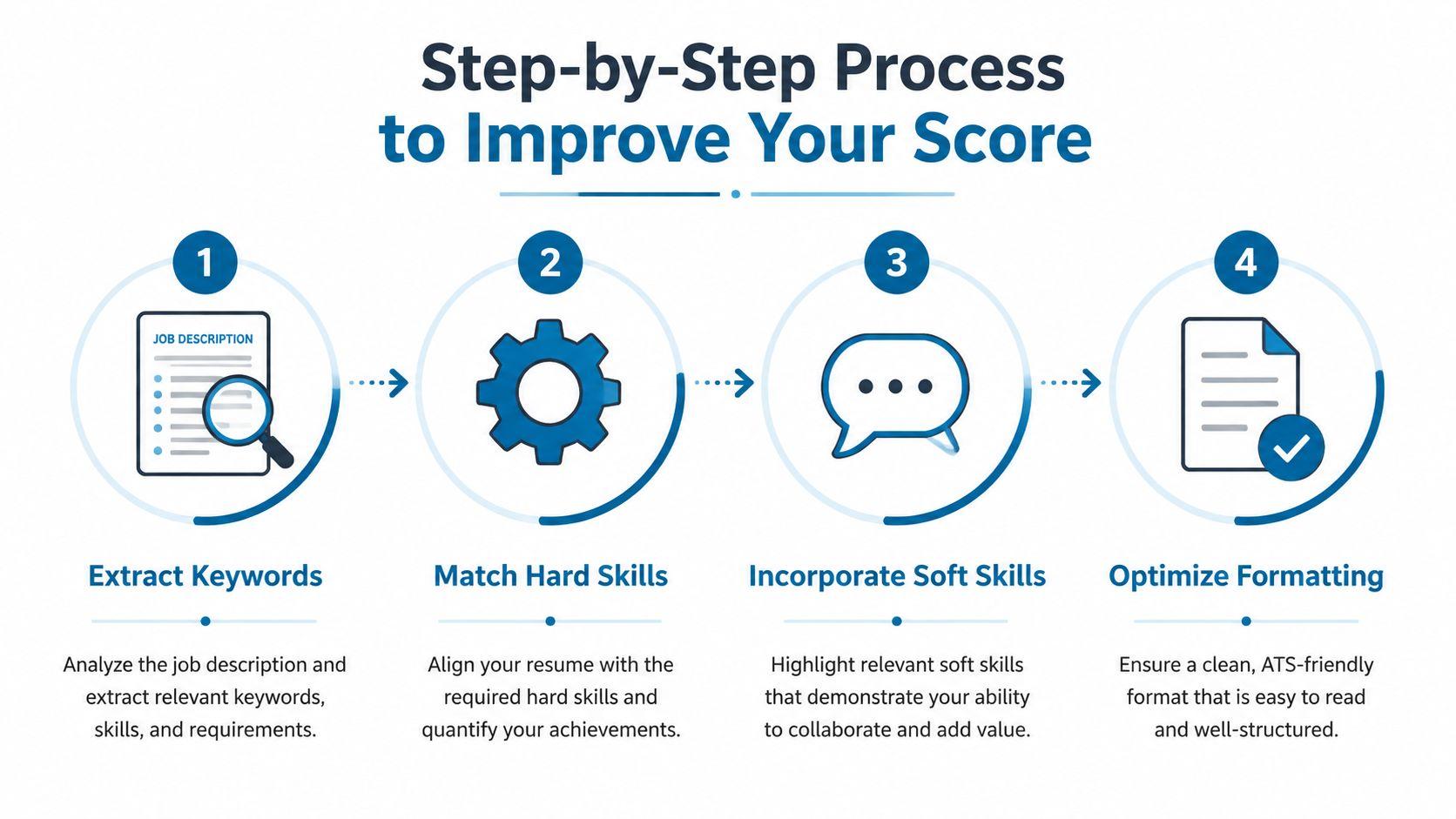
The cleanest way to raise a resume ATS score is to work from the job description backward. Start with the words the employer uses, then make sure your resume proves those same skills in a format the parser can read. If you skip that order, you end up guessing, and guessing usually produces generic resumes that look polished but rank badly.
Start with the job description, not your old resume
Pull out the hard skills, tools, certifications, role titles, and repeated verbs from the posting. Repeated terms matter because they often signal priority, especially when the same requirement shows up in multiple sections of the listing. Then compare those terms with your current resume and separate them into three groups, exact matches you already have, relevant skills stated differently, and missing requirements you can’t claim.
Rewrite bullets so the keywords live in evidence
Don’t dump a keyword list into a skills block and hope the system rewards you. Embed the terms in your achievement bullets where they’re tied to actual work. For example, a generic bullet like “Helped improve campaigns” becomes “Managed email marketing campaigns, tested subject lines, and improved lead generation workflows across the sales funnel.” The wording stays human, but the important terms are now visible to the parser.
Fix layout before you chase more keywords
A resume that can’t be parsed won’t benefit much from better wording. Use a single-column layout, standard section headings, and a standard font that the system can read cleanly. Keep date ranges readable and avoid tables, text boxes, sidebars, and graphics that split the text flow.
Run the resume against the role, then refine again
An ATS scanner can show you what’s still missing, but use it as a diagnostic tool, not as a score to worship. Some tools will flag genuine gaps, while others overvalue stuffing or weird phrasing. The better workflow is to make one targeted revision at a time, then rerun the scan and check whether the resume still reads naturally.
Useful test: If a bullet sounds like a person describing real work, you’re close. If it sounds like a keyword pile, it needs another pass.
For role-specific tailoring, I’d rather see someone work from a live posting like the Data Analyst role page than chase a generic template, because the job description itself is the scoring key.
Before and After Examples That Worked
The biggest ATS gains usually come from keyword placement and section order, not from decorative polishing. I’ve seen resumes improve fastest when the candidate stopped hiding relevant experience in the wrong place and started making the parser’s job easier. That’s exactly what happened in two common transformations.
What changed in the stronger versions
The marketing manager resume moved from 42 to 81 after the writer moved job-relevant terms into the summary and recent bullets, quantified results, and removed formatting elements that confused parsing. The software engineer resume moved from 58 to 89 after the candidate extracted exact terms from the posting, reorganized the skills section, and rewrote experience bullets so the right terms appeared in context.
| Optimization Category | Marketing Manager Before / After | Software Engineer Before / After | Impact Level |
|---|---|---|---|
| Keyword placement | Generic wording, then exact terms moved into summary and bullets | Broad language, then role terms mirrored from the posting | High |
| Section order | Weak lead section, then recent achievement-focused structure | Skills buried, then moved above detailed experience evidence | High |
| Formatting compliance | Layout elements interfered with parsing, then simplified | Cleaner text flow, then made fully parseable | Medium to High |
| Achievement clarity | Tasks only, then quantified outcomes added | Responsibilities only, then outcome-based bullets added | High |
The lesson isn’t that every resume needs more words. It’s that the most useful words need to appear where both the parser and the recruiter can find them fast.
The same principle applies if you’re targeting a product role, a technical role, or a broad search that includes remote work. A resume tuned for a general audience usually underperforms against a resume tuned for one opening, which is why role-specific tailoring matters. If you’re working through a product search, a Product Manager role page can be a useful reference point for the exact terms employers repeat.
Why There Is No Universal Passing Score
There’s no universal passing score for a resume ATS score because ATS systems don’t all rank the same way, and employers don’t all use the score as a cutoff. Some organizations treat ATS output as a sorting layer, others use it to filter aggressively, and many recruiters review every strong-looking application regardless of the numeric score. That’s why advice to “hit 80%” or “get above 85%” is only a rough heuristic, not a reliable rule.
Context changes the score’s meaning
A score that gets attention for one role can disappear in another. High-volume postings usually force recruiters to rely more heavily on system sorting, while niche roles often get read more flexibly because the candidate pool is smaller and easier to review manually. Job market pressure also changes the practical benchmark, which is why a score alone can’t tell you whether you’re competitive.
A 2026 benchmark of 90,242 real resumes reported an average ATS score of 60.3 out of 100 and a median of 60, with 85% scoring below 70, which the source treated as ATS-ready. In the same hiring ecosystem, 78% of HR professionals used an applicant tracking system in an HR.com and Eightfold AI report for 2025 to 2026, and another 2026 hiring-insights report said 71% of hiring managers screened applications with ATS software. Those numbers show that ATS scoring is embedded in real hiring workflows, but they also show how inconsistent the scoring environment remains. State of resumes benchmark
A score is a filter for one hiring team, not a law of hiring.
How to set a realistic target
Aim for a score that makes you visible against that specific posting, then check whether your resume still sounds credible. If you’re applying to a crowded remote opening, the bar is usually tougher because the recruiter can compare more applicants. If you’re targeting a specialized role, a slightly lower score may still be enough if your experience is unusually close.
For entry-level applicants, the best target is often clarity plus honest relevance, not a mythical perfect number. A role like the remote entry-level listings page is a better benchmark than a generic internet threshold because it reflects the actual type of competition you’re facing.
Balancing ATS Optimization with Human Readability
The handoff happens after the ATS. A recruiter still has to open the resume, skim it fast, and decide whether it feels credible, relevant, and easy to follow. A document can score well and still underperform if it reads like someone forced keywords into every line.
Write for the parser and the person
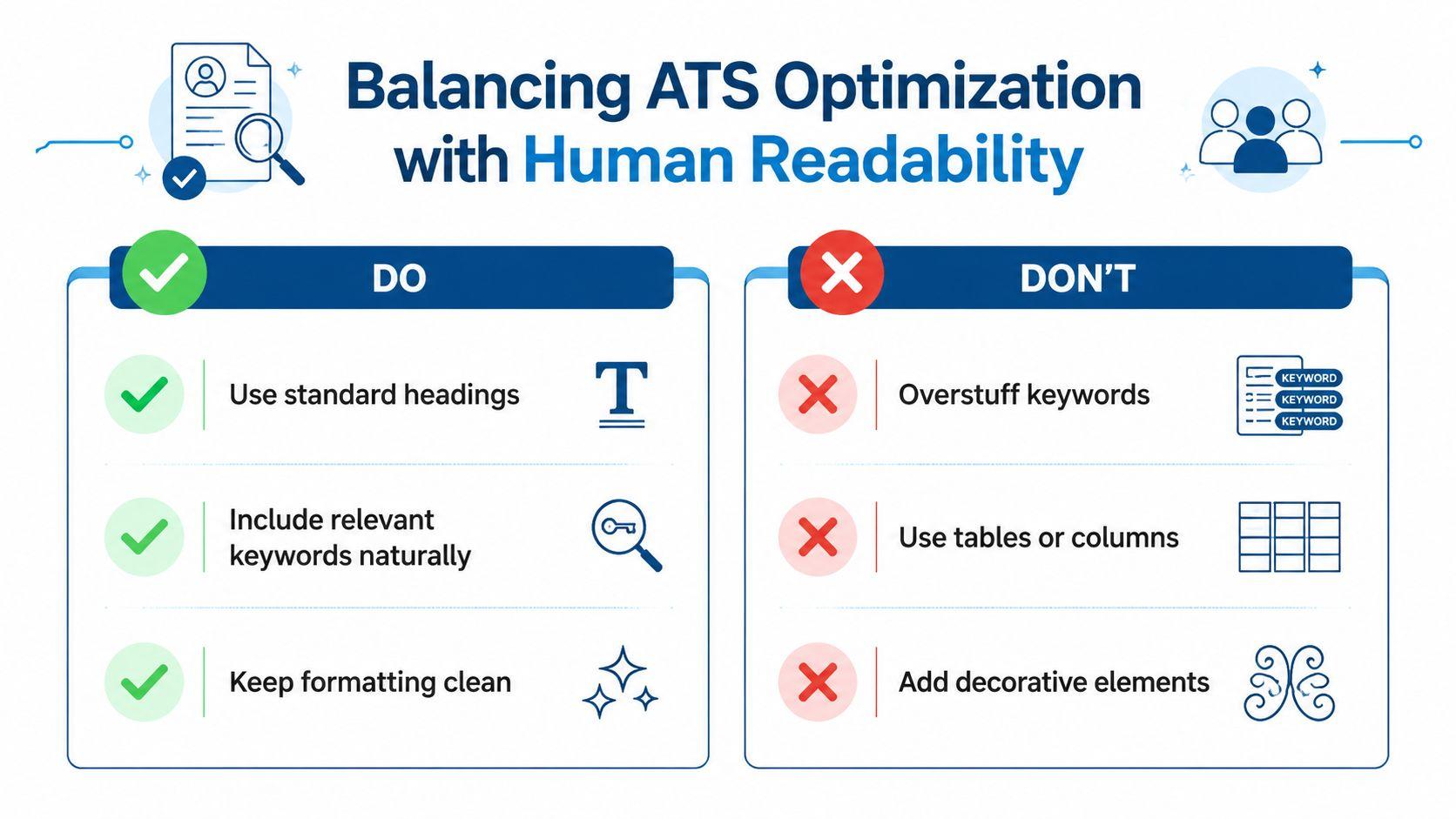
Natural keyword integration beats awkward repetition. Lead bullets with the result, then attach the relevant term to the work itself, not as a dangling keyword list. For example, “Reduced customer churn” is weaker than “Reduced customer churn by improving onboarding workflows and tightening retention analysis,” because the second version preserves meaning while still matching search terms.
Keep the page easy to skim
Clean section breaks, obvious headings, and a stable order help both machines and humans. A recruiter who can scan your title, recent role, and skills without effort is more likely to keep reading. A parser that can extract the same structure is more likely to score you accurately.
A practical self-audit looks like this.
- Standard headings: Use Experience, Education, and Skills, not creative labels.
- Relevant keywords: Place the exact job terms in summary, bullets, and skills where they fit naturally.
- Clean formatting: Avoid tables, sidebars, icons, and decorative elements that break text flow.
- Readable bullets: Start with action and proof, not filler.
- Credible story: Make sure the resume still sounds like one person’s career, not a keyword collage.
The ATS Resume Builder inside JobGlance scores a resume against concrete ATS checks and rebuilds it in a single-column template, which makes it one option for people who want to compare a resume against a specific job before applying.
If you want a faster way to test fit before you send another application, use JobGlance to compare your resume against live roles and see where the match breaks down. It’s a practical way to check ATS fit, surface missing terms, and keep your resume aligned with both the system and the recruiter who reads it next.
Keep reading


