Remote Work Visa Requirements for International Workers


On this page
Remote work visa requirements vary by employment type and destination. A foreign employee, freelancer, or business owner may need to document overseas work, income, insurance, intended stay, and tax exposure under a specific residence category. The fact that a job is performed online does not establish eligibility.
Country rules also differ materially in financial screening. The 2026 visa tracker records monthly income thresholds from $1,300 in Colombia to $8,333 in the Cayman Islands, a 6.4x spread. That gap can remove destinations before an applicant gathers documents. The sections ahead connect visa categories with employment arrangements and examine documentation details, stay limits, and employer sponsorship implications.
Why Remote Work Visas Matter
A remote work visa addresses a legal gap that tourist status does not reliably cover. It gives a foreign employee, freelancer, or business owner a defined basis for living in the host country while continuing work tied to employers or clients abroad. Tourist entry may allow a visit, but it does not automatically authorize an ongoing work arrangement. A standard work permit usually addresses employment connected to the local labor market.
The distinction matters because “remote” describes how work is performed, not where the worker is legally permitted to perform it. A work-from-anywhere role may fit a visa application, while a domestic-remote role can still restrict the worker to one country. Candidates reviewing worldwide remote jobs should make location eligibility an early screening test, before comparing salary, title, or benefits.
The legal category has become mainstream
Formal remote-work permits give employers and workers a clearer alternative to relying on visitor rules. Many tracked programs use a 12-month period, allow renewal, and treat 183 days of physical presence as a possible point for local tax residency, as noted earlier. These conditions differ by jurisdiction, so immigration status and tax exposure must be assessed together rather than as separate checklists.
The employment connection is another dividing line. Remote workers generally can’t work for local employers or local clients under these programs. That restriction distinguishes a remote-work visa from a standard work permit and explains why foreign-source income, employment contracts, or overseas client records often matter more than the applicant’s job title.
Practical rule: Start with the source of your income, not the name of your occupation. The same software engineer may qualify as a foreign employee in one program, a freelancer in another, and be ineligible where local-client work is required.
The right permit can clarify residence rights, employer approval, insurance evidence, and tax responsibilities. It does not remove every compliance obligation. It gives the worker and employer a documented framework, which reduces the risk that a long-term arrangement rests on assumptions about tourist rules.
For job seekers, the visa category therefore affects more than destination choice. It can determine which employment models remain viable, what documents an employer must provide, and whether a foreign company can support the application without becoming a local sponsor.
Understanding Remote Work Visa Requirements
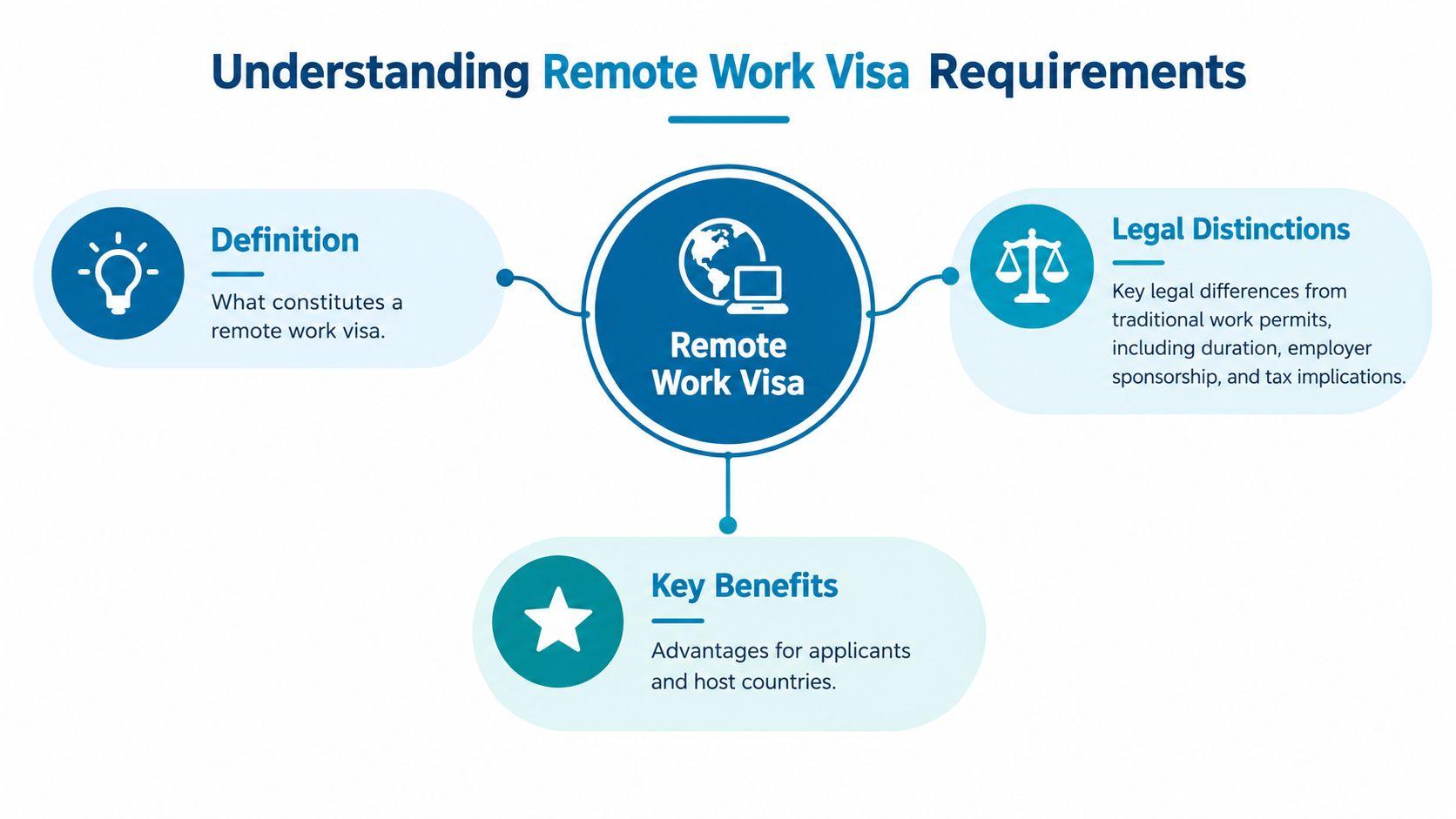
A remote work visa grants residence permission built around foreign work. The applicant usually continues working for an overseas employer, serving overseas clients, or operating a business outside the host country. In exchange for documented income, insurance, and a defined work arrangement, the host government permits residence without placing the applicant in its local labor market.
The permission has clear limits. It may allow residence for a specified purpose, but it does not automatically authorize a local job, invoices to local clients, or an employer change. Each action must be checked against the visa’s conditions and any alternative immigration route.
Remote-work status versus a traditional work permit
The two routes regulate different employment relationships:
| Feature | Remote-work visa | Standard work permit |
|---|---|---|
| Main work connection | Foreign employer, foreign clients, or foreign business | Local employer or local labor market |
| Applicant’s evidence | Foreign-source income, contracts, employment proof, insurance | Local offer, employment documents, and employer-based authorization |
| Employer role | Often consent or supporting documentation, rather than local sponsorship | Usually central to the application |
| Local work | Commonly restricted | Usually the purpose of the permit |
| Tax analysis | Often linked to physical presence and residence rules | Connected to local employment, payroll, and residence rules |
The distinction affects both the worker and the employer. An overseas employer may approve relocation and provide a confirmation letter, yet that approval does not make the company a local sponsor. A local company prepared to hire the applicant generally points toward a standard work-permit route, not a remote-work category.
The evidence must be auditable
Authorities look for documents that connect the applicant to a genuine, continuing income source. The Japanese Ministry of Foreign Affairs guidance describes Japan’s digital nomad regime as allowing a stay of up to six months with documented annual income of at least JPY 10 million. Possible evidence includes a tax payment certificate, income certificate, employment contract, or client contract specifying the term and compensation.
Korea applies the same evidence-focused logic. Its requirements include employment by a foreign company for more than one year, income above twice the prior year’s Korean GNI per capita after tax, criminal-record clearance, and medical insurance covering EUR 70,000 plus emergency repatriation. The application therefore tests more than whether someone works online. It tests whether foreign earnings are stable, documentable, and sufficient for residence without local employment.
Documentation nuances often determine the result. “Proof of income” may need to show gross or net income, monthly or annual amounts, employee status or freelance contracts, and foreign employment rather than local clients. The relevant document must match the program’s exact rule, and the employer’s role must be clear: consent and verification may be required even when local sponsorship is not.
Key Categories of Remote Work Visas
Remote-work programs are easier to compare by the applicant’s income relationship than by the label used in the application portal. Two countries may advertise a “digital nomad visa” while applying different rules to employees, freelancers, and business owners. The useful question is therefore: who pays the applicant, where is that payer based, and what documents prove that arrangement?
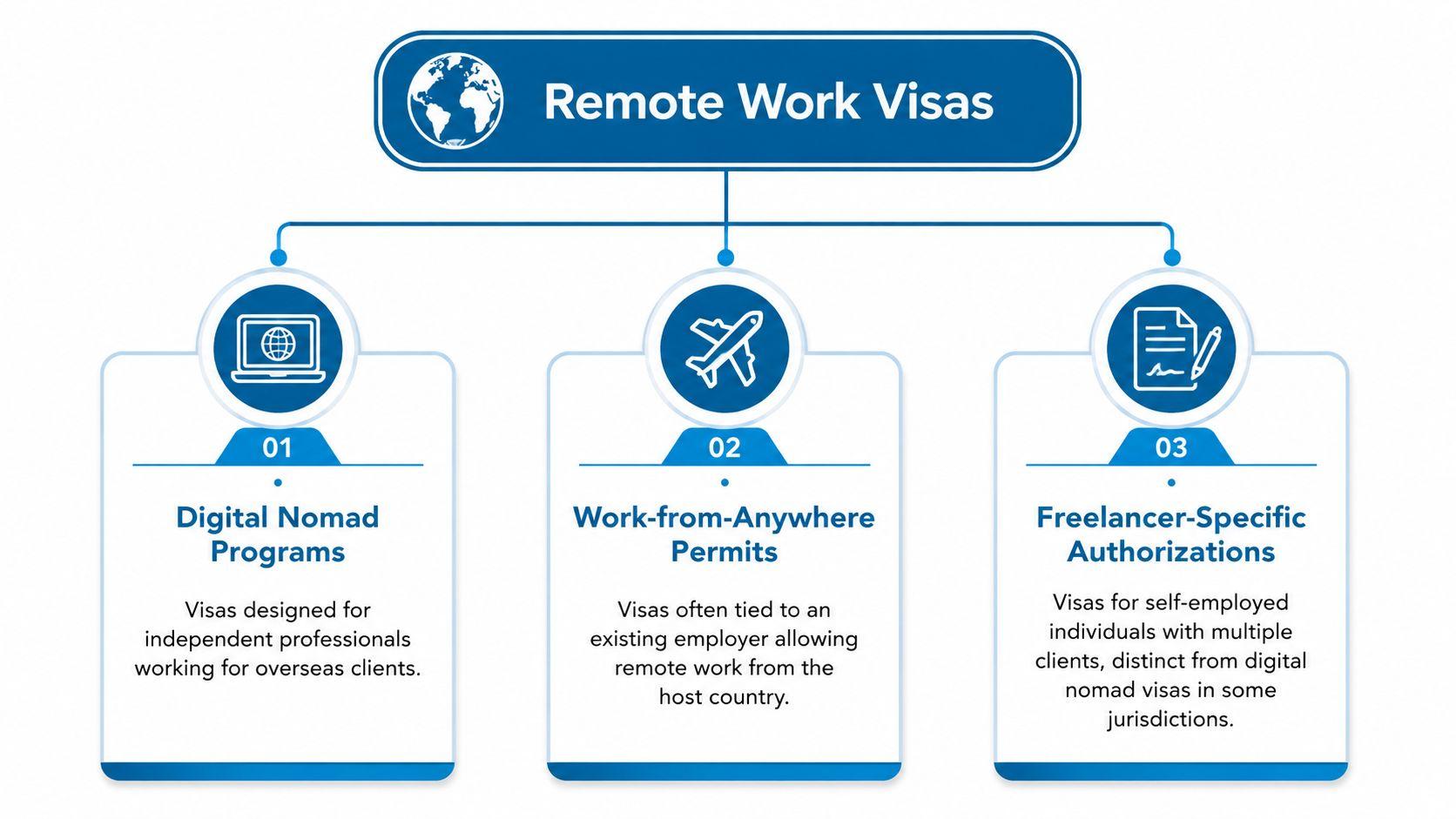
Digital nomad programs
These programs generally fit professionals working for overseas employers or clients who want temporary residence without entering the host-country labor market. An employee may submit an employment contract and a letter confirming permission to work remotely. A freelancer may need client contracts, invoices, bank statements, and evidence that those clients are based outside the destination.
The main test is the evidence, not the job title. Applicants usually need to document foreign-source income, maintain private health insurance, and follow limits on local commercial activity. Authorities may also request accommodation evidence, a clean criminal record, or proof of ongoing professional work, as outlined in this comparison of digital nomad visa documentation.
Work-from-anywhere permits
A work-from-anywhere permit is usually built around an existing foreign employment relationship. The employee stays attached to the overseas company, while the destination may require an employer letter, a contract showing compensation, and written confirmation that the company approves the proposed location.
Employer participation can matter even when local sponsorship is not a legal requirement. The company may still need to assess payroll, social security, permanent-establishment risk, data access, and internal policy. Visa approval settles the immigration question only. It does not automatically settle the employer’s tax, compliance, or operational obligations.
The UAE example demonstrates how detailed the employment evidence can become. In 2026, its employee track required at least USD 5,000 per month, one year with the employer, and at least one year remaining on the contract. Its freelancer track required multiple client contracts showing the same income over the preceding six months, according to the 2026 UAE remote-work visa report.
Freelancer-specific authorizations
Freelancer routes target applicants whose earnings come from several clients instead of one employer. A persuasive application links each contract to payment records and demonstrates continuity, rather than relying on one unusually large invoice.
Split-income cases create a separate classification problem. A person with an overseas salary and freelance payments from foreign clients may meet the total-income test yet fail a rule that accepts only one income category. Applicants should map each payment stream to the requirement it supports, then verify whether the program permits aggregation.
Use the following evidence priorities:
- Foreign employee: employer consent, employment contract, salary records, and confirmation that payroll remains foreign.
- Independent freelancer: client contracts, invoices, bank statements, and evidence that clients are outside the host country.
- Business owner: ownership records, business activity, foreign revenue, and a clear explanation of where services are delivered.
- Split-income worker: both employment and freelance records, plus confirmation that combined income is allowed.
The practical conclusion is that visa category follows the evidence architecture. A remote job alone does not make an application decision-ready. The documents must consistently identify the payer, the payer’s location, the applicant’s work arrangement, and the expected continuity of income.
Comparing Country Income Thresholds
Income thresholds determine which countries deserve consideration before an applicant compares lifestyle, language, or processing preferences. In 2026, reported European minimum monthly requirements ranged from about €817 in Albania to €6,866 in Iceland. Many programs clustered between €2,850 and €3,680 per month, according to the 2026 European visa tracker. The first screening question is therefore whether documented earnings satisfy the target country’s calculation method.
| Country | Monthly threshold | Duration | Renewable |
|---|---|---|---|
| Albania | About €817 | Country-specific | Country-specific |
| Spain | €2,849 | Country-specific | Country-specific |
| Portugal | €3,680 | Country-specific | Country-specific |
| Croatia | €3,622.50 | 18 months | No renewal |
| Greece | €3,500 | Country-specific | Country-specific |
| Iceland | €6,866 | Country-specific | Country-specific |
These figures are representative, not interchangeable salary rules. An authority may assess gross income, net income, savings, or broader financial means. Dependents can also increase the amount that must be demonstrated. Applicants comparing available visa-sponsored jobs in Europe should separate the employer’s advertised compensation from the income figure the immigration authority accepts.
Read the threshold as a formula
Spain’s financial test has been described as 200% of the Spanish national minimum wage, with additional amounts for dependents. Italy’s guidance requires legal income of at least three times the minimum needed for healthcare taxes, cited at no less than EUR 24,789 per year in 2024 guidance, according to this analysis of remote-work income requirements. A headline monthly figure can therefore hide the actual eligibility test.
Record four details before selecting a country:
- Measurement basis: Does the authority assess gross salary, net salary, savings, or a combination?
- Time period: Does it require recent monthly payments, an annualized salary, or a continuing balance?
- Dependents: Does the threshold increase for a spouse or children?
- Income source: Are foreign employment, freelance contracts, and business revenue treated equally?
Documentation must match the formula. An applicant can meet the nominal amount yet fail if bank statements do not align with the employment contract, or if income comes from a local client excluded by the visa category. This is particularly relevant for workers combining a foreign salary with freelance revenue. The total may qualify, while the program may reject aggregation across income types.
Thresholds also signal program design
The lower end of the European range may suit applicants with moderate but stable foreign income. The higher end functions as a premium-income filter, limiting eligibility to workers whose earnings can support residence without public assistance. The table is a screening tool, not a country ranking.
Outside Europe, requirements vary in both currency and structure. Colombia is listed at $1,300 per month, while the Cayman Islands is listed at $8,333, based on the global 2026 tracker. Japan instead uses an annual requirement of JPY 10 million, and the UAE’s 2026 employee route requires USD 5,000 monthly. Comparing only monthly amounts would conceal these differences in measurement.
Physical presence adds a separate planning issue. Many tracked programs were initially issued for 12 months, were renewable, and commonly treated 183 days as the point where local tax residency could begin. A visa may authorize residence while leaving tax obligations unresolved, so the application plan should include an intended travel calendar alongside the income calculation.
Navigating Employer Sponsorship Rules
Employer sponsorship and employer consent address different legal questions. A remote-work visa can be self-applied while the employer must still approve the destination, confirm the employment relationship, and provide supporting documents. A local work permit usually places more responsibility on the company, which may need to file the application, hold the required authorization, and manage ongoing compliance.
Classify the applicant’s employment type before asking the employer for documents. An employee generally needs an employment letter, contract, salary records, and confirmation that the work remains tied to an overseas company. A freelancer may need contracts from several foreign clients, invoices, and payment evidence. Visa programs commonly assess both the income source and the relationship behind it, so one bank statement may not explain an otherwise unclear file.
Separate consent from sponsorship
Employer consent means the company permits work from the destination. Sponsorship means the company has a formal immigration role, such as filing an application, issuing an official certificate, or accepting responsibility for local work authorization.
The distinction creates four separate evidence questions:
- Consent: Has the company approved the destination and remote arrangement?
- Evidence: Can it verify the role, compensation, employment term, and foreign status?
- Sponsorship: Must it file, support a work authorization, or carry compliance duties?
- Mobility review: Has it assessed payroll, social-security, tax, data, and permanent-establishment risks?
A candidate should not describe a visa as requiring “no sponsorship” until both the immigration rules and the company’s compliance position have been reviewed. Self-application removes one filing duty, but it does not force an employer to accept the arrangement.
Match evidence to the employment model
Japan requires documented annual income of at least JPY 10 million. An employment contract or client contract can establish the term and compensation under the Japanese official guidance. The applicant submits the file, but the employer or client often supplies the document that makes the income verifiable.
The UAE example shows why employee and freelancer routes should be assessed separately. In 2026, the employee route required a year with the employer and at least a year remaining on the contract. The freelancer route required multiple contracts showing the required income over the preceding six months, according to the UAE remote-work visa update.
Ask the company:
- Does it permit work from the destination?
- Will it issue a letter confirming remote authorization?
- Can it verify the employment term and compensation?
- Does it use payroll, an employer of record, or another mobility structure?
- Who pays for required insurance and immigration support?
For role comparisons, visa-sponsorship jobs should be searched separately from work-from-anywhere roles. Sponsorship signals employer involvement in obtaining work authorization. Work-from-anywhere signals geographic flexibility. The two can overlap, but neither term proves the other.
Step-by-Step Application Process
A reliable application starts with a decision tree, not a universal checklist. Independent immigration guidance notes that governments may separately require proof of foreign employment, foreign-source income, residence in the relevant consular district, and social-security steps, according to the Spanish consular guidance for digital nomads.
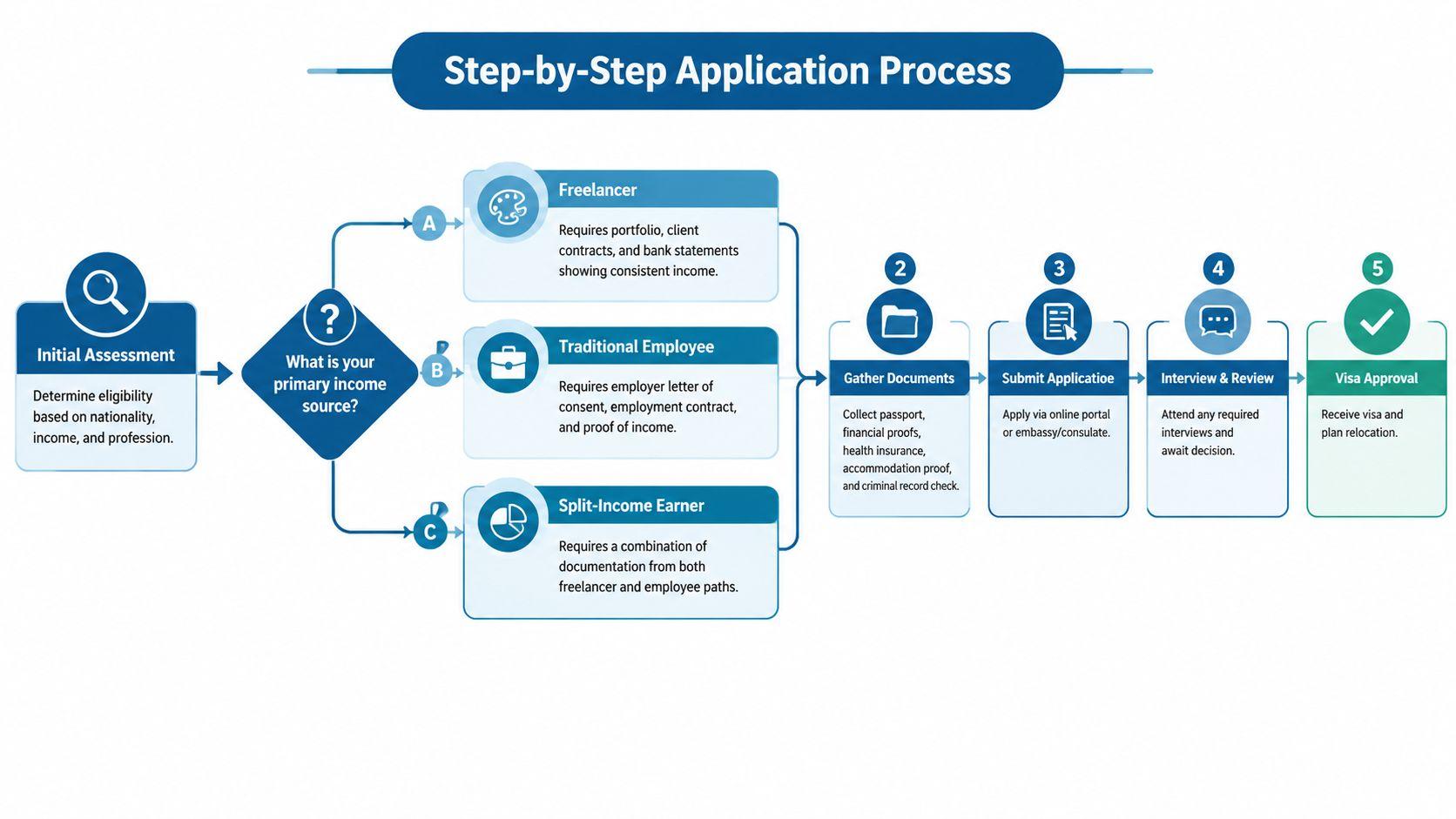
Choose the evidence path
- Freelancer: Assemble current client contracts, invoices or payment records, bank statements, and a portfolio or professional profile. Confirm that the clients are foreign if the program prohibits local revenue.
- Traditional employee: Obtain an employer consent letter, employment contract, salary evidence, and confirmation that the employer is based outside the destination.
- Split-income earner: Separate the salary file from the freelance file. Don’t rely on one bank statement to explain two unrelated income sources.
- Business owner: Add company ownership and foreign-revenue evidence, then explain how the business operates while you reside abroad.
After that classification, collect the common identity and compliance documents:
- Passport and application forms.
- Financial proof matching the program’s measurement period.
- Employment letters or client contracts.
- Private health insurance covering the host country.
- Accommodation evidence where required.
- Criminal-record documentation where required.
- Consular-district residence proof and translations or certifications where applicable.
The point isn’t to submit every document you possess. It’s to make each document answer a specific eligibility question.
The application normally moves from eligibility review to document gathering, submission through an online portal or embassy, interview or follow-up, and final approval. Keep the income period consistent across contracts, bank statements, and tax certificates. A mismatch can create more trouble than a missing optional document because it challenges the credibility of the entire file.
Watch the supporting video for a visual overview of the application workflow:
The decision-tree approach also helps split-income applicants avoid a common mistake. They shouldn’t ask, “Do I have enough total income?” They should ask, “Which rule does each income stream satisfy, and does this program allow those streams to be combined?”
Conclusion and Next Steps
Remote work visa requirements become manageable once you stop treating every program as a generic digital nomad checklist. The decisive variables are income source, foreign-work relationship, documentation quality, insurance, physical presence, and the employer’s compliance position. A digital nomad program may fit an overseas employee or freelancer, while a local job still calls for a standard work permit and employer sponsorship.
Use the threshold comparison to eliminate destinations that don’t fit your documented income. Then confirm whether the program accepts your employment type, whether dependents change the financial test, and whether the intended stay could create tax residency. Finally, get employer consent in writing and prepare documents that prove each rule separately.
For the job search itself, JobGlance can narrow listings with dedicated visa-sponsorship and work-from-anywhere filters, then rank matching roles against a candidate’s resume through its Smart Match system. It also aggregates roles from 100+ job sites, refreshes the database every 24 hours, and distinguishes globally remote work from remote roles restricted to one country, as described in the JobGlance remote jobs category.
Visit JobGlance to filter for visa sponsorship or work-from-anywhere roles before investing time in an application. Use the resulting match scores and listing details to focus on jobs whose location policy and employment structure align with your remote work visa requirements.
Keep reading


