How to Apply for Jobs Abroad Without Wasting Months


On this page
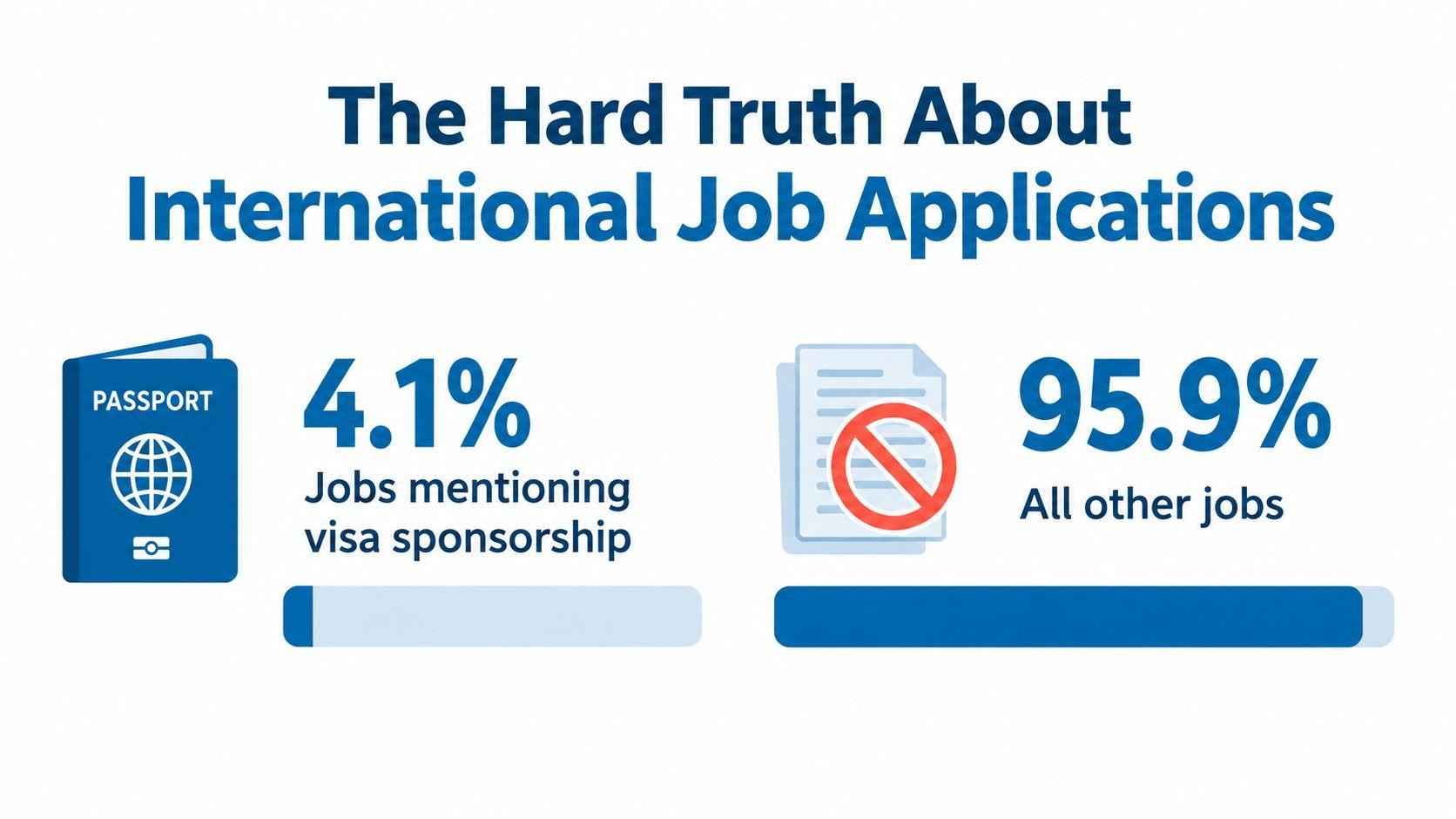
Only 4.1% of live job posts explicitly say sponsorship is available, while 61.5% say nothing at all. If you’re trying to apply for jobs abroad, your first job is to filter for eligibility, not to polish a résumé for roles you can’t legally take.
Most international candidates waste months on the wrong problem. They treat the search like a writing contest, then wonder why good applications disappear into silence. The bottleneck is harsher and simpler, the job has to be open to you before your résumé can matter.
The Hard Truth About International Job Applications
International hiring is mostly an eligibility problem. That sounds blunt because it is. A strong résumé can’t rescue an application when the employer never planned to sponsor, never hired across borders, or only wanted candidates already authorized to work locally.
The sponsorship signal is badly under-reported, which is exactly why so many applicants get trapped. In a large 2026 scan, only 4.1% of live posts explicitly stated sponsorship was available, while 61.5% didn’t mention it at all Applywave’s sponsorship trend scan. Silence doesn’t mean yes. It usually means the posting was written for the domestic market first, then left vague for everyone else.
That’s why candidates burn weeks tailoring bullets for jobs they were never eligible for. Recruiters aren’t trying to trick you, they’re optimizing for the easiest local hire or the cleanest administrative path. If you’re applying abroad, you need to think like an eligibility screener, not a hopeful applicant.
“Remote” is not a loophole
The same problem shows up with remote work. In a 2026 corpus of 180,429 active remote postings with resolvable location, 95.7% restricted eligibility to a single country Seekerscore’s remote-work analysis. That means most “remote” roles are only remote inside one labor market.
Practical rule: treat “remote” as a location condition, not a guarantee.
The mistake is applying first and checking geography later. That’s backwards. If you’re outside the allowed country, the role is dead on arrival, no matter how strong your experience is. The better move is to sort jobs into eligible and ineligible before you spend a single minute tailoring.
The fastest international candidates usually do one thing very differently. They stop opening every listing and start screening for sponsorship, work-rights language, and true location flexibility first. Everything else comes after that.
Filtering Roles by Visa and Work-Right Signals
Start with the job ad, but read it like a compliance filter. The words matter more than the tone. If a posting says “visa sponsorship available,” that’s an open signal. If it says “must have the right to work,” assume they want someone already authorized. If it says “relocation offered,” the employer may help, but you still need to check what that help covers.
The language around remote work needs the same skepticism. “Work from anywhere” is the signal you want. “Remote” by itself is too vague, because many companies mean remote inside one country, one payroll system, or one tax setup. Hybrid roles are another trap, because they often hide a relocation expectation behind friendly wording.
Use a simple triage system before you read details. Tag each role as Sponsored, Open to Remote, Relocation-Required, or Skip. If you can’t place the role quickly, you’re not ready to invest time in it.
The quiet part matters more than the headline. A vague posting can still be sponsor-friendly, but only if the employer has a history of hiring across borders.
That means you should check the company page for immigration policy, global team footprint, and any evidence that the employer hires internationally. In the UK, the sponsor system itself is large enough to matter, with 102,167 organisations and institutions registered as licensed sponsors for work and study at the end of June 2024 OECD reporting on UK migration data. That’s the kind of market where formal sponsorship capability is the first filter, not an afterthought.
If you want a tighter workflow, build your search around destination-country filters first, then employer track record, then the role itself. JobGlance lets you keep those filters in front of the search instead of buried in the job description, which is the right order for international applicants.
Building an ATS Resume That Survives the First Parse
Your résumé has to survive a machine before a recruiter ever sees it. That means single-column structure, standard headings, and no decorative nonsense. Fancy templates are a great way to lose fields, scramble dates, and confuse parsers before the application even lands.
Keep the parser happy first
Use a clean file name, something boring and professional like FirstName_LastName_Resume.pdf. Stick to standard section labels such as Summary, Experience, Education, and Skills. If the system can’t immediately identify your work history, it can’t score you properly.
International candidates hit special traps here. Degree equivalencies that only make sense in your home country can create confusion, so spell out the credential clearly. Dates should be consistent and easy to read. Photo fields, birthplace, marital status, and other personal details can hurt you in markets where recruiters don’t want them, so leave them out unless the local norm clearly expects them.
Mirror the posting, don’t stuff keywords
Use one job description as the source of truth. Pull the exact nouns and verbs the employer used, then reflect them naturally in your résumé. If the posting says stakeholder management, don’t rewrite it as “relationship building” just because it sounds nicer. Match the language, but keep it human.
Here’s the cleanest way to rewrite a bullet:
| Resume Element | Do | Don’t |
|---|---|---|
| Summary | Use a short, role-specific statement tied to the target posting | Write a generic career bio that could fit any job |
| Job bullets | Show impact with the terms the employer already uses | Bury your achievements under vague adjectives |
| Dates | Format employment dates clearly and consistently | Make the parser guess what month or year you mean |
| Education | Spell out degrees and institutions plainly | Assume local equivalencies are obvious |
| Skills | List the tools and methods named in the posting | Dump every skill you’ve ever touched |
A weak bullet says you “helped improve reporting processes.” A stronger one says you “built monthly reporting in Excel and Power BI, reduced manual preparation, and gave managers cleaner data for review.” That second version is defendable in an interview, which matters even more across borders because recruiters tend to probe harder when they’re considering sponsorship or relocation.
Your résumé should pass one test above all. Every claim on it needs to survive a direct question from a recruiter or hiring manager. If you can’t defend it clearly, cut it.
Running the Search in One Tool Instead of Ten Tabs
The biggest time sink in an international search isn’t applying. It’s bouncing between job boards, company pages, spreadsheets, and half-finished drafts while better candidates move faster. Consolidating the process matters because the best roles disappear into response queues quickly, and you can’t win that race if your workflow is scattered.
Open remote roles in one place
Use ranking before you use volume
A good search tool should rank roles against both your résumé and your eligibility filter. That’s the point of Smart Match in JobGlance, it scores each posting against your profile so you can focus on the jobs that fit instead of the ones that merely exist. The smart move is to set country-specific thresholds, then pin visa sponsorship and remote-eligible as default filters before you start browsing.
That changes the search from keyword hunting to decision-making. You’re not asking, “What’s new?” You’re asking, “What can I take?”
Research the company before you apply
Use company research before you send anything. You want clues about sponsorship history, relocation support, and whether the business has been shrinking, hiring, or freezing. JobGlance’s Deep Company Research is one example of a workflow that keeps those checks next to the posting itself, so you’re not tab-hopping between LinkedIn, the employer site, and your notes.
Practical rule: if the company can’t plausibly support international hiring, don’t spend time on a perfect draft.
Draft, edit, send
Once a role survives the filters, use an AI cover-letter draft as a starting point, not a final product. The value is speed, not voice. The candidate still needs to edit the opening, tighten the story, and make the language sound like a person, not a template.
You should also track every serious role in one pipeline with status tags like applied, screen, interview, offer, and withdrawn. That keeps you from applying twice, forgetting follow-up dates, or wasting emotional energy on dead leads. The bottleneck is not finding more jobs. It’s acting on the right ones faster than everyone else.
Acing the International Interview Loop
International interview loops test logistics as much as skill. A candidate can be excellent and still lose momentum if they sound unprepared for time zones, local compensation norms, or the mechanics of moving countries. That’s why the strongest candidates rehearse for the practical questions, not just the technical ones.
Salary, timing, and relocation need clean answers
The first pressure point is time zones. Some teams expect overlap windows, some use async written rounds, and some rely on recorded video responses because the hiring panel spans continents. If you’re serious about the role, show that you can work around the employer’s schedule without sounding difficult.
The second pressure point is salary. A Berlin loop is not the place to anchor on a U.S. number if the employer is hiring in euros. One candidate I’ve seen lose an offer did exactly that, then spent the rest of the process trying to justify a benchmark the company wasn’t using. Another candidate handled it better by leading with total compensation in euros and naming a relocation-ready start date. The second candidate sounded flexible and locally aware, which is what international hiring teams want to hear.
Answer the work-rights question without wobbling
Be direct about your status. If sponsorship is pending, say so plainly and keep the answer short. Don’t improvise timelines you can’t control, and don’t make the recruiter guess whether you’re eligible. If you need the employer to handle visa paperwork, say that early enough for them to assess the fit.
Culture fit also changes across borders. Communication style, hierarchy, holiday calendars, and meeting norms vary more than most applicants expect. What feels confident in one market can read as abrupt in another.
Interview rule: answer logistics like an adult, not like a hopeful tourist.
Use a simple rehearsal frame:
- Time zone question: state your overlap hours and any flexibility.
- Compensation question: speak in the local currency or the employer’s stated benchmark.
- Relocation question: give your earliest realistic start window.
- Culture-fit question: reference collaboration style, feedback style, or working cadence.
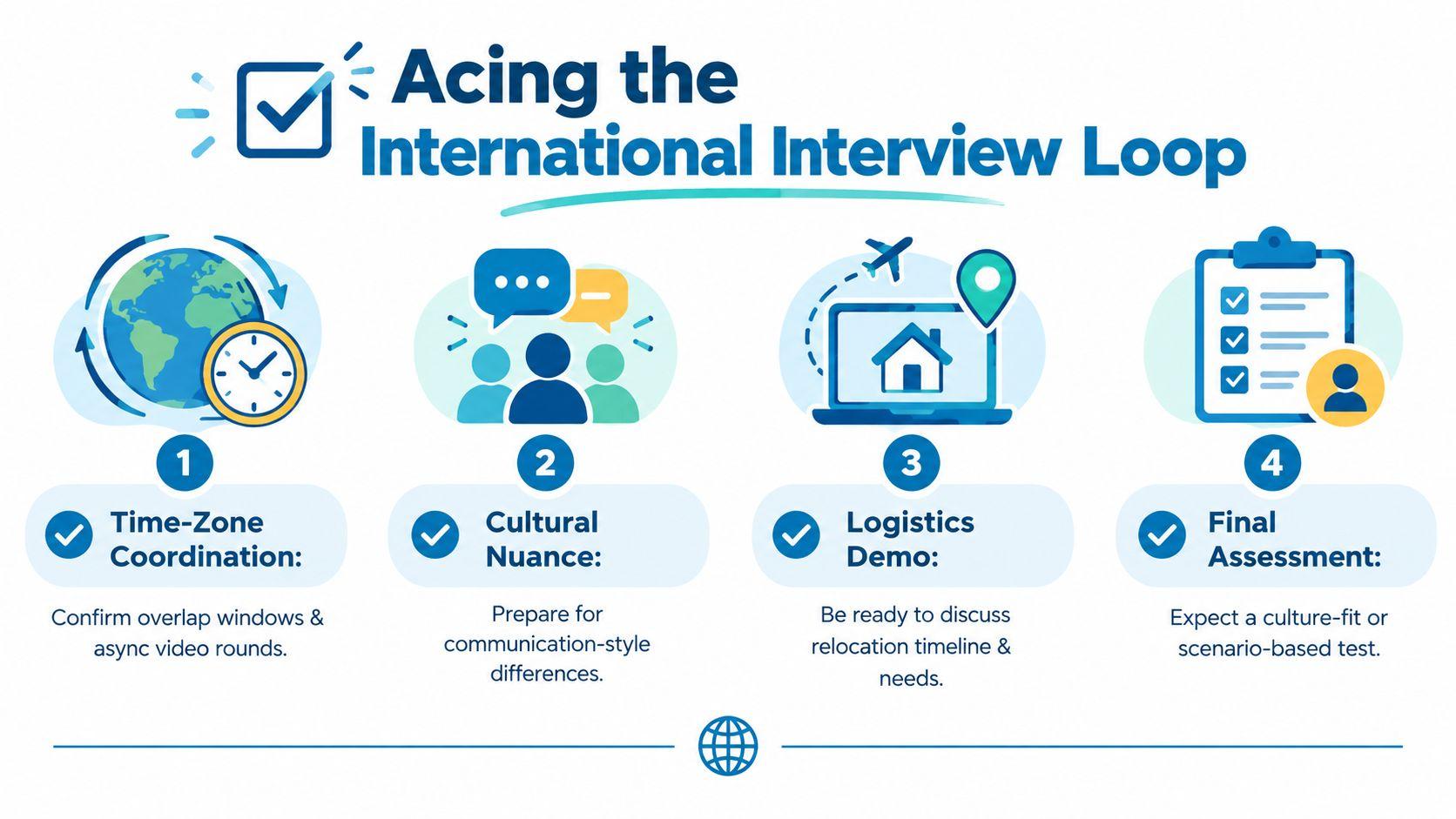
The point of the loop is not just to prove competence. It’s to prove that hiring you won’t create a cross-border headache.
From Offer Signed to First Day Onsite
Once the offer lands, stop celebrating long enough to inspect the paperwork. International hires get burned when they treat the offer letter like a victory lap instead of a legal checkpoint. The right sequence is contract, visa documents, tax, banking, then housing.
Read the contract like it can hurt you
Check whether the offer letter explicitly states sponsorship is included and which visa class it covers. Also look for probation length, at-will language, and any non-compete terms that might behave very differently in the destination country. If any of that feels vague, get clarification before you sign.
Get the document trail in motion
For UK hiring, employers usually need a sponsor licence to bring in workers from outside the UK, including many EU, EEA, and Swiss nationals who arrived after 31 December 2020 UK government sponsor-licence guidance. For Skilled Worker sponsorship, the role has to hit 70 points and some guidance says it must be at RQF6 or above with a minimum salary threshold of £41,700 or the occupation’s going rate, whichever is higher LSE visa sponsorship guidance. In the U.S., some employment-based categories require employer-side labor certification approval before the worker can proceed, and the State Department says applicants in those categories cannot move forward without that step U.S. State Department employment-based immigrant visas.
That means your paperwork list may include an employer-filed petition or certificate of sponsorship, background checks, apostilled transcripts, and biometrics appointments. Don’t wait for reminders. Keep your own checklist and track every dependency.
Sort tax, banking, and housing early
Tax residency gets messy fast, so bring in a cross-border accountant when the host country’s rules, your home country obligations, or a tax agreement might overlap. Banking matters too, because payroll can land in local currency or USD depending on the employer setup. If possible, open a local account before arrival or immediately after.
Housing is the last big practical step. Corporate relocation agents are not the same as lump-sum packages, and the difference affects how much help you get with deposits, leases, and move-in logistics. The best move plan is simple: days 1 to 30 for documents and shipping, 31 to 60 for housing and banking, 61 to 90 for settling in, registering with local authorities, and closing the loop with the employer’s immigration team.
Check U.S.-oriented sponsorship roles
If you handle the post-offer phase in order, you reduce the odds of a bureaucratic delay turning into a lost start date. That’s the job after the offer: make the move legally, financially, and logistically boring.
The One Rule to Carry Forward and Common Questions
The rule is simple. Filter by eligibility before you tailor anything. If the role doesn’t pass the sponsorship and work-right test, the rest of the application is decorative.
That rule holds up across countries because the bottleneck keeps showing up in the same place. Employers are often willing to hire internationally, but they don’t always advertise it clearly, and candidates keep wasting time on silence. A better search starts with the employer’s real hiring pattern, not the wording of the post.
How long does a realistic international search take? Longer than a domestic one, because sponsorship adds a gate. You’re not just competing on fit, you’re competing on legal and logistical feasibility too.
Should you apply directly or go through a recruiter? Apply directly when the company already has a sponsorship track record. Use a recruiter when you need a warm introduction into a market that rarely posts sponsorship openly.
What’s the fastest skilled-worker route? That depends on the destination. The U.S. uses H-1B in many skilled cases, the UK uses Skilled Worker sponsorship, the EU uses Blue Card pathways in some countries, and Australia uses TSS in eligible situations. Pick the route that matches the country and the employer, not the one with the flashiest reputation.
Do remote-first companies always handle cross-border payroll? No. Some hire employees, some use contractors, and some only hire within a set of approved countries. Ask which model they use before you invest in the loop.
Is a cover letter still worth it in high-volume ATS pipelines? Yes, but only if it’s specific. A generic cover letter is waste. A targeted one can explain relocation timing, sponsorship needs, and why you’re a fit for that employer’s market.
JobGlance exists to make that eligibility-first approach easier. It combines visa sponsorship and remote filters, match scoring, company research, and tracking so you can stop guessing and start applying with a real screen in place. If you’re ready to search the right way, visit JobGlance and build your next international job list around what you’re eligible to take.
Keep reading


