How to Research a Company for an Interview: A Practical


On this page
Most advice on how to research a company for an interview is still stuck in trivia mode. It tells you to memorize the About page, repeat the mission statement, and maybe mention the founding year, as if the interviewer is testing your recall instead of your judgment.
That approach misses the test. Hiring teams care far more about whether you understand what’s changing right now, where the business is under pressure, and whether this role sits in a growing or shrinking part of the company. A stronger approach treats company research as risk assessment and strategic alignment, not a fact hunt.
Why Most Company Research Advice Falls Short
The old playbook chases static facts because they are easy to find and easy to repeat. They rarely change how you answer questions in the room. If you know the company’s founding year but cannot explain its current position in the market, you have prepared to sound informed, not useful.
Recent signals matter more because they show where the interview is likely to go. Leadership changes, product launches, acquisitions, regulatory shifts, layoffs, partnerships, and hiring momentum all shape the role you are interviewing for. University career guidance still frames company research around what the company does, where it operates, who its customers are, who its competitors are, and what major changes happened in the last 1–2 years. That is a stronger lens than trivia, because it pushes candidates to read the business context, not just the homepage FSU career guidance PDF.
Think like an analyst, not a quiz contestant
Strong candidates do not walk in trying to impress the interviewer with memorized lines from the homepage. They try to understand the company’s current situation well enough to make their answers fit the moment. The key question is, What changed recently, and how does that affect this role?
Practical rule: if a detail will not change your answer, it probably does not deserve much of your prep time.
A useful research process starts with recent news and role context, then moves outward to culture and competitors. Career guides recommend using that time to build customized STAR stories and a few sharp end-of-interview questions instead of generic talking points AceHired interview research guide. The point is not to know everything. It is to know the few things that matter to this interview.
Building a Structured Research Stack
A good research stack keeps you from over-reading the company’s own marketing and under-reading the signals that predict interview fit. The stack should move from official information to third-party validation, then to employee sentiment, then to competitive context. That order matters because each layer answers a different question.
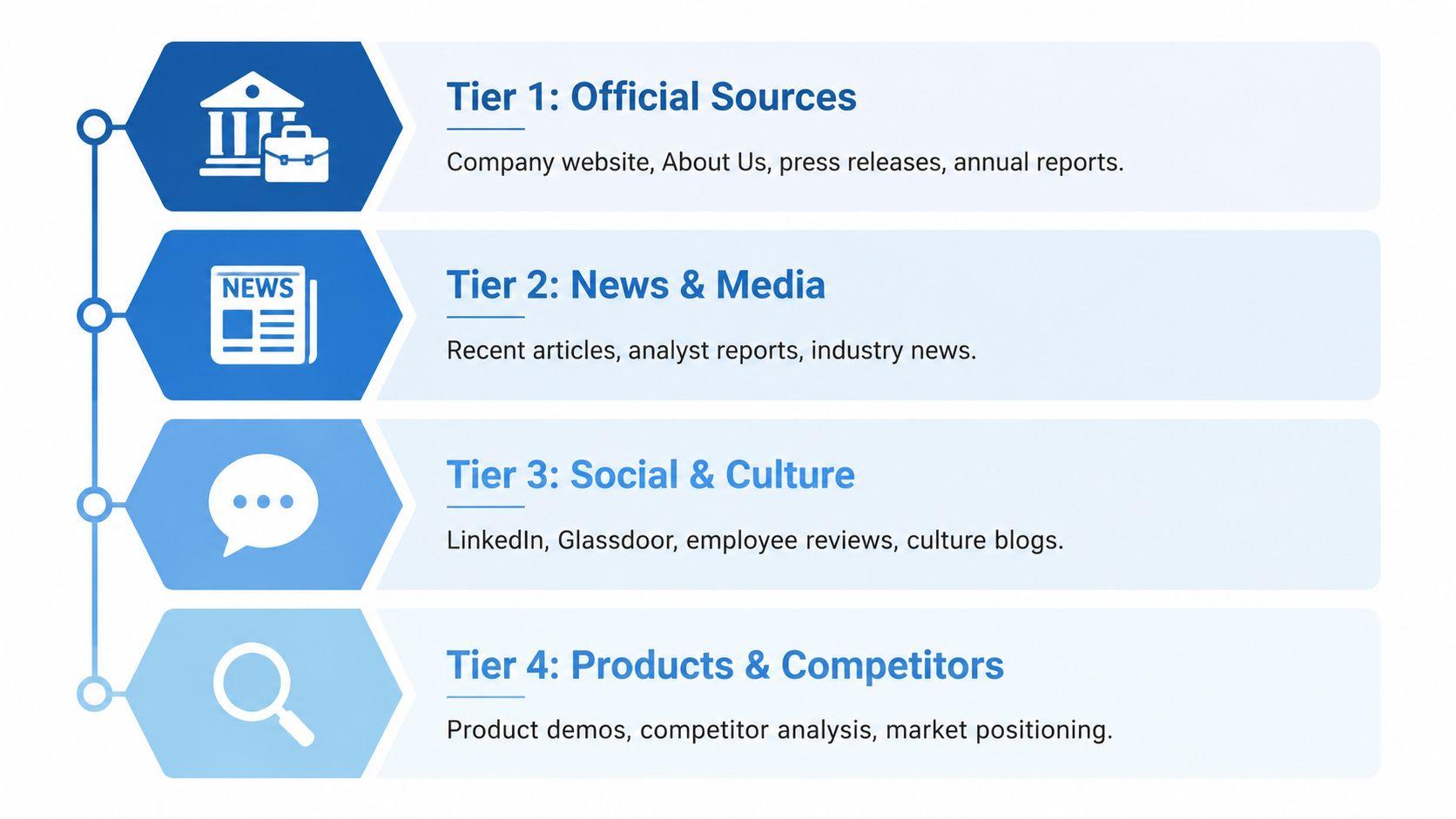
Start with the sources the company controls
Use the company website, investor relations pages, press releases, and leadership bios first. These sources tell you how the company wants to be understood, which helps you spot where its story is consistent and where it’s been revised. If you want a quick way to notice narrative drift, compare the current About page with archived versions in the Wayback Machine.
From there, move to current news and job postings. Open roles often reveal strategic priorities faster than a polished homepage does. If a company suddenly posts several roles in one function, that’s useful context for how to frame your answers.
Validate with outside sources
Third-party sources are where you check whether the company’s story holds up. Search recent news coverage, industry analysis, and filings if they exist. Hays recommends a full pass of about 60–90 minutes, using the company site, recent news, leadership bios, social channels, and employee-review patterns, then turning that into two STAR stories and five questions Hays employer research guide.
Recent signals should outrank polished pages. If the company’s messaging and its hiring pattern point in different directions, trust the pattern.
Use LinkedIn search filters to identify likely teammates and interviewers. Then look at their career paths, recent posts, and how closely their background matches the role. That’s much more useful than reading five paragraphs on the company’s About page.
If you’re comparing opportunities that involve sponsorship, a focused filter can help. Visa sponsorship roles in the US are often worth checking alongside the employer’s own careers page, because sponsorship policy is a company-level signal, not just a job-description detail.
Add culture and competition last
Employee reviews, product reviews, competitor pages, and market reports help you interpret the company’s operating style. But don’t treat one review as truth. Look for repeated patterns across multiple sources, then compare those patterns with leadership messaging and the role itself. Hays also recommends scanning employee reviews for trends, not isolated complaints, which is the right way to avoid getting spooked by one angry post.
A structured pass like this usually pays off better than rabbit holes. You’re not building a dossier. You’re building a decision filter.
Key Signals to Look For During Research
Not every detail matters equally. The signals that most often change interview strategy fall into four buckets, legitimacy, stability, culture, and interview difficulty. If you organize your notes around those categories, you’ll stop collecting random facts and start collecting usable evidence.
Read for legitimacy and stability first
Legitimacy means checking whether the company’s claims line up with independent evidence. Does its growth story make sense? Do the leaders have verifiable track records? Are there lawsuits, regulatory issues, or public controversies that could affect your comfort level? Final Round AI advises candidates not to overweight static About pages and to prioritize recent news and interviewer profiles instead, along with layoffs and review-site patterns Final Round AI company research guide.
Stability is a separate question. Look at funding stage, revenue signals when they’re public, recent layoffs, executive turnover, and whether the team tied to your role looks like it’s expanding or shrinking. In volatile markets, this is less about being paranoid and more about protecting your time.
Use culture signals carefully
Culture is easiest to fake in marketing copy and hardest to fake across patterns. Employee reviews help, but only if you read them as patterns, not verdicts. Look at how long people tend to stay, how leadership communicates, and whether job descriptions sound collaborative, urgent, chaotic, or vague.
The remote-work question deserves special attention. A role labeled “remote” doesn’t always mean work-from-anywhere. Global work policies can vary by jurisdiction, and many companies manage cross-border work through formal mobility rules, so you need to verify where the company hires and whether the role is country-limited or global global work survey PDF. If global flexibility matters to you, remote roles by location can help you compare employers before you spend time in interviews.
Check interview difficulty like a competitor would
Interview difficulty is one of the most underused research signals. Glassdoor and Blind can reveal the shape of the process, the kinds of questions asked, and whether a company runs panel interviews, case rounds, or unusually long loops. That matters because your prep should match the format, not your hope for the format.
Here’s a practical comparison:
| Signal Category | What to Check | Primary Sources | Green Flag Example | Red Flag Example |
|---|---|---|---|---|
| Legitimacy | Leadership track record, external validation, legal or regulatory issues | Company site, news, filings | Leadership bios match public history | Claims that don’t match outside coverage |
| Stability | Layoffs, executive turnover, hiring momentum, funding or market signals | News, LinkedIn, job board trends | Hiring clusters around your function | Quiet attrition and repeated role reposts |
| Culture | Review patterns, leadership language, team structure, role wording | Glassdoor, Blind, LinkedIn, job descriptions | Repeated mentions of clear ownership | Same complaints showing up across reviews |
| Interview difficulty | Loop length, panel format, recurring question themes | Glassdoor, Blind, candidate posts | Process matches the role’s seniority | Surprise case rounds or unclear stages |
Use this layer to calibrate your energy. If the process looks rigorous, prepare accordingly. If it looks messy, assume you’ll need tighter stories and better questions than usual.
Turning Research into Specific Answers and Questions
Research only matters when it changes what you say in the interview. The cleanest way to use it is to turn each meaningful finding into a STAR story or a question. If a finding does not fit either use, it probably is not worth carrying into the interview.
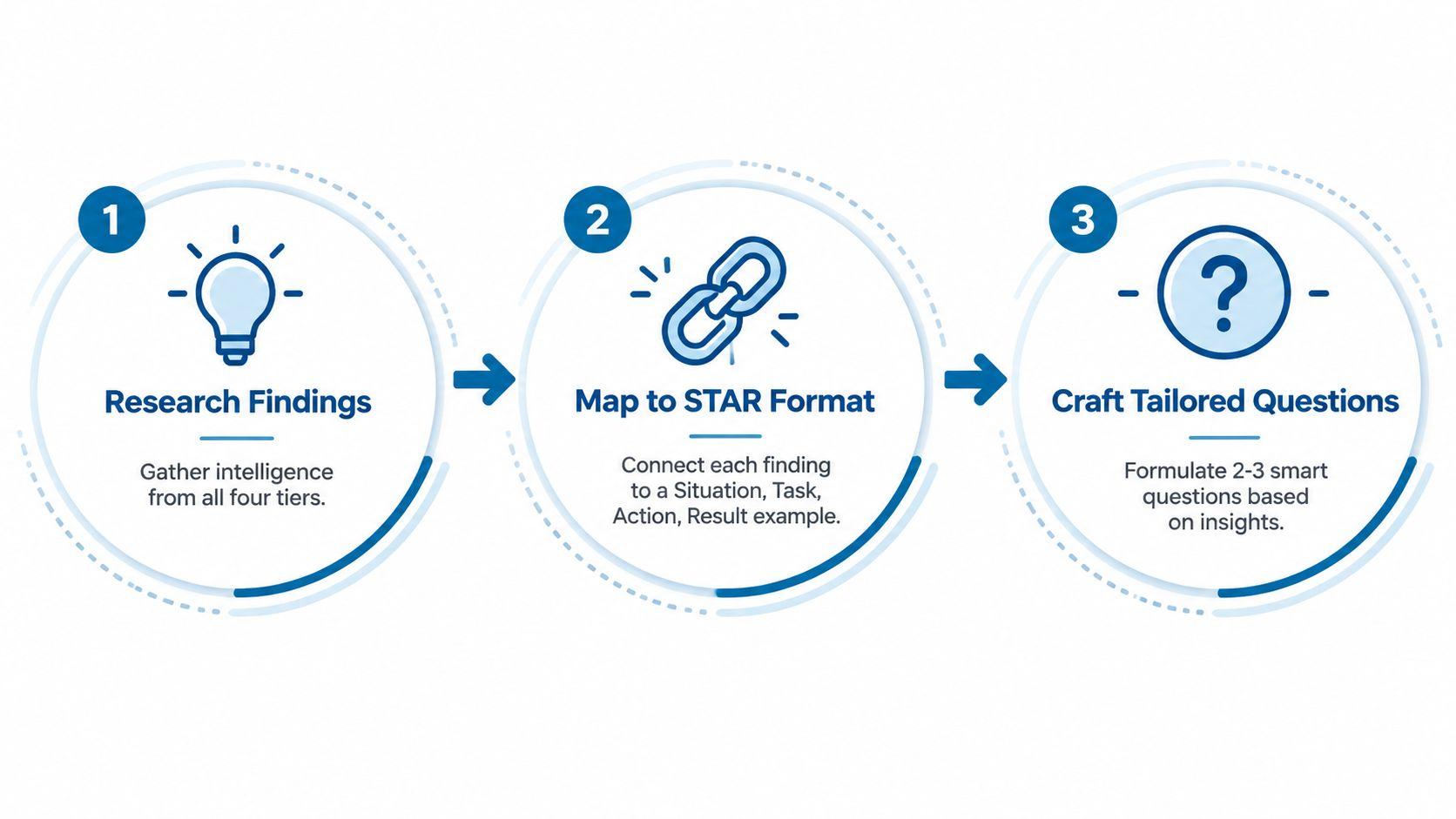
Map findings to stories
Take the company’s current priorities and look for where your experience overlaps. If the company just launched a new product line, use a story about launching, localizing, or supporting something under pressure. If the company is reorganizing, choose a story that shows you can work through ambiguity without losing momentum.
The strongest answer usually starts with an alignment statement. Something like, “Your team seems to be moving fast on X, and I’ve worked in a similar environment where Y mattered.” That sentence shows you have connected the research to your own history.
A one-page prep sheet is enough:
- Company signal: recent launch, hiring spike, leadership change, or market shift.
- Your proof point: one STAR story that shows relevant judgment or execution.
- Talking point: the one sentence that connects your experience to their current need.
- Question: one follow-up that shows you understand the trade-off behind the signal.
If you want a deeper comparison tool for mapping roles and context, product manager roles can help when you are preparing for interviews across similar companies or adjacent functions.
Ask questions that sound informed, not canned
Good questions come from research, not templates. If you found a recent partnership, ask how it affects the roadmap or the team’s priorities. If you saw repeated review-site comments about decision-making speed, ask how the team balances autonomy and alignment. If the interviewer’s profile suggests deep technical ownership, ask how success is measured inside their function.
A weak question asks for information you could have found in two minutes. A stronger one asks for context only the hiring team can provide. That is the difference between sounding curious and sounding prepared.
Strong questions reveal how the company works. Weak questions just prove you know how to use Google.
Some candidates use tools to systematize this process, including research briefs that surface company context, likely concerns, and suggested questions. JobGlance, for example, includes company research outputs alongside role matching, which can help when you are comparing multiple roles and want a fast read on fit. The tool still is not a substitute for judgment, but it can shorten the first pass.
Time Budgets and Checklists by Interview Stage
The right amount of research depends on the stage and the stakes. A recruiter screen calls for a different pass than a final round with multiple stakeholders. Spend too much time too early and you burn energy on low-value details. Spend too little time late and you miss signals that should have changed your approach.
Match effort to the stage
For a recruiter screen, stay focused. Learn what the company does, where the role sits, and whether there are obvious culture or location issues. For a hiring manager conversation, add team structure, competitor context, and recent business changes that could affect the work. For a final round, go deeper on interviewer backgrounds, recent press, and the public signals that point to where the company is heading.
A practical way to set the clock is to treat research as a risk check, not a pageview exercise. Career guides often suggest about 30 minutes for first screens and 60–90 minutes for later interviews, with a wider scan than the homepage alone AceHired interview research guide. Hays recommends 60–90 minutes for a structured pass and 2–3 hours for final-round prep, which lines up with that same progression Hays employer research guide. Final Round AI also cautions against spending more than 20% of final-round prep on the company website alone, a useful guardrail if you tend to get stuck reading polished copy Final Round AI company research guide.
Use a stage-based checklist
For a recruiter screen:
- Company basics: what the business does and who it serves.
- Role context: department, seniority, and reporting line if visible.
- One culture check: review patterns or location restrictions.
For a hiring manager call:
- Recent change: launch, pivot, funding, partnership, or restructuring.
- Competition: who they are up against and how they position themselves.
- Team shape: likely teammates, function maturity, and ownership scope.
For a final round:
- Interviewer profiles: background, function, and likely concerns.
- Public narrative: recent news, leadership messaging, and hiring momentum.
- Sharp questions: two or three that reference real trade-offs.
| Interview Stage | Time Budget | Priority Sources | Key Deliverables |
|---|---|---|---|
| Recruiter screen | 30 minutes | Company site, job description, recent news, one review source | Basic fit check, one STAR story, two questions |
| Hiring manager call | 60 to 90 minutes | News, leadership bios, team page, reviews, competitor context | Targeted positioning, two STAR stories, five questions |
| Final round | 2 to 3 hours | Interviewer profiles, recent press, public talks, reviews, company materials | Panel-specific prep, risk check, refined questions |
The line to hold is simple. Stop once the research has changed your answers. Any extra browsing after that usually adds comfort, not performance.
Real-World Scenarios and Common Pitfalls
A candidate interviewing at an early-stage startup spotted a recent funding announcement and a product pivot in the company’s public updates. Instead of giving a generic “I like fast-paced environments” answer, they framed a story about adapting to changing priorities and shipping under ambiguity. That made the conversation about fit feel specific, not rehearsed.
Another candidate ignored the review pattern and missed signs of quiet layoffs showing up in LinkedIn headcount changes. By the time they noticed, they were already deep in a process that was never likely to end well. That’s the cost of treating research as branding homework instead of a risk check.
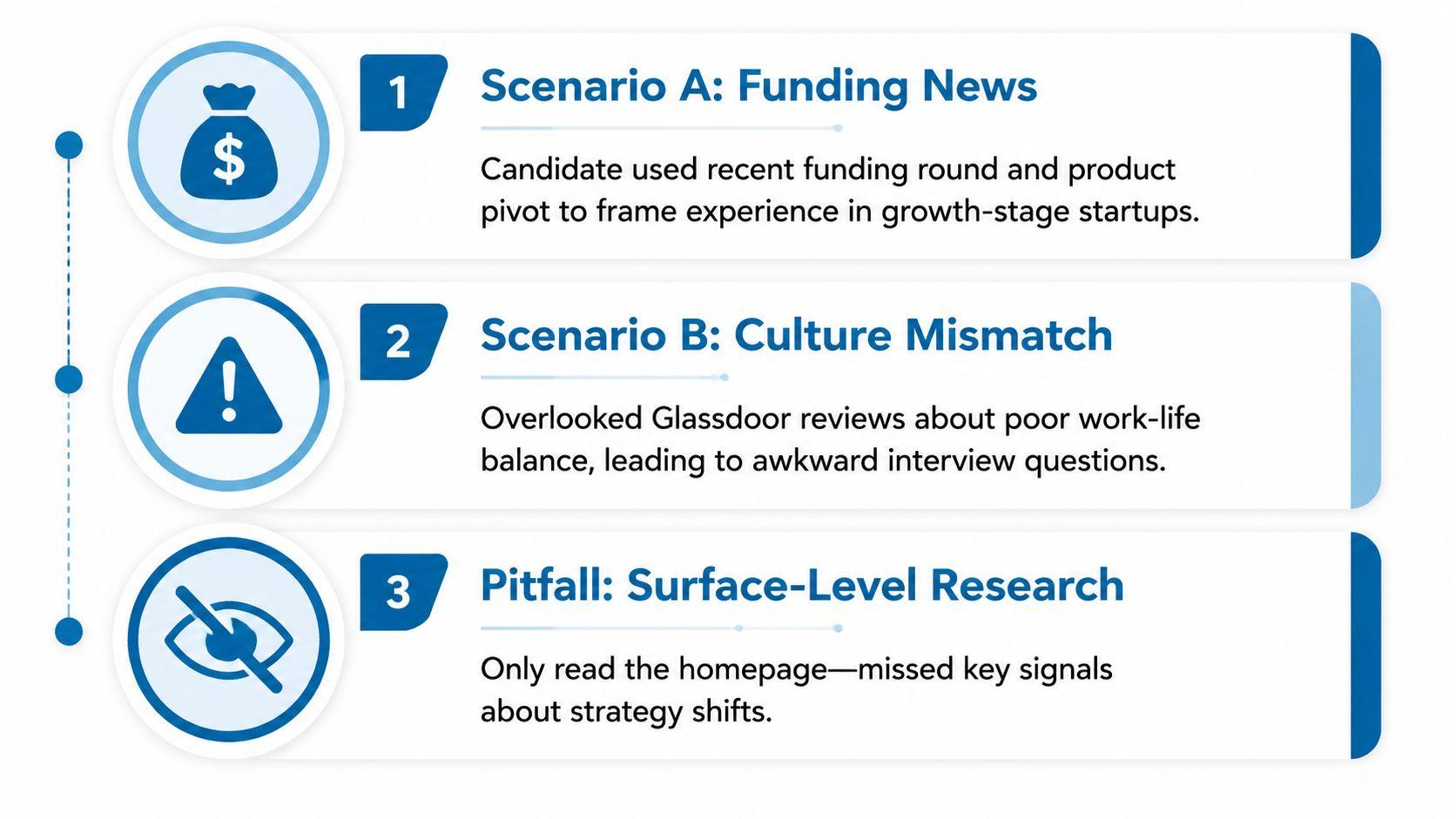
Five mistakes keep showing up:
- Over-relying on marketing pages: the company’s own language is useful, but it’s not the whole picture.
- Ignoring employee sentiment: recurring review patterns tell you more than isolated complaints.
- Skipping interviewer research: you should know who’s in the room and what they care about.
- Treating research as one-and-done: every new round can change the context.
- Reciting facts without value: if a fact doesn’t change your answer, it’s noise.
The best research protects you from bad-fit companies and helps you speak like someone who already understands the terrain. That’s the advantage.
If you want a faster way to compare roles, surface company signals, and keep your interview prep tied to real business context, JobGlance brings company research, role matching, and job search tools into one place. Visit JobGlance to check the roles you’re considering and use the same kind of signal-based thinking before your next interview.
Keep reading


