
10 DevOps Interview Questions for 2026


On this page
Tool-name memorization is the weakest way to prepare for DevOps interview questions. Naming Jenkins, Kubernetes, Terraform, or AWS proves recognition, not judgment. A strong answer connects an implementation choice to reliability, delivery speed, security, cost, and user impact, then explains what happened when reality differed from the design.
The progression below moves from delivery fundamentals through observability, incidents, architecture, security, Kubernetes, infrastructure management, recovery, communication, and continuous learning. It suits junior candidates building their first evidence base and senior candidates expected to explain trade-offs across teams and production systems. For every question, prepare the same response pattern: context, decision, implementation, measurable outcome, and lesson learned.
The emphasis reflects how the market is changing. A 2026 interview guide places CI/CD and deployment strategies at 25–30% of common interview areas, while containers, infrastructure as code, monitoring, incident response, and collaboration form the other major clusters. The guide says interviews increasingly test decision-making, automation maturity, security, AI integration, and scalability, not just definitions. (See the 2026 DevOps interview topic breakdown)
Use JobGlance’s DevOps and SRE Role Insights to compare live requirements, then use match scoring and Career Gap Analysis to decide which skills deserve practice first. You can also compare opportunities through remote technology roles and visa-sponsored technology jobs before tailoring your preparation to the roles you can pursue.
1. Explain Your Experience with CI/CD Pipelines and Infrastructure as Code
A strong answer starts with the delivery problem, not the tool list. Explain what triggered the pipeline, which stages protected production, how infrastructure changes were reviewed, and where a human approval remained necessary. Jenkins, GitLab CI, GitHub Actions, Terraform, CloudFormation, and Ansible are useful examples, but the interviewer wants to hear why you chose one approach over another.
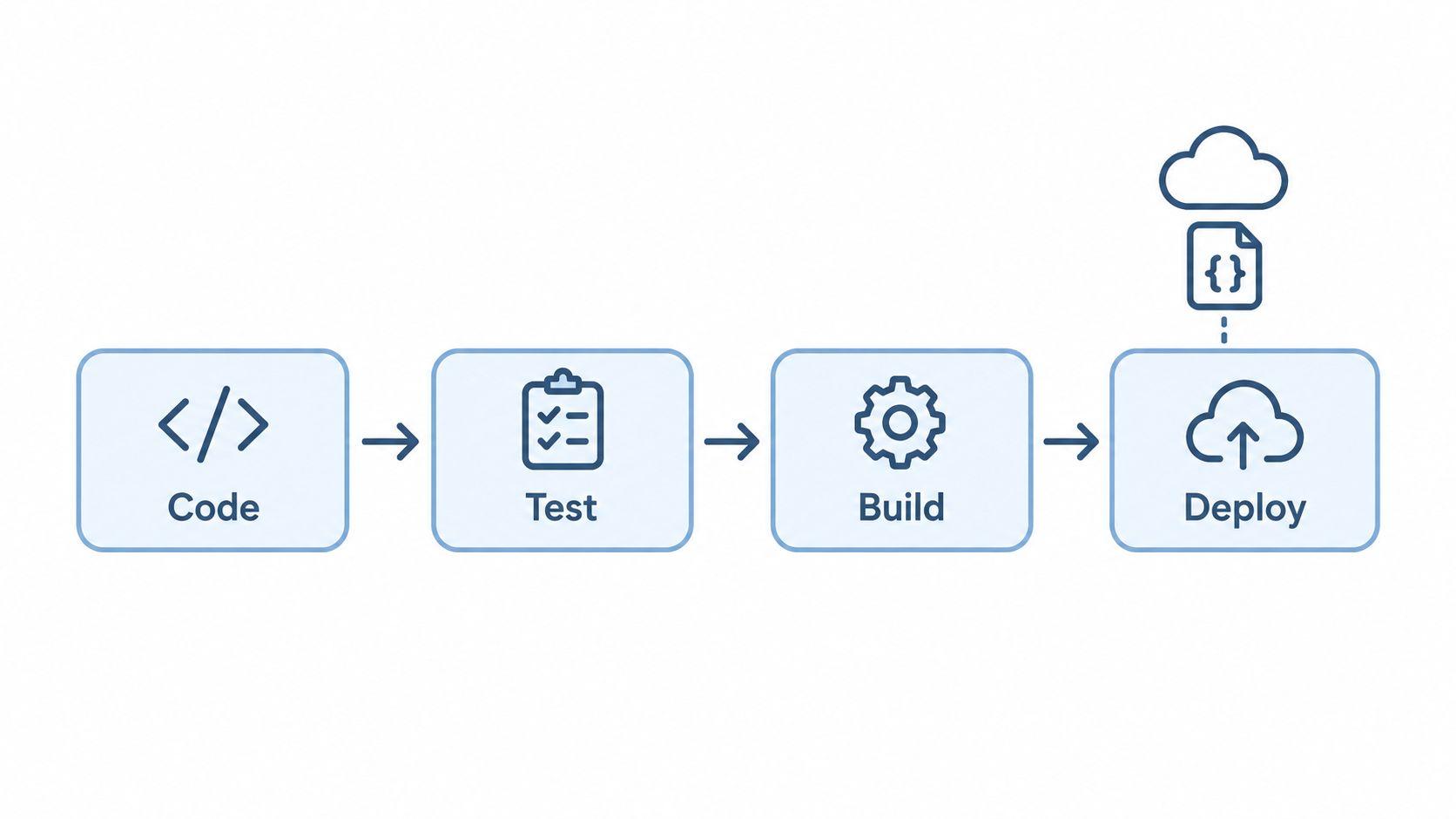
Describe a path such as commit, build, unit tests, security checks, artifact creation, staging deployment, health validation, and production release. Then explain how you handled a difficult boundary, such as a database migration. A credible answer might mention expand-and-contract migrations, backward-compatible schema changes, feature flags, and rollback limits. Rolling back application code doesn’t automatically undo a destructive database change.
Model answer outline and follow-ups
State whether the pipeline used push or pull deployment. Push models can be direct and fast, but they require careful credential control in the CI system. Pull models, often used with GitOps, let an agent reconcile the desired state and can narrow deployment permissions, though they introduce another control loop to observe.
Include delivery evidence such as deployment frequency, lead time, change failure rate, or time to restore service if you measured them. If you didn’t own those metrics, say so and describe the proxy you tracked instead. The CDF survey summary reports that 83% of developers were involved in DevOps-related activities, while 21% said they build CI/CD pipelines, a useful reminder that hands-on pipeline ownership is a meaningful differentiator.
- Junior: Explain one pipeline clearly and identify where tests, artifacts, and approvals occur.
- Mid-level: Discuss rollback design, secrets, deployment strategies, and observability gates.
- Senior: Connect pipeline architecture to team topology, governance, risk, and platform reuse.
Hands-on exercise: Build a small GitHub Actions or GitLab CI pipeline for a containerized service. Add a test stage, image scan, staging deployment, readiness check, and an intentional failure that blocks release. Document what can and cannot be rolled back.
2. Describe How You Monitor and Alert on Critical System Metrics
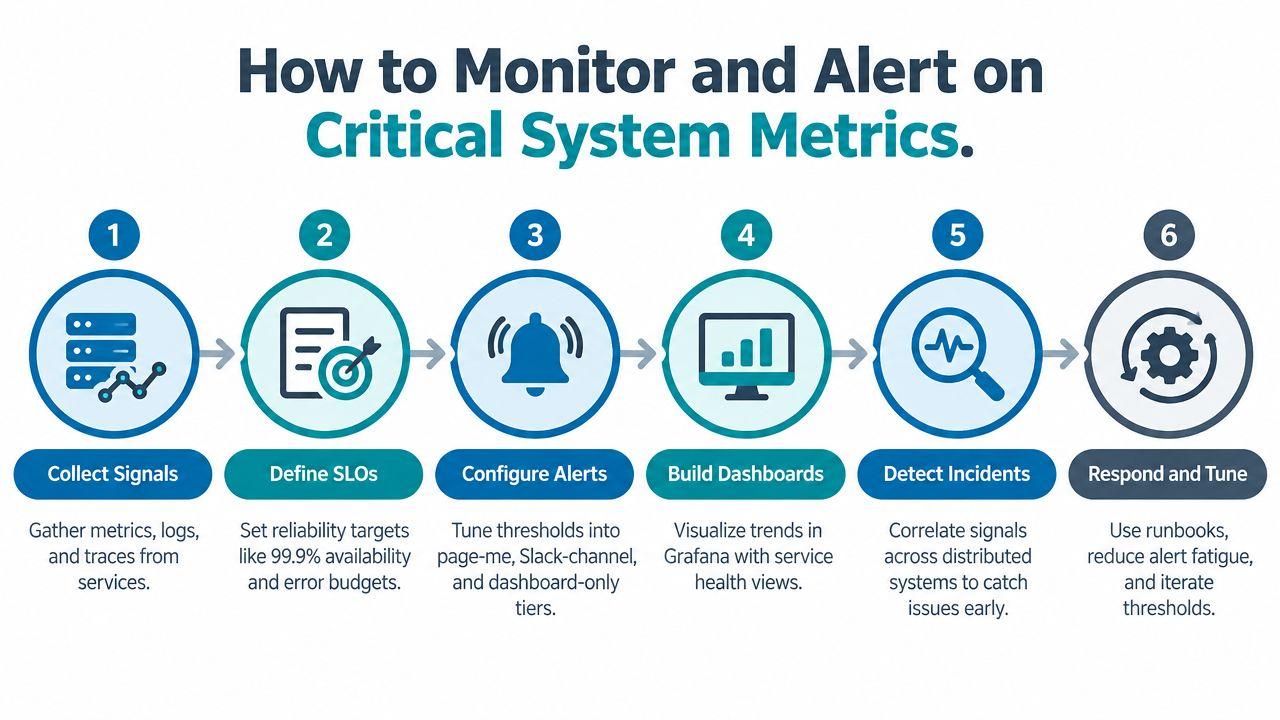
Monitoring starts with the service objective, not the dashboard. Define what users should experience, then choose signals that reveal whether the service is meeting that expectation. For a web service, request latency, error rate, traffic, saturation, dependency health, queue depth, and resource pressure may each explain a different failure mode. Prometheus, Grafana, Datadog, New Relic, ELK, and Loki can support the design, but tool names matter less than the decisions behind the telemetry.
Alert ownership is part of the answer. A page should identify a condition that requires human action, with enough context for the responder to begin investigating. Explain how you group related symptoms, tune thresholds, attach runbooks, and prevent suppression rules from hiding genuine failures. Separate an urgent page from a ticket, dashboard annotation, or trend alert.
Use an incomplete-telemetry scenario to show your reasoning. Suppose latency increases while the application error rate stays normal. Compare service latency with dependency latency, inspect traces for slow spans, check database connection pools, and correlate the timing with a deployment or infrastructure change. State which evidence would confirm or reject each hypothesis. Avoid presenting a diagnosis you did not make.
Reliability decisions should connect to delivery. SLOs define the expected service level, while error budgets provide a way to judge whether a risky change is acceptable. If the service has consumed its budget, possible responses include pausing risky releases, prioritizing reliability work, or temporarily changing alert thresholds during investigation. Keep the signal types distinct: metrics expose patterns, logs provide event detail, and traces show where time or failure moves through a distributed request.
Practical rule: Alert on a user-impacting symptom where possible, then attach resource and dependency signals that help the responder find the cause.
- Junior: Explain useful metrics and distinguish a warning from a page.
- Mid-level: Describe alert tuning, runbooks, dashboards, and correlation across signals.
- Senior: Discuss SLO design, error budgets, cardinality, telemetry cost, and ownership.
Hands-on exercise: Instrument a small service with request-duration and error metrics. Build a Grafana dashboard, add a latency alert, create a slow dependency, and write the first five diagnostic steps in a runbook. Then identify which alert would wake someone up and which would create a ticket.
3. Walk Us Through a Production Incident You Resolved
A strong incident answer is an evidence trail, not a hero story. Use a real event and separate observed facts from interpretation. Start with the customer-visible symptom, then give the first reliable signal, the hypotheses you tested, the mitigation, the recovery, and the prevention work.
Explain the timeline clearly. If a deployment caused failures, say why existing checks allowed it through, why detection took as long as it did, and which control changed afterward. Blaming one person leaves the same failure path available to the next engineer.
Model answer outline and follow-ups
Use situation, action, resolution, and prevention as a loose outline. Name the incident commander, explain how engineers shared updates, and state how support or customer teams received impact information. Mention escalation decisions only when you can defend them with the incident record.
The 2026 dataset from Final Round AI’s DevOps interview analysis reports that behavioral questions represented 58.3% of 13,733 question appearances across 563 sessions. Incident and collaboration stories therefore deserve the same preparation as technical answers.
Describe the review after service recovery. It may lead to a safer rollout, a missing alert, a tested runbook, a permission change, or a new dependency contract. Expect follow-ups about how you verified the prevention worked, and be ready to identify the alert or guardrail that would catch a recurrence. That evidence is especially relevant when preparing for DevOps and SRE roles.
- Junior: Show calm triage, escalation, and a clear technical fix.
- Mid-level: Show impact assessment, mitigation, communication, and a post-incident action.
- Senior: Show incident command, trade-offs, organizational learning, and prevention ownership.
Hands-on exercise: Break a local service by changing a dependency endpoint or exhausting a resource. Record the timeline, restore service, write a blameless review, and add one automated guardrail. Then test that the guardrail detects the same failure again.
4. How Would You Design a Scalable, Highly Available System
A strong design answer starts with constraints, not products. Ask about traffic patterns, read-heavy operations, acceptable latency, recovery objectives, and data that may be stale versus data requiring strong consistency. Those answers determine the architecture and show whether you can make decisions for the workload.
Use the simplest shape that meets those requirements. A load balancer can route requests across multiple application instances and remove unhealthy ones through health checks. Horizontal scaling can increase capacity and isolate failures, but it introduces coordination, routing, and state-management costs. Vertical scaling is simpler for some workloads, yet it creates a larger failure domain and eventually reaches machine limits.
Start with the request path: client, load balancer, application, data store, and asynchronous work. Then test each failure boundary. What happens when one instance stops responding? What does a user see when the database is unavailable? Which requests can degrade gracefully, and which must fail clearly?
Separate compute decisions from data decisions. Managed relational storage with replicas may support read capacity, while a queue handles asynchronous work, object storage keeps durable files, and a cache serves repeatable reads. Replication can improve availability while complicating consistency and failover. Caching reduces load but introduces invalidation and staleness problems.
Name AWS, Azure, or Google Cloud services only after explaining the responsibility they provide. The design should retain its principles if a provider component changes. Include cost and operations: replicas, cross-region recovery, and detailed telemetry can improve resilience while increasing spend and the team’s operational workload.
At different levels, the expected evidence changes:
- Junior: Draw the request path and identify obvious single points of failure.
- Mid-level: Explain scaling triggers, consistency choices, graceful degradation, and recovery behavior.
- Senior: Balance availability, cost, operability, compliance, and team capability, then defend the trade-offs.
Hands-on exercise: Design the service on paper, then deploy a small version with a load balancer, two application instances, a managed database or local equivalent, and dashboards. Remove one instance and record the user-visible result. For roles combining application and platform decisions, compare expectations in backend engineering roles and explain the assumptions behind your design.
5. Explain Your Approach to Infrastructure Security and Compliance
A strong security answer starts with risk, ownership, and evidence, not a tool list. Map identity first. Apply least privilege to people, CI identities, workloads, and service accounts. Separate duties so a pipeline can build an artifact without also approving and promoting it to production.
Use a concrete delivery path to show how controls work together. Secrets belong in a dedicated manager, with rotation, exposure monitoring, and safeguards against appearing in logs or build artifacts. Review infrastructure-as-code changes and run policy checks before application. For containers, cover trusted base images, vulnerability remediation, runtime restrictions, and image provenance. Network segmentation limits the blast radius of a compromised component.
Model answer outline and follow-ups
Connect each control to a business requirement and the evidence it produces. SOC 2, ISO 27001, and HIPAA can require different access controls and records, so name a framework only when it applies to the role. Automated checks, reusable secure modules, short-lived credentials, and clear ownership can reduce delivery friction while preserving control.
The Veracode DevSecOps skills survey reports that nearly 40% of organizations identified DevOps professionals with adequate security-testing knowledge as the hardest employees to find. It also reports that over 64% learned their most relevant skills on the job. Use that context to discuss controls you implemented, failures you corrected, and evidence you produced rather than relying on certification names.
Match the depth to the role:
- Junior: Explain IAM basics, secret handling, and why exposed credentials require immediate rotation.
- Mid-level: Discuss Terraform plan review, Checkov, supply-chain controls, RBAC, and audit evidence.
- Senior: Explain threat modeling, security ownership, exception handling, and risk-based prioritization.
Hands-on exercise: Add secret scanning and Terraform policy checks to a sample repository. Create an intentionally over-permissive role, catch it during review, correct it, and record the evidence an auditor would need. Be ready to explain which control would fail first if the pipeline identity were compromised.
6. How Do You Manage Kubernetes Deployments and Scaling
Strong Kubernetes answers connect object choice to failure behavior. A Deployment suits stateless workloads, a StatefulSet preserves identity or ordered storage behavior, and a DaemonSet places node-level agents. Explain how resource requests influence scheduling, how limits shape runtime behavior, and how readiness and liveness probes control traffic and restarts.
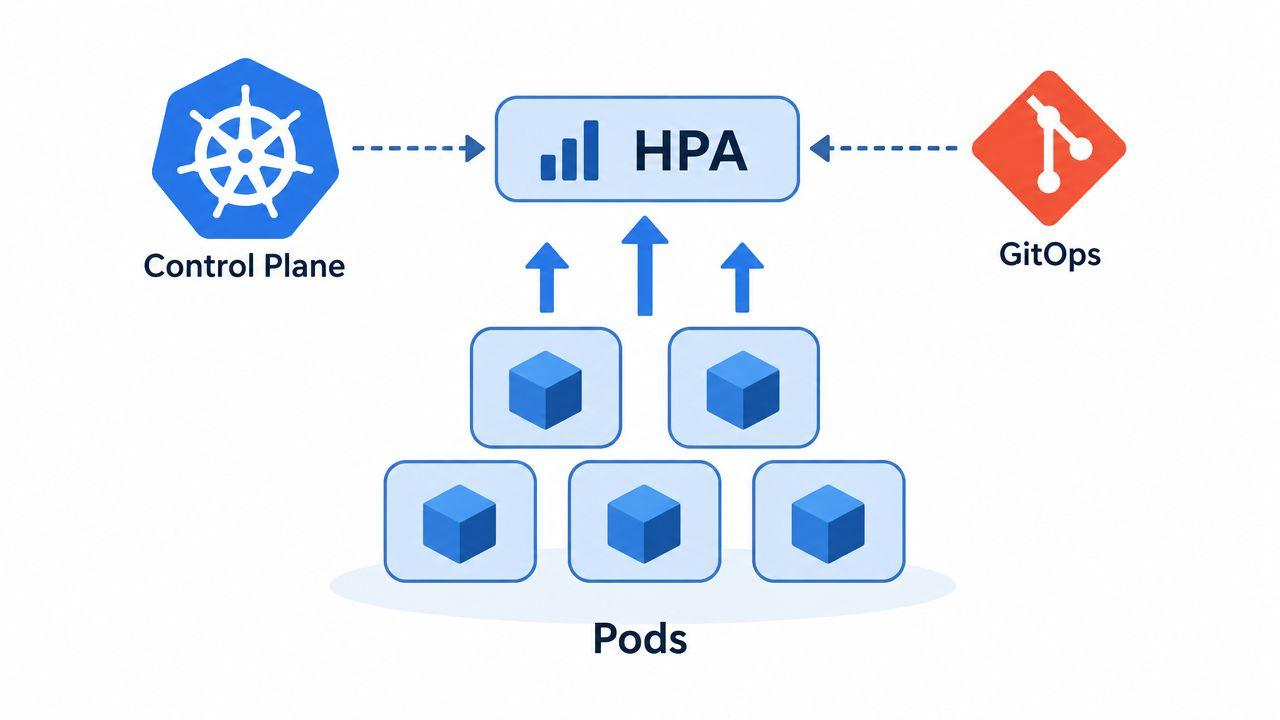
Scaling decisions depend on the bottleneck. Horizontal pod autoscaling responds to selected signals, while vertical scaling changes resource sizing. HPA can react poorly when metrics lag or CPU fails to represent user demand. A queue-based worker may scale more usefully from backlog. Startup time, image pulls, init containers, cluster capacity, and disruption budgets can decide whether extra replicas help during an incident.
Model answer outline and follow-ups
A useful answer describes progressive delivery, readiness gates, rollback conditions, and observable success criteria. GitOps tools such as Argo CD or Flux reconcile manifests from version control. Helm and Kustomize package or customize workloads, but templates can conceal complexity. Explain how values, secrets, and environment differences remain reviewable.
The DevOps skills analysis of 7,523 active postings found CI/CD in 67% of listings, automation in 58%, Kubernetes in 56%, AWS in 54%, and Python in 53%. It also reports Kubernetes and Terraform co-occurring in 39% of postings, supporting preparation that treats orchestration and infrastructure as connected delivery concerns.
Match the answer to the role:
- Junior: Explain Pods, Deployments, Services, probes, and basic resource settings.
- Mid-level: Discuss HPA, RBAC, GitOps, rollout failures, and cluster troubleshooting.
- Senior: Cover multi-cluster strategy, tenancy, capacity, cost, policy, and disaster recovery.
Hands-on exercise: Deploy a service with requests, limits, probes, RBAC, and HPA. Break its readiness probe, observe traffic behavior, inspect events, and recover without deleting the workload. Then explain which signal triggered scaling and what evidence showed the rollout was safe.
7. Describe Your Approach to Infrastructure as Code and Version Control
Infrastructure changes need the same controls as production code. A strong answer connects repository structure, module boundaries, environments, state management, review, testing, and promotion. Terraform, CloudFormation, and Pulumi offer different abstractions, yet engineers still need to understand provider resources and the failure modes of partially applied changes.
State management is a practical test of experience. Explain where state is stored, how locking prevents concurrent updates, how sensitive values are protected, and how the team restores a damaged or outdated state file. Treat drift as a decision: after a manual production change, engineers must choose whether to reconcile it, revert it, or encode it in the repository.
Show one pull request from validation to approval. Describe formatting, syntax checks, policy checks, a plan, and targeted tests. Changes affecting security, data, or capacity should receive appropriate review. Reusable modules reduce repetition, while excessive abstraction can obscure ownership and debugging. Keep the rendered plan understandable.
Cost belongs in the review as well. A valid plan can still create an unacceptable bill. Tools such as Infracost can estimate impact before approval, while tagging and ownership support later investigation. Report savings only when measurement supports the claim.
Adjust the depth to the role:
- Junior: Explain version control, plans, review, and how manual edits create drift.
- Mid-level: Discuss remote state, locking, modules, policy-as-code, testing, and recovery.
- Senior: Cover platform interfaces, multi-account structure, migration strategy, and governance that controls risk without blocking delivery.
Hands-on exercise: Build a Terraform module for a small service. Run validation and plan checks in CI, change one setting manually outside Terraform, detect the drift, and decide whether the code or the deployed infrastructure should remain authoritative. Bring the plan output and your decision rationale to the interview.
8. How Do You Handle Database Backups, Recovery, and Disaster Recovery Planning
A backup plan is only credible when it begins with business impact. For each data class, define the acceptable recovery point objective and recovery time objective. A system that can lose some recent data needs a different design from one requiring near-continuous replication. Clarify the roles of backup, replication, failover, and restoration. Replication can copy corruption or deletion, so independent recovery points remain necessary.
The design should cover retention, encryption, access controls, and immutability where appropriate. Keep production credentials separate from recovery credentials, so a compromised application account cannot remove every recovery copy. Cross-region replication can reduce regional risk, while adding cost, operational complexity, and consistency questions. Automatic promotion also requires health checks, fencing, DNS or routing changes, and controls against split-brain behavior.
Use a restore test to turn the design into evidence. Describe how you restore data into an isolated environment, verify row counts and application behavior, measure recovery duration, and record gaps. Include accidental deletion and ransomware scenarios. State who makes the recovery decision and which steps require approval.
Adjust the answer to the role:
- Junior: Explain scheduled backups, encryption, retention, and a manual restore.
- Mid-level: Discuss RPO, RTO, point-in-time recovery, replicas, and restore testing.
- Senior: Cover regional failure handling, ownership, communication, regulatory retention, and cost controls.
Hands-on exercise: Back up a local database, delete selected data, restore it into a separate environment, and document each command and elapsed step. Then simulate losing the primary environment. Explain which actions are automated, which require a decision, and what evidence would confirm that recovery succeeded.
9. Tell Us About a Time You Disagreed with a Decision. How Did You Handle It
A strong disagreement story is about decision quality, not winning an argument. Choose a real case where delivery speed, reliability, security, or maintainability pulled the team in different directions. Explain what the other person or team needed, what evidence supported your view, and how you compared the available options.
Your response should show listening and shared ownership. You might replace a debate over release safety with a canary deployment, defined rollback criteria, and an owner for the decision. If new evidence disproved your assumption, say so. If the team accepted a risk, state the consequence, owner, expiry or review point, and rollback limits.
The strongest stories include what happened after the decision. Did the guardrail catch a problem? Did the rollout complete safely? Did the team change its review process? Those details prove that you can turn disagreement into a controlled engineering decision rather than a personal dispute.
Collaboration is part of operating the system. A survey of about 1,600 IT professionals identified automation, process, and soft skills as the top three must-have areas, with collaboration and cooperation at 78%, problem-solving at 76%, interpersonal skills at 72%, and knowledge sharing at 69%. (Review the DevOps skills findings from The Enterprisers Project) Use those findings as a prompt to connect communication with concrete delivery behavior.
Level guidance
- Junior: Describe respectful escalation, active listening, and what you learned.
- Mid-level: Show evidence-based negotiation, a tested compromise, and measurable follow-through.
- Senior: Explain decision records, risk ownership, approval boundaries, and how you improved the team’s decision process.
Hands-on exercise: Write a one-page decision record for a risky release. List the options, evidence, risks, rollback limits, approvers, and the signal that would pause or reverse the rollout. Then practice explaining the decision from the other team’s perspective before presenting your own recommendation.
10. What’s Your Strategy for Keeping Your DevOps Skills Current
A strong learning strategy produces evidence, not a list of tools. Start with the target role, identify a real skill gap, build a small experiment, and inspect the result with another engineer. Name the documentation, community, project, or tool that shaped your work, then explain what changed in your design or operating practice.
Choose experiments that expose trade-offs. Try Argo CD, OpenTelemetry, a policy engine, or a serverless deployment, then record its effects on failure handling, observability, security, and ownership. A failed trial can be valuable evidence when you explain why the tool did not fit the workload and what you selected instead.
Learning should also move through the team. A junior engineer might introduce a serverless pattern, a security colleague might identify a supply-chain weakness, or a developer might reveal telemetry problems caused by a feature. Share those lessons through demos, runbooks, repositories, and design reviews.
The DevOps Institute skills report draws on an open survey of more than 2,000 respondents from organizations of different sizes worldwide. It describes successful DevOps work as a combination of automation, human, technical, functional, process, and framework knowledge. Build an answer that covers how you learn, how you test knowledge, and how you apply it.
Level guidance
- Junior: Show a repeatable routine using labs, documentation, and feedback.
- Mid-level: Connect learning to production improvements and team enablement.
- Senior: Explain how you assess emerging technology against strategy, risk, and total ownership.
Hands-on exercise: Select one skill from a target listing, build a small proof of concept, and record what worked, failed, and changed. Write a short guide that teaches the result. Compare recurring requirements across adjacent DevOps opportunities through JobGlance’s role listings, then identify which learning project would provide the strongest interview evidence.
10-Point DevOps Interview Questions Comparison
| Topic | 🔄 Implementation Complexity | ⚡ Resource Requirements & Speed | 📊 Expected Outcomes | 💡 Ideal Use Cases | ⭐ Key Advantages |
|---|---|---|---|---|---|
| Explain Your Experience with CI/CD Pipelines and Infrastructure as Code | Medium–High: pipeline design + IaC patterns and state management | CI runners, artifact storage, IaC backend; greatly accelerates deployments | Reduces deployment failures (~60%) and time‑to‑market (~50%); repeatable deploys | Teams shipping frequently; platform and SRE roles | ⭐ Reliable, auditable, reduces manual errors |
| Describe How You Monitor and Alert on Critical System Metrics | Medium: metrics/logs/tracing pipelines, alert tuning | Monitoring stack (Prometheus/Datadog/Grafana), on‑call rotation; enables faster detection | Proactive incident detection, lower MTTR, better SLO observability | Distributed microservices, customer‑facing services | ⭐ Early detection, SLO-driven decisions, reduced outages |
| Walk Us Through a Production Incident You Resolved | Low (behavioral) but expects mature incident process knowledge | Requires incident tooling, runbooks, and practiced on‑call processes | Demonstrates effective troubleshooting, communication, and postmortem improvements | Hiring SREs, on‑call engineers, ops roles | ⭐ Shows ownership, root‑cause analysis, blameless learning |
| How Would You Design a Scalable, Highly Available System? | High: multi‑AZ/region design, redundancy, tradeoffs (CAP, cost) | Significant infra (replication, load balancers, autoscaling); higher baseline cost for resilience | Targets high availability (e.g., 99.99%), graceful degradation under failure | High‑traffic systems, services with strict SLAs | ⭐ Resilience, capacity planning, cost/performance balance |
| Explain Your Approach to Infrastructure Security and Compliance | Medium–High: IAM, secrets, scanning, policy enforcement | Security tooling, audits, compliance processes; may add control overhead | Fewer misconfigurations, lower breach risk, compliance readiness | Regulated industries (finance, healthcare), prod systems with sensitive data | ⭐ Defense‑in‑depth, least‑privilege, auditability |
| How Do You Manage Kubernetes Deployments and Scaling? | High: cluster ops, resource tuning, networking, storage | Cluster resources, GitOps pipelines, observability; enables autoscaling and faster rollouts | Scalable container workloads, controlled rolling/blue‑green updates | Cloud‑native apps, microservices platforms | ⭐ Autoscaling, portability, rich ecosystem (Helm/ArgoCD) |
| Describe Your Approach to Infrastructure as Code and Version Control | Medium: module design, state locking, CI gating | IaC tools (Terraform/CFN), remote state backend, PR workflows; improves reproducibility | Reduced drift, auditable infra changes, faster recovery from outages | Multi‑environment cloud infra, teams needing repeatability | ⭐ Reproducible, reviewable, automatable infrastructure |
| How Do You Handle Database Backups, Recovery, and Disaster Recovery Planning? | Medium: backup strategy, replication, recovery testing | Storage for snapshots/archives, cross‑region replicas, periodic DR tests; restores can be automated | Low RPO/RTO when designed/tested; reduced data loss risk | Data‑critical apps, compliance‑sensitive systems | ⭐ Data durability, tested recovery, compliance alignment |
| Tell Us About a Time You Disagreed with a Decision. How Did You Handle It? | Low (behavioral): expects evidence‑driven conflict handling | Minimal infra cost; requires time for analysis, data, and discussion | Reveals influence style, collaboration, and ability to reach compromises | Leadership‑track roles, cross‑functional teams | ⭐ Demonstrates emotional intelligence, data‑backed persuasion |
| What’s Your Strategy for Keeping Your DevOps Skills Current? | Low–Medium: continuous learning routines and hands‑on practice | Time investment (e.g., 5–10% of workweek), labs, conferences, OSS contributions; enables quick adoption | Maintains relevance and ability to evaluate new tools/approaches | Any technical role in fast‑moving orgs | ⭐ Adaptability, sustained technical growth, mentoring benefits |
Turn Answers into Evidence
Start by sorting these questions against the role and seniority you want. A platform-heavy position may demand deeper Kubernetes, Terraform, IAM, and cluster reliability evidence. A product-focused DevOps role may emphasize pipeline design, developer experience, observability, and incident communication. An SRE-leaning role may probe SLOs, error budgets, recovery, and reliability trade-offs more.
Write one concise situation-action-result story for each behavioral prompt. Keep the situation specific, explain the action you personally took, state the outcome you can verify, and finish with the lesson that changed your practice. Don’t manufacture deployment counts, incident durations, cost reductions, or recovery improvements. If your team measured a result but you don’t remember the exact value, describe the outcome qualitatively and explain how it was measured.
Build a small evidence project instead of collecting command snippets. A useful exercise can combine a Git repository, a containerized service, a CI pipeline, Terraform, Kubernetes, monitoring, a secret-scanning step, and a tested restore path. It doesn’t need to resemble a production platform in size. It needs to let you demonstrate decisions, failure injection, diagnosis, rollback boundaries, and documentation.
Rehearse follow-ups aggressively. After you describe a pipeline, expect questions about credentials, artifacts, migration safety, test reliability, and failed deployments. After an incident story, expect questions about detection, communication, customer impact, and prevention. After an architecture answer, expect questions about cost, consistency, regional failure, and what you’d remove if the team were smaller.
Attach an outcome to every project claim. “I configured Prometheus” is weak. “I added service-level latency metrics, created an actionable alert, and used a runbook to investigate a deliberately slow dependency” gives the interviewer something to evaluate. The outcome may be a measured operational improvement, a verified recovery procedure, a clearer ownership boundary, or a documented decision that prevented repeated confusion.
Use the four DORA measures as a vocabulary for delivery performance: deployment frequency, lead time for changes, change failure rate, and time to restore service. KodeKloud’s DevOps interview guide also reflects the broader scope of current preparation, including cost spikes, rollback failures, security incidents, and reliability trade-offs. Don’t discuss those measures as badges. Explain which one mattered to the team, what it revealed, and what action followed.
Finally, compare the requirements of live DevOps and SRE listings with JobGlance’s remote and visa-sponsorship category pages. Look for recurring combinations such as CI/CD with Kubernetes, Terraform with cloud platforms, Python with automation, or observability with incident response. Use Career Gap Analysis to identify the skills that recur across the roles you saved, then choose the next hands-on exercise from that evidence.
DevOps interviewers aren’t looking for the longest list of tools. They’re looking for decisions, trade-offs, verification, communication, and learning. A credible answer proves that you can move from a code change to a reliable service, notice when the system behaves differently, and improve the path after something goes wrong.
Use JobGlance to find DevOps and SRE roles ranked against your resume, filter for remote or visa-sponsoring opportunities, and identify recurring skill gaps across saved listings. Then turn the highest-priority gap into a hands-on exercise and use the resulting evidence in your next interview.
Keep reading


